
Use this list of Constitutional Developments History Optional PYQs to see how UPSC has examined this part of the syllabus between 1995 and 2026. It is unit 10 of Paper 2, Section A – Modern India, with 19 questions, the latest from 2026.
Constitutional Developments – History Optional PYQs (1995–2026)
1. Why did the British Crown assume direct control over the Indian Government in 1858? Mention the new administrative arrangements. [2026/20m/4a]
2. Critically examine: “The significant feature of the Indian Councils Act of 1892 was the principle of election which it introduced, though the word ‘election’ was very carefully avoided in it.” [2025/10m/150w/1d]
3. Critically examine: The federal provisions of the Government of India Act of 1935 foundered on the rock of princely intransigence. [2024/10m/150w/1d]
4. While introducing the Indian Councils Bill of 1861, the British thought that the only Government suitable for India ‘is a despotism controlled from home’. Comment. [2023/20m/2b]
5. Discuss the major constitutional developments in India after 1858 and their impact on society and polity. [2021/20m/4a]
6. Is it justified to say that the Government of India Act of 1935 had all brakes, but no engine? [2019/20m/3b]
7. Critically examine: “An ideology of paternalistic benevolence, occasionally combined with talk of trusteeship and training towards self-government, thinly veiled the realities of a Raj uncompromisingly white and despotic.” [2018/10m/150w/1d]
8. Could Dyarchy (1919) satisfy the national sentiments of the Indians? [2018/10m/2c]
9. “India’s need for a federal system was more an imperative than a political choice.” Do you agree? [2016/10m/2c]
10. “Although the Government of India Act of 1935 replaced dyarchy with Provincial Autonomy, the overriding powers of the Governor diluted the spirit of autonomy.” Elucidate. [2015/10m/4c]
11. Critically examine: “Montague-Chelmsford reform proposals introduced ‘dyarchy’, but blurred the lines of responsibility.” [2014/10m/150w/1b]
12. “Though the Act of 1919 was superseded by that of 1935, the preamble to the former was not repealed—the preservation of the smile of the Cheshire cat after its disappearance, and the latter said nothing about Dominion Status.” Elucidate. [2013/25m/3b]
13. “In terms of the administrative structure, the Government of India Act of 1858, … meant more continuation than change.” Do you agree? Substantiate. [2010/20m/2a]

Preparing for Prelims too?
Our UPSC Prelims Topic-wise PYQ eBook covers every Prelims question with detailed explanations, so you can see exactly where UPSC asks from.
View the BookDownload Free Sample14. Comment on: “Please remember, in granting separate electorates we are sowing the dragon’s teeth and the harvest will be bitter.” (Morley) [2009/20m/200w/1c]
15. Analyse the factors responsible for the Civil Disobedience movement (1930–31). How far were its aims realised in the Government of India Act of 1935? [2005/60m/4]
16. Comment on: The Montague Declaration (20 August 1917) was observed more closely in the “realm of imperial relations” than anything else. [1998/20m/200w/1c]
17. Explain the attitude of the Indian National Congress towards the constitutional changes of 1909, 1919 and 1935. [1998/60m/4]
18. Comment on: The Government of India from Canning to Curzon was regarded “as a white man’s burden rather than as a call to creative effort or the preparation for a new era.” [1995/20m/200w/1b]
19. Comment on: The Diarchy provided by the Mont-Ford reforms “certainly created suspicion without the frictions within.” [1995/20m/200w/1c]
Summary of Constitutional Developments PYQs (1995–2026)
| Total questions (1995–2026) | 19 |
| Total marks asked | 395 |
| Questions in last 5 years (2022–2026) | 4 |
| Most recent year asked | 2026 |
| Sub-topics | None – questions are listed in a single sequence |
The earliest question here dates from 1995 and the latest from 2026; UPSC has drawn on this unit in 16 of the 32 years. In the last five years (2022–2026), 4 questions were set from it.
Official Syllabus
10. Constitutional Developments: Constitutional Developments in the Colonial India between 1858 and 1935.
Source: UPSC Civil Services Examination 2026 notification. The notification gives no title for this unit; the short title used here is editorial.
Where this unit stands in Modern India
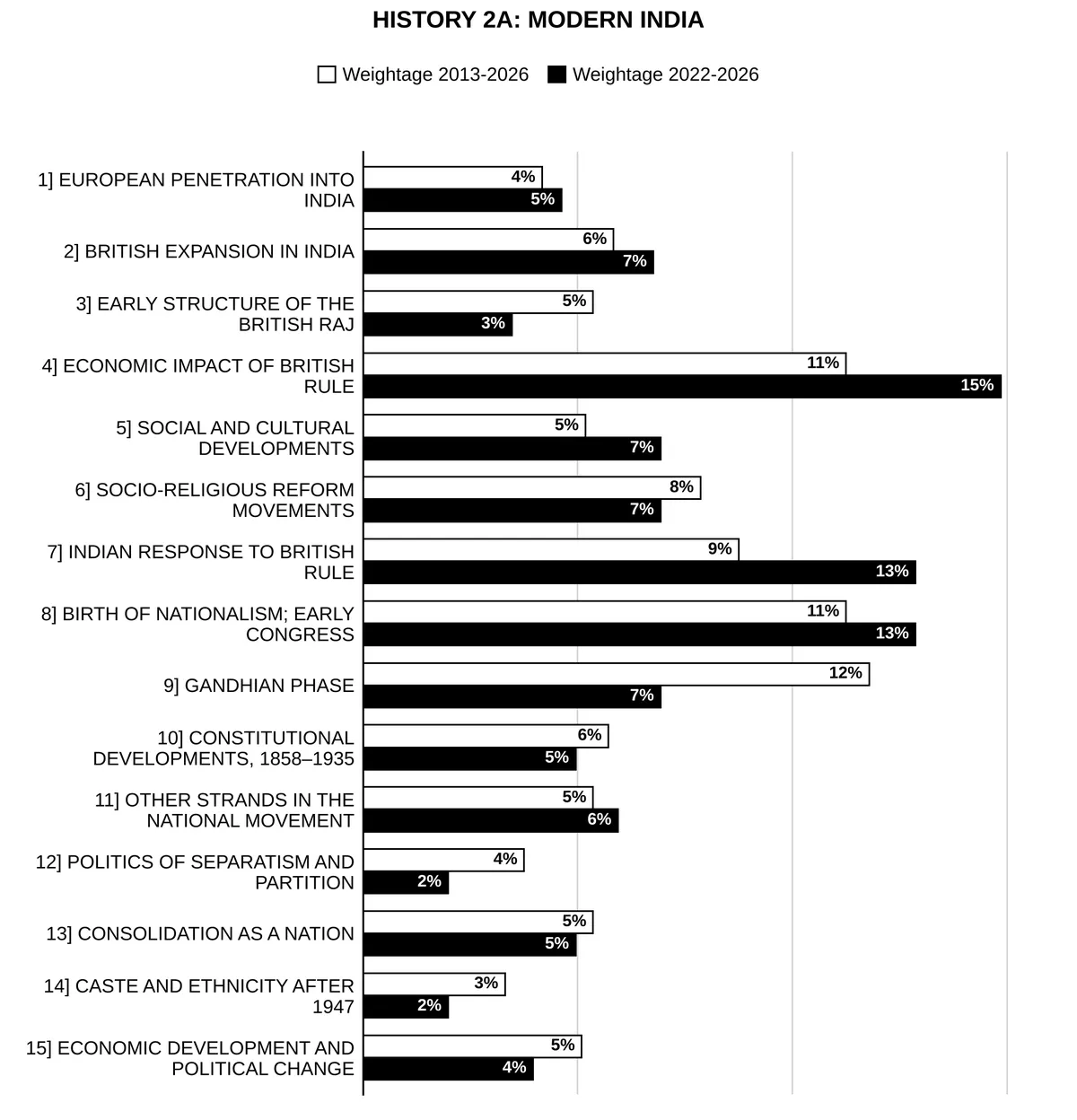
Constitutional Developments accounted for about 5% of the marks asked in Modern India in 2022–2026, down from 6% over 2013–2026, ranking 10th of the 15 units in the section by recent weightage.
How to use these PYQs
- Read the syllabus line in the box above alongside the questions and mark which phrases UPSC keeps returning to; those are the areas to prepare first.
- Questions run from the latest year to the oldest, so read the top of each list first for the current pattern, then use older ones for practice of content.
- Use the question code to set the length of your practice answer – marks and word limit tell you how much depth UPSC expected.
Frequently Asked Questions
How many History Optional questions have been asked from Constitutional Developments?
This collection lists 19 question entries from Constitutional Developments (unit 10 of Paper 2) between 1995 and 2026. They were asked in 16 of the 32 years and 4 came in 2022–2026.
When was Constitutional Developments last asked in History Optional?
Most recently in 2026, with 1 question (2026/20m/4a). Before that, it was asked in 2025.
Where can I find all History Optional PYQs topic-wise?
All units of Paper 1 and Paper 2, the map question and the earlier-syllabus questions are linked from History Optional PYQs Topic-wise (1995–2026).
« Previous: Gandhian Phase of the National Movement – History Optional PYQs (1995–2026)
Next: Other Strands in the National Movement – History Optional PYQs (1995–2026) »
Back to: History Optional PYQs Topic-wise (1995–2026) | Also see: History Optional year-wise question papers (1995–2026)