
Here are all 160 Organisation Behaviour questions asked in UPSC Commerce & Accountancy Optional Paper II from 1995 to 2026, arranged under the 7 topics of the official syllabus. Within each topic the latest questions come first.
Each question ends with a code such as [2024/15m/3b] – the year, the marks, the word limit (where UPSC set one) and the question number in the paper.
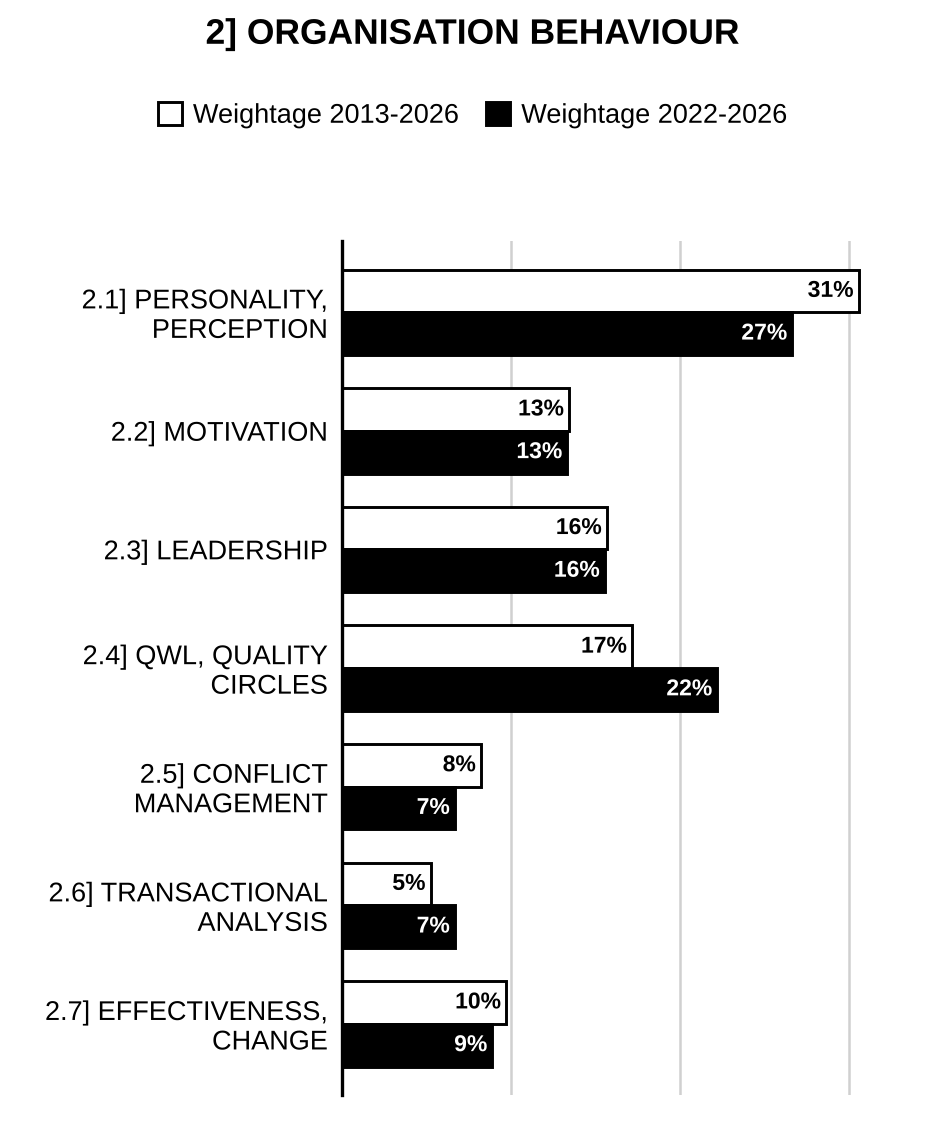
2.1] Individual in organization: personality and perception
51 questions
Determinants of Personality. [2025/10m/150w/1b]
Explain the process of perception and discuss how perceptual distortions can influence managerial decision-making in changing organisational environment. [2025/10m/2c]
How does sensation differ from perception? [2024/10m/150w/1a]
What are the ‘big five personality traits’? Which one seems to have the biggest impact on performance? How would the knowledge of these help the manager in his job? [2024/20m/2b]
Describe ‘Perceptual Process.’ Explain the selection, organisation and interpretation of stimuli. [2023/20m/4a]
How can the practice of Organisational Behaviour help in reducing production costs? Explain. [2023/10m/4c]
Critically discuss the impact of personality traits on the behaviour in organizations. [2022/10m/150w/1c]
Explain the causes of distortion in perception. Give suggestions for improving perceptual capabilities of managers in organizations. [2022/20m/2b]
Critically examine the Freudian stages of personality development. [2022/10m/3c]
Non-Verbal Communication. [2021/10m/150w/1a]
“Perception consists of three elements: the perceiver, the context and the target.” Elaborate. [2020/10m/2c]
What are the determinants of personality? Explain the major attributes influencing organisational behaviour. [2020/20m/4a]
Perceptual Selectivity. [2019/10m/150w/1e]
“With a view to taking advantage of personality characteristics of organisational members, it is desirable to measure their personality.” Elucidate this statement and explain the various methods for measuring personality. [2019/20m/3b]
Explain the nature of perception. How does management affect perception in the organisation? [2019/20m/3c]
Halo Effect. [2018/10m/150w/1c]
What is meant by impression management? Also distinguish between impression motivation and impression construction. [2018/10m/2c]
What is the nature of ‘selfs’ in the Johari Window? What implications does each have for interpersonal conflict? [2018/10m/3c]
Freudian Stages. [2016/10m/150w/1d]
Ethnocentrism. [2016/10m/150w/1e]
“When there is an accident in a factory, the supervisor may treat it as the carelessness of worker(s), while the worker(s) may treat it as the high-handedness of management and lack of adequate provisions of security measures.” What is the significance of this Phenomenon, and why people see the same situation differently? [2016/20m/4a]
“Biological factors are important in determining the personality of a person.” Comment on this statement. [2016/10m/4b]
Psychological Contract. [2015/10m/150w/1d]
“S-O-B-C model gives only a bare bones sketch of organisation behaviour rather than a full blown explanation. However it can serve as a conceptual framework for organisational behaviour.” What do you mean by this statement? Give suggestions to enrich this model. [2015/20m/4a]
What is positive psychology? How can Indian companies use the concepts of the same to foster entrepreneurial thinking in their workforce? Explain. [2015/20m/4b]
Scope of Impression Management. [2014/10m/150w/1b]
Figure Ground Principle. [2013/10m/150w/1b]
Interpersonal Conflict and Johari Window. [2013/10m/150w/1d]
“Essentially, groupthink results from the pressures on individual members to conform and reach consensus. Committees that are suffering from groupthink are so bent on reaching consensus that there is no realistic appraisal of alternative courses of action in a decision, and deviant, minority or unpopular views are suppressed.” Making an analysis of this statement, state how management is expected to be inclusive of all views for creating dynamic organisational climate. [2013/20m/2b]
“Impression management is the process by which people attempt to manage or control the perceptions others form of them.” What are the possible implications of this statement? What are its identifiable components? [2013/20m/4a]
“Commitment to the organisation plays an important role in developing relationship between job satisfaction and labour turnover.” Examine this statement in the context of major IT companies working in India. [2013/20m/7b]
Self-Managed teams. [2012/12m/150w/1c]
Explain internal and external factors which influence perception and discuss the role and application of perception in an organisation. [2011/30m/3b]
Internal vs. External locus of control. [2010/15m/150w/1a]
Application of ‘Johari Window’ in Conflict Resolution. [2010/15m/150w/1c]
Affective Events Theory. [2009/20m/200w/1a]
“The world, as it is perceived, is the world that is behaviourally important”. Explain with examples in the context of organisations. [2009/60m/2]
Critically analyse Holland’s topology of personality and congruent occupations. [2009/60m/3]
What is meant by the halo effect? Critically examine the current studies on this halo effect. [2007/60m/3]
Social Information Processing Approach (SIPA) [2006/20m/200w/1c]
Role stress. [2005/20m/200w/1b]
Interdisciplinary approach to organizational behaviour. [2004/20m/200w/1b]
Perception is considered as a subjective, active and complex process. Discuss. What steps will you take to reduce barriers and biases? [2003/60m/3]
Define learning and explain the process of learning. [2001/60m/2]
One cannot predict the effectiveness of an organisation structure or of a leader without understanding the group process that exists in the situation. Explain whether you agree or disagree with this statement and why. [2001/60m/3]
Perception. [2000/20m/200w/1c]
Organization behaviour as a dynamic system. [2000/20m/200w/1d]
What do you understand by the concept of “Organisation Behaviour”? Explain its nature as a dynamic one. Illustrate it. [1999/60m/2]
Examine the role played by “Status System” in industrial organisation. Identify the problems and suggest remedies to make the system functional. [1999/60m/3]
Perceptual Process. [1995/20m/200w/1c]
Discuss the Organisation Behaviour as a dynamic system. Identify its subsystems and complex interrelationships among them. Establish the need to apply this knowledge for the benefit of Indian enterprises. [1995/60m/3]
2.2] Motivation
21 questions
What are the major criticisms levelled against Herzberg’s two-factor theory of motivation? Explain its contribution for the better understanding of motivation at the workplace. [2024/20m/3a]
How is Herzberg’s “Motivation-Hygiene Theory” useful to organisations? List any five ‘Hygiene Factors’ applicable to Indian organisations. [2023/20m/3a]
Explain, with the help of the expectancy theory, why a lot of workers are not motivated on their jobs and do only the minimum necessary to get by. [2022/20m/3a]
Discuss the implications of Maslow’s need hierarchy theory and Herzberg’s two-factor theory in relation to employee motivation and compensation. [2021/20m/7b]
Assumptions of Theory X and Theory Y. [2020/10m/150w/1e]
What are the major contributions of Herzberg’s theory of motivation? Do you think it makes a contribution to the better understanding of motivation in the workplace? Comment and give arguments in support of your answer. [2018/20m/3b]
The theories of motivation are not competitive to each other, their inter-relationship needs an understanding for integrating them. Suggest steps for the same. [2017/20m/3a]
What are the various elements in the ‘Porter-Lawler Model’ of motivation? What are the implications of these elements in motivating a person? [2016/20m/4c]
“Most of the theories of motivation are complementary, but not competitive to each other. Hence, there is need to understand their interrelationships and integrate them.” Discuss the statement and suggest action plan for integration. [2014/20m/3a]
Equity Theory of Work Motivation. [2013/10m/150w/1a]
Critically examine the inter-linkage of three main aspects of the Expectancy model of motivation. In what ways does this model value human dignity? Explain. [2010/30m/3a]
Critically evaluate the concept of ‘Complex man’. In what respects is it different from other theories of motivation? [2006/60m/7]
Explain Herzberg’s contribution to the theory of motivation. How does it differ from the model of motivation given by Maslow? [2004/60m/3]
Motivation. [2002/20m/200w/1c]
Porter-Lawler model of motivation. [2001/20m/200w/1c]
Discuss the contributions of McGregor, Herzberg and Likert to the theory of motivation. [2000/60m/3]
Models of motivation. [1999/20m/200w/1d]
Explain any two theories of motivation and their relevance to Indian conditions. [1998/60m/3]
Maslow theory of human motivation. [1997/20m/200w/1b]
Define morale. Bring out the important factors that affect employee morale. State briefly the steps to build high morale in an organisation. [1997/60m/4]
Vroom’s Valency & Expectancy Theory. [1996/20m/200w/1d]
2.3] Leadership
30 questions
Analyse the role of modern leadership theories in shaping quality of work life in contemporary organisations. [2026/20m/4b]
Explain the different leadership styles commonly found in organisations. Evaluate how such leadership styles can influence employee motivation, performance and organisational culture. [2025/20m/3a]
Explain the major differences between transactional and transformational leaders. [2024/10m/150w/1b]
Critically analyze the Path-Goal Theory of Leadership. [2023/10m/2c]
Critically evaluate the contingency theory of leadership propounded by Fiedler. How is this theory different from situational leadership theory propounded by Paul Hersey and Kenneth Blanchard? [2022/20m/4a]
Transformational Leadership. [2021/10m/150w/1c]
Describe the Path-Goal theory of leadership and its associated leadership styles. [2021/20m/4c]
Integrative Model of Leadership. [2020/10m/150w/1c]
Explain Likert’s four systems of management in terms of leadership styles. [2020/10m/3c]
Managerial Grid. [2019/10m/150w/1c]
What are some styles of charismatic leadership? Critically examine the Robert House theory of charismatic leadership in the context of Indian scenario. [2018/20m/4b]
Trait theory. [2017/10m/150w/1d]
“Leadership vacuum works as double-edged sword.” What are the implications of this statement? [2017/10m/3c]
Tridimentional Grid. [2016/10m/150w/1c]
Managerial Grid. [2014/10m/150w/1e]
What is charismatic leadership? Are charismatic leaders born or made? How do they influence followers? Discuss. [2014/10m/3c]
Differentiate the key characteristics of Transactional Leadership and Transformational Leadership. Why do most of Indian organisations need transformational leader? How can such leader be developed and promoted in the organisation? [2013/10m/4c]
Path Goal Theory of Leadership. [2012/12m/150w/1b]
Path-goal theory of leadership. [2011/15m/150w/1b]
Leadership styles. [2007/20m/200w/1c]
3-D Management style. [2006/20m/200w/1a]
Discuss the basic concept and model of situational leadership. How does it differ from other leadership models? [2006/60m/4]
Magnetism. [2005/20m/200w/1c]
Path-Goal theory. [2005/20m/200w/1d]
Explain the contributions of Robert Blake and Jane Mouton, Paul Hersey and Kenneth Blanchard, and Robert Tannenbaum and Warren H. Schmidt to the Theory of Leadership. [2002/60m/4]
One cannot predict the effectiveness of an organisation structure or of a leader without understanding the group process that exists in the situation. Explain whether you agree or disagree with this statement and why. [2001/60m/3]
What do you understand by leadership style? How will you secure effective leadership in the management of an organisation? [1998/60m/4]
Leadership styles in Indian organisation. [1997/20m/200w/1d]
What is the importance of Leadership? Describe its various styles. Discuss their relative merits and demerits. [1996/60m/3]
Likert’s Linking Pin Model. [1995/20m/200w/1d]

Preparing for Prelims too?
Our UPSC Prelims Topic-wise PYQ eBook covers every Prelims question with detailed explanations, so you can see exactly where UPSC asks from.
View the BookDownload Free Sample2.4] Quality of work life and quality circles
17 questions
Explain the concept of quality circles. [2026/10m/150w/1d]
Analyse the role of modern leadership theories in shaping quality of work life in contemporary organisations. [2026/20m/4b]
Evaluate critically the impact of Total Quality Management (TQM) on employees’ behaviour and organisational effectiveness. [2026/10m/4c]
Relationship between quality work life (QWL) and organisational performance. [2025/10m/150w/1a]
Explain the concept of PDCA. State in detail its features, application, advantages and limitations. [2025/20m/2b]
Explain the phases of developing quality circle. [2024/10m/2c]
“‘How does the policy of ‘Flexitime’ affect organisational functioning?” Explain. [2023/10m/150w/1d]
Describe the importance of ‘Quality of work life’ in improving employee work efficiency. [2023/20m/3b]
Factors Affecting Quality of Work Life. [2021/10m/150w/1b]
Explain the objectives and the phases involved in establishing a Quality Circle system for an organisation. [2021/20m/3b]
Quality Circles. [2019/10m/150w/1d]
“The overriding purpose of Quality of Work Life (QWL) is to change the climate at work so that the human – technological – organisational interface leads to a better quality of work life.” Examine this statement. How do gaps create problems for this interface? [2018/20m/4a]
“Quality circles tend to show little or no effect on the productivity of an organization.” Do you agree? Suggest a framework to make it more responsive and effective. [2017/20m/3b]
“Organisational citizenship behaviour enhances the effectiveness of quality circles.” Comment. [2015/10m/4c]
“Quality circles are getting popularity for academic purpose, but they tend to show little or no effect on employee satisfaction and productivity.” Comment. How can these quality circles be made more effective and viable in their approach? [2014/20m/2b]
How do you differentiate Teams from Quality Circles in Total Quality Management Companies? Highlight the roles of various functionaries of quality circles. What steps would you suggest to implement quality circles in big organisations? [2013/20m/2a]
Rationale of Quality Circles (QC) [2011/15m/150w/1c]
2.5] Management of conflicts in organizations
14 questions
Explain the sources of conflict at the following levels: (i) Within individual (ii) Interpersonal conflict (iii) Structural conflict. [2026/10m/6b]
Explain the three forms of intra-personal conflict. [2023/10m/150w/1e]
Briefly review how conflict can provide benefits to the organization. [2022/10m/2c]
Explain the different types of conflicts in an organisation. What are the different styles of handling interpersonal conflicts? [2020/20m/2b]
What do you understand by role conflict? What are its causes? Discuss the methods to overcome role conflict. [2019/10m/4b]
What is the nature of ‘selfs’ in the Johari Window? What implications does each have for interpersonal conflict? [2018/10m/3c]
“Conflict in an organization is not always problematic, but it paves the way for development.” Elucidate. What are the possible implications of this statement? Develop a suggestive framework to make the conflict management more responsive and effective. [2014/20m/4a]
Interpersonal Conflict and Johari Window. [2013/10m/150w/1d]
“The organisation is made up of overlapping and interlocking role sets. These role sets would normally transcend the boundaries of the classical conception of organisation.” In view of this statement, examine the important strategies that can be used to manage intergroup conflict effectively. How do these dynamics provide theoretical foundation for the need of today’s interfunctional team? [2013/20m/3b]
Distinguish between substantive and affective conflict. Examine Rahim’s criteria for conflict management. [2011/30m/4a]
Application of ‘Johari Window’ in Conflict Resolution. [2010/15m/150w/1c]
Management of conflict. [2003/20m/200w/1b]
Organisational conflict. [2001/20m/200w/1d]
Management of conflicts. [1996/20m/200w/1c]
2.6] Transactional analysis
5 questions
“Transactional analysis provides a useful but limited framework for understanding organisational communication.” Comment. [2026/20m/4a]
Delineate any five complementary transactions in relation to Transactional Analysis. [2023/10m/3c]
What is the relevance of Transactional Analysis in modern organisations? Explain the key types of transactions. [2021/20m/4b]
“Transactional analysis is a method of analysing and understanding interpersonal behaviour.” Examine this statement. [2019/20m/4c]
Social Transaction. [2004/20m/200w/1d]
2.7] Organizational effectiveness and management of change
22 questions
Describe customer expectations and organisational changes. [2026/10m/150w/1e]
How does organizational transition differ from organizational change and renewal? [2024/10m/3c]
“There is a need for integrating individual and organizational goals.” Examine this statement. How does it affect organizational effectiveness? [2024/20m/4b]
Briefly explain the main systems of organizational effectiveness. [2022/10m/150w/1e]
Sources of Resistance to Change. [2021/10m/150w/1d]
“Organisational change has to be managed on technological, social and economic dimensions.” Elaborate this statement. What precautions should be taken in a democratic set-up to make a change acceptable to the personnel? [2019/20m/4a]
Benchmarking. [2018/10m/150w/1a]
Organisational Re-engineering. [2018/10m/150w/1b]
Adaptive Coping Cycle. [2018/10m/150w/1d]
Balance Score Card. [2015/10m/150w/1a]
Force Field Analysis. [2015/10m/150w/1c]
“In today’s dynamic business environment, continuous learning and innovation is important for survival of organisation.” In view of this, explain the role of culture in increasing organisational effectiveness. How is the culture linked with size, structure, complexity, diversity and leadership? [2013/20m/3a]
Kurt Lewin’s change model. [2011/15m/150w/1a]
“Every business needs a strategy to take care of changes both expected and unexpected.” Comment. How do you think resistance to change can be overcome? [2011/30m/4b]
‘To bring about organisational effectiveness, it calls for Organisational Development (OD) interventions.’ Explain which type of OD interventions can be used and why? [2010/30m/3b]
How do the organisation’s managers judge its effectiveness? What standards are they using to evaluate performance? How well is the organisation doing when judged by the criteria of control, innovation and efficiency? [2007/60m/4]
Organisation control and effectiveness. [2003/20m/200w/1c]
Organisational change. [2003/20m/200w/1d]
Organisational effectiveness. [2002/20m/200w/1d]
What is the need for change? Explain the management strategies for dealing with human resistance to orgnisational change. [2001/60m/4]
What do you understand by the “management of change”? How can resistance to change be reduced? Discuss. [1998/60m/2]
Define organisation development. What are its characteristics and limitations? How is it different from organisation growth? Give examples. [1996/60m/4]

Strengthen your GS papers
Our UPSC Mains Topic-wise & Year-wise PYQ eBook (2013–2026) maps every GS question to the syllabus, so you know what UPSC asks and how often.
View the BookDownload Free Sample« Previous: Organisation Theory | Next: Human Resources Management (HRM) »
Back to: Commerce & Accountancy Optional PYQs – Topic-wise | Also see: Commerce & Accountancy Optional year-wise question papers
Last updated: 30 October 2026