
Here are all 182 Organisation Theory questions asked in UPSC Commerce & Accountancy Optional Paper II from 1995 to 2026, arranged under the 8 topics of the official syllabus. Within each topic the latest questions come first.
Each question ends with a code such as [2024/15m/3b] – the year, the marks, the word limit (where UPSC set one) and the question number in the paper.
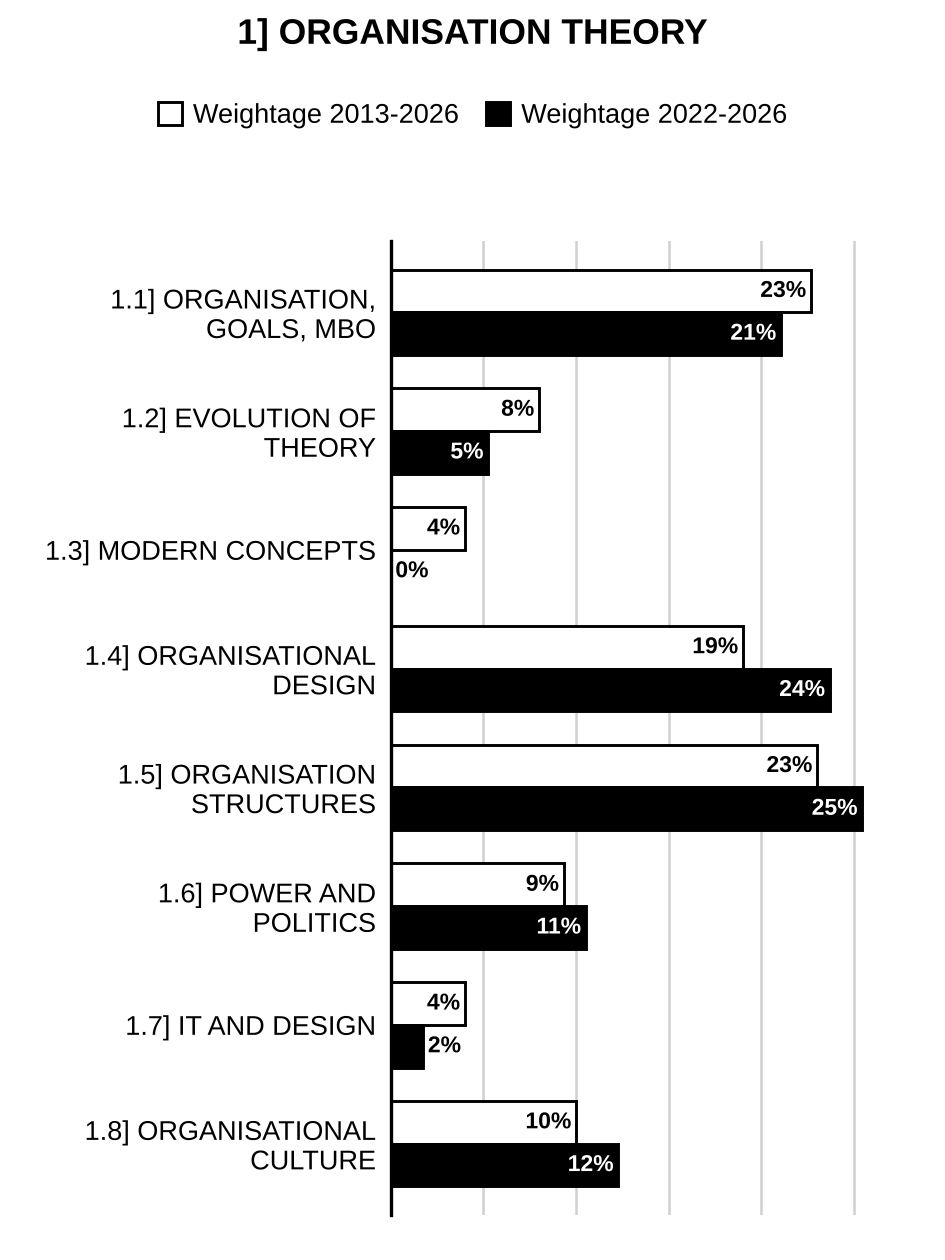
1.1] Nature and concept of organisation, environment and goals
42 questions
“Technological environment is considered dynamic.” Comment. [2026/10m/150w/1a]
Explain the concept of organisational goals. [2026/10m/150w/1b]
Types of external-environment of organisation. [2025/10m/150w/1c]
“Organisations often pursue multiple and sometimes conflicting goals.” Critically evaluate this statement. How these conflicting goals affect organisational strategy, decision-making and performance? Elaborate. [2025/20m/4b]
How have organizations been defined? Compare different perspectives of organizations in India and Western countries. [2024/20m/2a]
“There is a need for integrating individual and organizational goals.” Examine this statement. How does it affect organizational effectiveness? [2024/20m/4b]
What are the external environmental factors that are essential to an organisation? [2023/10m/150w/1a]
“Profit maximization as a goal, is being gradually considered less important in many organisations.” Express and justify your opinion on the above statement. [2023/20m/2b]
“MBO is a mixed blessing.” Elucidate the statement. [2022/10m/150w/1a]
“The environment is a major contingency for which an organisation must plan and to which it must adapt.” Explain. [2021/20m/2a]
“An organisation without goals is like a rudderless ship.” Comment and explain the importance of goals. [2021/20m/3a]
Problems of Management by Objectives (MBO) [2020/10m/150w/1d]
Goal Succession. [2019/10m/150w/1a]
“There is a need for integrating individual and organisational goals for effective performance.” Explain this statement. [2019/10m/3a]
Organizational environment decides the success or failure of an enterprise. Do you agree? Give arguments in support of your answer. [2017/20m/2b]
Explain the technique of management by objective. Give suggestions for making it more effective. [2017/20m/4a]
Explain the internal and external changes which must be taken into account by the management in framing its policies. [2017/20m/4b]
“Organisations are collectivities of people that have been established for the pursuit of relatively specific objectives on a more or less on continuous basis”. Elucidate the implication(s) of this statement. [2016/20m/2a]
“Political and legal environment works both as a promoting and as a restraining force in business operations”. Examine this statement. [2016/10m/2c]
VUCA World. [2015/10m/150w/1b]
“Since liberalisation there has been continuous pressure on the functioning of regulatory agencies which monitor Indian business organisations.” Evaluate this statement and suggest remedial measures to enhance their effectiveness. [2015/20m/2b]
“Organization is the human group deliberately and consciously created for the attainment of certain goals with rational coordination of closely relevant activities.” In the light of this statement, discuss the distinguishing features of an organization. [2014/20m/2a]
What is agency problem? Do you find any such problem in Indian organisations? What steps can be taken to solve such problems? [2013/10m/3c]
The CEO of an autonomous organisation wants to introduce Management by Objective system in the organisation. What should be the steps for implementation and precautions that the CEO should keep in mind? [2012/30m/4a]
‘In order to exist, sustain and grow, an organisation needs to have a pyramid of a set of goals to be achieved by the people.’ Explain with suitable examples. [2010/30m/2a]
Contingency plans. [2006/20m/200w/1d]
Do you think an organization must grow bigger and bigger? Can it be kept small? Answer the questions analysing the forces that affect the status of an organization. Use Indian examples to elucidate your answer. [2006/60m/2]
Define, differentiate and integrate the stated goals and operating goals of an organization. [2006/60m/3]
The Carnegie view of goal formation. [2005/20m/200w/1a]
“Business is simply a form of human competition, greatly resembling war.” Do you agree with this statement? Could there be any difference between a war organization and a business organization? Answer with examples. [2005/60m/2]
Analyze the organization of a private engineering college from sociological and social-psychological viewpoints. [2005/60m/3]
“The objective of a company is only to increase the intrinsic value of equity shares.” Do you agree with this statement? How do you categorize this particular goal-setting process? [2005/60m/4]
What is meant by ‘plurality of goals’? Describe the specific areas of corporate goals. [2004/60m/2]
Primary goals of organisation. [2003/20m/200w/1a]
Personal and organisational goals. [2002/20m/200w/1b]
Professionalism in Management. [2000/20m/200w/1a]
Multiple goals. [1999/20m/200w/1b]
Goal Multiplication. [1998/20m/200w/1a]
Primary goals of organisation. [1997/20m/200w/1a]
Significance of Organisation. [1996/20m/200w/1a]
Goal succession. [1996/20m/200w/1b]
Features of Organisation. [1995/20m/200w/1a]
1.2] Evolution of organisation theory
20 questions
Neo-classical theory of organisation. [2025/10m/150w/1e]
Describe the main propositions of the neo-classical organisational theory. [2023/10m/150w/1b]
Write a brief note on ‘systems approach’ in the context of the evolution of organization theory. [2022/10m/150w/1d]
Social Systems Approach of Management. [2020/10m/150w/1b]
What are the main features of Neo-Classical organisation theory? Explain the implications of this theory for organisational design. [2019/20m/2c]
Red-tapism. [2018/10m/150w/1e]
Cynical puppeteering of people. [2017/10m/150w/1e]
Ritualism. [2016/10m/150w/1a]
The criticisms of Neo-classical organisation theory ranges from ‘human relations as a tool for cynical puppeteering of people’ to ‘human relations no more than a trifling body of empirical descriptive information’. Throw light on this statement. [2016/20m/2b]
Cybernetic Aspects of System Theory. [2014/10m/150w/1a]
Importance of Personnel Ratios in a bureaucratic system. [2012/12m/150w/1d]
Humanistic Perspective for Employee Management. [2012/12m/150w/1e]
“The Neo-classical theory of organisation embarked on the task of compensating for some deficiency in classical doctrine.” Explain it and discuss the salient features of modern concept of organisation theory. [2011/30m/2b]
Bureaucratic Dysfunctions. [2010/15m/150w/1d]
Parkinson’s law. [2007/20m/200w/1b]
What do you understand by system? Distinguish between open system and closed systems. Which system is more appropriate for business and for government organisations? Why? Discuss. [2002/60m/2]
Contingency approach to organisation. [2001/20m/200w/1a]
“The classical organizational structure inhibits productivity and is unable to accommodate the change.” In view of this statement explain how behavioural model overcomes such objection to the classical organizational structure? [2000/60m/2]
Define ‘Bureaucracy’. What are its characteristics? How can Indian Managers reduce its evils in the present environment? [1997/60m/3]
Describe the contributions of Taylor and Taylor[?] to the Development of Organisation theory. What are the criticisms made on their work? Do you agree with them? Substantiate your argument with examples. [1996/60m/2]
1.3] Modern concepts of organisation theory
9 questions
How does a learning organisation differ from a traditional organisation? What impact do these differences have on the way people are managed? [2018/20m/2a]
Empowered organization. [2017/10m/150w/1c]
“The critics of organizational theory are of the view that modern theory of organization is like ‘an old wine in new bottle’.” Examine the statement. [2017/20m/2a]
What is meant by empowered organisations? Suggest steps to foster an empowered organisation. [2015/10m/2c]
“The Neo-classical theory of organisation embarked on the task of compensating for some deficiency in classical doctrine.” Explain it and discuss the salient features of modern concept of organisation theory. [2011/30m/2b]
Bounded rationality. [2009/20m/200w/5a]
Bounded rationality. [2007/20m/200w/1d]
Limits on rationality. [1999/20m/200w/1c]
Explain the contributions of Simon and March to Organisation Theory. Elucidate the characteristic of rationality and its importance in the analysis of human behaviour. How is this aspect practiced in the Indian management processes? [1995/60m/4]
1.4] Organisational design
29 questions
Define organisational design. Explain in detail the salient features of organisational design that managers must consider. [2026/20m/2b]
What is formalisation? Discuss its role in achieving organisational efficiency and mention the potential challenges of high formalisation. [2026/20m/3a]
“Organisational design is not merely about structure, but about strategically aligning people, processes, and objectives in an ever-changing environment.” Discuss. [2025/20m/2a]
Discuss how mechanistic and organic structures affect decision-making, communication and flexibility within an organisation. [2025/10m/3c]
What are the major challenges in achieving effective coordination in an organisation and how does it impact overall performance? Discuss. [2025/10m/4c]
Why do we need to coordinate formal and informal organizations? [2024/10m/150w/1c]
Distinguish between delegation of authority and decentralization. [2024/10m/4c]
Identify some changes observed in the demographic composition of the Indian IT sector. Describe the impact which these changes have on organisational design and structure. [2023/20m/4b]
“The choice between centralization and decentralization cannot be made in isolation, none is good or bad.” Critically evaluate this statement. [2022/20m/2a]
Discuss the important structural dimensions of organisations. [2021/10m/2b]
“Rules are different from norms.” In the light of this statement, explain the importance of rules and norms from the organisational design perspective. [2021/20m/2c]
“Organic structures are opposite to mechanistic structures.” Discuss. [2021/10m/3c]
Discuss the different factors determining the degree of decentralisation. [2020/20m/3a]
Span of Management. [2019/10m/150w/1b]
Explain the concept and rationale of decentralisation. What are the factors which influence decentralisation? [2019/20m/2a]
“Informal organisation is detrimental to the interest of formal organisation and, therefore, it is an evil to be nipped in the bud itself.” Comment on this statement and explain how managers should handle informal organisation. [2016/20m/3a]
“There is a positive relationship between the organizational environment and its structural design.” Make an analysis of this statement and in the light of the same, suggest steps to design an organization. [2014/20m/3b]
“Practically, it is not possible to determine whether an organisation is centralized or decentralized merely by looking at the organisation chart. The determining factor is how much of the decision making is retained at the top and how much is delegated to the lower levels.” Examine this keeping in mind that team-oriented organisations have emerged in recent years. [2013/20m/4b]
A large municipal corporation intends to design a network of citizen service centres with the objective of enhancing citizen satisfaction. Advise the Commissioner, with justification, about how the following elements should be considered while designing the centres: Boundary Spanning Roles, Geographic Dispersion, Decision Making, Formalization and Flexibility. [2012/30m/2a]
Miles and Snow had classified organisations into four types depending on the strategy of each organisation. What should be the features of the corresponding organisational design? [2012/30m/3b]
“Organisation design may involve strategic decisions but is properly viewed as a path to effective strategy execution.” Explain it and discuss the basic principles of organisational design. [2011/30m/2a]
‘Centralisation and Decentralisation not only exist in an organisation, but they also reinforce each other.’ Elaborate with illustrations. [2010/30m/4a]
How does the informal organisation emerge? Explain the issues involved in monitoring of informal organisations. [2007/60m/2]
Span of Management. [2004/20m/200w/5c]
Define formal and informal organisation. Explain their relative importance. [2003/60m/2]
Informal organisation. [2002/20m/200w/1a]
Informal Organisation. [1998/20m/200w/1b]
What do you understand by informal organisation? Give its special features. How does it differ from formal organisation? [1997/60m/2]
What are the functions and limitations of Informal Organisation? In your opinion, can its behaviour be influenced? If so, how? Give examples. [1995/60m/2]

Preparing for Prelims too?
Our UPSC Prelims Topic-wise PYQ eBook covers every Prelims question with detailed explanations, so you can see exactly where UPSC asks from.
View the BookDownload Free Sample1.5] Designing organizational structures
40 questions
Elucidate organisational structure with reference to work from home and flexitime. [2026/10m/150w/1c]
Critically examine in detail the various types of organisational structure. [2026/20m/2c]
Differentiate between line and staff functions. Describe in detail the role of coordination and specialisation while designing functional organisational structure. [2026/20m/3b]
Types of Organisational Structure. [2025/10m/150w/1d]
To what extent does a project based organisational structure enhances goal clarity and flexibility and how sustainable in this approach for long-term strategic growth? [2025/20m/3b]
What are the limitations of matrix organization? [2024/10m/150w/1d]
Examine the different approaches for designing organizational structure. Evaluate the process involved in it. [2024/20m/3b]
Distinguish between delegation of authority and decentralization. [2024/10m/4c]
Explain how the matrix structure breaks the unity-of-command concept. [2022/10m/150w/1b]
Despite the complementary and supplementary relationship of line and staff, why is there a conflict between them? Give sound suggestions to minimize this conflict. [2022/20m/4b]
Line and Staff Conflicts and their resolution. [2020/10m/150w/1a]
“A manager while delegating authority should observe certain principles.” Elaborate. [2020/20m/2a]
What are the reasons for adopting a matrix organisation? Discuss the various problems involved in it. [2020/20m/3b]
“The line managers’ orientation differs considerably from that of expert advisors.” Examine this statement. [2019/10m/2b]
Explain the concept of ‘Management by Exception’. What are its limitations? Suggest measures to overcome them. [2019/10m/6a]
Management by exception. [2017/10m/150w/1a]
Principle of accountability. [2017/10m/150w/1b]
Line and staff functions in a modern organization are irrelevant. Do you agree? Comment. [2017/10m/4c]
Strategy-Structure Relationship. [2016/10m/150w/1b]
“The relative advantages of functional structure of organisations are like two-edged swords.” What are the implications of this statement? [2016/20m/3b]
Accountability vs Responsibility. [2015/10m/150w/1e]
According to Hendry Mintzberg, how does the power dynamics between various parts of the organisation, result in different structural forms of organisation? What are these structural forms, and how do they affect organisational effectiveness? [2015/20m/3a]
In post modern-organisations, are traditional concepts like line and staff functions irrelevant? Do you think so? Give arguments in support of your answer. [2015/10m/3c]
Fishnet Organization. [2014/10m/150w/1c]
Problems in Matrix Organization Structure. [2014/10m/150w/1d]
Specialisation vs. Professionalisation. [2013/10m/150w/1c]
“Organisation structure influences the division of the tasks, grouping of activities, coordinating the activities and the overall accomplishment of the tasks.” In the light of this statement, discuss various components of organisation structure. [2013/10m/2c]
“Organisation is not a single entity but a managed configuration of different parts.” Discuss the relevance of the statement using the frame-work of organisation structure proposed by Mintzberg. [2012/30m/3a]
“Authority is the cement of organisational structure and a thread that makes it possible.” Elucidate it and discuss the role of power of knowledge. [2011/30m/3a]
Discuss the role of trust in delegation. [2009/30m/7b]
Matrix organisation. [2007/20m/200w/1a]
Organisational Charts. [2004/20m/200w/1a]
Organisation control and effectiveness. [2003/20m/200w/1c]
Organisational structure refers to the way in which an organisation activities are divided, grouped and coordinated into relationships between managers and employees, managers and managers, and employees and employees. Discuss. [2002/60m/3]
Professional bureaucracy. [2001/20m/200w/1b]
Matrix structure of organization. [2000/20m/200w/1b]
How do the recent trends towards diversification and multi-nationalism in organizations affect the design and implementation of sound and effective organizational control? [2000/60m/4]
Structure of formal organisation. [1999/20m/200w/1a]
Organisational Control. [1998/20m/200w/1d]
Line and Line and Staff Structure in organisation. [1997/20m/200w/1c]
1.6] Power and politics
18 questions
How do different sources of power influence the formal and informal power structures within an organisation, and what are the implications for leadership effectiveness and ethical decision-making? [2025/20m/4a]
Why does organizational politics emerge? What are its consequences? Suggest measures to avoid them. [2024/20m/4a]
How is power used as a tool of organisational control? Elaborate in detail the various sources of power. [2023/20m/2a]
Power and Authority. [2021/10m/150w/1e]
Discuss the different tactics which are used to gain power in an organisation. [2020/10m/4c]
“The political power game is very real in modern organisations.” Comment on this statement. Also examine its postulates of power in organisations that help focus on the political realities. [2018/20m/2b]
How ‘power’ differs from ‘authority’? Discuss the sources of power in an organisation. [2016/10m/3c]
According to Hendry Mintzberg, how does the power dynamics between various parts of the organisation, result in different structural forms of organisation? What are these structural forms, and how do they affect organisational effectiveness? [2015/20m/3a]
“Organizational politics refers to intentional behaviours that are designed to enhance or protect a person’s influence and self-interest.” Analyze the statement and discuss the reasons contributing the political behaviour and the way-outs to avoid organizational politics. [2014/20m/4b]
Dominant coalition in organisations and its importance. [2012/12m/150w/1a]
“Authority is the cement of organisational structure and a thread that makes it possible.” Elucidate it and discuss the role of power of knowledge. [2011/30m/3a]
‘Organisational Politics is a way of life and it can be constructively used by following ethical political behaviour for accomplishment of organisational activities.’ How far do you agree or disagree? Give reasons. [2010/30m/2b]
What are the different sources of power in an organisation? [2009/30m/7a]
Coalition formation. [2006/20m/200w/1b]
What is ‘Power’? How is it related to Leadership? Explain the strategy of acquiring political power. [2004/60m/4]
Define power. Describe the bases of power. Explain their influence on behaviour in the organisation. [1999/60m/4]
Sources of power. [1997/20m/200w/5b]
Bases of Power. [1995/20m/200w/1b]
1.7] Impact of information technology on organizational design and structure
8 questions
“The implementation of information technology produces change in organizational structure as their relationship is dynamic.” Explain in brief. [2022/10m/4c]
Examine the attributes of virtual organisation. Also assess their implications in the Indian corporate sector. [2018/10m/4c]
Virtual organization emphasizes vitality and growth of an organization. Elucidate. [2017/10m/2c]
“Competitiveness of Indian industry is directly linked with digitisation initiatives.” Identify the issues involved and implication of this statement. [2015/20m/2a]
What is virtual organization? Do you visualize it in Indian scenario? Examine its merits and limitations. [2014/10m/2c]
In the Information Technology sector, virtual project management is a common buzzword. Explain the concept and discuss how can such a project be executed well? [2012/30m/4b]
Emergence of ‘Virtual Organisation’. [2010/15m/150w/1b]
In what ways Information Technology has forced and influenced many organisations to restructure themselves? Explain with suitable examples. [2010/30m/4b]
1.8] Managing organizational culture
16 questions
Explain the various types of organisational culture. [2026/10m/2a]
Discuss the methods of managing and changing organisational culture. [2026/10m/3c]
What should be done to improve the work culture in our country? Give suitable suggestions. [2025/10m/8a]
How does socialization help in maintaining organizational culture? [2024/10m/150w/1e]
Describe the relationship between organisational culture and climate. [2023/10m/150w/1c]
“Organizational culture is the set of assumptions, beliefs, values and norms which are shared by an organization’s members.” Explain. Discuss the positive and negative impacts of organizational culture. [2022/20m/3b]
“Creation of organisational culture is a long-term process.” In light of this statement, discuss the process involved in creating organisational culture. [2020/20m/4b]
OCTAPAC Culture. [2018/10m/150w/5a]
“Organisation culture is the long term phenomenon that decides the success or failure of the mission and vision of the organisation and ultimately its survival in the current global scenario.” Explain this statement and also identify the cultural problems of modern business organisations. [2015/20m/3b]
“Organizational culture emphasizes building on employees’ strength and rewards more than punishments. It emphasizes individual vitality and growth.” Elucidate. [2014/10m/4c]
Concept of Diversity and Inclusion in the Organisation. [2013/10m/150w/1e]
“In today’s dynamic business environment, continuous learning and innovation is important for survival of organisation.” In view of this, explain the role of culture in increasing organisational effectiveness. How is the culture linked with size, structure, complexity, diversity and leadership? [2013/20m/3a]
Discuss how can “culture of safety” be built and sustained in an organisation dealing with hazardous chemicals? [2012/30m/2b]
Work culture. [2005/20m/200w/5c]
Organisation is culture bound. Discuss and explain that sound organisation culture is key to progress of any organisation. [2003/60m/4]
Organisational Culture. [1998/20m/200w/1c]

Strengthen your GS papers
Our UPSC Mains Topic-wise & Year-wise PYQ eBook (2013–2026) maps every GS question to the syllabus, so you know what UPSC asks and how often.
View the BookDownload Free Sample« Previous: Financial Markets and Institutions | Next: Organisation Behaviour »
Back to: Commerce & Accountancy Optional PYQs – Topic-wise | Also see: Commerce & Accountancy Optional year-wise question papers
Last updated: 30 October 2026