
Here are all 163 Human Resources Management (HRM) questions asked in UPSC Commerce & Accountancy Optional Paper II from 1995 to 2026, arranged under the 7 topics of the official syllabus. Within each topic the latest questions come first.
Each question ends with a code such as [2024/15m/3b] – the year, the marks, the word limit (where UPSC set one) and the question number in the paper.
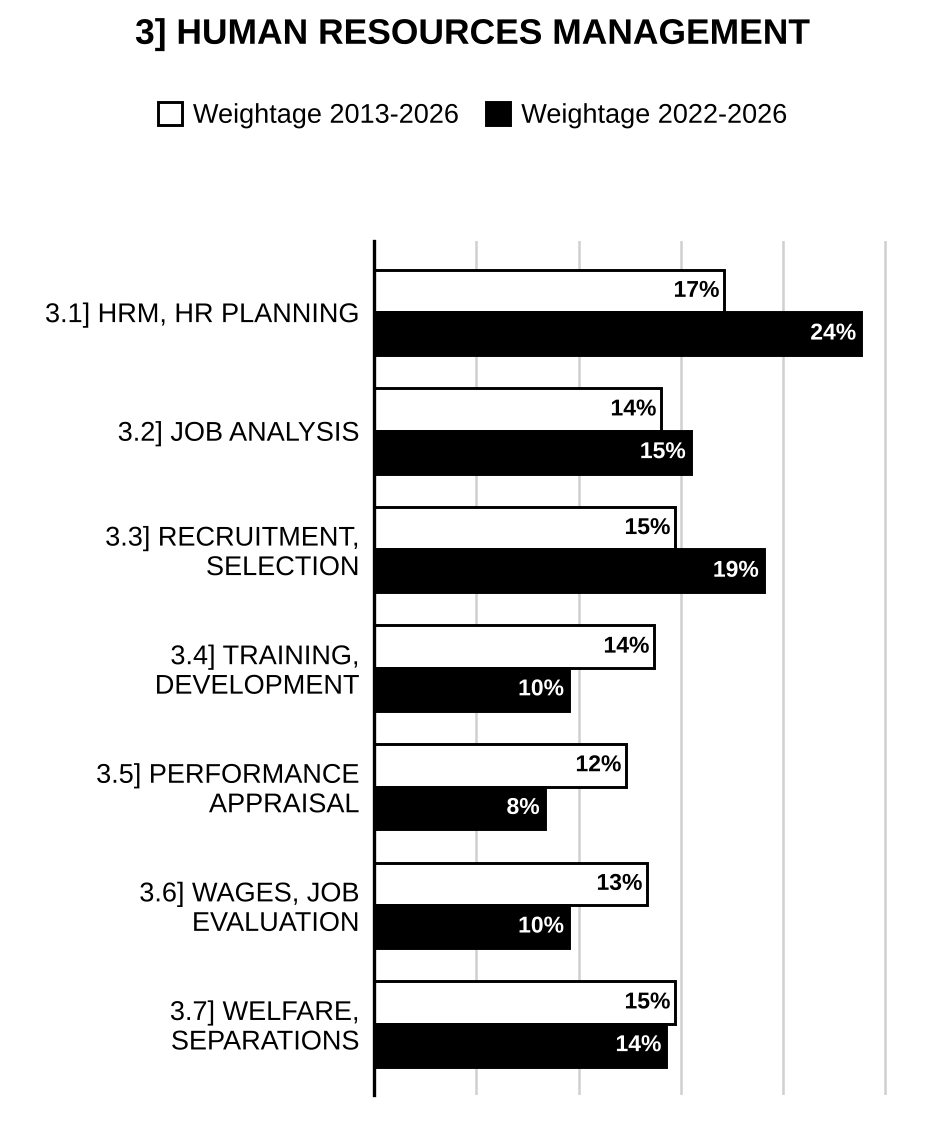
3.1] Meaning, nature and scope of HRM; human resource planning
27 questions
Paradoxes in Human Resource Management (HRM) [2026/10m/150w/5a]
“Geopolitical realignments, accelerating technological change and shifting organisational expectations are elucidating the challenges of human resource management and redefining the role of HR managers.” Comment. [2026/20m/6c]
Discuss the problems faced in human resource planning. [2024/10m/150w/5a]
Describe the scope and relevance of HRM in organisations today. [2023/20m/8a]
“The approach towards Human Resource Management has undergone transformation through different stages and this process of transformation is still going on.” Explain this statement. [2022/20m/6a]
“Human Resource Planning is a prerequisite for effective management of human resources.” In the light of this statement, analyze the significance of Human Resource Planning. [2022/20m/7a]
Talent Management. [2020/10m/150w/5a]
“Human Resource Planning (HRP) is essentially concerned with the most effective use of scarce talent.” Justify. [2020/20m/7a]
Human Resource Planning. [2019/10m/150w/5b]
“Demand forecasting of human resource is the process of estimating the future quantity and quality of people required.” In the light of this statement, evaluate various techniques specially applicable to the service industry. [2018/20m/6b]
“The basic aim of talent management is to develop and maintain a talent pool consisting of a skilled, engaged and committed workforce.” Do you agree with this comment? Assess its implications in the context of recent government initiatives for the development of talent management in the country. [2018/10m/7c]
Examine the influence of human resource outsourcing on business enterprises. Suggest suitable measures to make it more relevant and effective. [2017/10m/8c]
Burack Smith Model forecasting Human resource needs. [2016/10m/150w/5b]
“Human resource management practices are culture bound.” Discuss this statement and show how different cultures adopt different human resource management practices. [2016/20m/6a]
Human Resource Accounting. [2015/10m/150w/5b]
HR Outsourcing. [2014/10m/150w/5c]
“The emergence of Talent Management is the result of changing orientations of Human Resources Management as it involves all the managers shaping the company, the jobs even the strategy to attract talented people.” Critically examine the statement and suggest strategies for attracting and retaining talent in the organisation. [2013/20m/8a]
Increasing number of organisations are taking up the environmental agenda. In that context the concept of ‘Green HR’ has been doing the rounds. In your opinion what will be the features, benefits and drawbacks of this concept? [2012/30m/8a]
Explain how human resource management boosts solvency, profitability and efficiency of an organisation. [2011/30m/6a]
Why do some organisations need more complex and comprehensive Human Resources planning systems than others? What kinds of information might an HR planner want to collect about the external labour market? Describe. [2010/30m/6a]
Workload forecasting. [2009/20m/200w/1c]
Discuss the role of Personnel Department in an organisation. [2003/60m/8]
Role of personnel department in an organisation. [2002/20m/200w/5d]
Explain the role and importance of Personnel Department in the organisation. [1998/60m/8]
Role of Personnel Officer. [1997/20m/200w/5a]
What is personnel research? For this purpose, explain the essentials of effective record-keeping. Give a brief account of personnel research in India along with an assessment of future research needs. [1996/60m/8]
Personnel Audit. [1995/20m/200w/5d]
3.2] Job analysis, job description and job specification
18 questions
“Job rotation, job enlargement and job enrichment are merely attempts by managers to avoid individuals at work.” Comment. [2026/20m/6a]
Impact of traditional job specifications. [2025/10m/150w/5b]
How is job design different from job analysis? [2024/10m/7c]
“A good job-description leads to improved employee satisfaction.” Explain. [2023/10m/150w/5a]
Describe the relationship between the activities of Performance Appraisal and Job-Analysis. [2023/10m/6c]
Explain briefly how the process of job specification is dependent on job analysis and related to job requirements. [2022/10m/6c]
What is a good job description? List some methods of collecting job description information. [2021/10m/6b]
“Job analysis is mainly and essentially a data collection process.” In light of this statement, elaborate the different methods of data collection. Compare Position Analysis Questionnaire (PAQ) with Management Position Description Questionnaire (MPDQ). [2020/20m/7b]
Job Specification. [2019/10m/150w/5a]
“Job analysis is useful for overall management of all personnel activities.” In the light of this statement, explain the purpose and methods of job analysis. [2019/20m/7b]
Repertory Grid. [2018/10m/150w/5b]
Job-psychographic method. [2017/10m/150w/5a]
“A job description is a word picture of the organisational relationships, responsibilities and specific duties that constitute a given job or position.” Discuss the major criteria for a well-made job description that link the underlined factors. [2016/20m/7a]
“Compared to factory workers, it is more difficult to attempt job analysis, job description, and job specification for the Scientists and Engineers working in Research and Development Departments.” Comment. How does the HR Department help management to address these challenges effectively? [2015/20m/6b]
Why are workers not more proactive in job analysis programmes, though it is more helpful in their possible development in comparison to managers? Identify the reasons and offer suggestions to make the job analysis more relevant and effective. [2014/20m/6a]
‘Job analysis typically produces merely a job description and the context in which work activities are performed.’ Critically evaluate the statement. [2010/30m/7a]
“Job analysis is a systematic investigation of the tasks, duties and responsibilities of a job….”. Critically analyse this statement in the context of employee performance. [2009/60m/4]
Human engineering. [2007/20m/200w/5a]
3.3] Recruitment, selection, orientation and placement
19 questions
Define recruitment. Describe the various methods of recruitment. Which method, in your opinion, will be more suitable to recruit a higher post like marketing manager? Explain in detail. [2025/20m/7b]
“Tests are useful in predicting the failure rather than success of the candidate on the job.” Comment. [2024/20m/6a]
Explain the purpose of employee orientation. [2023/10m/150w/5b]
‘Placement Problems’ arise more in larger and geographically scattered organisations. Comment. [2023/10m/7c]
“Recruitment process is often very strenuous, time-consuming and expensive, as also equally frustrating from the point of view of the organization.” Suggest the methods which can improve the objectivity of recruitment process. [2022/20m/7b]
What is Placement? Explain the components of an Employee Induction Programme. [2021/20m/6c]
“Different types of tests are used in the selection of employees.” Discuss. [2021/20m/7a]
“Selection is virtually a kind of elimination process.” In the light of this statement, explain the objectives and process of selection. [2019/20m/8a]
Suppose that your firm has gone outside of the organization to fill a position in middle management even though it has an announced policy of promotion from within. An employee has challenged this action on the basis of policy. What could be an appropriate reply? [2017/10m/6c]
What is employee selection? Explain the different types of tests being used in the process of selection of employees. [2017/20m/8b]
“Placement is a decisive step that affect both the employees and the organisation.” Explain the statement. [2016/20m/6b]
Induction vs. Orientation Programme. [2014/10m/150w/5d]
e-Recruitment. [2014/10m/150w/5e]
“Skill development programme fits into recruitment policy of Indian employers and Government is also proactive to it.” Comment on the statement and identify the issues as to why this programme is not successful in India so far. [2014/20m/8a]
Reliability of Recruitment Tests. [2012/12m/150w/5d]
Design a socialisation and induction programme for the newly recruited General Manager for a medium enterprise with two manufacturing units. Why should a person at that level have a formal programme? [2012/30m/7a]
Thomas profiling hiring technique. [2011/15m/150w/5a]
Objectives of orientation programmes. [2011/15m/150w/5c]
Induction Training. [2004/20m/200w/5d]

Preparing for Prelims too?
Our UPSC Prelims Topic-wise PYQ eBook covers every Prelims question with detailed explanations, so you can see exactly where UPSC asks from.
View the BookDownload Free Sample3.4] Training and development process
23 questions
“Training programmes are helpful to avoid personnel obsolescence.” Elucidate. [2025/10m/7c]
Elucidate the executive development techniques relating to interpersonal and decision-making skills. [2024/20m/7b]
How do organisations identify the training needs of their employees? Explain. [2023/10m/8c]
Describe the importance and types of training. [2021/20m/6a]
What are the different barriers to an effective training programme in an organisation? [2020/20m/6a]
“Management Development Programmes (MDPs) are understood as a conscious effort to improve managerial effectiveness through a planned and deliberate learning process.” In light of this statement, discuss the two broad methods of developing managers and supervisors in an organisation. [2020/20m/8a]
“One thing is now universally accepted that in the long run the cost of not training is always more than the cost of training and the greater the training activity in an organization, the less the doubt about its utility.” Comment. [2017/20m/6a]
Discuss briefly the various on-the-job and off-the-job training and development methods. [2016/10m/6c]
Ethical Training. [2014/10m/150w/5a]
“Skill development programme fits into recruitment policy of Indian employers and Government is also proactive to it.” Comment on the statement and identify the issues as to why this programme is not successful in India so far. [2014/20m/8a]
“Professional students in India are facing the problem of unemployability and Indian employers are criticizing the professional institutions for not producing students as per their standards.” Explain this statement. Also identify the reasons and consequences for this issue, and suggest action plan to overcome this unemployability problem. [2013/20m/6a]
A process of digitalization in an organisation requires training and reskilling of employees. How should HR Department manage this in the organisation? What steps and measure should they take to minimize the conflict arising out of the redeployment of employees after the training? [2013/20m/7a]
“The main objective of mentoring is to help an employee attain psychological maturity and effectiveness and get integrated with the organisation.” Elucidate and discuss the essentials of successful mentoring. [2013/10m/8c]
Principles of Adult Learning. [2012/12m/150w/5b]
Mobile phone based learning is the way forward for organisations. Do you agree/disagree? Why? [2012/30m/6a]
CEO of a manufacturing company made the following comment to the HR Head. “If we are investing time and resources in skill training for our production workers, we should get to know the benefits”. How will Donald Kirkpatrik’s theory help to answer the question? [2012/30m/6b]
Emerging perspective on training in India. [2011/15m/150w/5b]
Succession planning for managers. [2010/15m/150w/5c]
Career planning and succession-planning. [2009/20m/200w/1b]
Managerial development methods. [2009/20m/200w/1d]
Career Anchor. [2009/20m/200w/5d]
Executive development. [1996/20m/200w/5d]
Training Methods for Operatives. [1995/20m/200w/5c]
3.5] Performance appraisal and 360° feedback
20 questions
“Performance appraisal is not merely for appraisal but is for accomplishment and improvement of performance.” Elaborate. [2025/10m/6a]
Elaborate the merits and limitations of 360° feedback. [2024/10m/150w/5b]
Describe the relationship between the activities of Performance Appraisal and Job-Analysis. [2023/10m/6c]
Briefly discuss the four integrated components of 360° feedback. [2022/10m/150w/5b]
Performance Management. [2021/10m/150w/5b]
Differentiate between the traditional and modern methods of Performance Appraisal. [2021/10m/7c]
Computerised and Web-based Method of Performance Appraisal. [2020/10m/150w/5e]
“Performance appraisal is not merely for appraisal, but also for accomplishment and improvement of performance.” Comment. [2019/20m/7c]
How is performance management system different from performance appraisal system? Also explain how customised performance appraisals can be used as a strategic tool for performance management system. [2018/20m/7a]
360° feedback system. [2017/10m/150w/5b]
Merit rating vs. Job rating. [2017/10m/150w/5c]
A manufacturing company has about 200 employees in its plant. It undertakes performance appraisal on informal basis. The company wants to adopt a formal appraisal system. Advice the company as to how it should proceed in the matter. [2016/10m/7c]
Behavioural Anchored Rating Scale. [2015/10m/150w/5a]
What is the impact of ‘Halo Effect’ on Performance Appraisal? Explain. [2015/10m/6c]
“360° feedback system is gaining popularity.” Comment. Also examine the barriers to its effective implementation in India. [2015/20m/7a]
360 degree Feedback System. [2013/10m/150w/5e]
Achieve model of performance. [2011/15m/150w/1d]
“The primary function of performance appraisal is to help each employee to handle the current job better.” Explain. Which method would you recommend for appraising managerial personnel in India? [2011/30m/7a]
360° Feedback evaluation. [2010/15m/150w/5d]
‘The backbone of the entire employee evaluation process is the “Appraisal Interview” itself.’ Critically evaluate this statement. [2010/30m/6b]
3.6] Salary and wage administration; job evaluation
32 questions
Job evaluation and internal equity. [2025/10m/150w/5a]
Factors influencing salary and wage administration. [2025/10m/150w/5d]
“An experiment in profit-sharing scheme on a wide scale would be definitely undertaking a voyage on uncharted seas.” Discuss this statement. [2024/20m/8b]
Principles of Wage and Salary Administration. [2020/10m/150w/5c]
“A good incentive plan should have sufficient incentives for workers to raise their output and also should not put undue burden on management.” Elaborate. [2020/10m/7c]
Wages vs. Productivity. [2019/10m/150w/5e]
“It is often argued that reward systems should be adjusted in line with changing organisational strategic objectives – yet in the real world, this is not often the case.” Comment on this statement. [2018/10m/8c]
Merit rating vs. Job rating. [2017/10m/150w/5c]
“In an organization, we pay for jobs but not for men.” Do you agree? How does job evaluation affect human relations in industry? [2017/20m/6b]
What are the essentials of a satisfactory wage system? Briefly explain the various methods of wage payment and discuss the merits and demerits of each. [2017/20m/7b]
“The immediate objective of job-evaluation process is to obtain internal and external consistency in wage and salaries.” Elucidate the statement and throw light on the effect of job-evaluation on human relation in an industry. [2016/20m/7b]
“Cafeteria Scheme allows individual employees to decide, with certain limits, on the make up of their Fringe Benefits Package.” Discuss. Also examine the implications of this statement. [2015/20m/6a]
Stock Option Scheme. [2014/10m/150w/5b]
Compensation Survey. [2013/10m/150w/5d]
“Effective administration of incentive scheme is possible only when all the prerequisites such as good methods, good standards, good scheduling and good management practices are present.” Comment and evaluate the need for guaranteed day wages. [2013/10m/7c]
Cost of Company Approach to Compensation is grossly misleading. [2012/12m/150w/5a]
Explain the circumstances under which job evaluation has a good chance to succeed and describe the procedure for job evaluation. [2011/30m/7b]
Considerations in designing ‘pay for performance’ incentive system. [2010/15m/150w/5a]
Bedeaux point plan. [2009/20m/200w/5c]
Customary bonus. [2007/20m/200w/5c]
Implicit contract theory. [2005/20m/200w/5a]
Automatic wage indexing. [2005/20m/200w/5b]
The concept of fair wage. [2003/20m/200w/5a]
Profit sharing. [2003/20m/200w/5d]
Wage Policy in India. [2002/20m/200w/5a]
Examine the factors that should be taken into account in formulating a national wage policy. What, according to you are the major impediments to the evolution of a national wage policy in India? [2000/60m/7]
National Wage Policy. [1998/20m/200w/5c]
Productivity-Linked Bonus. [1997/20m/200w/5c]
Requirements of a sound wage policy. [1997/20m/200w/5d]
Economic satisfaction of workers. [1996/20m/200w/5a]
National Wage Policy. [1995/20m/200w/5b]
What is Bonus? How could it become critical in maintaining smooth industrial relationship between the management and the employees? What are your suggestions to improve the employer-employee relationships? [1995/60m/7]
3.7] Employee welfare, promotions, transfers and separations
24 questions
Impact of employees’ welfare on their performance. [2026/10m/150w/5e]
How will you deal with the problems of transfers and promotion in your organisation? Explain. [2026/10m/7b]
How is voluntary separation different from involuntary separation? [2024/10m/150w/5d]
“Employee Welfare is the joint responsibility of the State, Employers and Trade Unions.” Comment on the above statement. [2023/20m/6b]
Distinguish ‘transfer’ from ‘promotion’/‘demotion’ and state the purposes of resorting to ‘transfer’. [2022/10m/150w/5a]
Explain how promotion can be used as a tool to enhance job performance. [2021/10m/4a]
Transfers and Separations. [2020/10m/150w/5d]
Exit Policy. [2019/10m/150w/5d]
“The compliance with the statutory labour welfare provisions in India is half-hearted and inadequate.” Do you agree with this statement? Comment. [2019/20m/6c]
“There are a number of misconceptions that people have about the glass ceiling.” What are some of these? Also, what can organisations do to help break the glass ceiling? [2018/20m/3a]
Golden Handshake. [2018/10m/150w/5c]
“Merit-based promotion leads to dissatisfaction of all except one, hence the resulting effect is negative; seniority-based promotion has the distinctive advantage of satisfying all in due course of time.” Critically evaluate this system. Also suggest a suitable promotion policy for Indian enterprises. [2018/20m/6a]
Suppose that your firm has gone outside of the organization to fill a position in middle management even though it has an announced policy of promotion from within. An employee has challenged this action on the basis of policy. What could be an appropriate reply? [2017/10m/6c]
Versatility transfer. [2016/10m/150w/5a]
“There is a need for a balanced exit policy for the mutual benefit of employer and employees.” Keeping this in your mind, outline the salient features of exit policy statement. [2014/20m/7b]
“In the current scenario, public enterprises are working as model employer but their downsizing programme has daunted this philosophy.” Comment on this statement in the context of Indian scenario and suggest an action plan for them. [2013/20m/6b]
What type of provisions relating to social security for workers are provided in the Constitution and Labour Laws in India? How can such social security benefits be improved through collective bargaining? [2013/20m/8b]
Discuss how can “culture of safety” be built and sustained in an organisation dealing with hazardous chemicals? [2012/30m/2b]
Is the concept of employee welfare redundant when it comes to the new generation of employees (Gen Y)? Explain. [2012/30m/7b]
“Employees’ welfare schemes are to create efficient, healthy, loyal and satisfied labour force for the organisation.” Elucidate this statement and suggest some welfare measures for the benefit of the employees. [2011/30m/6b]
Voluntary Retirement Scheme (VRS) and ‘Catch-22’ situation. [2010/15m/150w/5b]
Explain key features of Industrial Grievances. Suggest a model grievance procedure for settlement of such disputes. [2010/30m/7b]
“An effective grievance handling procedure is one that is preventive rather than curative”. Comment and examine. [2009/60m/6]
Grievance handling process. [2001/20m/200w/5b]

Strengthen your GS papers
Our UPSC Mains Topic-wise & Year-wise PYQ eBook (2013–2026) maps every GS question to the syllabus, so you know what UPSC asks and how often.
View the BookDownload Free Sample« Previous: Organisation Behaviour | Next: Industrial Relations (IR) »
Back to: Commerce & Accountancy Optional PYQs – Topic-wise | Also see: Commerce & Accountancy Optional year-wise question papers
Last updated: 30 October 2026