
Here are all 174 Industrial Relations (IR) questions asked in UPSC Commerce & Accountancy Optional Paper II from 1995 to 2026, arranged under the 7 topics of the official syllabus. Within each topic the latest questions come first.
Each question ends with a code such as [2024/15m/3b] – the year, the marks, the word limit (where UPSC set one) and the question number in the paper.
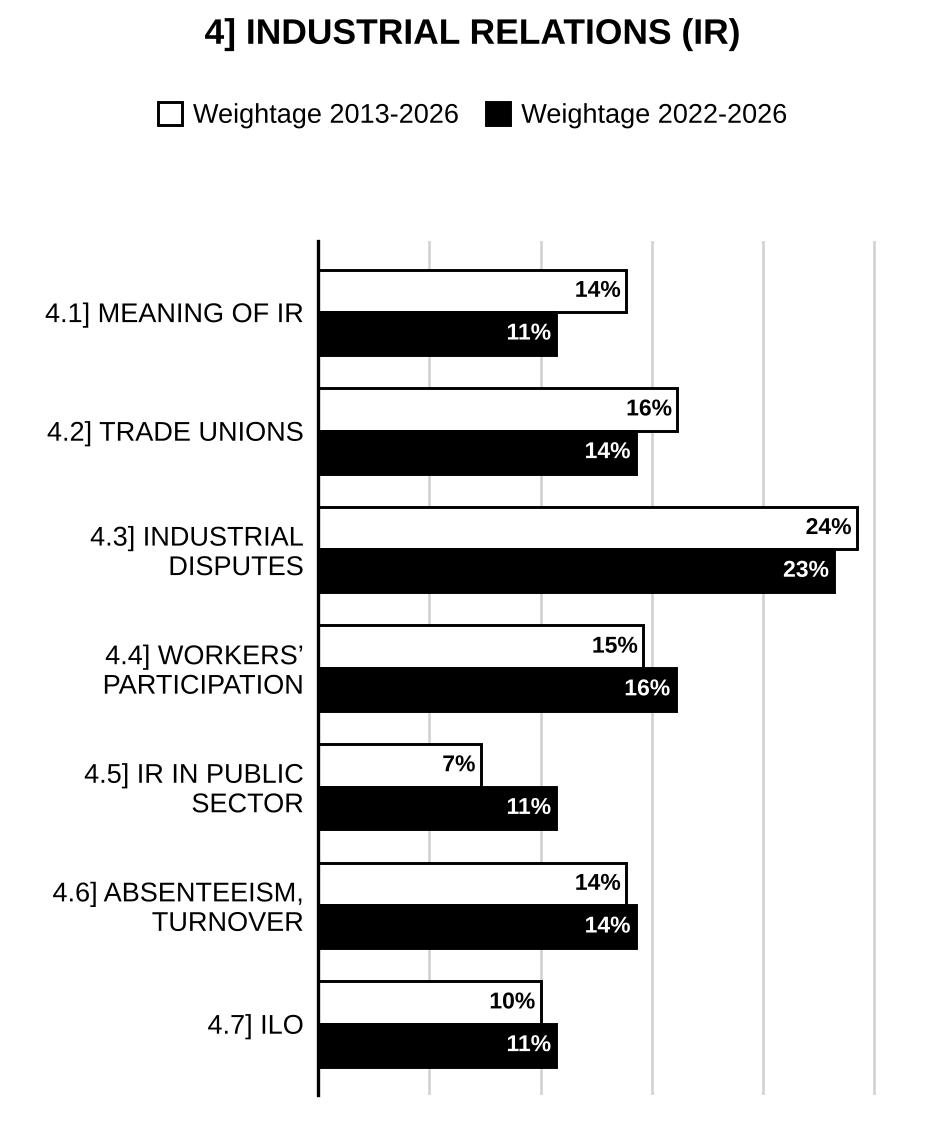
4.1] Meaning, nature, importance and scope of industrial relations
33 questions
“Over the last few decades, the relationships between workers and management have considerably changed.” Comment. [2026/10m/8a]
Examine the scope of industrial relations in the light of modern labour market transformations, including the impact of changing work patterns, globalisation and technological advancement. [2025/20m/6c]
Discuss the essential conditions for congenial industrial relations. [2022/10m/150w/5d]
State the responsibilities of Industrial Relations Managers. [2022/10m/150w/5e]
“Rapid industrialization in India is heavily dependent on harmonious industrial relations.” Explain the impact of globalization on industrial relations. [2022/10m/7c]
Scope of Industrial Relations. [2021/10m/150w/5d]
What is the importance of industrial relations? Explain how Industrial Relations (IR) can be enhanced in organisations. [2021/20m/8c]
“The fundamental aim of industrial relations is to maintain sound relations between employees and employers.” Elucidate. What are the various approaches to industrial relations? [2019/20m/6b]
Standing Orders. [2018/10m/150w/5d]
Dunlop’s approach of Industrial Relation. [2016/10m/150w/5d]
Industrial Jurisprudence. [2016/10m/150w/5e]
“I.T. Companies in India seek special concessions in the Factories Act of 1948, for their establishments.” What are these concessions? Do you agree that these should be granted? Give arguments in support of your answer. [2015/20m/7b]
“Changing Indian labour legislations is the last unfinished agenda since 1991.” Assess its rationale. [2015/10m/8c]
Effectiveness of Social Dialogue. [2013/10m/150w/5a]
Bipartite and Tripartite Approach to Labour Relations. [2012/12m/150w/5c]
“Industrial Relations in India is a dynamic and evolving concept.” Explain it and suggest measures for improving industrial relations in public enterprises in India. [2011/30m/8a]
Industrial jurisprudence. [2009/20m/200w/5b]
“The rural background of the industrial workers has been an obstacle to industrial commitment and stability of workforce.” Elucidate this statement and formulate a suggestive policy framework to overcome this problem in the era of liberalisation, privatisation and globalisation. [2007/60m/6]
International division of labour. [2006/20m/200w/5c]
Inside contracting. [2006/20m/200w/5d]
Discuss the emerging scenarios of industrial relations in the era of liberalisation and globalisation of Indian economy. [2006/60m/6]
Discuss briefly the factors to be considered in a contingency framework for industrial relations. [2005/60m/8]
Point out the essential prerequisites of good industrial relations. [2004/60m/6]
Explain the socio-economic conditions of Industrial labour in India. Has there been any change in the socio-economic conditions of labour in recent year? [2003/60m/6]
Characteristics of Indian Labour. [2002/20m/200w/5b]
What is meant by industrial relations? Explain the nature and scope of industrial relations system in India in the context of globalisation. [2002/60m/6]
Discuss the impact of changed economic scenario in India on industrial relations. Do you think that trade union movement will experience a setback in the times to come? [2000/60m/8]
Scope of industrial relations. [1999/20m/200w/5a]
Stages of commitment of industrial labour. [1999/20m/200w/5b]
Migratory nature of Indian labour. [1998/20m/200w/5a]
“Good industrial relations are essential for the rapid industrial development of a country.” Comment on this statement and describe the characteristics of good industrial relations. [1997/60m/6]
Indian Industrial Relations. [1995/20m/200w/5a]
What is Bonus? How could it become critical in maintaining smooth industrial relationship between the management and the employees? What are your suggestions to improve the employer-employee relationships? [1995/60m/7]
4.2] Trade unions
25 questions
Positive impact of liberalisation on Trade Union Movement (TUM) [2026/10m/150w/5d]
Define trade union. What are the challenges faced by trade unions in present time? Elaborate. [2025/20m/8b]
“Multiplicity of unions has retarded the effective working of trade unions in India.” Discuss. [2024/10m/6c]
How do Trade Unions contribute to the betterment of Employer-Employee relations? Describe. [2023/20m/6a]
State the criteria for the recognition of Trade Unions in India. Also point out the rights of a recognized Trade Union. [2022/20m/8b]
“Trade unions are an impediment to the growth of industry.” Do you agree? Critically evaluate the role of trade unions in the present context. [2021/20m/8a]
“The main concern of trade union is that such unionism will lead to fragmentation and weakening of the trade union movement.” In light of this statement, discuss the challenges faced by different trade unions. [2020/20m/6b]
Trade Union Rivalry. [2019/10m/150w/5c]
“The Trade Union movement in India has not developed on healthy lines.” Examine this statement. [2019/10m/7a]
Dissolution of Trade Union. [2018/10m/150w/5e]
“Indian trade union movement has failed to serve the purpose of its own formation.” In the light of this statement, develop a suggestive framework to improve the functioning of trade unions in India. [2017/20m/7a]
Why do employees join a trade union? Discuss a strategy which an organisation can adopt for dealing with the trade union with the possibility of making the company union free. [2016/20m/8a]
“Indian trade union movement is plagued by intraunion rivalry, outside leadership and political patronage, and has failed to serve the purpose of its own formation.” Elucidate and develop a suggestive framework to improve the functioning of trade unions in India. [2014/20m/6b]
Check-off system. [2007/20m/200w/5d]
Evaluate the role and effectiveness of outside leadership in trade unions. How do adverse consequences of outside leadership be avoided in Indian scenario? Explain. [2007/60m/7]
Mafia unionism. [2006/20m/200w/5a]
Multi-unionism. [2005/20m/200w/5d]
Discuss briefly the factors that inhibit the success of trade union movement in India. [2004/60m/7]
Discuss the problems of trade union movement in India. Examine why Indian Trade Unions are dominated by outside leadership? [2002/60m/7]
Compare and contrast the organisational structure and performance of Indian Trade Unionism with their counterparts in foreign countries. [2001/60m/6]
Role of outside leadership in Indian Trade Union Movement. [2000/20m/200w/5b]
Discuss the impact of changed economic scenario in India on industrial relations. Do you think that trade union movement will experience a setback in the times to come? [2000/60m/8]
Evaluate the present approach and attitude of managements in industry towards trade union movement. Suggest ways and means for achieving mutual understanding between the parties for a positive result. [1999/60m/6]
“The greatest obstacle to the growth of healthy Trade Union Movement in India is the unhealthy influences of rival political parties.” Elucidate. [1998/60m/6]
Examine the functions of Trade Unions relating to an Industrial Organisation and evaluate their effectiveness. Discuss how Trade Unions can strengthen the organisation to meet the stiff competition existing in the market. Illustrate. [1996/60m/6]
4.3] Industrial disputes
46 questions
“Many of the industrial conflicts have their roots in communication gap between management and workers.” Discuss the statement and also give its solution. [2026/20m/7a]
Critically examine the existing machinery for prevention and settlement of industrial disputes in India. [2026/20m/7c]
Causes of Industrial Disputes. [2025/10m/150w/5e]
“Workers’ participation democratises workplaces, while collective bargaining institutionalises conflict.” Critically evaluate this statement. [2025/20m/6b]
Why is collective bargaining not effective in India? Explain its reasons. [2024/10m/150w/5c]
“There are two approaches of managing industrial disputes in an organization–preventive and curative.” Examine this statement. Also evaluate their individual effectiveness. [2024/20m/8a]
Write a note on ‘Collective Bargaining’. [2023/10m/150w/5d]
Discuss the weaknesses of a conciliation machinery in settling industrial disputes. Suggest suitable measures to make conciliation machinery effective. [2022/20m/6b]
“Collective bargaining in India has not been very successful.” Comment. Discuss the suggestions to be made to make the functioning of collective bargaining effective. [2022/10m/8c]
Strike vs. Lockout. [2021/10m/150w/5a]
“Industrial conflict is basically a struggle between management and workers.” Examine this statement. [2021/10m/8b]
Adjudication and Collective Bargaining. [2020/10m/150w/5b]
What are the causes of industrial disputes? Explain the steps taken for preventing and settling industrial disputes in India. [2019/10m/8c]
“Collective bargaining is important to both employers and employees but there are certain snags.” Do you agree with this statement? Suggest measures to make the process more effective. [2018/20m/7b]
Strikes vs. Lockouts. [2017/10m/150w/5d]
“Mutual trust in an organization is the main key to collective bargaining.” Comment. [2017/10m/7c]
“The objective of arbitration is not compromise but adjudication, though the parties are at liberty to compromise. A wise arbitrator will certainly promote such agreements, but as a rule, there is no place for compromise in the awards.” In the light of this statement compare the advantages and disadvantages of settlement approach and arbitration. Also show at which stage of negotiation parties may opt for arbitration. [2016/20m/8b]
Union demands and collective bargaining settlements in private industry and public sector industries differ significantly. List down the differences and suggest suitable remedies. [2016/10m/8c]
Conciliation vs Mediation in Disputes Resolution. [2015/10m/150w/5c]
Pen down strike vs Tool down strike. [2015/10m/150w/5d]
Banning Lockouts. [2015/10m/150w/5e]
“Collective bargaining requires mutual trust among key stakeholders within an industry.” Comment. What considerations are to be taken into account in managing collective bargaining arrangements? [2015/20m/8b]
There are two approaches of managing industrial disputes in an organization, viz., preventive and curative. Discuss these two approaches. [2014/10m/7c]
General Prohibition on Strikes and Lockouts under ID Act, 1947. [2013/10m/150w/5c]
What type of provisions relating to social security for workers are provided in the Constitution and Labour Laws in India? How can such social security benefits be improved through collective bargaining? [2013/20m/8b]
Provisions in ID Act 1947 related to workmen during closure of industrial establishments. [2012/12m/150w/5e]
Collective Agreements in the Indian Banking Industry are finalized at the national level by the representative Trade Union (in spite of multiple unions across different banks) and the association of management. In the context of enhanced competition should individual banks be allowed independence in collective bargaining? Justify your opinion. [2012/30m/8b]
“The objective of arbitration is not compromise but adjudication……” Explain with examples and relevant case laws, where applicable. [2009/60m/8]
Concession bargaining. [2006/20m/200w/5b]
Discuss the behavioural theories of collective bargaining process. [2006/60m/8]
Do you agree that collective bargaining is based on mistrust and conflict? Answer by broadly outlining a bargaining framework and the process of collective bargaining. [2005/60m/7]
Mechanism of industrial peace in India. [2004/20m/200w/1c]
Constituents of an industrial peace system. [2004/20m/200w/5b]
What is meant by ‘collective bargaining’? State its characteristics. At what levels can it arise? [2004/60m/8]
Causes of industrial unrest. [2003/20m/200w/5b]
Real collective bargaining is by its very nature a rough tough undertaking. Its essence is a reluctant exchange of commitments both parties want to yield less and get more. It is different from business deal in which both parties have something less than 100 percent trust in one another. In the context of this statement, examine and explain various approaches to collective bargaining. [2002/60m/8]
Collective bargaining. [2001/20m/200w/5c]
What are the causes of industrial conflicts? Explain the role of State in resolving the conflicts. [2001/60m/7]
What are the merits and demerits of collective bargaining v/s direct governmental intervention as approaches to industrial conflict? Give your answer with reference to Indian conditions. [2001/60m/8]
Machinery for prevention and settlement of industrial disputes. [2000/20m/200w/5d]
Compulsory adjudication. [1999/20m/200w/5c]
Sources of industrial disputes. [1999/20m/200w/5d]
Why do industrial workers and managements resort to strikes and lockouts? Is there any logical approach to minimise these in India? Discuss. [1999/60m/7]
What are the causes of labour unrest in India? What remedial measures have been taken so far? [1998/60m/7]
Explain the process of collective bargaining including the conditions essential for its success. What are its limitations? Discuss how you propose to overcome them in the present dynamic business environment. Give examples. [1996/60m/7]
Discuss the steps to be taken to settle industrial disputes speedily and amicably. By this process, is it possible to maintain united and contented labour force? Examine whether such a force can meet the changes taking place in the country at present. [1995/60m/8]

Preparing for Prelims too?
Our UPSC Prelims Topic-wise PYQ eBook covers every Prelims question with detailed explanations, so you can see exactly where UPSC asks from.
View the BookDownload Free Sample4.4] Workers’ participation in management
20 questions
What is the present status of workers’ participation in management in Indian context? Explain its rationale and future prospects in the era of contemporary world. [2026/20m/8c]
“Workers’ participation democratises workplaces, while collective bargaining institutionalises conflict.” Critically evaluate this statement. [2025/20m/6b]
Is there any difference between union participation and employee participation? Discuss the pros and cons of both and suggest whether and how they can coexist. [2025/20m/8c]
Explain the rationale of workers’ participation in management. Suggest measures to make it more effective. [2024/20m/6b]
“Industrial Democracy functions in India through the demarcation of levels of participation and accordingly, matters of participation.” Explain. [2023/20m/7b]
Philosophy of Workers’ Participation in Management. [2021/10m/150w/5c]
“The objective of workers’ participation has been to bring labour and management closer and work for achieving organisational goals.” In this context, discuss the various reasons responsible for the failure of workers’ participation schemes in India. [2020/10m/8c]
“In India, workers’ participation in management is a farce and an ineffective mechanism but it can be reinforced with suitable legal initiatives.” Comment and offer your suggestions to make the legal framework more effective and viable. [2018/20m/8a]
“One of the instruments of industrial democracy is workers participation in management.” Comment on this statement and offer suggestions to make workers participation more relevant and effective. [2017/20m/8a]
“Constitutional provisions are in favour of Workers Participation in Management, but its implementation requires effective strategies.” Discuss. [2015/10m/7c]
“Workers have not been empowered to participate in worker participation management programmes, though it is a popular instrument of industrial democracy.” In the light of the statement, analyze the factors responsible for it and offer suggestions to make the worker participation more viable and effective. [2014/20m/8b]
“Workers’ participation in management scheme in India is almost a failure because it is neither based on sound foundation nor workable in practice.” Examine the factors responsible for creating this environment and suggest rational measures to make it more effective. [2013/10m/6c]
“Workers’ participation in management is a myth.” Do you agree with this statement? What measures do you advocate for improving effectiveness of workers’ participation in management in public enterprises? [2007/60m/8]
Critically explore the possibility of Industrial Democracy happening in India. [2005/60m/6]
Status of participative management in India. [2004/20m/200w/5a]
Explain the forms of workers participation in management. Why it could not succeed in India inspite of its desirability? [2003/60m/7]
Industrial democracy. [2001/20m/200w/5a]
Why should workers participate in management? What are the methods of workers’ participation in the management of public and private sector units in India? How do you visualize its future prospects? [2000/60m/6]
Comment on the advisability or otherwise of allowing workers’ participation in management. To what extent have public enterprises in India set a good example in respect of workers’ participation in management? [1997/60m/7]
Workers’ participation in Management at present. [1996/20m/200w/5c]
4.5] Industrial relations in public enterprises
11 questions
What do you mean by a model employer? Critically examine the role of public enterprises in acting as a model employer. [2024/20m/7a]
Describe the status of Industrial Relations in the Indian Public Sector Undertakings. [2023/20m/8b]
Critically examine the strengths and weaknesses of industrial relations in public sector. [2022/20m/8a]
Union demands and collective bargaining settlements in private industry and public sector industries differ significantly. List down the differences and suggest suitable remedies. [2016/10m/8c]
“Disinvestment programme has adversely affected the IR climate in public enterprises.” Assess the implications of this statement. In this context, make out a viable plan to protect the interest of employees. [2014/20m/7a]
“In the current scenario, public enterprises are working as model employer but their downsizing programme has daunted this philosophy.” Comment on this statement in the context of Indian scenario and suggest an action plan for them. [2013/20m/6b]
“Industrial Relations in India is a dynamic and evolving concept.” Explain it and suggest measures for improving industrial relations in public enterprises in India. [2011/30m/8a]
In what ways do the Industrial Relations in public and private enterprises differ from each other? How can the two sectors stand to gain from each other’s experiences so as to improve their industrial relations? [2010/30m/8a]
Model employer. [2007/20m/200w/5b]
“Workers’ participation in management is a myth.” Do you agree with this statement? What measures do you advocate for improving effectiveness of workers’ participation in management in public enterprises? [2007/60m/8]
Comment on the advisability or otherwise of allowing workers’ participation in management. To what extent have public enterprises in India set a good example in respect of workers’ participation in management? [1997/60m/7]
4.6] Absenteeism and labour turnover
20 questions
Technological innovations and employees’ retention. [2026/10m/150w/5b]
“High labour turnover is a symptom of weaknesses within an organisation.” Discuss the statement. How can the management in collaboration with different stakeholders reduce the labour turnover? Comment. [2026/20m/8b]
Impact of absenteeism. [2025/10m/150w/5c]
Explain the productivity implications of labour turnover. [2024/10m/150w/5e]
Why is controlling absenteeism necessary for organisations? Explain. [2023/10m/150w/5c]
“Competition among industries often leads to labour turnover.” Do you agree with the statement? Justify your answer. [2023/10m/150w/5e]
“Excessive turnover of labour is neither in the interest of the employer nor in the interest of the employees.” Explain this statement. [2022/10m/150w/5c]
Labour Absenteeism. [2021/10m/150w/5e]
“Management should try to remove the irritants which encourage exit of workers.” In view of this, discuss the different methods of reducing labour turnover. [2020/20m/8b]
What is meant by attrition rate? Why and how are Indian information technology and marketing companies facing this growing attrition rate? Develop a suggestive framework to overcome these problems. [2018/10m/6c]
Measures to control Absenteeism. [2016/10m/150w/5c]
“Majority of I.T. Companies are keen to reduce their labour turnover.” What are the reasons for it? How could exit interviews and post exit questionnaires enable them to do so? Comment. [2015/20m/8a]
Examine the reasons and impact of growing labour turnover in Indian IT companies, though their compensation package is better and more competitive. Prepare a plan of action to improve their retention. [2014/10m/8c]
Retaining Talent. [2013/10m/150w/5b]
“Commitment to the organisation plays an important role in developing relationship between job satisfaction and labour turnover.” Examine this statement in the context of major IT companies working in India. [2013/20m/7b]
Strategies to curb absenteeism. [2011/15m/150w/5d]
“The rural background of the industrial workers has been an obstacle to industrial commitment and stability of workforce.” Elucidate this statement and formulate a suggestive policy framework to overcome this problem in the era of liberalisation, privatisation and globalisation. [2007/60m/6]
Absenteeism among Indian Labour. [2002/20m/200w/5c]
Problem of labour turnover in information technology industry. [2000/20m/200w/5a]
Labour Turnover in Indian Industries. [1998/20m/200w/5b]
4.7] ILO and its functions
19 questions
Role of the International Labour Organisation (ILO) in the dynamic world order. [2026/10m/150w/5c]
What is the role of International Labour Organisation (ILO) and how has it influenced labour and social policies in India? Elaborate. [2025/20m/7a]
Explain the organs of International Labour Organization. [2024/10m/8c]
“ILO is still relevant for Modern India.” Elaborate in detail. [2023/20m/7a]
Discuss the influences of ILO on Indian labour legislation and the system of labour relations. [2020/10m/6c]
What are the recommendations of the International Labour Organisation for minimising the labour problems related to international workforce? To what extent have these recommendations been fulfilled in the Indian context? [2019/20m/8b]
Discuss the objectives and functions of International Labour Organisation (ILO). Also critically examine its pattern of structure and contribution in the field of Indian labour market. [2018/20m/8b]
International Labour Organization (ILO) [2017/10m/150w/5e]
Examine the influence of ILO on labour policy, labour legislation and trade union movement in India. [2014/10m/6c]
How far has International Labour Organisation influenced the Indian labour situation? Suggest suitable measures in this regard. [2011/30m/8b]
‘The uneven economic development in the world presents the main hinderance to the adoption of I.L.O. conventions and recommendations laying down ‘uniform’ minimum labour standards.’ Comment and also bring out the impact of I.L.O. conventions on Indian labour legislations. [2010/30m/8b]
Achievements of ILO. [2003/20m/200w/5c]
ILO and Industrial relations. [2001/20m/200w/5d]
I.L.O. and Labour Legislations in India. [2000/20m/200w/5c]
What are the objectives of ILO? Explain its contribution towards India and its labour policies. [1999/60m/8]
International Labour Organisation. [1998/20m/200w/5d]
Describe the composition and structure of I.L.O. and discuss its impact on Indian labour legislation. [1997/60m/8]
Importance of International Labour Organisation (ILO) [1996/20m/200w/5b]
Is there any influence of International Labour Organisation over the development of Indian Industrial Relations? Evaluate. Examine the prospects of introducing modernisation in this field. [1995/60m/6]

Strengthen your GS papers
Our UPSC Mains Topic-wise & Year-wise PYQ eBook (2013–2026) maps every GS question to the syllabus, so you know what UPSC asks and how often.
View the BookDownload Free Sample« Previous: Human Resources Management (HRM)
Back to: Commerce & Accountancy Optional PYQs – Topic-wise | Also see: Commerce & Accountancy Optional year-wise question papers
Last updated: 30 October 2026