
Here are all 153 Coordination Chemistry questions asked in UPSC Chemistry Optional Paper I from 2000 to 2026, arranged under the 7 topics of the official syllabus. Within each topic the latest questions come first.
Each question ends with a code such as [2024/15m/3b] – the year, the marks, the word limit (where UPSC set one) and the question number in the paper.
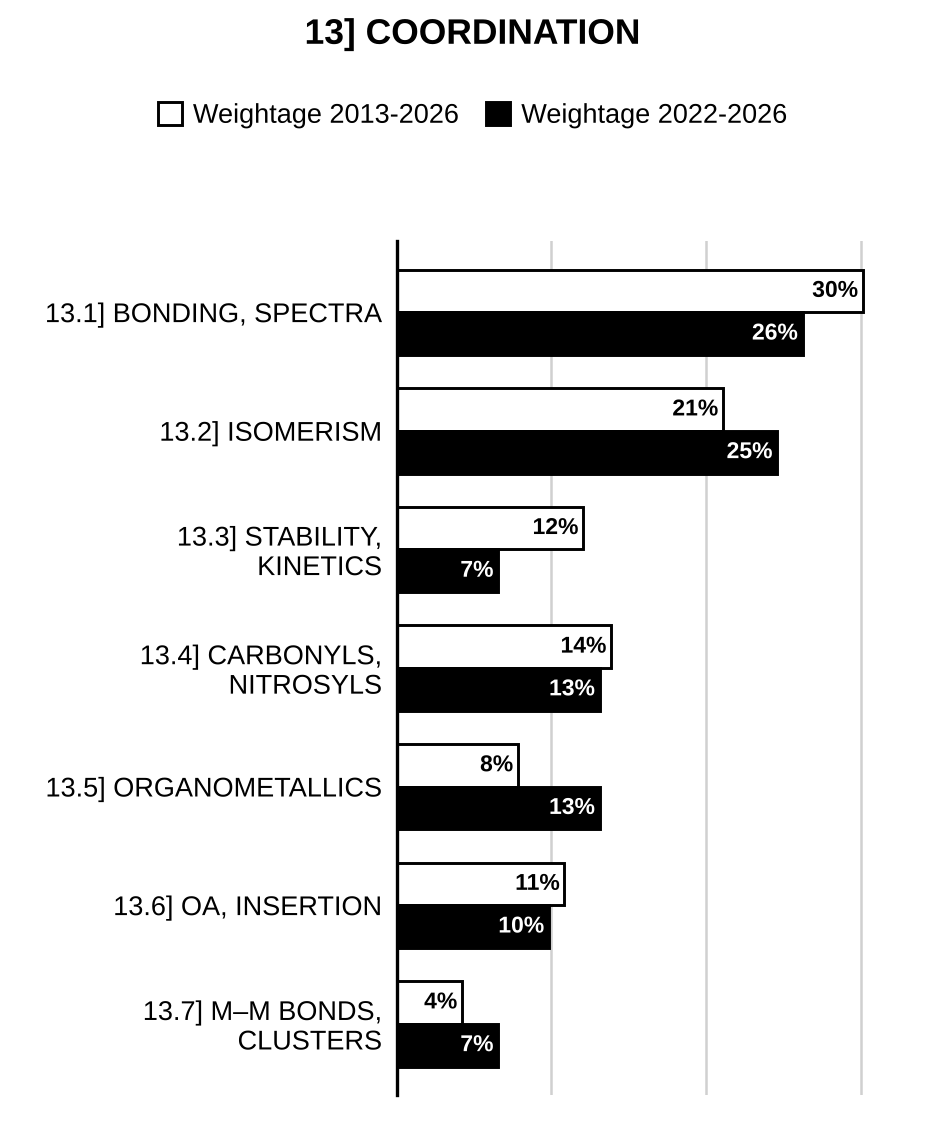
13.1] Bonding, magnetism and spectra of complexes
53 questions
Why is the electronic spectrum of pale pink, whereas the spectrum of is deep blue? Explain. [2026/10m/6b(i)]
Which complex ion has higher value of crystal field splitting energy ()? Justify your answer. (i) or (ii) or (iii) or [2025/10m/5f]
Show the splitting of ‘d’ orbitals in square planar field according to Crystal Field Theory (CFT). Comment on the following statement: ‘The difference in energy between the and orbitals in square planar field is identical to the difference between the same orbitals in the octahedral field.’ [2024/10m/7a]
On the basis of Crystal Field Theory, account for the following statement: While is paramagnetic, is diamagnetic. [2024/10m/7c(i)]
Nickel was found to be coordinated with oxygen in the UV-visible spectrum of complex ion. Predict theoretically the number of peaks and assign them to the corresponding electronic transitions. [2023/10m/7d]
Calculate the spin only magnetic moment () of the central metal atom in the following complexes: (i) (ii) (iii) (iv) [2023/10m/8b]
Aqueous solution of is bright yellow and not pale-violet like other metal ions having high-spin configuration. Discuss the origin of the colour. [2022/10m/6e]
Compare and comment on the magnetic properties of the following complexes: (i) (ii) [2022/10m/7e]
The complex is diamagnetic, but is paramagnetic and has two unpaired electrons. Explain these observations and deduce the structure of two complexes. [2020/10m/4d]
Why are d-d electronic transition forbidden? Why are they weakly absorbing and why do they occur at all? [2020/10m/4e]
In the crystal structure of , the is six-coordinated with four at a distance of 1.93 Å and two at 2.27 Å. Explain the reason(s) for this. [2020/10m/8d]
What are the limitations of crystal field theory in explaining the bonding of coordination complexes. What modifications were suggested to overcome the limitations. [2019/10m/4c(i)]
Draw, giving reasons, the d-orbital splitting in the 5 coordinate square pyramidal and trigonal bipyramidal arrangements. [2019/10m/5b]
Why tetragonal distortions occur in octahedral complexes? Illustrate it with suitable example. What will be the result of the extreme distortion to the octahedral complex? Present the d-orbital splitting scheme in this case. [2019/15m/7b]
Determine the geometry of (paramagnetic complex with two unpaired electrons) using valence bond theory. [2018/5m/6c(i)]
Using Orgel diagram, assign the absorption bands of at 8500, 13800 and 25300 in solution. Calculate the 10 Dq value. [2018/10m/6c(ii)]
Explain crystal field theory. How does it differ from valence bond theory? How does this theory account for the fact that is paramagnetic while is diamagnetic though both are octahedral. [2017/15m/8a(ii)]
Explain the pattern of splitting of d-orbitals in a square-planar ligand field. Label each energy level properly. [2016/5m/5a(i)]
Calculate the crystal-field-stabilization energy and spin-only magnetic moment of . [2016/5m/5a(ii)]
Explain crystal-field stabilization-energy. What are the factors that affect its magnitude? [2016/15m/6b]
What are low-spin and high-spin complexes? Indicate spin states of and complexes. Explain their magnetic character. [2016/15m/8a(i)]
Explain why– (i) is essentially colourless, while is highly coloured; (ii) examples of carbonylate anions are more than those of metal carbonyl cations. [2015/10m/5b]
Arrange the following ligands in order of increasing and justify your arrangement: , and [2015/5m/7c(i)]
The complex is less paramagnetic than . Explain. [2015/5m/7c(ii)]
What are the salient features and limitations of the Crystal Field Theory? Show the splitting of the ion in weak and strong fields in an octahedral environment. [2014/10m/5b]
Explain why (i) The complex exists, but does not. (ii) is more stable than , whereas is more stable than . (iii) Copper metal dissolves in HCN with evolution of hydrogen gas, but it does not dissolve in sulphuric acid. (iv) The stability constant of is higher than that of (). [2013/20m/6b]
(i) Explain what is lanthanide contraction. (ii) is coloured but is colourless. Explain. [2012/16m/8b]
Compare the 10 Dq values of the following ions with proper justification (At. No. of V, Fe and Os are 23, 26 and 76 respectively) (i) and (ii) and
Given: Constants for use: ; ; ; ; [2012/10m/8d]
Draw the shape of ‘d’ orbitals. On the basis of Crystal Field Theory explain splitting of ‘d’ orbitals in octahedral and tetrahedral fields. The splitting pattern is different in octahedral and tetrahedral fields. Why? [2011/15m/5a]
Discuss shape, hybridization, number of unpaired electrons, magnetic moment and their magnetic behaviour in the following: (i) (ii) (iii) (iv) [2011/20m/8c]
How do you explain the magnetic properties of transition metal ions, by the Crystal Field Theory? [2010/15m/5b]
Find the expression for CFSE of , and systems in weak and strong octahedral fields in terms of and (pairing energy). [2010/20m/7b]
Give reasons for the following: (i) is a square planar, while is tetrahedral. (ii) is diamagnetic, while is paramagnetic. (iii) Low-spin tetrahedral complexes are not known. (iv) is colourless, while is coloured. [2010/8m/8d]
(i) Explain the pattern of splitting of d orbitals in a square planar ligand field. (ii) Calculate the Crystal Field Stabilisation Energy and Spin-only Magnetic Moment of . [2009/20m/5c]
(i) Explain why octahedral Co(II) complexes have rather higher magnetic moment than tetrahedral Co(II) complexes. (ii) Explain the origin of the colour of permanganate. [2009/20m/7c]
“Tetrahedral complexes of 3d transition metals are always of high spin.” Justify the statement. [2008/10m/5c(i)]
Calculate the crystal field stabilisation energy and spin-only magnetic moment of . [2008/10m/5c(ii)]
“The complex is paramagnetic whereas is diamagnetic.” Justify the observations. [2008/10m/7c(i)]
Explain the origin of pale pink colour of . [2008/10m/7c(ii)]
Electronic spectra of coordination compounds cannot be explained by valence bond theory and it is essential to consider splitting in d-orbitals. Justify. [2006/20m/5b]
Draw the shapes of d-orbitals. How do these split up in the presence of octahedral and tetrahedral fields? Explain the relationship between CFSE for the two geometries. Calculate the magnetic moments of and and predict their geometry. [2006/30m/6a]
Explain crystal fields stabilization energy (CFSE). What are the various factors which affect its magnitude? Calculate CFSE and magneitc moments () in cases of and . [2005/25m/4a]
Explain the intense blue colour of aqueous permanganate solution. What happens to it when the solution is left in sunlight for a day? [2005/20m/5b]
What is meant by CFSE? Discuss CFSE in weak and strong field cases for various configurations. [2004/30m/4a]
Explain the factors that influence the stabilization of tetrahedral/octahedral co-ordination in the formation of complexes. [2004/20m/6b]
A solution of shows an absorption maximum at . With the help of crystal-field theory, predict the number of absorption bands in the visible spectrum of the above species. Give reason to support your answer. [2003/20m/5c]
values for the H.S. Fe(II) octahedral complexes are in the range of 5.1-5.7 B.M. while [?] value is only 4.90 B.M. Why? [2003/20m/7a]
What is denoted by the quantity 10 Dq? How is it measured? What are the factors that affect the magnitude of 10 Dq? [2002/20m/6a]
Show that the tetrahedral field splitting is 0.444 times the octahedral field splitting. [2001/20m/6a]
Identify the less intense band for each of the following pairs of electronic transitions and explain the reason for the difference in intensities: (i) ; and (ii) ; and [2001/20m/6b]
How many bands are expected in the electronic spectrum of and why? [2000/20m/6a]
Explain, applying crystal field theory, why is easily oxidized to [2000/20m/6b]
What is the explanation for and being tetrahedral on the basis of crystal field theory? [2000/20m/7c]
13.2] Isomerism, nomenclature and stereochemistry
28 questions
What is ionization isomerism? Mention the type of isomerism in the given pairs of complexes: (i) and (ii) and (iii) and [2026/5m/5h]
Draw the possible stereoisomers of the following complex and explain their optical activity.
[Figure: Dinuclear cobalt complex cation, overall charge 4+ (in square brackets): (en)2Co and Co(en)2 joined by two bridging ligands, NO2 (upper bridge) and NH2 (lower bridge), i.e. ] [2025/10m/7c]
Write the IUPAC nomenclature of the following complexes: (i) (ii) (iii) (iv) (v)
[Figure: (iv) drawn as [(H3N)4Co and Co(NH3)4]4+ joined by two bridges: NH2 (H2N, upper bridge) and OH (lower bridge)] [2024/10m/5c]
Identify A, B and C. What is the relationship between A and B?
[Figure: Scheme: –NaNO2→ A; A –UV ray→ B and B –Let stand or warm, HCl→ A (pair of opposite arrows between A and B); –Dilute NH3 (aqueous)→ C (downward arrow); C –NaNO2, concentrated HCl→ B] [2024/5m/7b(ii)]
Draw all possible stereoisomers for complex ion. [2023/10m/6b]
Write the IUPAC nomenclature of the following complexes: (i) (ii) (iii) (iv) (v) [2023/10m/6c]
Write IUPAC nomenclature of and . Give structure and draw their shapes with explanation. [2022/10m/5d]
Cite one example of an optically active tetracoordinated complex compound where the metal ion and donor atoms lie on a plane. Justify your answer. [2022/10m/7a]
Which one is more stable between the two isomers? Explain. [2022/10m/8a]
How many geometrical isomers and stereoisomers are possible in the coordination compounds of the type (AB–bidentate ligand)? [2021/10m/5d]
Write the name of the following complexes using the IUPAC nomenclature: (i) , (ii) , (iii) , (iv) , (v) [2020/10m/8c]
Describe any three systems of nomenclature of conformational isomers of complexes. [2019/10m/1b]
(i) Draw the structure of the following complexes: (A) bis (-benzene) chromium (O) (B) fac-triaquatris (dimethylamine) cobalt (III) tetraoxosulfate (VI) (ii) Give IUPAC nomenclature of (A) (B) [2018/10m/5c]
Draw all possible stereoisomers of . [2018/10m/8d]
Draw labelled structures of all the possible isomers of dichloro bis (ethylenediamine) cobalt (III) ion. Does a meso form exist? Give reason to support your answer. [2016/10m/5b]
Write IUPAC nomenclature of the following: (i) (ii) [2016/10m/6c]
Starting with , prepare diammine dichloro platinum (II). Name the isomer formed. Choose the relevant starting material and write all the steps to get the other geometrical isomer of the above product. [2016/10m/7c]
Discuss the geometrical and optical isomerism in octahedral complexes of the type and , where A – A and A – B are bidentate ligands. [2014/10m/6d]
(i) Does the complex have isomeric forms? If so, draw their structures and identify the type(s) of isomerization. (ii) Write the chemical (IUPAC) name of the complexes. (iii) Do the isomers have identical physical properties and chemical reactivities? [2013/15m/8a]
Draw all the stereoisomers of and comment on their optical activity. [2012/20m/8c]
(i) Complex formation is an acid-base reaction. Explain with suitable example. (ii) Draw the cis and trans structures of complex diamminedichloroplatinum(II). Which form of the complex is used in the treatment of cancer? (iii) Write a note on cytochromes. [2011/20m/6a]
Give the IUPAC names of the following complexes: (1) (2) (3) (4) (5) [2011/10m/7a(i)]
Discuss the different types of isomerism exhibited by coordination compound. Give suitable examples. [2010/20m/6c]
Write IUPAC names of the following: (i) (ii) (iii) (iv) (v) [2010/10m/7d]
(i) Write IUPAC nomenclatures of , , , . (ii) Explain the terms ‘chelate effect’ and ‘lability’ in complexes with examples. [2009/20m/8a]
Explain the possible isomerism in the following complexes: , , [2008/10m/8a(i)]
Explain ionization, coordination, linkage and optical isomerism in coordination compounds with a suitable example for each. [2006/20m/8b]
Explain with suitable examples geometrical, optical and linkage isomerisms in co-ordination compounds. [2002/20m/6b]
13.3] Stability and reaction mechanisms of complexes
22 questions
What is chelate effect? How is it affected by the ring size? [2026/5m/5f]
Complete the following reaction and explain the mechanism with the help of pi-bonding theory.
[Figure: Reaction: (Zeise’s anion; square-planar Pt with three Cl and one C2H4, drawn with Cl above, Cl to the left, Cl below and C2H4 to the right of Pt, in square brackets with charge –) + NH3 → (product to be completed)] [2025/10m/7e]
Identify and in the substitution reaction given below: Justify by explaining the kinetic trans-effect using polarization theory. [2023/10m/5e]
Describe with suitable examples the role of Chelate effect, Template effect and the entropy effect on the stability of complexes. [2019/15m/8b]
How do you prepare the above isomers starting from using the concept of trans effect? (Order of trans directing ability: )
[Figure: Two square-planar Pt(II) isomers of [PtBrCl(py)(NH3)], each drawn as a parallelogram around Pt: first isomer – Br (top left), py (top right), NH3 (bottom right), Cl (bottom left), with Br trans to NH3 and Cl trans to py; second isomer – Br (top left), NH3 (top right), py (bottom right), Cl (bottom left), with Br trans to py and Cl trans to NH3] [2018/10m/7d]
What are “labile” complexes? Outline the relationship between lability and electronic structure of a complex. Name the type of method used in the study of such complexes. [2016/10m/6a(ii)]
Starting with , prepare diammine dichloro platinum (II). Name the isomer formed. Choose the relevant starting material and write all the steps to get the other geometrical isomer of the above product. [2016/10m/7c]
Account for the following observations: (i) Although has three basic sites, it functions as a bidentate ligand when the ligand is in excess. (ii) Copper(I) iodide is a stable species, while copper(II) iodide does not exist. [2015/10m/8a]
For the complex reaction the value is 1.88. Explain the value, giving the structure of . [2015/10m/8b]
(i) Specify the basis of the Irving-Williams series and arrange the , , and ions according to this series. (ii) Specify the basis of the trans effect and arrange , , and in this sequence. [2014/10m/5a]
Explain why (i) The complex exists, but does not. (ii) is more stable than , whereas is more stable than . (iii) Copper metal dissolves in HCN with evolution of hydrogen gas, but it does not dissolve in sulphuric acid. (iv) The stability constant of is higher than that of (). [2013/20m/6b]
What is EDTA? Give its molecular structure, total number of donor atoms available in it and dentate character. Draw the molecular structure of Zn-EDTA complex. [2011/10m/7a(ii)]
(i) Write IUPAC nomenclatures of , , , . (ii) Explain the terms ‘chelate effect’ and ‘lability’ in complexes with examples. [2009/20m/8a]
“The trans-effect series has proved very useful in rationalising known synthetic procedures and in devising new ones.” Justify the statement with suitable examples. [2008/10m/8a(ii)]
What is meant by stability of a complex ion? On what factors does the stability of a complex ion depend? Explain with suitable examples. [2007/20m/8a]
Why ethylenediamine forms much stronger complexes with transition metals as compared to , even though both are N-donors? [2006/20m/1d]
What do you understand by thermodynamic and kinetic stability of complexes? Give suitable examples for each. [2006/20m/3b]
Explain ‘trans effect’ and dicuss its theories. Describe substitution in square planar complexes with sutiable examples. [2005/20m/7b]
What are chelate complexes? What are the various factors influencing the stability of chelate complexes? [2004/30m/4b]
Diammine dichloroplatinum (II) exists in two geometrical forms – one of the forms is a well-known anticancer agent. Given that the trans effect of , outline the steps of preparation of any one of the two isomers. [2003/20m/7b]
What product will be obtained if is treated in the following ways? (i) and then by (ii) and then . [2001/20m/7a]
Furnish explanation for the general inertness of square planar complexes of Pd (II) and Pt (II). [2000/20m/6c]

Preparing for Prelims too?
Our UPSC Prelims Topic-wise PYQ eBook covers every Prelims question with detailed explanations, so you can see exactly where UPSC asks from.
View the BookDownload Free Sample13.4] Metal carbonyls and nitrosyls
20 questions
What is EAN rule? Calculate the EAN value of the following: (1) (2) (3) (4) [2026/10m/6b(ii)]
The bond orders of some metal carbonyls are:
| M – C bond order | C – O bond order | |
| 1.33 | 2.64 | |
| 1.89 | 2.14 | |
| 2.16 | 1.85 |
Explain the above facts. [2024/10m/7b(i)]
Elucidate the structure(s) of . Comment on its magnetic behaviour. [2024/15m/7c(ii)]
Write IUPAC nomenclature of and . Give structure and draw their shapes with explanation. [2022/10m/5d]
In the coordination compound , one NO ligand bonds linearly while the other is bent. Explain the different modes of bonding of NO ligands in this molecule and expected M–N bond orders. [2021/20m/8c]
How is is converted into sodium nitroprusside? Write reaction of ion with sodium nitroprusside. [2017/10m/7a(ii)]
What is meant by EAN rule applied to the complexes? Apply the concept of EAN rule on the following two complexes and and draw your conclusion about the validity of the rule. [2017/10m/8a(i)]
Write the structure of . Show that each Fe atom conform to the 18 electron rule. [2016/10m/5c]
What are metal carbonyls? How is obtained by Mond’s process? Show that the molecule , has a tetrahedral structure. [2016/15m/7a(i)]
Construct the MO diagram for the CO molecule. On the basis of the diagram, state whether the bonding in metal carbonyls is of the type M—C or M—O. Explain your reasoning. You may ignore the 1s electrons. [2015/10m/1e]
Explain why– (i) is essentially colourless, while is highly coloured; (ii) examples of carbonylate anions are more than those of metal carbonyl cations. [2015/10m/5b]
Why does carbon monoxide form metal carbonyls? Give synthesis of metal carbonyls and discuss and bonding in case of . [2011/20m/8b]
Explain with the aid of suitable diagrams how CO forms sigma and pi bonds in . Apply EAN rule to . [2008/20m/8b]
Explain the structures of , , and . Show that the metal atoms in these carbonyls obey inert gas rule. [2007/20m/8c]
How metal carbonyls are synthesized? What are the characteristic features of metal-carbon bonding in carbonyls? Draw the structures of , and . [2006/25m/8a]
Explain the nature of metal-carbonyl bond in carbonyls. Draw the structures of , , and . In what respects terminal CO group is different than bridging CO in such complexes? [2005/20m/6b]
Discuss the preparation properties and uses of carbonylate anions. [2004/20m/8b]
Discuss the formation, structure and properties of metal complexes involving NO. [2002/20m/8a]
Draw the structures of the metal carbonyls given below: , , and . [2001/20m/6c]
contains metal in zero-valent state and yet it is quite stable. Why? [2000/20m/5a]
13.5] Organometallic complexes
12 questions
Why is ferrocene termed as a sandwich compound? Explain its structure. [2026/5m/5g]
Complete the following reaction and explain the mechanism with the help of pi-bonding theory.
[Figure: Reaction: (Zeise’s anion; square-planar Pt with three Cl and one C2H4, drawn with Cl above, Cl to the left, Cl below and C2H4 to the right of Pt, in square brackets with charge –) + NH3 → (product to be completed)] [2025/10m/7e]
What is Zeise’s salt? Outline its synthesis method. Describe its structure. [2024/10m/5d]
Sketch the synthesis of and complexes starting from . [2023/10m/8a]
Consider the above pairs of -donor ligands:
[Figure: Two pairs of cyclic π-ligands, each drawn as a polygon with an inscribed circle: pair (I) – cyclopentadienyl (five-membered ring) above and cyclobutadiene (four-membered ring, square) below; pair (II) – cyclopentadienyl (five-membered ring) above and benzene (six-membered ring) below]
Identify the metal ions/atom among Co(O), Mn(I), Fe(II), and Fe(III), which form neutral mixed sandwich compound. Explain. [2022/10m/6c]
Depict the structure of ferrocene and describe the bonding of it by Molecular orbital theory including orbital diagrams. [2019/10m/8c]
Explain the following properties of Ferrocene: (i) Easy electrophilic substitution of its Cp ring. (ii) Oxidation is difficult in comparison to that of cobaltocene. [2017/10m/5d]
Point out the special structural features of the following compounds: (i) (ii) (iii) (iv) [2014/10m/7a]
Discuss the stability of cyclopentadienyl complexes. Give suitable examples containing carbonyl and nitrosyl ligands. [2007/20m/6b]
What is ferrocene? Draw its structure and explain its characteristic bonding features. [2006/15m/2b]
What are metallocenes and their characteristic structural features? Discuss the structure of ferrocene with MO diagram. [2005/20m/7a]
Cyclopentadiene, molecule bonds as –, – or –. Show the various modes of bonding of this molecule giving example. [2001/20m/7c]
13.6] Organometallic reactions and fluxional molecules
10 questions
The following molecule shows the rigid or fluxional behaviour at higher temperature or in the presence of a base. Justify the answer with the help of H NMR spectrum.
[Figure: η³-allyl palladium complex: an allyl group C–C–C drawn as a delocalised (dashed) arc bonded to Pd through dashed bonds from both terminal carbons; the central carbon carries H(x); the left terminal carbon carries H_B (upper) and H_A (lower); the right terminal carbon carries H_B′ (upper) and H_A′ (lower); Pd also bears Cl and PPh3, i.e. [Pd(η³-C3H5)Cl(PPh3)]] [2025/10m/6a]
Complete the following chemical reactions and indicate the category of these reactions. Justify your answer. (i) (ii) [2025/10m/8e]
‘All the F atoms appear indistinguishable in the F NMR spectrum of hybridized molecule.’ Explain how. [2024/10m/8a]
How would you account for bonding in the following fluxional molecules based on NMR spectral studies at variable temperatures? (i) (ii) [2021/20m/7b]
Write Vaska’s catalyst with structure and show its oxidative addition with HCl and oxygen. [2017/15m/7a(i)]
What do you understand by an “oxidative addition” reaction? How does it differ from an “insertion-reaction”? Give one example in each case. [2016/10m/5d]
What are “Fluxional” molecules? How does nmr spectroscopy help the detection of fluxional character? [2016/15m/8b]
What are fluxional molecules? How are these characterized? [2006/15m/4b]
What do you understand by an oxidative addition reaction? How does it differ from an insertion reaction? Explain giving two examples of each type supported by chemical equations. [2003/20m/6b]
What are fluxional? Discuss their structural aspects with two suitable examples. [2002/20m/8b]
13.7] Metal–metal bonds and clusters
8 questions
Describe the bond order and quadruple bonding in ion. [2026/10m/6c]
(i) Calculate the number of metal-metal bond in . (ii) Determine the structural type of the metal atom cluster, . [2022/10m/6a]
Determine the number of metal-metal bond(s) in (Z = 75) using simplified MO energy level diagram. [2018/5m/8a(ii)]
Point out the special structural features of the following compounds: (i) (ii) (iii) (iv) [2014/10m/7a]
Draw the contours of the five d orbitals. Show how , and bonds are formed with metal d-orbital participation. [2014/10m/7e]
Explain the salient features of the structure of and . [2009/20m/8c]
Explain the following briefly: (i) Metal atom clusters (ii) Fuel cells (iii) BET isotherm (iv) Quantum yield. [2006/20m/3c]
Draw the structures of the metal carbonyls given below: , , and . [2001/20m/6c]

Strengthen your GS papers
Our UPSC Mains Topic-wise & Year-wise PYQ eBook (2013–2026) maps every GS question to the syllabus, so you know what UPSC asks and how often.
View the BookDownload Free Sample« Previous: Bio-Inorganic Chemistry | Next: Main Group Chemistry »
Back to: Chemistry Optional PYQs – Topic-wise
Last updated: 30 October 2026