
Here are all 85 Water Management and Irrigation questions asked in UPSC Agriculture Optional Paper I from 1995 to 2026, arranged under the 6 topics of the official syllabus. Within each topic the latest questions come first.
Each question ends with a code such as [2024/15m/3b] – the year, the marks, the word limit (where UPSC set one) and the question number in the paper.
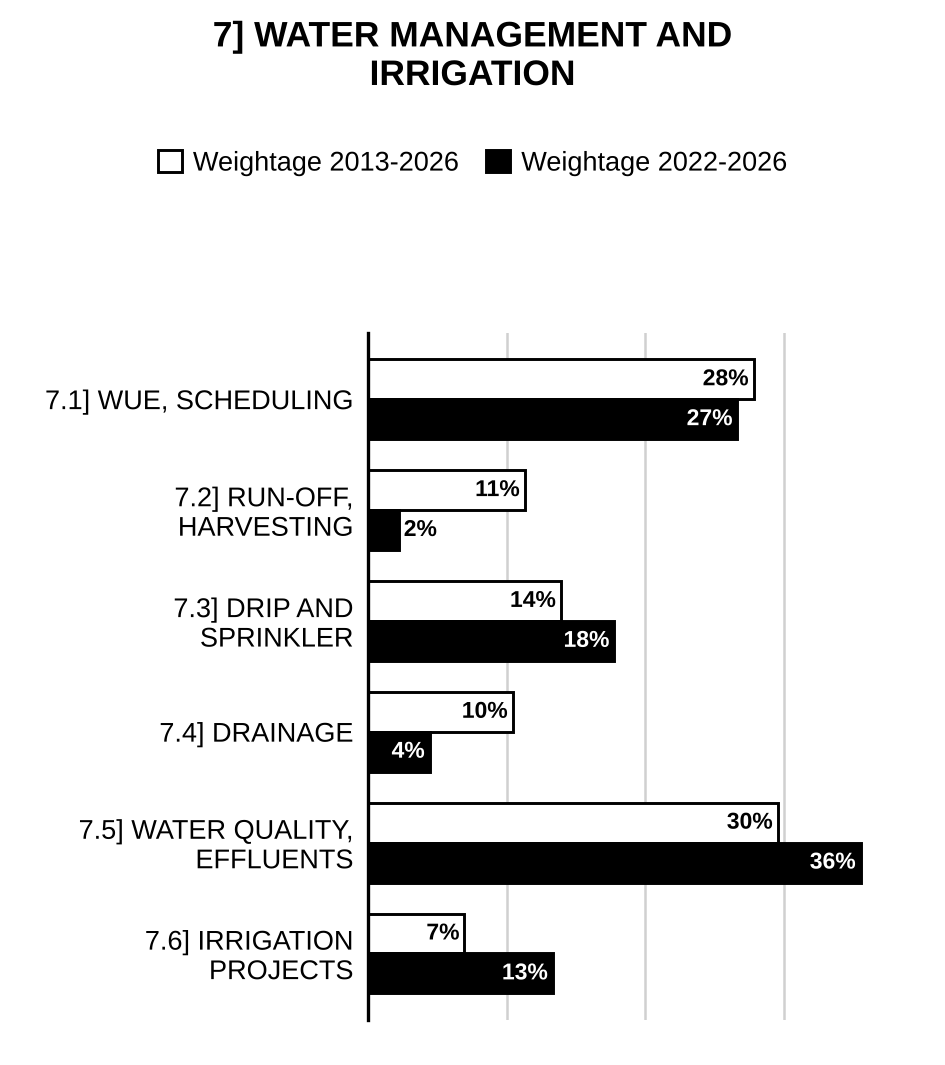
7.1] Water-use efficiency and scheduling of irrigation
30 questions
Briefly discuss the criteria for irrigation scheduling in crop plants. [2026/10m/150w/5b]
Explain the term irrigation scheduling. Elaborate the criteria IW/CPE ratio of irrigation scheduling along with its merits and demerits. [2024/10m/150w/5b]
It is proposed to give four (4) irrigations to six (6) hectare area of wheat crop. Depth of each irrigation is 60 mm, which will be given with a pump of discharge @ 5 litre/second. Find out the duration (in days) of pump operation to discharge the required quantity of water. [2024/10m/150w/5e]
Explain the term water use efficiency in relation to crop production. Discuss the role of pressurised irrigation methods to achieve the objectives of more crop per drop programme. [2024/20m/8b]
What are the major aims of irrigation? Discuss the different types of irrigation efficiencies which are used in adjudging the most efficient irrigation method. [2023/10m/150w/5b]
Discuss the various parameters of quality of irrigation water. Write irrigation scheduling for pulses cultivation in arid and semi-arid regions. [2022/20m/8a]
Define water use efficiency and water productivity. List the crops having high and low water use efficiency. [2020/10m/150w/5a]
What is scheduling of irrigation in crops? What are the important factors considered while deciding irrigation schedules for different regions and crops. [2020/20m/6a]
Precise water saving irrigation practices to enhance water use efficiency. [2018/10m/150w/1d]
Listout the approaches for scheduling of irrigation. [2018/10m/7b]
It is proposed to test the relative efficiency of scheduling irrigation to groundnut at 25%, 50% and 75% depletion of available soil moisture. Field capacity of soil in the effective root zone depth of 60 cm is 16% with a permanent wilting point of 6%. At what respective soil moisture contents, irrigations are to be scheduled with three irrigations? [2018/10m/7c]
What are different techniques used for increasing water use efficiency in relation to crop production? [2017/20m/6b]
Discuss the significance of quality of irrigation water and rain-water harvesting for crop productivity. Describe how irrigation is scheduled in the critical stage of crop growth. [2016/20m/8b]
What are the scientific irrigation scheduling criteria? What is critical stage approach for scheduling irrigation? [2013/10m/200w/2c]
What is permanent wilting point (PWP)? Describe surge-flow irrigation. [2012/15m/200w/4c]
Water distribution efficiency and Water use efficiency in agriculture. [2012/15m/7a]
Importance of available soil moisture in irrigation water management. [2011/15m/150w/5a]
Criteria of scheduling irrigation. [2011/15m/8d]
Harnessing synergy between water and nutrients for high crop productivity. [2010/15m/150w/1b]
Water Requirement and Irrigation Requirement. [2009/10m/3d]
Water-use Efficiency and Irrigation Efficiency. [2009/10m/3e]
Scheduling Irrigation. [2009/20m/200w/5a]
Scheduling irrigation. [2006/20m/200w/5b]
Potential evapotranspiration. [2005/20m/200w/1b]
What is water use efficiency? Enlist the factors affecting water use efficiency. Suggest measures to increase water use efficiency in crops. [2003/60m/8]
Discuss the criteria for scheduling irrigation in field crops. Give their merits and demerits also. [2002/60m/4]
Discuss the different approaches of scheduling irrigation in field crops. Give your opinion about the scope of: drip and sprinkler irrigation in field crops. [2001/60m/6]
Soil moisture depletion approach. [1997/20m/200w/5c]
Suggest various approaches of scheduling irrigation in field crops and select the most appropriate one with reasoning. Describe one of the approaches for scheduling irrigation in cereal crops. [1996/60m/3]
Discuss the sources of water logging and its effect on soil physical conditions. Explain the techniques of scheduling irrigation in field crops. [1995/60m/6]
7.2] Reducing run-off losses; rainwater harvesting
10 questions
Rain water harvesting and Watershed Management. [2022/10m/150w/5d]
What is irrigation potential of India and how can it be increased through rainwater harvesting? [2021/20m/6b]
Define water harvesting along with different methods of water harvesting in India. Write governmental initiatives to promote rain water harvesting. [2020/20m/4b]
Discuss the importance and method of water harvesting under different agro-ecosystems. [2018/20m/2a]
Write a note on rain water harvesting and recharge of ground water. [2014/10m/6a]
What is water harvesting? Why in modern-day agriculture is it becoming increasingly significant? [2012/12m/150w/1d]
Briefly discuss about runoff harvesting and recycling on watershed basis. [2012/15m/200w/6b]
Minimizing run-off losses of irrigation water. [2010/12m/100w/5a]
Water harvesting and run-off recycling. [2003/20m/200w/5a]
Explain the climatic and edaphic factors that form the constraints associated with dryland agriculture. Describe the measures which will help in the reduction of runoff and increase the infiltration of water in soil. [1996/60m/7]
7.3] Drip and sprinkler irrigation
15 questions
Describe the various components of the drip irrigation system with the help of a schematic diagram. [2026/10m/150w/5c]
Explain the term water use efficiency in relation to crop production. Discuss the role of pressurised irrigation methods to achieve the objectives of more crop per drop programme. [2024/20m/8b]
Discuss about Micro-Irrigation Systems and their advantages in Indian Agriculture. [2022/20m/7a]
How to improve drainage of waterlogged areas? Discuss the advantages and limitations of drip and sprinkler irrigation methods. [2021/20m/7b]
Differentiate between the followings: (i) Fertigation and Herbigation (ii) Agroforestry and Agrostology (iii) Cooperative Societies and Non-Governmental Organizations (NGOs) (iv) Dry land farming and Irrigated farming. [2020/20m/2a]
What are the components of drip irrigation system? Enumerate the benefits of drip-fertigation. [2019/10m/8c]
Fertigation vs Herbigation. [2016/10m/150w/1e]
Surface and sub-surface drip irrigation. [2011/15m/150w/1c]
Explain the fertigation giving its merits. Give suitable fertilizers of major nutrients used in fertigation through micro-irrigation. [2011/30m/2a]
Enumerate fertigation equipments along with their merits and demerits. [2011/30m/2b]
What is micro-irrigation and what are its advantages compared to conventional methods of irrigation? Describe the important micro-irrigation systems with respect to their pros and cons, the precautions in their use and the cropping situations. [2009/60m/8]
Sprinkler irrigation system. [2005/20m/200w/5d]
Discuss the different approaches of scheduling irrigation in field crops. Give your opinion about the scope of: drip and sprinkler irrigation in field crops. [2001/60m/6]
Drip Irrigation. [1999/20m/200w/1b]
Discuss systems and methods of irrigation in Indian agriculture. [1998/60m/8]

Preparing for Prelims too?
Our UPSC Prelims Topic-wise PYQ eBook covers every Prelims question with detailed explanations, so you can see exactly where UPSC asks from.
View the BookDownload Free Sample7.4] Drainage of water-logged soils
10 questions
Enunciate the reasons for waterlogging and describe various management strategies to mitigate waterlogging. [2025/20m/7b]
How to improve drainage of waterlogged areas? Discuss the advantages and limitations of drip and sprinkler irrigation methods. [2021/20m/7b]
Biodrainage and its limitations. [2019/10m/150w/5d]
Describe different measures to improve the drainage of water-logged soils to increase soil fertility and crop productivity. [2017/20m/8b]
What are various drainage systems? Discuss their benefits. [2014/10m/150w/5c]
Bio-drainage and Horizontal drainage. [2012/15m/7b]
What are the causes of water logging in our country? How are the soil and crop productivity affected by it? Suggest methods of prevention to enhance agricultural production. [2005/60m/2]
Drainage. [1998/20m/200w/5b]
Water logging. [1997/20m/200w/5a]
Discuss the sources of water logging and its effect on soil physical conditions. Explain the techniques of scheduling irrigation in field crops. [1995/60m/6]
7.5] Quality of irrigation water and industrial effluents
16 questions
On the basis of Boron content, classify irrigation water suitability for various soils and crops. [2026/10m/6a]
Categorise industrial effluents and briefly discuss their effects on soil properties. [2026/20m/6b]
Explain the term ‘conjunctive use of water’. Suggest the management practices to improve poor quality irrigation water with reference to salinity hazards. [2025/20m/7a]
Discuss the management practices for improving the crop yield potential in regions where poor quality water is available for irrigation. [2023/20m/6b]
Discuss the various parameters of quality of irrigation water. Write irrigation scheduling for pulses cultivation in arid and semi-arid regions. [2022/20m/8a]
Describe Q. Nos. 5(a), 5(c), 5(d), 5(e) and answer Q. No. 5(b) (in about 150 words each): Parameters for determination of quality of irrigation water. [2021/10m/150w/5e]
How are soil and water polluted by industrial effluents? What are the strategies to minimise this problem? [2017/20m/6a]
Discuss the significance of quality of irrigation water and rain-water harvesting for crop productivity. Describe how irrigation is scheduled in the critical stage of crop growth. [2016/20m/8b]
Explain how industrial effluents affect soil and water pollution. What measures can be taken to reduce this impact? [2016/20m/8c]
How does industrial effluent affect soil and water? Enumerate the methods of effluent management in agriculture. [2014/20m/6b]
Quality of irrigation water. [2013/10m/150w/5d]
What is water quality classification? Describe the hazards arising out of water quality. [2012/15m/200w/8d]
Principles of treatment of industrial effluent for irrigation purpose. [2011/15m/150w/5b]
Residual Sodium Carbonate (RSC) in irrigation water. [2011/15m/8b]
Management of industrial effluents in checking soil and water pollution. [2010/12m/100w/5b]
Quality of irrigation water. [2004/15m/200w/5b]
7.6] Irrigation projects in India
4 questions
Discuss the changes in irrigated area through different sources of irrigation in India since independence. Classify the irrigation projects based on cultivable command area, purpose served and financial return. [2024/20m/6b]
Discuss the efforts of the Government of India for extension, renovation and modernization of irrigation projects. [2023/10m/150w/5e]
What is irrigation potential of India and how can it be increased through rainwater harvesting? [2021/20m/6b]
Bring out the geographic status of groundwater availability in India. [2010/15m/8b]

Strengthen your GS papers
Our UPSC Mains Topic-wise & Year-wise PYQ eBook (2013–2026) maps every GS question to the syllabus, so you know what UPSC asks and how often.
View the BookDownload Free Sample« Previous: Soil and Water Conservation and Dryland Agriculture | Next: Farm Management and Agricultural Economics »
Back to: Agriculture Optional PYQs – Topic-wise
Last updated: 30 October 2026