
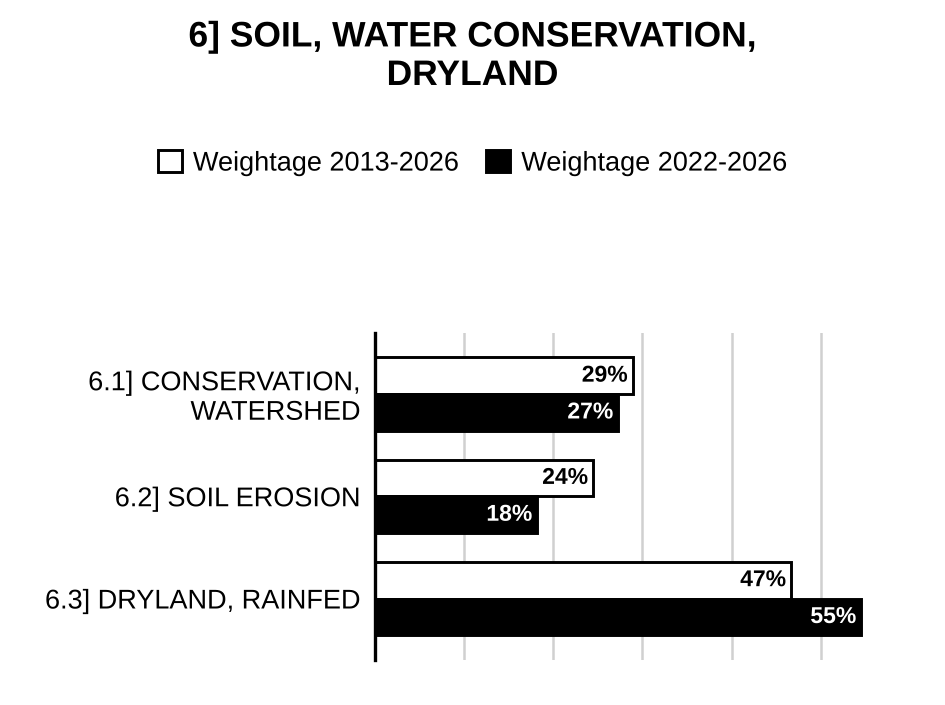
Here are all 67 Soil and Water Conservation and Dryland Agriculture questions asked in UPSC Agriculture Optional Paper I from 1995 to 2026, arranged under the 3 topics of the official syllabus. Within each topic the latest questions come first.
Each question ends with a code such as [2024/15m/3b] – the year, the marks, the word limit (where UPSC set one) and the question number in the paper.
6.1] Soil conservation and integrated watershed management
22 questions
How can GIS be utilised for land use analysis and micro-watershed planning? [2026/10m/2c]
Write down the approaches for soil conservation. [2026/10m/150w/5a]
Write down the practices involved in ‘Integrated Watershed Management’ for improving livelihood security. [2026/10m/7c]
Write down the principles involved in Integrated Watershed Management. Briefly discuss the relevance of Integrated Watershed Management under climate change scenario. [2024/10m/150w/5a]
Discuss the role of integrated watershed management in rainfed agriculture. [2023/10m/7c]
Contour bunding and Graded bunding. [2022/10m/150w/5c]
Rain water harvesting and Watershed Management. [2022/10m/150w/5d]
Give an elaborate account of agronomic measures of watershed management. [2019/20m/7a]
What do you mean by integrated watershed management and what is its significance in dryland agriculture? [2017/20m/8a]
Explain various soil conservation methods and integrated watershed management approach. What is soil erosion? Discuss the methods of managing soil erosion. [2016/20m/7b]
Why is watershed management important in dryland agriculture? [2015/10m/150w/1a]
Watershed management. [2013/10m/150w/6a]
What do you understand by degraded land? Discuss the strategies for rehabilitation of such land. [2012/15m/200w/2c]
Explain integrated watershed management as a hydrological unit. Describe the principles and objectives of watershed management. Describe the benefits and causes of deterioration of watershed. [2011/30m/6a]
Describe the principles and limitations of dryland farming. Suggest suitable technologies based on watershed management to enhance crop production under such conditions. [2006/60m/2]
Watershed management. [2004/15m/200w/5a]
What do you mean by water and wind erosion? Write the mechanism and factors affecting them. Suggest measures for soil and water conservation. [2004/60m/7]
Differentiate dryland agriculture from rainfed agriculture. Suggest soil and water conservation measures and management practices to improve productivity in dryland areas. [2003/60m/7]
Write the role of dryland agriculture and its problems. Briefly describe the suitable technologies for increasing and stabilising agricultural production from such areas on watershed basis. [2002/60m/8]
Contour farming. [1998/20m/200w/5a]
Watershed management. [1997/20m/200w/5b]
What do you understand by soil and water conservation? Describe the situations under which these are considered essential. Suggest suitable soil and water conservation practices under levelled field conditions. [1996/60m/6]

Preparing for Prelims too?
Our UPSC Prelims Topic-wise PYQ eBook covers every Prelims question with detailed explanations, so you can see exactly where UPSC asks from.
View the BookDownload Free Sample6.2] Soil erosion and its management
16 questions
Briefly discuss the measures to control soil erosion by wind. [2026/10m/8c]
Explain saltation, surface creep and suspension with reference to wind erosion. [2025/10m/150w/5a]
Briefly discuss the factors affecting soil erosion. Write down the agronomic measures for soil conservation. [2024/10m/8c]
Discuss the ways and means of minimising erosion for conserving soil. [2023/10m/150w/5a]
Define soil erosion and its different forms. Explain agronomic and mechanical measures to reduce the adverse effects of soil erosion in crop production. [2021/20m/6a]
Agronomic manipulation for preventing soil erosion. [2019/10m/150w/5b]
Soil erosion and its management. [2017/10m/150w/5b]
Explain various soil conservation methods and integrated watershed management approach. What is soil erosion? Discuss the methods of managing soil erosion. [2016/20m/7b]
How is soil erosion caused? [2015/10m/150w/1b]
Enumerate the factors influencing soil erosion. Classify and discuss briefly various types of erosion. [2013/10m/200w/2a]
Describe the factors responsible for soil erosion and agronomic measures to control it. [2012/15m/200w/6a]
Sheet erosion and rill erosion. [2011/10m/3a]
Accelerated erosion. [2006/20m/200w/5a]
What do you mean by water and wind erosion? Write the mechanism and factors affecting them. Suggest measures for soil and water conservation. [2004/60m/7]
Wind Erosion. [2002/20m/200w/5d]
What is water erosion? Write its mechanism, soil loss equation and control measures. [2000/60m/8]
6.3] Dryland agriculture and rainfed areas
29 questions
Briefly discuss the problems associated with dryland agriculture in India. What are the ways to increase production and productivity in dryland areas? [2026/20m/6c]
Write down the agronomic measures for climate-resilient crop production in rainfed areas. [2025/20m/2b]
Discuss different in situ moisture conservation practices recommended in dryland areas. [2025/10m/3c]
Discuss the sensitive stages for drought and high temperature in cereals and pulses. [2025/10m/150w/5b]
Present a brief note on the types of mulches and their role in soil moisture conservation. [2025/10m/6c]
Briefly discuss the crop management practices for stabilising yield in dryland areas. Enlist the crops with their characteristics suitable for dryland agriculture. [2024/20m/6a]
Elaborate on the various problems encountered in agricultural production at dryland areas of Bundelkhand region of Uttar Pradesh and Deccan Plateau of Andhra Pradesh. Also explain the probable solutions to minimise the problems. [2023/20m/6a]
Narrate various components of contingent crop planning in dry land agriculture. [2022/20m/6b]
Describe Q. Nos. 5(a), 5(c), 5(d), 5(e) and answer Q. No. 5(b) (in about 150 words each): Technologies and policies for sustained crop production in rainfed agriculture. [2021/10m/150w/5a]
What is contingent crop planning? How it helps in dry land agriculture? [2020/10m/3c]
Contingency planning in dryland/rainfed agriculture. [2018/10m/150w/1b]
Problems of dryland agriculture. [2017/10m/150w/5a]
Differentiate between rainfed and irrigated agriculture. List out the major problems of rainfed agriculture. Describe the various soil moisture conservation measures to boost crop production in rainfed farming. [2016/20m/6a]
Write the concept of soil moisture constraints. Write the role and availability of moisture to plants. [2015/15m/6b]
Describe the management of paddy-wheat cropping system having forecast of poor rain. [2014/10m/150w/1c]
How to increase water absorption and retention capacity of soil? [2014/10m/7c]
Briefly discuss about soil management under water stress condition. [2012/15m/200w/4d]
Conservation furrow. [2012/12m/150w/5c]
In the context of Integrated Farming System (IFS), describe feasible enterprise diversification for dryland areas with special reference to small landholdings. [2010/30m/3a]
What are the various water conservation practices that can be used in rainfed agriculture? [2010/20m/8a]
Mulching and Cover Crops. [2009/20m/200w/1d]
Describe the principles and limitations of dryland farming. Suggest suitable technologies based on watershed management to enhance crop production under such conditions. [2006/60m/2]
Differentiate dryland agriculture from rainfed agriculture. Suggest soil and water conservation measures and management practices to improve productivity in dryland areas. [2003/60m/7]
Write the role of dryland agriculture and its problems. Briefly describe the suitable technologies for increasing and stabilising agricultural production from such areas on watershed basis. [2002/60m/8]
Agro-techniques for stabilising crop production in rainfed conditions. [2001/20m/200w/5a]
Technology for Dry Land Agriculture. [1999/20m/200w/5d]
Define dryland agriculture. Discuss the agro-techniques for stabilizing production under such condition. [1997/60m/6]
Explain the climatic and edaphic factors that form the constraints associated with dryland agriculture. Describe the measures which will help in the reduction of runoff and increase the infiltration of water in soil. [1996/60m/7]
Describe the technological changes required for stability of crop production under rainfed agriculture. Also explain measures to be adopted to achieve the food production by 2000 A.D. [1995/60m/7]

Strengthen your GS papers
Our UPSC Mains Topic-wise & Year-wise PYQ eBook (2013–2026) maps every GS question to the syllabus, so you know what UPSC asks and how often.
View the BookDownload Free Sample« Previous: Soils and Soil Fertility | Next: Water Management and Irrigation »
Back to: Agriculture Optional PYQs – Topic-wise
Last updated: 30 October 2026