
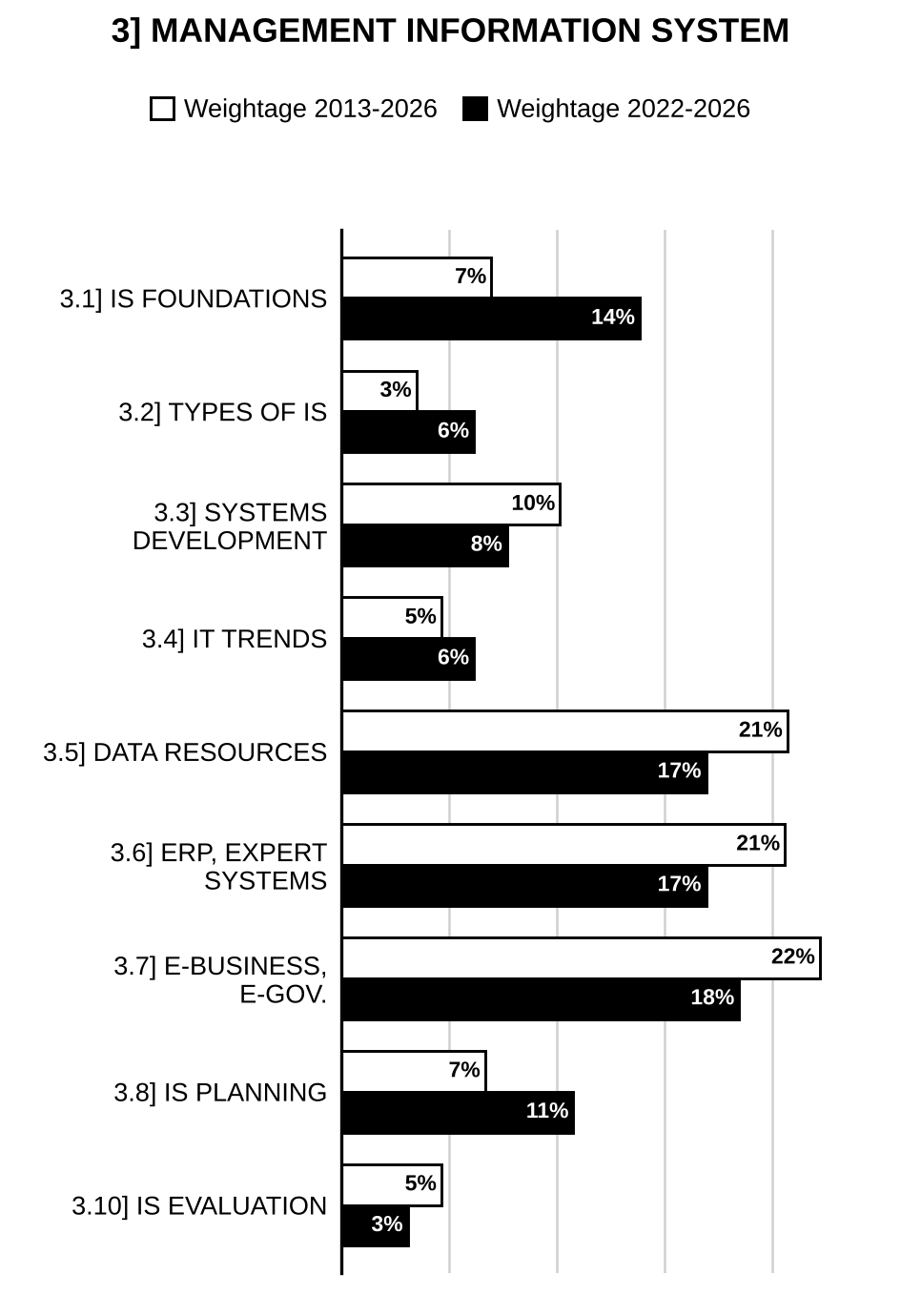
Here are all 111 Management Information System questions asked in UPSC Management Optional Paper II from 1995 to 2026, arranged under the 9 topics of the official syllabus. Within each topic the latest questions come first.
Each question ends with a code such as [2024/15m/3b] – the year, the marks, the word limit (where UPSC set one) and the question number in the paper.
3.1] Conceptual foundations of information systems
11 questions
“Information Resource Management is a strategic plan of an organisation.” Elaborate. [2025/10m/4b(i)]
What are the important components that must be considered for implementation of Information Resource Management. [2025/5m/4b(ii)]
Explain the fundamental role of Information Systems in business and organisations. [2025/5m/4c(i)]
What do you mean by Information Resource Management? State its features. [2023/10m/1b]
What exactly is an information system? How does it work? What are its management, organization and technological components? [2022/15m/4a]
Discuss the special characteristics of information as an important resource and show by means of a block diagram how information is processed in an order processing department in a fairly large organisation. [2016/10m/1e]
Enumerate the objectives and importance of MIS in business and industry. State its advantages and limitations. [2014/5m/1e(i)]
‘Data is used by clerks. Managers depend on their intuitive judgement.’ [2010/10m/5a]
How do you justify the statement, Conventional role of Management Information System as standard information reporting system has changed to real time information support system? Give the components of emerging MIS in the contemporary environment. [2006/60m/7]
Examine the advantages of Management Information System for a service organisation. What are the functions in which it differs from the Management Information System application in manufacturing organisation? [2001/60m/8]
Before the invention of Computers, the Business Houses were operating on the basis of Manual Reporting System (MRS), as their Management Information System (MIS). Today, we have Computerised Management Information System (CMIS). Comment and compare, the applicability and utility of these two systems in Indian Industrial Scene. [1996/60m/4]
3.2] Types of information systems
6 questions
Explain the salient features of information system. Describe its various types with suitable examples. [2026/10m/150w/1e]
(i) Define ERP. (ii) Discuss the various types of Information Systems. (iii) Define Expert System. State its common characteristics. [2023/20m/4c]
“Decision Support System (DSS) and Management Information System (MIS) are very helpful for managers in taking decisions.” Comment and support your answer. [2021/5m/2b(i)]
How can DSS be differentiated from MIS? [2021/5m/2b(ii)]
Why are information systems so essential for running and managing business today? Explain how Management Information System (MIS) differs from Transaction Processing System (TPS) and Decision Support System (DSS). [2012/12m/150w/1e]
Information System and DSS. [2004/20m/200w/5b]
3.3] Systems development
11 questions
Describe System Development Life Cycle (SDLC). Critically evaluate its applicability in large-scale Government IT Projects with suitable examples. [2026/15m/2c]
Discuss in brief system development management life cycle in the context of Management Information System. [2024/10m/1c]
What is System Development Life Cycle (SDLC)? Describe in detail the different phases of SDLC and the duties and functions involved in each stage. Compare the strengths and weaknesses of SDLC. [2019/20m/4c]
Discuss the need and method of ‘Rapid Application Development (RAD)’. How does it differ from the traditional ‘System Development Life Cycle (SDLC)’? [2017/10m/1d]
Explain Waterfall approach to system development life cycle (SDLC). Discuss its strengths and weaknesses. [2016/5m/2b(ii)]
You are invited as an MIS consultant to a major chain of bakeries in Bangalore. The bakery chain has a major manufacturing centre at the heart of the city and 78 exclusive franchise outlets in a 20 km radius. The outlets have no baking facility but have heating as well as refrigeration facilities. All items are supplied from the central store (attached to the central manufacturing facility) through delivery vans. The frequency depends on the usage pattern at the outlets. The items, numbering around 1500 (not all in all outlets), includes pastries, biscuits, light refreshments, frozen cutlets etc. The quality control department of bakery has an ageing schedule for each item. This could vary from 6 months for biscuits to a day for Gulab Jamun. The chain participants will destroy the items once the time is elapsed and loss is shared on 30-70 basis between bakery and the outlet. In rare instances the bakery used to transfer the items between the stores. The current information system of the company is simple. The outlets call up between 9 and 10 am to give orders. The company, if feasible, will deliver the items on the same day. If not backlogged and serviced on some future day. This is creating problems for the outlets. Many are not able to get connection with bakery over phone on time. Even those who placed the orders, could not get in time. This has resulted in overstating the demand and large amount of wastage. Even though contract forbids the outlets from having some other products, the managers are discreetly selling other products (mainly unbranded similar looking products from local producers). As commission from the bakery is large, the major reason (according to managers) for this unethical practice is lack of availability. Do you think a structured MIS can be of any help? Prepare a proposal for developing an MIS for the bakery chain. State your assumptions. Identify the work system(s) and clearly define the processes. Conduct a detailed analysis to make process (work system) modifications (if needed). [2015/20m/2b]
(i) Why are micro-payments so important for the future of e-commerce? Explain why traditional payment systems are inadequate for e-commerce. (ii) What are the phases of the system development life cycle (SDLC)? Explain the duties and functions involved in each stage. State in detail the role of system analyst in the system development. [2014/15m/3c]
In general, what do you understand by information architecture? What are the well known types of information architecture? [2012/13m/200w/3c]
You have completed the task of system development for a business firm of your choice. Discuss the model you adopted, define system objectives, draw document flow chart and system flow chart, define the input and output document, and how they are processed. [2007/60m/7]
Present an overview of Systems and Design and explain some important tools which have been used for system development. [2003/60m/7]
Essential features of systems analysis. [2002/20m/200w/5b]
3.4] Trends in information technology
8 questions
Discuss in brief the new information technology trends that will change the way of industry workings. [2024/15m/4a]
Critically analyse the impact of technological advancements such as Artificial Intelligence and Block-Chain on International Business Operations and Supply Chain Management. How can companies leverage these technologies to gain a competitive advantage? [2023/10m/5c]
A new software which has been designed for providing e-business solutions can be sold both as a product and also as a service. Consider two examples of software as product and service and discuss the pricing and promotional strategy for the same. [2018/10m/1c]
In this age of rapid technological change and IT enabled business processes, in what ways are the organisational elements such as organisational structures, business processes and work flows getting affected? Discuss. [2017/10m/1e]
Trends in Information Technology. [2007/20m/200w/5b]
Future trends in Information Technology. [2003/20m/200w/5b]
Information Technology Revolution. [2001/20m/5d]
Changing trends in Information Technology. [2001/20m/200w/5b]

Preparing for Prelims too?
Our UPSC Prelims Topic-wise PYQ eBook covers every Prelims question with detailed explanations, so you can see exactly where UPSC asks from.
View the BookDownload Free Sample3.5] Managing data resources
22 questions
What do you mean by managing data resource? Outline the advantages of a Database Management Approach to manage the Data Resource of Business compared with a File Processing Approach. [2026/20m/3c]
Discuss briefly DSS and RDMS, and make their comparisons. [2024/20m/4c]
(i) Define DSS. (ii) State the main characteristics of DSS. (iii) State the components of DSS. [2023/15m/4b]
What are the components of DSS? [2021/5m/2b(iii)]
What are the similarities and dissimilarities between data-driven and document-driven DSS? [2021/5m/2b(iv)]
When is a database known as a relational database model? What are tables and fields in a Relational Database Management System (RDBMS)? What is a primary key? What is a unique key? What is a foreign key? What is a join? Explain each type of join. [2020/15m/3c]
What is Decision Support System (DSS)? Describe the different methods of classification of DSS applications and state their components. [2019/10m/1c]
Indian Railways, the world’s largest railway, had introduced the Computerised Reservation System (CRS) in one location Delhi in 1986. Presently over 750 locations all over the country have CRS terminals and 97% of the reservations are done through this system. With increase in data load, the Indian Railways adopted a decentralised database system approach with the data spread over multiple mainframe computers installed at various places in the country. Later, Indian Railway Catering and Tourism Corporation (IRCTC) introduced web-based ticketing through its web site http://www.irctc.co.in which links to the CRS at the back end for transactions.
(i) What is data integration? How crucial is data integration for the Indian Railways CRS? [2017/7m/3a(i)]
(ii) How do we manage data integrity and data redundancy in a distributed data system like the Indian Railways CRS? [2017/7m/3a(ii)]
(iii) What aspects would be critical to the successful running of such a big but distributed database system? [2017/6m/3a(iii)]
What is meant by Database Normalization? Describe 1NF, 2NF and 3NF. [2016/6m/3c(ii)]
Explain the key difference between DBMS and RDBMS. Name the software products which are both DBMS and RDBMS compliant. [2016/10m/4c(i)]
Vanguard’s decision support system software is used by thousands of companies for enterprise decision analysis. The software makes it possible to apply decision analysis techniques throughout an organization to problems ranging from simple projects to enterprise-wide strategic plans. The Vanguard Sys. is a comprehensive business solution for improving the quality, reliability, and speed of management decisions. It does this by helping collaborate with colleagues on important plans, analyze alternatives using state-of-the-art modeling and simulation techniques, automate routine decisions using expert system technology, and improve overall management effectiveness by adding structure to a normally chaotic process. Vanguard’s collaboration abilities go well beyond simple communication strategies like Web conferencing. Rather, Vanguard is based on principles of knowledge capture. The Vanguard Sys. can combine the knowledge captured by many individuals to create a Collective Intelligence that is useful for testing business plans and automating routine operations. Vanguard combines all of the most powerful and essential quantitative methods in management with features of spreadsheets, artificial intelligence tools, and math applications to produce an advanced business modeling system. Vanguard improves the speed, reliability, and quality of routine decisions by combining its business modeling capabilities with Expert System technology. Vanguard has the potential to transform business by improving management team decisions rather than simply analyzing operational data. Vanguard supports a wide variety of methods for integrating data and it can connect to virtually any business system, e.g. Support for Customizable Functions, etc. (i) Identify the main capabilities of the DSS software from the narrative. (ii) Why should DSS support data integration as mentioned? (iii) The Vanguard Sys. has been dubbed also as a KMS and an Expert System. Why do you think a DSS should also be a KMS? An Expert System? [2015/15m/4a]
What is meant by DSS in context to business and management decision-making? Explain with an example that you are aware. State ten characteristics and capabilities of DSS. [2014/5m/2c(i)]
(i) What is information system planning? Describe Nolan’s six-stage model for IS planning. State the advantages and disadvantages of the model. (ii) Suppose we wish to implement a transaction processing system that maintains ACID properties even in the presence of crashes. In the event of a crash, any information stored on disk can be retrieved but any data stored in memory will be lost. Describe one serious shortcoming of each of the following implementations: (1) The database is updated on disk on each transaction. (2) The database is kept in memory and on disk, with the copy on disk updated every fifty transactions. (3) The database is kept in memory. A log file is maintained on disk recording every transaction. [2014/15m/4c]
An antiseptic mouthwash is one of the major products of WL Company. Materials collected from eucalyptus farms are shipped to WL’s manufacturing plants. The mouthwash is purchased by thousands of retail stores, some of them are giants like Walmart and many are small. The manufacturing plant must forecast the overall demand to avoid high inventories or shortages. WL decided to use Demand Planning Decision Support System (DSS) from a well-known vendor of IT software. Used with other products in the vendor’s Supply Chain Planning Suite, the system analyzes manufacturing, distribution and sales data against expected demand and business climate information to help WL decide how much mouthwash (and other products) to produce and distribute and how much each raw ingredient is needed. For example, the model anticipates the impact of promotions or of a production line being down. The sales and marketing people at WL meet monthly with employees in finance, procurement and other departments. The groups enter the expected demand for mouthwash into a Capacity Planning DSS supplied by another firm. The system schedules the production of mouthwash in amounts needed and generates electronic purchase orders for WL’s suppliers. The innovative Collaborative Planning, Forecasting and Replenishment system (CPFR) program launched a few years ago has led to supply chain excellence at WL. During CPFR pilot, WL increased its products’ shelf fill rate–the extent to which a store’s shelves are fully stocked–from 87% to 98%, earning the company about US $ 8 million a year in additional sales or equivalent of a new product launch. Later WL decided to use Internet to expand the CPFR program to all its suppliers and retail partners. (i) How are Supply Chain Management (SCM) and Enterprise DSS related? (ii) In WL case, how do Demand Planning DSS, Capacity Planning DSS and CPFR result in supply chain excellence? (iii) How is second generation ERP different from first generation ERP? (iv) Can first generation ERP help achieve supply chain excellence? Can second generation ERP help do this? [2013/20m/4a]
Design a model for banking application. Banks have customers. Banks are identified by a code, name and address of the main branch. Customers are identified by cust_id, name, address and phone number. A customer can have one or more bank accounts. Accounts are identified by an account number, account type (savings or current) and a balance. Customers can avail loans. Loans are identified by loan_id, loan_type (home, car, personal) and an amount. Banks have branches. Branches are identified by Branch_ID, Branch_Name, Address. Accounts and loan are related to branches. (i) Identify the entities. (ii) Find the relationship among the entities. (iii) Show the cardinality ratio of the relationship. (iv) Identify the key attributes and other attributes of each entity. (v) Write relational scheme for branch and bank. [2013/15m/4b]
(i) Name three principal methods of creating database. Describe any two methods in detail. (ii) What are the key differences between traditional commerce and e-commerce? (iii) Explain the required features of a B2B platform for e-commerce. [2013/15m/4c]
What is the problem with the original information system for tracking the quality of parts? [2012/12m/200w/3a]
How did the company improve the quality of its vehicles with the improved information system? [2012/15m/200w/3b]
What are the major capabilities of Data Base Management System (DBMS)? Why is a relational DBMS so powerful? What are the principal technologies for accessing information from databases to improve business performance and decision making? [2012/12m/150w/5d]
‘Data warehouses are used to store historical data for audit purposes.’ [2010/10m/5b]
Models of database. [2006/20m/200w/5b]
Decision Support Systems (DSS) [2003/20m/200w/5c]
3.6] ERP and expert systems
19 questions
“Expert Systems play a significant role in Organisations.” Discuss it giving at least four benefits of Expert Systems. [2025/10m/4a(i)]
Elaborate the different components of Expert Systems giving suitable examples. [2025/10m/4a(ii)]
Discuss briefly the advantages and disadvantages of ERP system. [2024/15m/4b]
(i) Define ERP. (ii) Discuss the various types of Information Systems. (iii) Define Expert System. State its common characteristics. [2023/20m/4c]
Define ‘knowledge-based expert system’. Briefly discuss its major applications in business. [2022/10m/1b]
Why is ERP important to a company? [2021/4m/4c(i)]
Explain the economic aspects of ERP implementation and the hidden cost therein. [2021/5m/4c(ii)]
Discuss in detail any three ERP implementation strategies. [2021/6m/4c(iii)]
What is the main purpose of an expert system? What are its advantages and disadvantages? Explain its architecture. [2020/10m/1c]
What have been the contributions of expert systems with respect to management of COVID-19 pandemic? [2020/10m/1d]
What is Enterprise Resource Planning (ERP)? What are the differences between an ERP system and multiple software applications? What are the differences between Material Requirements Planning (MRP I) and Manufacturing Resource Planning (MRP II)? [2020/20m/4a]
What is Enterprise Resource Planning? Describe the different functional areas of it. What are the advantages and disadvantages of using ERP? [2019/15m/4a]
What is the difference between data and information? Introduce the key concept of Enterprise Resource Planning (ERP) and how ERP can help in managing organisational resources and operational planning. If you have to implement ERP in your organisation, what will be the key considerations for deciding on the system? [2018/15m/4b]
“ERP systems are usually based on best management practices.” Comment on the practical implications of this statement. [2017/15m/4c]
Vanguard’s decision support system software is used by thousands of companies for enterprise decision analysis. The software makes it possible to apply decision analysis techniques throughout an organization to problems ranging from simple projects to enterprise-wide strategic plans. The Vanguard Sys. is a comprehensive business solution for improving the quality, reliability, and speed of management decisions. It does this by helping collaborate with colleagues on important plans, analyze alternatives using state-of-the-art modeling and simulation techniques, automate routine decisions using expert system technology, and improve overall management effectiveness by adding structure to a normally chaotic process. Vanguard’s collaboration abilities go well beyond simple communication strategies like Web conferencing. Rather, Vanguard is based on principles of knowledge capture. The Vanguard Sys. can combine the knowledge captured by many individuals to create a Collective Intelligence that is useful for testing business plans and automating routine operations. Vanguard combines all of the most powerful and essential quantitative methods in management with features of spreadsheets, artificial intelligence tools, and math applications to produce an advanced business modeling system. Vanguard improves the speed, reliability, and quality of routine decisions by combining its business modeling capabilities with Expert System technology. Vanguard has the potential to transform business by improving management team decisions rather than simply analyzing operational data. Vanguard supports a wide variety of methods for integrating data and it can connect to virtually any business system, e.g. Support for Customizable Functions, etc. (i) Identify the main capabilities of the DSS software from the narrative. (ii) Why should DSS support data integration as mentioned? (iii) The Vanguard Sys. has been dubbed also as a KMS and an Expert System. Why do you think a DSS should also be a KMS? An Expert System? [2015/15m/4a]
What is an expert system (ES)? Describe the advantages and limitations of ES. [2014/5m/1e(ii)]
Highlight the major functions of ERP system. State five factors, which are driving ERP adoption by small and medium enterprises. [2014/10m/2c(ii)]
An antiseptic mouthwash is one of the major products of WL Company. Materials collected from eucalyptus farms are shipped to WL’s manufacturing plants. The mouthwash is purchased by thousands of retail stores, some of them are giants like Walmart and many are small. The manufacturing plant must forecast the overall demand to avoid high inventories or shortages. WL decided to use Demand Planning Decision Support System (DSS) from a well-known vendor of IT software. Used with other products in the vendor’s Supply Chain Planning Suite, the system analyzes manufacturing, distribution and sales data against expected demand and business climate information to help WL decide how much mouthwash (and other products) to produce and distribute and how much each raw ingredient is needed. For example, the model anticipates the impact of promotions or of a production line being down. The sales and marketing people at WL meet monthly with employees in finance, procurement and other departments. The groups enter the expected demand for mouthwash into a Capacity Planning DSS supplied by another firm. The system schedules the production of mouthwash in amounts needed and generates electronic purchase orders for WL’s suppliers. The innovative Collaborative Planning, Forecasting and Replenishment system (CPFR) program launched a few years ago has led to supply chain excellence at WL. During CPFR pilot, WL increased its products’ shelf fill rate–the extent to which a store’s shelves are fully stocked–from 87% to 98%, earning the company about US $ 8 million a year in additional sales or equivalent of a new product launch. Later WL decided to use Internet to expand the CPFR program to all its suppliers and retail partners. (i) How are Supply Chain Management (SCM) and Enterprise DSS related? (ii) In WL case, how do Demand Planning DSS, Capacity Planning DSS and CPFR result in supply chain excellence? (iii) How is second generation ERP different from first generation ERP? (iv) Can first generation ERP help achieve supply chain excellence? Can second generation ERP help do this? [2013/20m/4a]
How do supply chain management (SCM) systems and customer relationship management (CRM) systems help integrate suppliers and customers better? [2012/20m/200w/3d]
3.7] e-Business architecture and e-Governance
22 questions
Critically analyse the advantages of E Governance for Government, Public and Business giving suitable examples. [2025/10m/1e]
Elucidate the conceptual framework of e-business. Identify the significant changes it has brought to business processes. [2025/10m/5e]
What is e-business? Discuss the dependance of e-business on Internet, Intranet and Extranet to implement and to manage innovative e-business application. [2024/10m/1d]
(i) Define e-Governance. (ii) State the advantages of e-Governance. (iii) State the e-Governance initiatives. [2023/15m/4a]
Define and discuss the unique features of e-commerce, digital markets and digital goods. [2022/15m/4b]
What is e-business architecture? Which technological innovations have had a major impact on it? [2021/5m/3a(i)]
Describe the four pillars of e-governance and the various types of interactions performed in e-governance. [2021/5m/3a(ii)]
Discuss the Indian Government’s efforts and actions towards implementing e-governance. [2021/5m/3a(iii)]
What is the difference between e-government and e-governance? Do you think, across the world, countries have achieved satisfaction in e-government? [2020/15m/2b]
What are the nine pillars of Digital India? Explain. How are these going to help in achieving the objectives of Digital India? Discuss. [2018/15m/3b]
ITC had come up with a web-based initiative called e-choupal which offers the farmers information about products and services they can use to enhance farm productivity, improve price realisation and reduce transaction costs. Farmers can access local and global information on scientific farming practices, weather forecasts as well as market prices, all in Hindi at the village choupal. e-choupal also facilitates supply of farm inputs and purchase of commodities at their doorsteps. In order to overcome the constraints at the village level, this model is designed to provide service support through a lead farmer designated as e-choupal coordinator who acts as the interface between the computer system and the farmers.
(i) How is e-choupal different from other agri-based portals? [2017/5m/2c(i)]
(ii) What technological aspects should be considered while designing such a web-based system? [2017/5m/2c(ii)]
(iii) What factors would be critical to the success of such a venture? Discuss their role. [2017/5m/2c(iii)]
Discuss the merits and demerits of online payment systems and the legal and ethical issues of online business. [2016/5m/1d(ii)]
Discuss the use of M-commerce to achieve competitive advantage for an organisation in the context of web-based marketing. Also discuss the limitations of E-commerce. [2016/10m/3b(i)]
Discuss some of the important pre-requisites for successful e-governance. Explain how can e-government improve citizen participation in public affairs. [2016/6m/3c(iii)]
Describe the value chain of e-commerce and the procedures for implementing e-commerce. How would you start performing the industry analysis for a small business that wants to launch an e-commerce project? Explain. [2016/10m/4c(ii)]
Company A is a leader in creating online auctions for buyers of industrial parts, raw materials, commodities, and service around the globe. The company has created auctions for goods and services for hundreds of industrial product categories. It auctions more than Rs. 500 crores worth of purchase orders a year and saves buyers an estimated 2 to 25% of total expenses. The company operates two types of market places. First the company helps the customers purchase goods and services through its global B2B market place where reverse auctions usually take place. Second, the company helps companies improve their asset recovery results by getting timely market prices for surplus assets through the company’s Asset Exchange, employing a forward auction process, as well as other selling models. The company’s Onsite Auctions include: (1) asset disposal recovery and (2) sourcing (e-procurement) functions. These functions provide: Assets disposal analysis; Detailed sales offering; Targeted market outreach; Event coordination and Sales implementation. The company helped several companies make asset recoveries. For example, QR Corporation needed a channel for end of life, old models and refurbished power protection products. These were difficult to sell in regular distribution channels. Before using auctions, the company used special liquidation sales, which were not very successful. The company A deployed the auction site and helped QR determine the auction strategies (such as starting bid price and auction running length), which were facilitated by Decision Support System modeling. The site became an immediate success. (i) What makes company A different from other online B2B portal for online auction? (ii) What are the technological considerations in designing such portals? (iii) Why does company A concentrate on asset recovery and on e-procurement? [2015/18m/3a]
(i) Why are micro-payments so important for the future of e-commerce? Explain why traditional payment systems are inadequate for e-commerce. (ii) What are the phases of the system development life cycle (SDLC)? Explain the duties and functions involved in each stage. State in detail the role of system analyst in the system development. [2014/15m/3c]
What is an Electronic Business (e-commerce)? What is Electronic Data Interchange (EDI)? What are the elements of e-commerce and EDI? What are the benefits of e-commerce and EDI? [2013/10m/1e]
(i) Name three principal methods of creating database. Describe any two methods in detail. (ii) What are the key differences between traditional commerce and e-commerce? (iii) Explain the required features of a B2B platform for e-commerce. [2013/15m/4c]
Explain some of the technological developments that have led to the rapid growth of e-Business. [2010/20m/6a]
In what way has e-Business affected the operation and management of organizations? Give illustrations. [2010/20m/6b]
What have been the social and economic implications of e-Business? Substantiate your answer with facts and figures. [2010/20m/6c]
3.8] Information systems planning
7 questions
What do you mean by Information System Planning? Describe the objectives and steps involved in Information System Planning. [2026/15m/4b]
How do information systems help businesses use synergies, core competencies and network-based strategies to achieve competitive advantage? [2022/20m/4c]
How can information system bring competitive advantage to business organisations by supporting managerial decision-making? [2021/10m/1c]
What is MIS planning? Discuss with an example how it is linked with general business planning. [2016/5m/1d(i)]
(i) What is information system planning? Describe Nolan’s six-stage model for IS planning. State the advantages and disadvantages of the model. (ii) Suppose we wish to implement a transaction processing system that maintains ACID properties even in the presence of crashes. In the event of a crash, any information stored on disk can be retrieved but any data stored in memory will be lost. Describe one serious shortcoming of each of the following implementations: (1) The database is updated on disk on each transaction. (2) The database is kept in memory and on disk, with the copy on disk updated every fifty transactions. (3) The database is kept in memory. A log file is maintained on disk recording every transaction. [2014/15m/4c]
How can information technology help a business form strategic alliance with its customers, suppliers and others? Illustrate with examples. [2005/60m/7]
How could business, leverage its investments in information technology to build a strategic IT Platform, that serves as a barrier to new entrants into its markets? [2004/60m/7]
3.10] Evaluation of information systems
5 questions
State at least eight evaluation factors for an excellent information system. [2025/10m/4c(ii)]
Write short notes on the following: (i) Cyber Security (ii) Cryptography (iii) Ethical Hacking. [2018/15m/2b]
What is the role of a ‘Firewall’? Discuss the relative merits of developing firewalls in-house or buying a commercial firewall software? [2016/15m/4a(ii)]
How does Quant evaluate the automated system? Is this adequate? [2011/10m/2iv]
‘Information systems should be evaluated on the basis of the level of technology used in them.’ [2010/10m/5c]

Strengthen your GS papers
Our UPSC Mains Topic-wise & Year-wise PYQ eBook (2013–2026) maps every GS question to the syllabus, so you know what UPSC asks and how often.
View the BookDownload Free Sample« Previous: Production and Operations Management | Next: Government Business Interface »
Back to: Management Optional PYQs – Topic-wise
Last updated: 30 October 2026