
Here are all 182 Law of Torts questions asked in UPSC Law Optional Paper II from 1995 to 2026, arranged under the 13 topics of the official syllabus. Within each topic the latest questions come first.
Each question ends with a code such as [2024/15m/3b] – the year, the marks, the word limit (where UPSC set one) and the question number in the paper.
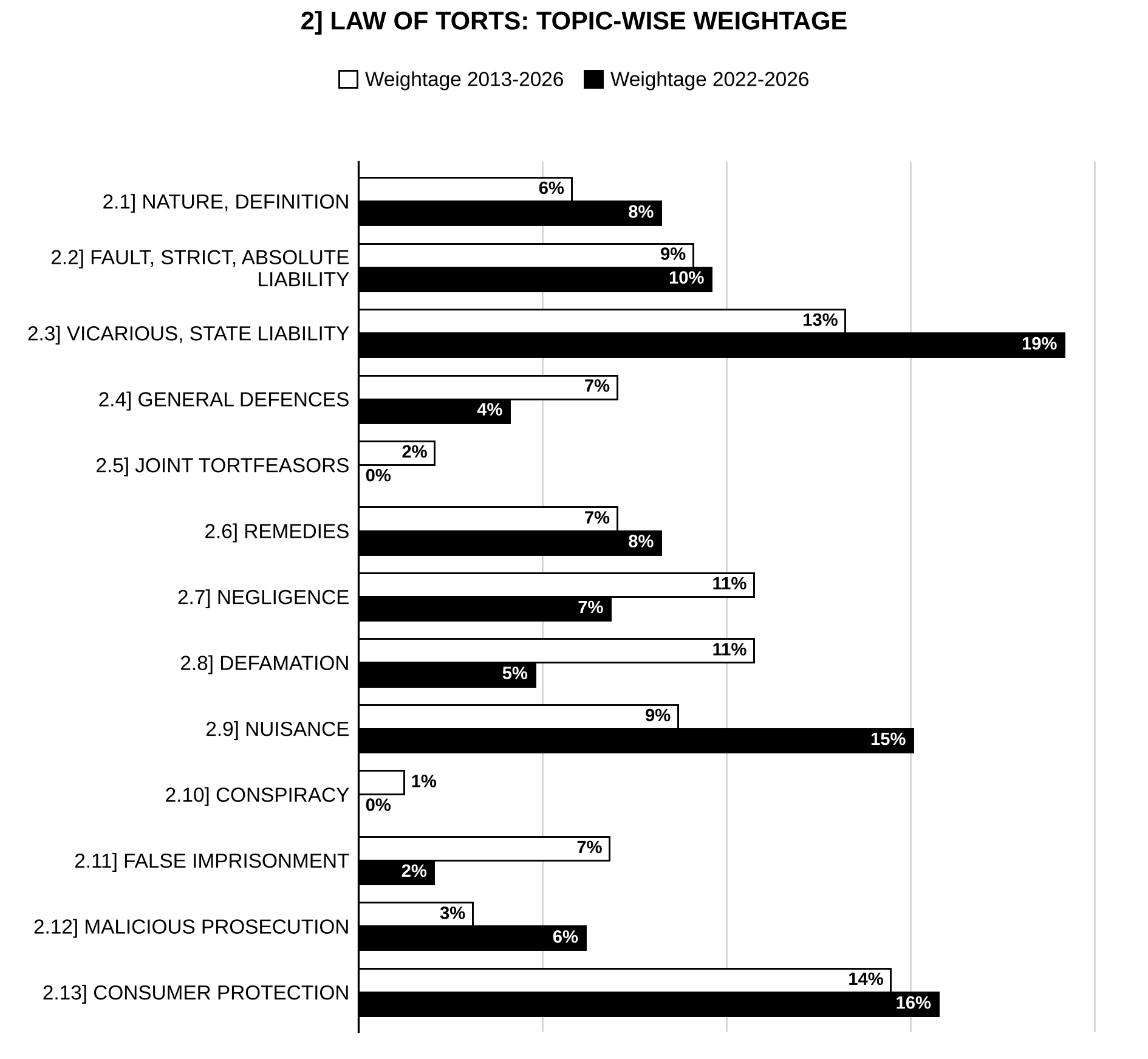
2.1] Nature and definition of tort
20 questions
“The law of torts is said to be a development of the maxim ubi jus ibi remedium.” Illustrate your answer with the help of decided case-laws. [2025/15m/3b]
“Tortious liability arises from breach of duty primarily fixed by the law. This duty is towards persons generally and its breach is redressible by an action for unliquidated damages.” Comment. [2022/15m/4c]
“‘Pigeonhole theory’ in the law of tort holds no justification now.” Critically examine. [2019/10m/150w/1d]
“The paramount task of the law of torts is to pay an important regulatory role in the adjustment of losses and eventuate allocation of their cost and that until the emergence of the welfare state, the law of torts provided the only source for alternating the plight of the injured.” In the light of the above statement, discuss the nature and scope of law of torts and substantiate your answer with leading case law. Also discuss the position in India. [2018/10m/150w/1d]
“Law of torts is said to be a development of the maxim ‘Ubi jus ibi remedium’.” Discuss the statement. [2017/10m/150w/1d]
“A tort is a specie of civil wrong.” Examine this definition and add other features to make it comprehensive. [2014/10m/150w/1d]
“Tort is concerned with the allocation on prevention of losses which are bound to occur in society.” Discuss. [2011/15m/150w/1c]
“Before a person can recover for loss which he suffered from another person’s act, it must be shown that his case falls within the class of actionable wrongs.” Discuss. [2011/15m/150w/1d]
“Damnum sine injuria and injuria sine damnum are two different principles of law”. Comment briefly. [2009/20m/4b]
Distinguish between tortious liability and criminal liability. [2007/20m/200w/1d]
“In tort the plaintiff wins his case only when he proves as to what particular tort the defendant has committed against him.” Examine. [2006/20m/200w/1d]
A, the owner of a mill, was getting water for his mill from a stream which was naturally flowing near the mill of A. B, the owner of another mill, dug an extensive well which hindered the flow of water to A’s mill. Is B liable for a tort? Give reasons to support your answer. [2006/30m/3b]
Which one of the following two expressions is correct and why? ‘Law of Torst’ or ‘Law of Tort’. [2005/20m/200w/1d]
“All torts are civil injuries but all civil injuries are not torts.” Explain the above statement. [2004/20m/200w/1c]
Distinguish between tortious liability and contractual liability. [2004/20m/200w/1d]
“It is the task of the law of tort to determine when the law will and will not grant redress for damage suffered.” Discuss. [2003/20m/200w/1c]
“Whenever there is a breach of duty there is a cause of action in tort.” Discuss. [2001/20m/200w/1c]
“In tort the plaintiff wins his case only when he proves as to what particular tort the defendant has committed against him.” Examine. [1997/20m/200w/1c]
“Duties in tort exist by virtue of the law itself, and are not dependent upon the consent of the persons subjected to them.” Examine. [1996/20m/200w/1c]
“Law of tort is based upon a fundamental general principle that it is wrongful to cause harm to other persons in the absence of some specific ground of justification or excuse.” Examine. [1995/20m/200w/1d]
2.2] Fault liability, strict liability and absolute liability
13 questions
‘If an enterprise is permitted to carry on any hazardous or inherently dangerous activity for its profits, the cost of any accident arising on account of such activity must be an appropriate term of overheads.’ Comment. (M. C. Mehta v. U.O.I.) [2024/20m/4a]
How is the rule of ‘absolute liability’ different from ‘strict liability’? Cite the relevant judgements. [2022/15m/2c]
Discuss the evolution and development of rule relating to ‘No-fault liability’ in India with help of decided cases. [2021/20m/4a]
“Rule of absolute liability has been expounded by the apex court in M. C. Mehta’s vs. Union of India.” How far is it a reform over the rule of strict liability? Comment. [2018/15m/4b]
Explaining the concept of ‘no liability’, mention the Indian Acts in which this concept has been incorporated. [2017/15m/4c]
“No fault liability rule has undergone a drastic change in the recent past.” Comment. [2016/10m/150w/1c]
“The object of Public Liability Insurance Act, 1991 is to provide relief to the victims of accidents in hazardous industries in addition to any other right to claim compensation.” Explain with case law. [2016/15m/8c]
“If a person brings or accumulates on his land anything which if it should escape may cause damages to his neighbours, he does so at his peril.” Discuss the above statement by referring the judicial pronouncements alongwith the exceptions thereto. [2007/30m/3a]
Discuss the rule of strict liability with the help of relevant case law. Is there any difference between strict liability and absolute liability? [2006/30m/3a]
There was a leakage of oleum gas from one of the units of Mr. X’s Textile Industry, situated in the city of Mumbai, on 4th and 5th October, 1995. It resulted in the death of an advocate practising in a court and all the ill effects of the same to various other persons. Mr. Y, a public spirited individual filed a writ petition, under Art. 32 of the Constitution, before the Supreme Court of India claiming compensation. Decide the liability of the occupier. [2000/20m/200w/1d]
What are the exceptions to the rule of strict liability? Briefly examine each of them. [1999/30m/2b]
Explain the nature, scope and extent of the liability of the polluter for environmental torts in the light of the “Polluter pays principle” as developed in recent Supreme Court decisions. [1999/30m/4b]
Discuss the legal principles, in the background of the recent changes in the law, applicable to the determination of liability for injury caused by “hazardous substances” and also the nature of the said liability. Refer to relevant case law. [1996/30m/3a]
2.3] Vicarious liability including State liability
15 questions
“‘Vicarious liability’ is based on public policy rather than fault.” Critically analyse the above statement in the light of decided cases. [2026/20m/2a]
Explain the principle of liability of master for the torts committed by his servant. Write case-laws. [2025/10m/150w/1d]
‘The determination of vicarious liability of the state is linked with the negligence made by all its functionaries and no immunity can be claimed.’ In the light of above observation discuss; vicarious liability of state with reference to its sovereign functions. [2024/10m/150w/1d]
“He who acts through another, does the act himself.” Discuss the tortious liability entailed in the above statement. [2023/10m/150w/1d]
The ‘State Liability’ under the Law of Tort has undergone metamorphosis. Explain with the help of case laws. [2022/20m/2a]
“The common cases of vicarious liability relate to servant driving his vehicle in the course of employment.” Explain in the light of decided cases. [2020/10m/150w/1e]
The rule “Crown was not answerable for tort committed by its servant” has never been applied in India. Examine the statement in the light of the decided cases. [2020/15m/4c]
“A master is liable for all acts of his servant done during the course of employment.” Explain it in general and from Indian perspective in particular. [2018/15m/3b]
When is principal not liable for the torts committed by his servant? Discuss. [2017/15m/3b]
“State liability in Torts has undergone an acute transformation in recent times.” Discuss in the light of latest judicial pronouncements. [2015/15m/3c]
“Although the decision of the Supreme Court in Kasturi Lal v. State of U.P. has not been overruled as such, yet for all practical purposes its force has been considerably reduced.” Elucidate. [2014/20m/4a]
‘A master is not responsible for a wrongful act unless it is done in the course of employment’. Comment and explain the circumstances when wrongful acts are deemed to be done “in the course of employment”. Refer to decided cases. [2009/30m/3b]
“State has to answer for every wrong committed by its erring servant.” Comment. [2008/20m/200w/1c]
A car diver in the course of his employment leaves the ignition keys in the car and leaves the car on a crowded road. During his absence a trespasser gets into the car and drives it causing an accident resulting into injuries to the plaintiff. The plaintiff sues the car owner in tort. Decide. [2003/30m/3b]
Even if the master cannot actually control the way in which the servant does his work, because the servant is a skilled professional who knows his job and will carry it out in his own way, the master nevertheless remains liable for the negligence of the servant. Comment. [1999/20m/200w/1d]
2.4] General defences
11 questions
Discuss the doctrine of ‘Volenti non fit injuria’ as a defence to tortious liability. What are the limitations on the scope of this doctrine? [2026/15m/2c]
Explain the maxim ‘volenti non fit injuria’. Is the knowledge of risk not the same thing as consent to suffer the risk? Support your answer with judicial pronouncement. [2018/15m/2b]
Explain ‘necessity’ as a defence for the liability of tort and also mention the classes of necessity. [2017/10m/150w/1e]
“Harm suffered voluntarily does not constitute a legal injury and is not actionable.” Elaborate along with its limitations. [2016/20m/3a]
“The maxim is ‘volenti non fit injuria’ and not ‘scienti non fit injuria’.” Explain. [2014/10m/150w/1c]
X, while driving car, suddenly became unconscious and fell back in his seat. The car became uncontrolled, it hit and killed Y. Discuss the liability of X. [2013/15m/3c]
The defendant had been carrying cargo in a lorry for the plaintiff. On the way there was heavy rainfall. The cargo was damaged by seepage due to rainwater rising from below, while it had been securely protected by the defendant by tarpaulin from above. The flash flood on the highway had stranded hundreds of lorries including that of the defendant, and the water level on the highway rose above tyres and up to the level of the platform which resulted in the seepage. However, the plaintiff claimed heavy damages from the defendant on the ground of negligence or want of due care. Discuss whether the defendant can have any defence in this case. [2012/12m/150w/1d]
“Defence of ‘Volenti-non-fit injuria’ is not available when the rescuer is injured in an act of rescuing.” Discuss. [2010/20m/200w/1c]
‘Volenti non fit injuria is a defence for liability in tort’. Illustrate your answer with decided cases. [2009/20m/200w/1c]
“Knowledge of the danger does not amount to consent to undertake the risk.” Discuss with the help of decided cases. [2008/30m/3b]
“Statutory right affords no protection if negligence, unreasonable conduct, want of jurisdiction or irregularity is proved.” Comment. [1999/30m/3a]
2.5] Joint tortfeasors
3 questions
Explain the liability of ‘Joint Tortfeasors’ for a wrongful Act. How is it different from the liability of ‘Independent Tortfeasors’? [2021/15m/3b]
“Liability of joint tort feasors in Law of Tort is Joint and Several.” Discuss. [2015/10m/150w/1c]
The liability of joint tort-feasors is ‘joint and several’. In the light of this statement discuss who are joint tort-feasors and their liability with the help of illustrations and case law. [2005/30m/3a]
2.6] Remedies
10 questions
“Doctrine of ‘foreseeability’, not the ‘proximity’, is a correct test of ‘remoteness’.” Explain with the help of case-laws. [2025/10m/150w/1a]
Explain the various kinds of damages that a plaintiff can claim after a tort has been committed against him. [2023/10m/150w/1e]
What are the remedies available under the Law of Tort other than damages? Discuss by citing suitable illustrations. [2022/10m/150w/1b]
What are the various kinds of ‘damages’ that a plantiff can avail as a remedy under the law of Torts? Under what circumstances can “prospective damages” be awarded? [2021/15m/2c]
“The expression ‘measures of damages’ means the scale or rule by reference to which the amount of damages is to be recorded and assessed.” In the light of the above statement, examine the changing contours of damages as a tortious remedy. [2020/15m/2b]
“Ascertainment of causation is a problem, when the events causing damage to plaintiff are not simultaneous but successive.” Elaborate it with the help of decided cases under the law of tort. [2019/15m/3c]
Critically examine the development of the law relating to remoteness of damages. Which test do you prefer for deciding the question of remoteness of damages and why? Give reasons for your answer. [2018/10m/150w/1b]
“It is not the hindsight of a fool, it is the foresight of a reasonable man which alone can determine the liability.” Discuss. A threw a lighted cracker in a crowded market. It fell on B’s shop. C was standing nearby. To save himself and B’s shop too, C threw the cracker away. It then fell on D’s shop. D in his turn, threw it away which then fell on E who became blind. Decide, who is liable to E? [2008/30m/3a]
“In assessing damages, the law takes an account of certain consequences but considers only proximate consequences.” State the test by which the remoteness of consequences is determined by the courts for this purpose. Refer to judicial pronouncements. [2004/30m/4a]
“Where damages cannot be precisely calculated in terms of money, the court may take into account the motives and conduct of the defendant, and where these aggravate the plaintiffs injury the damages will be correspondingly increased.” Discuss. [2001/20m/200w/1d]

Preparing for Prelims too?
Our UPSC Prelims Topic-wise PYQ eBook covers every Prelims question with detailed explanations, so you can see exactly where UPSC asks from.
View the BookDownload Free Sample2.7] Negligence
22 questions
Does ‘Res ipsa loquitur’ reverse the ‘burden of proof’ completely? Comment. [2026/10m/150w/1a]
“In Negligence, the chain of causation must remain intact.” Describe the essentials of ‘negligence’ by referring case-laws. [2023/15m/2b]
In an action for ‘Negligence’, what does the plantiff need to establish in order to affix civil liability of defendant? What does it take for the maxim ‘res ipsa loquitor’ to apply? [2021/15m/3c]
“A goldsmith putting earring to woman’s ear does not require as much care as a surgeon performing surgery on the ear of woman.” Elaborate the law relating to degree of care required under the law of tort. [2019/20m/4a]
When, under the law of torts even using reasonable care, is a person liable for the tort of negligence? Discuss. [2017/20m/2c]
“Direct evidence of negligence, however, is not always necessary and the same may be inferred from the circumstances of the case.” Elucidate with cases. [2016/15m/3b]
Discuss with the help of decided cases where the Court while deciding cases on contributory negligence keeps in mind the negligence on the part of plaintiff and defendant both. [2015/15m/4b]
“The age of a child must be considered in deciding whether it has been guilty of contributory negligence.” Discuss and refer to case law. [2014/10m/3c]
W, wife of A was diagnosed to be suffering from toxic Epidermal Necrolysis. Doctor D was consulted who prescribed a long acting Cortico steroid ‘Depomedrol’ injection at a dose of 80 mg twice daily. Despite administration of this medicine her condition deteriorated rapidly and she died within a week. On expert opinion, it was found that the line of treatment followed by D is not supported by any school of medical thought and is in sheer ignorance of basic hazard relating to use of steroids. A files a complaint in Consumer Forum claiming Rupees 75 lakhs as damages for death of his wife W. D objects to the jurisdiction of the Consumer Forum and also pleads lack of negligence on his part. Decide. [2014/20m/4b]
“The principle of ‘res ipsa loquitur’ is an exception to the rule that it is for the plaintiff to prove negligence of the defendant.” Discuss with reference to some cases. [2012/12m/150w/1e]
Mr. X himself was driving a car and when he was passing through a railway level crossing, his car was hit by a mail train. The car was smashed and Mr. X was seriously injured, and died in hospital. In an action by the widow against the Union of India, as owner of the Railway, it was contended that the level crossing was unmanned and the gates were open. This constituted negligence on the part of the Railway. Further it was contended that there was no contributory negligence on the part of Mr. X, the deceased, as he could not have a look at the railway line from a distance as his view was obstructed by some trees, etc., nor could he hear the sound of the coming mail train while he was in the car with the engine running and the windscreen closed. Decide the case giving your reasons. [2012/30m/2b]
“It is possible to support an action for nuisance as well as of negligence on the same set of facts, however, there are certain points of distinction between the two.” Discuss. [2012/20m/3a]
“The defendant must not only owe the plaintiff a duty of care, he must be in breach of it.” In the light of the above statement examine as to how would the court find out as to whether there is a breach of a duty on the part of the defendant or not. Refer to case law. [2011/30m/4a]
Discuss the principle of Res-ipsa-Loquitur. Refer to recent cases. [2010/20m/200w/1d]
The doctrine of “alternative danger” is the extention of the doctrine of “contributory negligence”. Discuss. [2007/20m/200w/1c]
“When a plaintiff acts as a reasonable and prudent man, he is entitled to damages even though he selects the more dangerous alternative when confronted by the defendant’s negligence.” Discuss. [2003/20m/200w/1d]
A car diver in the course of his employment leaves the ignition keys in the car and leaves the car on a crowded road. During his absence a trespasser gets into the car and drives it causing an accident resulting into injuries to the plaintiff. The plaintiff sues the car owner in tort. Decide. [2003/30m/3b]
“In the tort of negligence the question as to whether the defendant has acted as a reasonable man or not depends on many factors.” Discuss. [2001/30m/3a]
Explain the occupier’s liability in respect of structures. [2000/30m/2b]
Explain the law relating to contributory negligence of children. [2000/30m/3a]
X, one Ayurvedic doctor prescribed the medicine of Allopathy which caused the death of a patient. What is his liability? Explain the liability of the doctors under the Consumer Protection Act. [2000/30m/7b]
Examine how and when a duty of care arises, a breach of which on the part of the defendant makes him liable in an action for negligence. What is the liability, if any, for negligent misstatement which causes financial loss to the plaintiff? [1996/20m/200w/1d]
2.8] Defamation (tort)
19 questions
Discuss the law of defamation. Is this correct to say that law of defamation gives too much protection to ‘reputation’ and imposes too a great restriction on the freedom of speech? Comment. [2025/20m/3a]
“The ‘Right of Reputation’ is acknowledged as an inherent personal right of every person.” Discuss the statement in the light of Law of Defamation in India. [2022/15m/3b]
What are the defences available to an accused in a civil suit for ‘defamation’? Explain. [2021/15m/4b]
“‘Privilege’ means that a person stands in such relation to the facts of the case that he is justified in saying or writing what would be ‘slanderous’ or ‘libellous’ in anyone else.” Explain the statement with leading case law. [2020/15m/3c]
“Imputation of unchastity against a woman by spoken words is a wrong actionable without proof of special damage.” Examine under the law of tort. [2019/15m/4c]
Mention the defences of tort of defamation and also discuss whether exceptions given under the Indian Penal Code, 1860 for the offence of defamation may be claimed as additional grounds by the defendant. [2017/15m/3c]
“It is immaterial whether the defendant intended the defamatory statement to apply to the plaintiff or knew of the plaintiff’s existence if the statement might reasonably be understood by those who knew the plaintiff, to refer to him.” Elucidate with case law. [2016/15m/3c]
Discuss with the help of judicial pronouncements the situations in which plaintiff may prove apparently non-defamatory statements as defamatory. [2015/20m/4a]
“It is not necessary that in all cases of tort of defamation there must be a loss of reputation of the plaintiff.” Explain and illustrate. [2014/10m/4c]
X sends an e-mail to Y containing defamatory matters against him. The e-mail is received by Y who deletes it after reading. Is X liable for publication? Refer to relevant case law. [2013/15m/3b]
The editor of a weekly published a series of articles directed against the business of the plaintiff alleging how the wealth of the vast empire was built up by having recourse to the unlawful and questionable means involving tax-evasion, import-export rackets, foreign exchange violations and how the investigations into the operations of the organisation were bogged down. In an action for defamation, the defendant put up the defence of fair comment on a matter of public interest. The plaintiff brought evidence to show that the defendant had to tender an apology to the plaintiff in an earlier defamation case and that the present publication was motivated by malice. Discuss the defence of fair comment in the light of the facts of the case. [2010/20m/4a]
Explain the ingredients of “Innuendo”. What is a plaintiff required to prove in order to sustain the plea of Innuendo? [2009/20m/200w/1d]
‘A statement made in performance of duty is privileged’. In the light of this statement critically examine the tort of defamation. X the famous writer and art critic while criticising the paintings of Y the famous painter, wrote in the newspaper as follows: ‘Mr. Y’s paintings are pots of paint hurled in the eyes of the public’. He afterwards wrote to Y saying that whatever he had written had been said by him in the course of his duty and hoped that he would not allow this to interfere with their friendship. Y replied and said ‘Next time I meet you, I shall punch your nose damn hard. I hope you will not allow this to interfere with our friendship’. What torts, if any, have they committed and what defences are available to them? [2009/30m/3a]
What is meant by ‘innuendo’? What are the facts, the Plaintiff must prove or establish in order to sustain a plea of innuendo? [2005/20m/200w/1c]
“Absence of knowledge that a matter is defamatory or absence of intention to injure the plaintiff is, by itself, no excuse for the defendant in tort.” Discuss. [2003/30m/3a]
Distinguish the wrong committed in the following two incidents and also give decisions: (i) X circulated a handbill to his neighbours alleging that Y became the Chairman of the Village Panchayat by paying money to the members of the Panchayat. (ii) X goes on informing his community members in many families that Ms Y is not chaste as many people have seen her in the company of different people at various places. [2002/30m/3b]
Distinguish between the following: Libel and slander. [1999/15m/3b(i)]
How do you distinguish the following? What reasons can be attributed for the difference? (i) A solicitor, acting on behalf of his client, dictated a letter to the plaintiff stating therein that she (plaintiff) bears immoral character. The letter then was posted to the plaintiff. (ii) X told Z that Y is suffering from AIDS though the statement is not true. [1998/30m/3a]
The defendant newspaper company publishes the photographs of Mr. A and Mr. B along with the caption that they were getting married on that day. They published this only Mr. A himself had confirmed to their correspondent that the news was true. The fact, however, was that Mr. A was already married but his wife was residing in another city because their relations were strained. The wife Mrs. A files a defamation suit against the defendant. Decide. [1997/30m/3b]
2.9] Nuisance
18 questions
Can a ‘single act’ amount to both public and private nuisance? Explain with the help of examples. [2026/10m/150w/1d]
“Nuisance is no branch of negligence.” Explain. Describe who can sue and who is liable for nuisance. [2025/15m/2c]
“A person is liable for Public nuisance, when he does an act or illegal omission which causes any common injury, danger or annoyance to the public …” Discuss Nuisance in the light of above statement along with its types. [2024/15m/3b]
Elucidate the essentials of ‘Private Nuisance’. Also discuss the remedies available to a plaintiff in a suit for ‘private nuisance’. [2023/15m/3c]
“‘Public nuisance’ does not create a civil cause of action for any person.” Comment. [2020/10m/150w/1d]
“Any interference with a plaintiff’s property may cause personal discomfort to the plaintiff in enjoyment of the property.” Critically examine the statement with the help of decided cases. [2019/15m/2a]
“Public nuisance is a crime whereas private nuisance is a civil wrong.” Explain. [2015/15m/3b]
“Nuisance as a tort means an unlawful interference with a person’s use or enjoyment of land or some right over or in connection with it.” Comment. [2013/10m/125w/1c]
“It is possible to support an action for nuisance as well as of negligence on the same set of facts, however, there are certain points of distinction between the two.” Discuss. [2012/20m/3a]
We must use our property so as not to cause discomfort to another’s use of property. Yet a temporary discomfort is not actionable. Explain the law. [2010/20m/4b]
“Acts done with the intention of annoying a neighbour and actually causing annoyance will be nuisance.” Comment. ‘A’, a music teacher, gives music lessons at his residence. B, the neighbour, resides in the adjoining house, maliciously causes discomfort to A, by hammering against the party wall, beating the trays, whistling and shricking. A prays for an injunction against B, should he succeed? [2007/30m/3b]
Distinguish the following two incidents and point out regarding wrong, if any, which has been committed in these incidents. Distinguish in the context of the nature and composition of these wrongs: (i) The Municipality permitted a political party to hold a meeting in a public park blocking a busy road. X wanted to go to Y’s house crossing the road but was not allowed. There was no other way to go to Y’s house. (ii) A customer was suspected of having committed a theft in the departmental store by the staff. She was detained by the Manager for 2 days in a Store-room. [2002/30m/3a]
The defendant establishes a flour mill in the heart of a city adjacent to the plaintiff’s house in a residential area. Running of the mill causes vibrations to the house and unpleasant noise. The plaintiff sues the defendant and claims damages and injunction. The defendant argues that he has a freedom to establish his own trade and business and that his flour mill is also beneficial to a large number of residents in the area. Decide. [2001/30m/3b]
Public nuisance and private nuisance. [1999/15m/3b(ii)]
The mere fact that a process or business is useful to persons generally, in spite of its annoyance to the plaintiff, is no defence to an action for the tort of nuisance. Examine. [1997/20m/200w/1d]
Branches of trees grown on B’s land overhang on the side of A, his neighbour. A repeatedly requests B to cut off these overhanging branches so that A is able to enjoy sunlight. B does not pay heed to these requests. A goes on to the side of B and cuts off those branches. [1996/15m/3b(ii)]
Under the tort of nuisance a person cannot increase the liabilities of his neighbour by applying his own property to special uses, whether for business or pleasure. Examine. [1995/20m/200w/1c]
Study very carefully the following two situations: Situation A: The defendant, a deeply religious man and owner of a house in the heart of a city, set it apart free of rent for those who wished to use the same for religious purposes. As a result the house remained occupied most of the time. The music played through the loudspeakers during religious ceremonies caused constant noise and inconvenience to the neighbours. Situation B: The defendant established a flour mill in a residential area in the heart of a city adjacent to the plaintiff’s house. Continuous running of the mill for long hours everyday caused unpleasant noise as well as continuous vibrations in the house of the plaintiff. Compare the tortious liability of the defendants in the above mentioned situations. Give reasons and Cite case-law. [1995/30m/3b]
2.10] Conspiracy (tort)
2 questions
“The law making conspiracy a crime is designed to curb immoderate power to do mischief which is gained by a combination of the means.” Explain. [2016/15m/4b]
“The purpose of a combination and the means employed to achieve that purpose are the two most important considerations in the tort of conspiracy.” Examine. [1995/30m/3a]
2.11] False imprisonment
10 questions
Explain ‘false imprisonment’ as per law of Torts and distinguish it from ‘malicious prosecution.’ [2024/15m/3c]
What constitutes ‘Malicious Prosecution’? How it is different from ‘False Imprisonment’? [2021/10m/150w/1e]
Mere physical boundaries are not the essential requirement to constitute the tort of ‘false imprisonment’, but psychological boundaries too are enough in this regard. Critically examine. [2019/15m/4b]
“Every confinement of the person is an imprisonment, whether it be in a common prison or in a private house, or in the stocks or even by forcibly detaining one in the public streets.” Explain with the help of case law. [2016/20m/4c]
“Total restraint on the liberty of movement of a person, however short its duration may be, will amount to false imprisonment.” Discuss with the help of relevant case law. [2015/15m/4c]
“Assault is an act of the defendant which causes to the plaintiff reasonable apprehension of the infliction of a battery on him by the defendant.” Comment and distinguish between assault and battery. [2013/20m/3a]
Distinguish the following two incidents and point out regarding wrong, if any, which has been committed in these incidents. Distinguish in the context of the nature and composition of these wrongs: (i) The Municipality permitted a political party to hold a meeting in a public park blocking a busy road. X wanted to go to Y’s house crossing the road but was not allowed. There was no other way to go to Y’s house. (ii) A customer was suspected of having committed a theft in the departmental store by the staff. She was detained by the Manager for 2 days in a Store-room. [2002/30m/3a]
Distinguish between: Malicious prosecution and False imprisonment. [2000/15m/3b(i)]
Distinguish the wrong committed in the following: (i) The defendant told the plaintiff to leave the premises in occupation of the plaintiff. When the plaintiff refused, the defendant collected some of his workmen who mustered round the plaintiff, tucking up their sleeves and aprons and threatened to break the plaintiff’s neck if he did not leave. The plaintiff then left the place. (ii) A takes B by the collar and pushes him down the hill. [1998/30m/3b]
Examine the tortious liability of A in the following: A pretends to lock the plaintiff in a room by purporting to turn the key of the door from outside and taking it away. The fact is that the door, though shut, is not locked. The plaintiff remains in the room for two hours under the belief that he has been locked inside. [1996/15m/3b(i)]
2.12] Malicious prosecution
9 questions
Explain ‘false imprisonment’ as per law of Torts and distinguish it from ‘malicious prosecution.’ [2024/15m/3c]
Critically analyse with the help of decided cases, the essentials to be proved by a plaintiff in a suit for damages for ‘Malicious Prosecution.’ [2023/15m/4c]
What constitutes ‘Malicious Prosecution’? How it is different from ‘False Imprisonment’? [2021/10m/150w/1e]
“Malice is not to be inferred merely from the acquittal of the plaintiff. The plaintiff must prove independently of the acquittal that his prosecution was malicious and without reasonable and probable cause.” Comment. [2016/10m/150w/1d]
Explain the essentials of malicious prosecution. What are the grounds on which plaintiff can claim damages? [2012/30m/2a]
“It is an actionable wrong to institute, maliciously and without reasonable and probable cause, criminal proceedings which may injure person’s reputation, personal freedom or property.” Elucidate. [2008/20m/200w/1d]
“In tort of malicious prosecution the plaintiff must prove among other things, that the defendant was the person who was actively instrumental in putting the law in force.” Discuss. [2005/30m/3b]
Distinguish between: Malicious prosecution and False imprisonment. [2000/15m/3b(i)]
“In the tort of malicious prosecution the plaintiff must prove, among other things, that the defendant was the person who was actively instrumental in putting the law in force.” Examine. [1997/30m/3a]
2.13] Consumer protection law (Consumer Protection Act, 1986)
30 questions
How does the changed definition of ‘consumer’ align with modern market practices such as ‘e-commerce’? Discuss. [2026/10m/150w/1c]
“The establishment of ‘Consumer Mediation Cell’ and procedure for mediation in the Consumer Protection Act, 2019 is a step towards alternative dispute resolution in consumer cases.” Discuss. [2025/15m/4c]
“The introduction of ‘product liability’ under the Consumer Protection Act, 2019 marked an end of the ‘buyer beware’ doctrine and the introduction of ‘seller beware’ as the new doctrine.” Discuss. [2024/10m/150w/1e]
Elaborate the reasons for including ‘e-commerce’ in Consumer Protection Act, 2019. Also discuss the consequences for not complying with the provisions of the Act by the e-commerce entities. [2023/15m/3b]
Outline the legal framework for the protection of online consumers provided under the Consumer Protection Act, 2019 and the Consumer Protection (E-Commerce) Rules, 2020. [2022/15m/4b]
Discuss the ambit & scope of ‘consumer’ as defined under the Consumer Protection Act, 2019. [2021/10m/150w/1d]
Critically examine the Consumer Protection Act, 2019 and distinguish it with the Consumer Protection Act, 1986. [2020/15m/3b]
“E-commerce has adversely affected the consumer protection in India.” Elucidate the statement. [2019/10m/150w/1e]
“Consumer Protection Councils also play a very important role in consumer protection.” Examine the statement and elaborate the objects, composition and functions of the Central, State and District Consumer Protection Councils. [2017/20m/4a]
“Provisions of the Consumer Protection Act, 1986 shall be in addition to and not in derogation of the provisions of any other law for the time being in force.” Critically examine the statement. [2016/15m/4a]
“The Consumer Protection Act, 1986 provides a three tier structure for redressal of complaints.” Elucidate. [2015/20m/3a]
W, wife of A was diagnosed to be suffering from toxic Epidermal Necrolysis. Doctor D was consulted who prescribed a long acting Cortico steroid ‘Depomedrol’ injection at a dose of 80 mg twice daily. Despite administration of this medicine her condition deteriorated rapidly and she died within a week. On expert opinion, it was found that the line of treatment followed by D is not supported by any school of medical thought and is in sheer ignorance of basic hazard relating to use of steroids. A files a complaint in Consumer Forum claiming Rupees 75 lakhs as damages for death of his wife W. D objects to the jurisdiction of the Consumer Forum and also pleads lack of negligence on his part. Decide. [2014/20m/4b]
Explain the scope of rule of “Caveat Emptor” in the expanding law of consumer protection. [2014/15m/7c]
“The definition given under the Consumer Protection Act, 1986 gives altogether a new legal colour and scope to the term ‘Consumer’.” In the light of this statement, explain the term ‘Consumer’. [2013/10m/125w/1e]
“With the enactment and implementation of the Consumer Protection Act, 1986, a new consumer jurisprudence has developed in India.” Elaborate. [2011/30m/4b]
Discuss the liability of hospitals under the Consumer Protection Act, 1986. Refer to decided cases also. [2010/20m/4c]
List briefly the procedure to be followed by a District Forum on receipt of a complaint regarding defective goods under the Consumer Protection Act, 1986. [2009/20m/4c]
“The law of consumer protection has come to meet the long felt necessity of protection to the common men from the wrongs for which the remedy under ordinary law for various reasons has become illusory.” Discuss this statement and explain to what extent the Consumer Protection Act, 1986 has succeeded in its objectives. [2008/30m/4a]
Discuss the composition and objects of Consumer Protection Council under the Consumer Protection Act, 1986. [2007/30m/4a]
Discuss the jurisdiction of various authorities under the Consumer Protection Act, 1986 for the settlement of disputes. [2004/30m/3b]
Discuss in detail the meanings of ‘complaint’ and ‘unfair trade practice’ under the Consumer Protection Act, 1986. Are these definitions satisfactory and in consonance with the spirit of this Act? [2003/30m/4b]
What is unfair trade practices? Explain why the following transactions are or are not unfair trade practice(s): (i) selling renovated goods as original; (ii) exaggerating usefulness of a product; (iii) suggesting a trade name for the product, which belong to another. [2002/30m/7b]
Explain the meaning of ‘consumer’ and ‘service’ under the Consumer Protection Act, 1986. [2001/30m/4b]
Explain how far the rule of Caveat Emptor has undergone changes especially after passing the Consumer Protection Act. [2000/10m/200w/5d(i)]
X, one Ayurvedic doctor prescribed the medicine of Allopathy which caused the death of a patient. What is his liability? Explain the liability of the doctors under the Consumer Protection Act. [2000/30m/7b]
What tests would you apply to determine whether a person “consumer” within the meaning of Section 2(d)(i) of the Consumer Protection Act, 1986? What is the scope and effect of the “Explanation” added to the above sub-clause by the Amendment Act of 1993? Explain with the aid of suitable illustrations. [1999/30m/7b]
Do you find any areas of conflict between the Indian Sale of Good Act and the Consumer Protection Act? Critically review the areas and suggest how you would like to resolve the conflict. [1998/60m/8]
Examine the nature and scope of the remedies under the Consumer Protection Act, 1986. [1997/30m/8b]
Explain the scope and content of the expression ‘contract of personal service’ in the exclusionary part of section 2 (1) (o) of the Consumer Protection Act, 1986. What is the distinction between ‘contract of service’ and ‘contract for services’? In which category would you place the contract between a doctor and his patient? Is the service rendered by a doctor under such a contract covered by the exclusionary part of the definition of ‘service’ in section 2 (1) (o) of the Act? Refer to case law. [1996/30m/8b]
Examine the concepts of ‘consumer’ and ‘consumer dispute’ under the Consumer Protection Act, 1986. [1995/20m/200w/5d]

Strengthen your GS papers
Our UPSC Mains Topic-wise & Year-wise PYQ eBook (2013–2026) maps every GS question to the syllabus, so you know what UPSC asks and how often.
View the BookDownload Free Sample« Previous: Law of Crimes | Next: Law of Contracts and Mercantile Law »
Back to: Law Optional PYQs – Topic-wise
Last updated: 30 October 2026