
Here are all 404 International Law questions asked in UPSC Law Optional Paper I from 1995 to 2026, arranged under the 15 topics of the official syllabus. Within each topic the latest questions come first.
Each question ends with a code such as [2024/15m/3b] – the year, the marks, the word limit (where UPSC set one) and the question number in the paper.
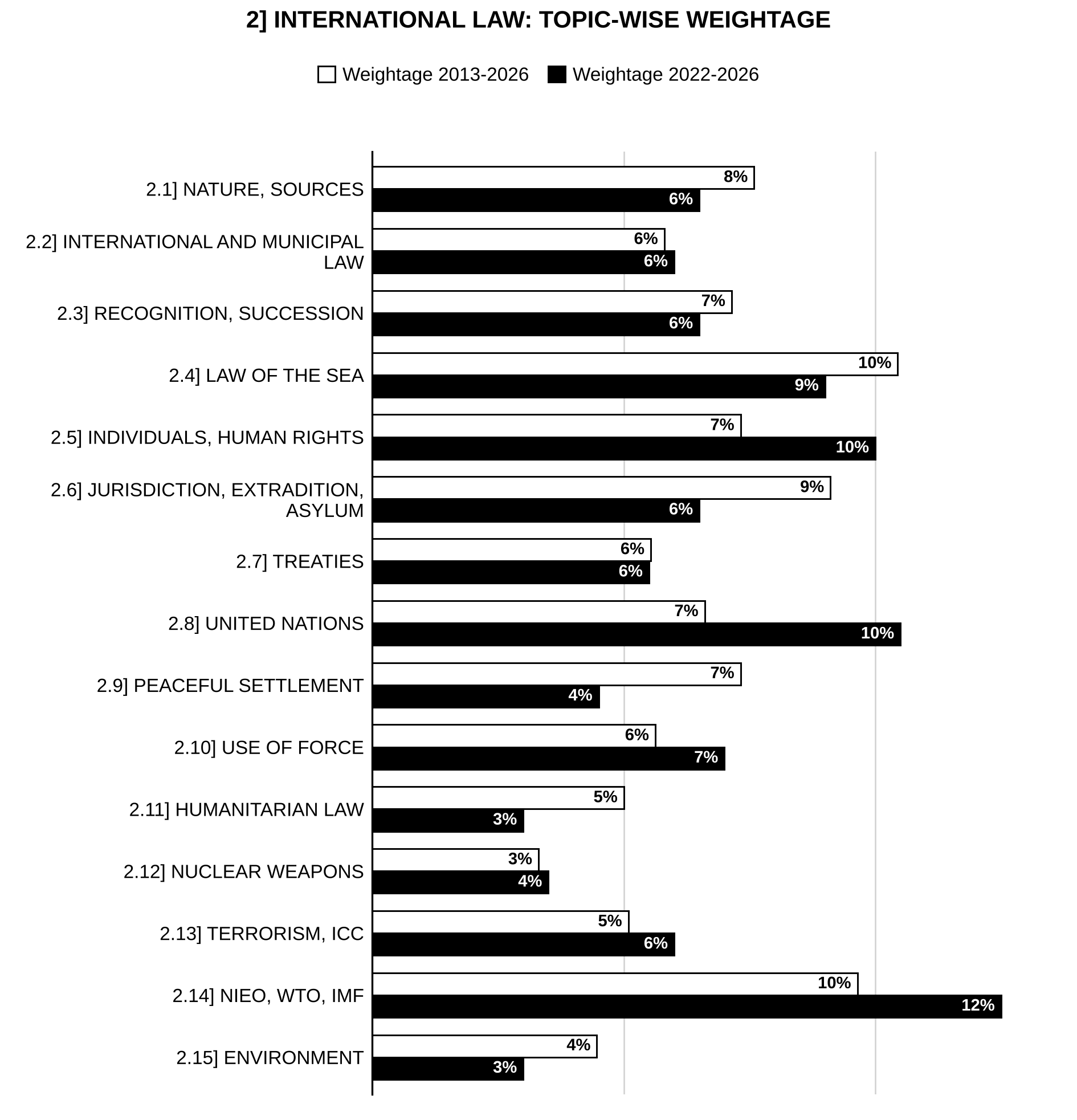
2.1] Nature and definition of international law
47 questions
Whether International Law is a law in the true sense of the term ‘law’ or not? Examine. [2026/10m/150w/5a]
“International Law may be defined as that body of law which is composed for its greater part of the principles and rules of conduct which States feel themselves bound to observe and, therefore, do commonly observe in their relation to each other.” Explain. [2026/15m/6c]
Define International Law. Enumerate its weaknesses and give suggestions for improvement. [2024/10m/150w/5a]
“Law must be stable, and yet it cannot stand still, as it needs to reconcile the conflicting needs of stability and change and in the fast-developing world, the stability appears to have become the casualty in international law.” Differentiate between traditional International Law and new International Law in light of the above statement. [2023/20m/6a]
Keeping in view the growth of International Law in the contemporary era, do you think the classical definition of International Law has become redundant? [2022/10m/150w/5a]
Discuss the various efforts made towards the codification of International Law during the 20th century. [2021/10m/150w/5a]
Do you agree with the view that International law is merely a positive morality? Discuss the nature and scope of International law. [2020/15m/6c]
“International Law is the vanishing point of Jurisprudence.” Explain. [2019/10m/150w/5a]
Explain the distinctions between traditional and modern definitions of international law. Critically examine the growing scope and importance of international law in the present context. [2018/10m/150w/5a]
“International law is primarily concerned with Rights, Duties and Interests of States.” Critically examine the statement with reference to the place of Individuals and Non-State entities in International law. [2018/20m/8a]
Discuss the nature and basis of International Law. [2016/10m/5a]
Discuss the constituent elements of an international rule of customary law with the help of cases. [2016/10m/8a]
“Today there is a huge shift of the basis of International law though the principal component of International law is represented by binding rules, imposing duties and conferring rights upon the state.” Comment critically. [2015/10m/150w/5a]
“In the ultimate analysis individuals alone are the subjects of International law.” Comment. Also discuss the Transformation theory in the context of the relation between International law and Municipal law. [2015/15m/8c]
It is impossible to fix a precise date or period in history to mark the beginning of International Law as it predates recorded history. Critically examine the history, nature, scope, and relevance of International Law in Contemporary International Society. [2014/10m/150w/5a]
The Arbitration Commission of European Conference on Yugoslavia emphasised in opinion no. 2 that “it is well established that whatever the circumstances, the right to self-determination must not involve changes to existing frontiers at the time of independence (Uti possidetis juris) except where the states concerned agree otherwise.” Explain the present day relevance of principle of self-determination as a human right incorporated in both the international covenants with the help of at least one actual instance. [2013/10m/5d]
“The substance of customary law must be looked into primarily in actual practice and ‘opinio juris’ of the States.” In the light of above statement and by referring to case law, explain the interplay between objective and subjective elements in acceptance of a particular custom as a source of international law. [2013/25m/6a]
It is often said that customary international law is earlier to apply than to define. What are the inherent problems in defining ‘custom’ and how can a custom be considered as a source of international law? [2012/12m/150w/5a]
What is meant by right of national self determination of peoples and what is its role in the creation of a new State? Critically examine how minority rights can be protected while balancing the territorial integrity of a State at the same time. [2012/30m/6a]
One extreme view is that International Law is a system without sanctions. However, it is not quite true that there are no forcible means of compelling a state to comply with International Law. Comment and state various sanctions for the observance of International Law. [2011/15m/150w/5a]
“The fundamental principles of International law are passing through a serious crisis and this necessitates its reconstruction.” Do you agree with this statement? Give reasons. [2010/20m/200w/5a]
The traditional definitions of International law with its restrictions to the conduct of States inter se, in view of developments during the last six decades cannot stand as a comprehensive description of all the rules now acknowledged to form part of International law. Elaborate with examples those developments which are not covered by the exclusive rules governing the conduct of States. [2010/30m/6a]
Sanctions of International Law. [2009/20m/8a]
“It is difficult to maintain the distinction between formal and material sources taking into account that material sources consist simply of quasi constitutional principles of inevitable but unhelpful generality. What matters is the variety of material sources, the all-important evidence of the existence of consensus among States concerning particular rules of practice.” Critically examine the various sources of International Law in the development of Modern International Law, with the help of relevant case law. [2008/20m/5a]
Do you find any distinction between the State Liability and State Responsibility under International Law? Critically examine the general principles of State Responsibility in International Law. [2008/20m/5d]
“International Law is defined as ‘Vanishing point of Jurisprudence’.” (Holland). Examine this viewpoint with reference to the nature of International Law. [2007/20m/200w/5a]
What do you mean by the term ‘Subjects of International Law’? What are its attributes? [2007/20m/200w/5d]
Discuss the importance of International Customs as a source of International Law. When does a usage crystallize into a custom? [2007/30m/6a]
Jus Cogens. [2007/20m/8c]
Do you agree with the view that “International Law is merely a positive morality”? Discuss the nature of International Law. [2006/20m/200w/5a]
“The controversy whether International law is law or not is meaningless because, in fact, it is law and is generally obeyed.” Highlight the views of prominent writers about the above statement. [2004/20m/200w/5a]
“The term ‘general principles of law recognised by civilized nation’ is very wide and vague”. Comment in the context of Article 38(i)(c) of the Statute of the ICJ. [2003/20m/200w/5c]
If we examine the ‘opinions’ on the definition of International Law, we are inclined to ask: ‘What is so international in the so-called International Law?’ – Analyse. [2002/20m/200w/5a]
Discuss State responsibility in respect of the act of multinational corporations on the basis of the Bhopal Gas Leak case. [2002/20m/200w/5b]
“International law has progressed by leaps and bounds; yet the theoretical controversy about the nature of international law is far from over.” Comment. [2001/20m/200w/5a]
Highlight the significance of “judicial decisions” as a source of international law. [2001/20m/200w/5c]
“International Law is a ‘weak-law’.” Do you agree with this statement? Give reasons. [2000/20m/200w/5a]
The theory of consent as the binding force of international law. [2000/20m/8b]
It is too late to deny the legal character of international law, but in the present state of affairs it is tragically ineffective. [1999/20m/200w/5a]
What is the basis of obligation of International law? Discuss the respective viewpoints of naturalist and positivist schools. [1999/30m/7b]
The British ship Scotia collided in mid-ocean with the American ship Berkshire which was not carrying the lights required by the law. Decide the fault and liability under appropriate principles of international law. [1998/20m/7a]
“Before a usage may be considered as amounting to a customary rule of international law, the material and psychological aspects involved in the formation of the customary rule must be established.” Discuss. [1997/20m/200w/5a]
A lieutenant of State forces in a town in Mexico was ordered by the Mayor of the town to proceed with troops to quell riots against certain American citizens. The troop on arriving at the scene of the riot, instead of dispersing the mob, opened fire on the house in which Americans were taking refuge and killed one of them. Can the Mexican government be held responsible for the wrongful acts of the soldiers, even though they had acted beyond the scope of their authority? Discuss with reference to the rule of state responsibility for international delinquencies. [1997/20m/7a]
Legal significance of the Resolutions of the General Assembly. [1997/20m/8a]
“A provision of treaty may sometime generate a rule of customary international law.” Discuss. [1996/20m/200w/5a]
“International law is the name for the body of customary and treaty rules which are considered legally binding by States in their intercourse with each other.” Discuss. [1995/20m/200w/5a]
Calvo doctrine. [1995/20m/8c]
2.2] International law and municipal law
19 questions
Critically examine the theories which have been propounded to explain the relationship between International Law and Municipal Law. [2026/10m/150w/5b]
International Law and Municipal Law are two branches of unified knowledge of law, which are applicable to human community in someway or the other. Elaborate with the help of prevalent theories. [2024/15m/6c]
“States show considerable flexibility in the procedures, whereby they give effect to the rules of the International Law, within their territory.” Explain the acceptability of norms of International Law in India, citing relevant cases on the subject. [2023/15m/6b]
Critically examine various theories relating to the relationship between International Law and Municipal Law. [2022/20m/6a]
Explain different theories on the relationship between International law and Municipal law. [2021/10m/150w/5b]
(i) Explain the State practices relating to observing International law within the Municipal law. (ii) Explain the role of arbitration for peaceful settlement of international disputes. [2020/20m/7a]
What are the various theories prevalent for deciding the relationship between International Law and Domestic Law? How do the National Courts in India apply the International Law? [2019/20m/6a]
What are the theories relating to relationship between International Law and Municipal Law? Elaborate. [2017/10m/150w/5a]
Discuss how International Law becomes part of the law of the land in India. In case of conflict between the International Law and Municipal Law, which one would be applied by the Municipal Courts of this country? Explain. [2016/20m/6a]
“In the ultimate analysis individuals alone are the subjects of International law.” Comment. Also discuss the Transformation theory in the context of the relation between International law and Municipal law. [2015/15m/8c]
Define the concept of ‘opposability’ in the context of relationship between International Law and Municipal Law. Also discuss the relevance of this concept in modern times with special reference to India. [2014/15m/8b]
“Due to increasing penetration of international legal rules within the domestic systems, the distinction maintained between two autonomous zones of international and municipal law has been somewhat blurred.” Explain with special reference to Indian practice. How international legal rules emanating from customs and treaties, influence the actions of domestic agencies? [2013/10m/5a]
With reference to the relationship between international law and municipal law, discuss the ‘transformation’ and ‘specific adoption’ theories. How can these two theories be harmonised with reference to States’ obligations under relevant international law. [2012/12m/150w/5b]
“In practice the relationship between International Law and Municipal Law exists in the mixture of International Law supremacy, Municipal Law supremacy and a coordination of legal system.” Comment on the aforesaid statement of Edward Collins in the context of the relationship between International Law and Municipal Law. [2009/20m/200w/5d]
“The relationship between International Law and Municipal Law is one of co-ordination and interdependence”. Discuss. [2003/20m/200w/5d]
What will be the eclipsing reach of the proposals in the WTO and the GATT Final Act on the Municipal law in India? [2002/30m/6b]
“The relationship between international law and municipal law has posed a difficult problem to municipal courts, namely to what extent may such courts give effect within the municipal sphere to rules of international law.” Clearly examine the criterion which has been adopted by municipal courts to resolve this issue. [2001/30m/6a]
Concept of opposability. [1997/20m/8d]
Discuss various theories as to the relationship between International law and Municipal law and explain the practices followed by the United States, Britain and India for adopting international law into their own legal systems. [1995/30m/6a]
2.3] State recognition and state succession
34 questions
What do you understand by ‘State succession’ and ‘State recognition’? Differentiate between them. [2026/10m/150w/5e]
Discuss the different theories of State Succession and the rights and duties arising out of the State Succession. [2025/10m/150w/5c]
What is State recognition? Draw a distinction between recognition de jure and de facto. [2024/10m/150w/5b]
Explain the impact of recognition on the powers and privileges of the States. [2023/10m/150w/5c]
Distinguish between ‘De-facto’ and ‘De-jure’ Recognition. [2022/10m/150w/5b]
Elaborate various theories of State succession. [2022/15m/6b]
Distinguish whether ‘Recognition of States’ is an act of policy or of law. Also distinguish between Constitutive and Declaratory theories on the recognition of States. [2021/20m/6a]
What do you understand by ‘State Succession’? Discuss various theories of State succession and explain the rights and obligations arising out of State succession. [2021/15m/6b]
In resolution 67/19, the United Nations General Assembly decides to accord to Palestine, a non-member observer state status in the United Nations. Explain the importance of the resolution while determining the Statehood of Palestine. Analyse your arguments in the light of various theories of recognition. [2020/20m/6a]
What do you mean by State-Recognition? What are the legal effects of recognition? Differentiate between de-facto and de-jure recognition. [2019/10m/150w/5b]
What are the factors that govern the recognition of insurgency and belligerancy? [2017/10m/150w/5b]
International Law evidences the evidentiary theory of recognition. Discuss. [2016/10m/5e]
Define and distinguish between the following: (i) Recognition of State and Recognition of Government (ii) De facto and De jure recognition Also explain the concept ‘Collective recognition’. [2015/15m/6c]
Recognition confers the legal status of a State under International Law upon the entity seeking recognition. Important legal effects are being derived from recognition. Critically examine the statement. [2014/10m/150w/5c]
“States are subject to a duty under International Law to recognise a new State fulfilling the legal requirements of Statehood, but the existence of such a duty is not borne out by the weight of precedents and practices of States. The decision of a State in according or withholding recognition is a matter of vital policy that each State is entitled to take by itself.” Reconcile and argue which of these two statements (extreme views) regarding recognition of a State given by Lauterpacht (obligatory) and by Podesta Costa (Facultative) is more appropriate, with the help of instances in regard to de facto and de jure recognition. [2013/25m/6b]
“The distinction between ‘dejure/defacto recognition’ and ‘recognition as the dejure and defacto government’ is insubstantial, more especially as the question is one of intention and the legal consequences thereof in the particular case. If there is a distinction it does not seem to matter legally.” Comment and discuss the distinction between the two. [2011/30m/6a]
What do you understand by the principle of ‘Continuity of State’ in the context of succession of government? Pinpoint the major areas to be addressed to improve upon the existing position relating to State succession rules and practice. [2010/20m/200w/5b]
Discuss with illustrations the law and the practice of various States in relation to non-recognition of governments. [2010/30m/6b]
Examine critically the different views regarding the recognition of States, highlighting the legal consequences of acts of recognition and policies of non-recognition. Also mention the difference between ‘express recognition’ and ‘implied recognition’. [2009/30m/6a]
International practice supports the evidentiary theory as to the nature, effect and function of recognition. Comment. [2007/30m/6b]
“A State is, and becomes, an international person through recognition only and exclusively.” Discuss. Is there any duty under International Law to recognise a State? [2006/20m/200w/5d]
What do you understand by state succession? To what extent does succession take place to (a) the treaty rights and obligations, and (b) contractual obligations of the extinct state? Explain. [2005/30m/8b]
“The granting of recognition to a new state is not constitutive but a declaratory act.” Do you agree with this view? Discuss the theories of recognition and state which theory is correct in your view. [2004/30m/8b]
Explain Recognition of a State and Recognition of a Government. [2003/20m/200w/5b]
Recognition of a State and Recognition of a government. [2001/20m/8a]
A revolution takes place in State ‘X’. ‘Y’ seizes power in an unconstitutional manner by installing himself as the Head of State ‘X’. What principles will govern the question of recognition of ‘Y’ as the Head of States ‘X’ on the part of other states? What consequences will ensure if recognition is accorded or refused? [2000/20m/7b]
A foreign bank has given a loan to the Government of State ‘A’ for the improvement of roads in ‘X’, a province of State ‘A’. ‘X’ is subsequently ceded to State ‘B’. The Government of State ‘B’ refuses to accept any responsibility of the loan. Is State ‘B’ entitled to do so? Discuss. [2000/20m/7c]
Pakistan has taken loan from certain international loaning agencies for its development. Part of the loan was spent on the development of the then East Pakistan which is now the independent State of Bangladesh. After East Pakistan seceded from Pakistan, Pakistan contended that the responsibility for the repayment of that portion of debt which was spent on East Pakistan had devolved on Bangladesh. Bangladesh denied it. Decide giving reasons. [1999/20m/8a]
Rhodesia becomes independent by the unilateral Declaration of Independence. Examine the implications under relevant principles of international law. [1998/20m/7b]
“So far the municipal law effects are concerned, the judicial decisions have virtually erased a number of distinctions between de jure and de facto recognition.” Examine. [1997/20m/200w/5b]
Smith and Company registered in India was carrying on trade with Sikkim before it became part of India. The government of Sikkim confiscated a few consignments sent to the company’s office in Sikkim from India. Soon thereafter Sikkim became part of India. Smith and Company claims consignments or their value from government of India. Discuss the liability of the government of India towards Smith and Company. [1997/20m/7b]
While as a matter of international law, private rights acquired from an erstwhile sovereign do not cease to exist on a change of sovereignty, nevertheless, their enforcement as such rights in the courts of the successor sovereign may be barred by the act of State doctrine. Discuss and illustrate. [1996/20m/200w/5c]
State X deposited some gold in State Y. There was a rebellion in State X and the rebels were successful in establishing a parallel government. After some time State Y granted de jure recognition to the new government formed by rebels. The new government claims the gold deposited in State Y by the old government. Decide. [1996/30m/7b]
Ten aircraft that belonged to the monarchical government of pre-revolutionary Russia were lying in the British airfield even after they were sold to an American company. The Communist Government that came to power in Russia after the revolution and was recognised de jure by Britain made a claim for the ownership of the aircraft. Discuss whether the previous transaction of sale is binding on the new government. [1995/30m/7a]
2.4] Law of the sea
39 questions
Discuss the facts and the Principles of the Law of the Sea, emerged in ‘Corfu Channel Case’, with reference to the territorial sea and contiguous zone. Give your opinion, how far the ‘Strait of Hormuz’ problem could be resolved under the UN Convention on the Law of the Sea (1982) in the light of the principle of ‘innocent passage’ by foreign vessels. Explain. [2026/20m/7a]
What is ‘Contiguous Zone’? Discuss the Indian position on this subject. [2025/10m/150w/5e]
What is innocent passage on the Law of the Sea? Examine the Indian position on this matter. [2025/15m/6b]
Distinguish between the concept of territorial sea and inland water. Comment on the breadth of territorial sea that is internationally accepted. [2024/10m/150w/5d]
What do you mean by ‘Contiguous Zone’? Explain with reference to Indian practices on the subject. [2023/10m/150w/5b]
How do you distinguish between ‘Continental Shelf’ and ‘Exclusive Economic Zone’? Explain giving examples. [2023/15m/6c]
What are the various Rights of States over ‘territorial-waters’? [2022/10m/150w/5d]
Explain the main features of Law of the Sea. What is the difference between the jurisdiction over ‘Territorial Sea’ and ‘Exclusive Economic Zone’? [2021/15m/6c]
Discuss the rights and obligations of Coastal States and other States in the territorial waters and contiguous zone. [2020/15m/7b]
Briefly explain the following: (i) Doctrine of Innocent Passage (ii) Exclusive Economic Zone and the rights of other States thereto. [2019/15m/6b]
“Continental Shelf was regarded as the natural prolongation of the land mass of the coastal state.” Critically examine the Delimitation of the Continental Shelf with the help of relevant case law of the International Court of Justice (ICJ). [2018/20m/6a]
Define ‘high seas’. Discuss in brief the provisions of the convention on high seas. Is freedom of fishing on high seas recognized? [2017/20m/6a]
Discuss the legal regime of ‘right of innocent passage’ through the territorial waters (including international straits) of a State. [2016/20m/7a]
Discuss the law of delimitation of the continental shelf of a State including the continental shelf common to two or more States. [2016/20m/7b]
Discuss the functions, powers and jurisdiction of the International Tribunal for the Law of the Sea (ITLOS) established under the UN Convention on the Law of the Sea, 1982. [2016/10m/7c]
Critically evaluate the laws/conventions/practices available for the protection and preservation of marine environment under International law. Also discuss the rules provided under International law for ‘transit passage’ and its abuses. [2015/20m/7a]
Under modern International law what meaning has been assigned to the term ‘High Sea’? Explain. Also discuss the scope of the concept of freedom of the High Sea with reference to legality of nuclear test in the areas of High Sea. [2015/15m/8b]
What is ‘fishery zone’? How it is different from ‘Exclusive Economic Zone’? Do you agree with the statement that ‘a coastal state has a special interest in the maintenance of the productivity of the living resources in any area of the high seas adjacent to its territorial sea’. Elucidate. [2014/15m/6c]
What is the importance and meaning of ‘Base Line’ under UN convention on Law of Sea 1982? How is it determined? [2014/15m/8c]
Explain the rights and duties of coastal state over continental shelf, exclusive economic zone and high seas as defined under the provisions of UN Convention on Law of Sea (III), 1982. [2013/10m/5c]
Having regard to the United Nations Convention on Law of Sea (UNCLOS-III), which came into force in 1994, and its two predecessor UN Conventions on the Law of the Sea, analyse how far these conventions have been able to effectively codify customary international law of sea. [2012/30m/8a]
“Vessels on the high seas are subject to no authority except that of the State whose flag they fly. In virtue of the freedom of the sea, that is to say, the absence of any territorial sovereignty upon the high seas, no State may exercise any kind of jurisdiction over foreign vessels upon them.” Give a critical appraisal of this principle in the light of the case law and views of the International Law Commission. [2011/30m/6b]
Exclusive Economic Zone. [2010/20m/8a]
‘Piracy jure gentium’ on High Seas. [2009/20m/8b]
Laws relating to Territorial Waters, Continental Shelf and High Seas. [2008/20m/8c]
Define ‘Continental Shelf’ and distinguish it from ‘Exclusive Economic Zone’. Critically evaluate the rights and obligations of coastal states in the Exclusive Economic Zone. [2007/30m/7a]
Territorial Sea. [2007/20m/8a]
Discuss the provisions relating to the exercise of control by a coastal state over the artificial islands, installations and structures constructed by it in the Exclusive Economic Zone and the conservation and utilization of living resources therein. [2005/30m/7a]
Explain the scope of the concept of freedom of the High Seas and discuss also the legality of nuclear tests in the areas of High Sea. [2004/20m/200w/5d]
“The Law of Sea Convention 1982, does not bestow on landlocked states any definite right of transit.” Do you agree with this statement? Give reasons. [2004/30m/7a]
Explain the juridical basis of claim of a coastal state over the continental shelf in the light of North Sea Continental shelf cases decision. [2003/30m/6b]
‘The legal regime of the Continental Shelf has undergone profound changes.’ What is the present concept of Continental Shelf? [2002/20m/200w/5c]
A private Korean ship delivered some narcotics and philanthropic drugs to an Indian national near Madras, well within the territorial waters of India. The Indian coastguards came to know about it and chased the Korean ship which started moving in full speed towards Colombo. Before it could be captured by the Indian coastguards, the ship entered the Sri Lankan territorial waters. Indian guards entered the Sri Lankan waters, captured the Korean ship and brought it to India. The Sri Lankan Government protested. Discuss the legal position of India under international law in relation to the right of hot pursuit. [2001/30m/7b]
Anglo-Norwegian Fisheries case and the Straight base-line method. [2001/20m/8b]
Exclusive Economic Zone (EEZ) and Contiguous Zone. [2001/20m/8c]
Examine the principal achievements of the United Nations Convention on the Law of Sea of 1982 and their significance for India. [1999/60m/6]
“Although there can be a Continental Shelf where there is no E.E.Z., there cannot be an E.E.Z. without a corresponding Continental Shelf. It follows that for juridical and practical reasons, the distance criterion must now apply to the Continental Shelf as well as to the E.E.Z., and this is quite apart from provision as to distance in para 1 of Art. 76 (Sea Law Convention 1982)” – I.C.J. in Libya/Malta case concerning the Continental Shelf – I.C.J. Rep. 1985 p. 13. Critically examine the above observations of the International Court and consider whether they entail any departure from the law as expounded by the court in the 1969 Continental Shelf cases. [1997/30m/6a]
“The exclusive economic zone is sui generis and although not territorial, it nevertheless, importantly modifies the regime of the High Seas over which it extends.” Critically examine this statement drawing attention to the special features and legal incidents of this new maritime zone as established by the UN Sea Law Convention-1982. [1996/20m/200w/5d]
Transit passage. [1995/20m/8b]
2.5] Individuals in international law
29 questions
Define the term ‘nationality’. State the various modes of acquisition of nationality by a person. Differentiate between ‘nationality’ and ‘domicile’. [2026/15m/7c]
What do you mean by Human Rights? Discuss the procedure for the enforcement of Human Rights of a person as laid down under the International Law. [2026/15m/8c]
Examine the definition, meaning of ‘Nationality’ and modes of acquisition of nationality. Also, make a distinction between Nationality and Citizenship. [2025/20m/7a]
Examine the importance of nationality and discuss the modes of acquisition of nationality. [2024/10m/150w/5c]
What is statelessness? A stateless person is often subjected to a number of human rights violation. What are the impediments that people face due to statelessness? Elaborate the human rights issues that are connected to statelessness. [2024/15m/8c]
“Triumph of Positivism has reduced an individual to be an object of international law rather than a subject of international law.” Comment on the status of the individual under international law in the light of the above statement. [2023/10m/150w/5a]
Discuss various modes of acquisition and loss of Nationality. [2022/15m/6c]
Define ‘Double Nationality’ and ‘Statelessness’. Evaluate the efforts taken to eliminate or reduce them. [2021/10m/150w/5d]
Discuss the status of individual in International Law especially with reference to human rights treaties. [2020/10m/150w/5e]
It is generally viewed that “Rights and Duties are correlative”. However, the International Human Rights Movement has developed more as rights-oriented than duties-oriented. Why has this happened? Explain with the help of various International Human Rights instruments. Can you think of a ‘Human Duty Movement’ instead of a ‘Human Rights Movement’? [2018/10m/150w/5c]
Define ‘Nationality’. What are the modes of acquisition and loss of nationality? What is the position of nationality of married women? [2017/15m/7b]
Discuss the status of individual in International Law especially with respect to Human Rights Treaties. [2016/10m/5b]
“A man’s nationality is a continuing legal relationship between the sovereign state on the one hand and the citizen on the other.” Explain the above statement. Also mention the difference between ‘nationality’, ‘double nationality’ and ‘statelessness’. [2015/15m/6b]
“States are not under a duty to recognize a nationality acquired by a person who has no genuine link or connection with the naturalizing state.” [Nottebohm case (second phase) ICJ, 1955] In the light of above statement, explain the concept of ‘nationality’ and its acquisition with the help of suitable instances. [2013/10m/5e]
A member of European Union has witnessed widespread disturbances, consequent upon a military coup, including censorship on all forms of media and communication, targeting civilians sympathetic with the ousted leader by assaulting and killing, severe rationing and control on essential commodities such as fuel and food resulting into galloping inflation. In the light of these grave violations of human rights, examine the role of: (i) Security Council (ii) European Court of Human Rights. [2013/25m/8b]
What is meant by right of national self determination of peoples and what is its role in the creation of a new State? Critically examine how minority rights can be protected while balancing the territorial integrity of a State at the same time. [2012/30m/6a]
Optional Protocol to the International Covenant on Economic, Social and Cultural Rights, 1966 providing an enforcement mechanism for individuals in the international sphere is a watershed moment for the enthusiasts of second generation rights. Discuss the proposed mechanism, its significance and viability. [2012/30m/8b]
‘The Universal Declaration of Human Rights is comprehensive and has to some extent affected the content of national laws, being expressly invoked by tribunals, yet it is not a legal instrument and some of its provisions could hardly be said to represent legal rules. Some of its provisions either constitute general principles of law or represent element considerations of humanity. Perhaps its greatest significance is that it provides an authoritative guide, produced by the General Assembly, to the interpretation of the provisions in the Charter.’ Comment and discuss the importance of the Universal Declaration of Human Rights. [2011/15m/150w/5b]
Statelessness. [2010/20m/8c]
“A human rights violation is now conceived as a violation not only of those personally and directly aggrieved but of everybody.” Examine critically the above statement with reference to present scenario of our country and rest of the world. [2009/20m/200w/5c]
“India is neither a signatory to the 1951 Convention nor to the 1967 Protocol relating to the status of refugees and is already a signatory to other Universal Human Rights instruments. The Indian courts have taken the lead by resorting to judicial activism in protection of refugees with the aid of International Instruments, constitutional and various legislative provisions.” Discuss. [2008/20m/5b]
Globalisation and Human Rights. [2008/20m/8a]
What is the role of the United Nations in the promotion and protection of Human Rights? How far the Universal Declaration of Human Rights has been successful in creating a human rights culture? [2006/30m/7b]
“The authors of the United Nations Charter were the first to regard respect for human rights as an instrument of peace.” Explain the above statement in the light of the provisions of the U.N. Charter relating to the promotion of human rights. [2005/20m/200w/5b]
Discuss the position of “individual” in international law. [2003/20m/200w/5a]
Discuss the position of an individual under the European Convention on Human Rights. In what way has the position of an individual been further improved by the convention? Examine in the light of lawless case. [2001/30m/7a]
The formulation of binding general rules of international law for the protection of human rights and fundamental freedoms by adequate machinery for their enforcement still remains more a promise than an achievement. [1999/20m/200w/5c]
“Right to peace and right to development are not human rights in true sense.” Discuss. [1998/20m/200w/5b]
“Everyone has the right to a nationality and no one shall be arbitrarily deprived of his nationality.” Discuss. [1998/20m/200w/5d]
2.6] Territorial jurisdiction of States, extradition and asylum
42 questions
What is ‘asylum’? Is ‘Right to Asylum’ a fundamental right of a person in other country to save from prosecution? Explain. [2026/10m/150w/5c]
Examine the principles of acquisition of territorial sovereignty by newly emerged states. [2025/15m/6c]
Discuss the different types of ‘Asylum’ and make a distinction between Territorial and Extraterritorial Asylum. [2025/15m/8b]
Discuss the law on extradition. The procedure for granting asylum and approving extradition requests differ significantly. Explain. [2024/15m/7b]
What are Territorial Asylum and Extraterritorial Asylum? Explain. [2022/10m/150w/5c]
Explain the principle of ‘Double Criminality’ and the ‘Rule of Speciality’ under the international law of extradition. [2021/10m/150w/5c]
“Asylum ends where extradition begins.” Comment. Distinguish between territorial asylum and extra-territorial asylum. [2020/15m/6b]
What do you understand by territorial jurisdiction of States? Do you agree with the view that Right to Seek Asylum is firmly established under International Human Rights Law? If so, substantiate your answer with reasons. [2019/20m/7a]
“Where Extradition begins Asylum ends.” Critically examine the above statement with special reference to extraditable persons and extradition crimes. [2018/10m/150w/5b]
Discuss the scope of right of asylum under International Law and explain ‘territorial’ and ‘extra-territorial’ asylum. [2017/15m/8b]
Can India invoke the India-UK Mutual Legal Assistance Agreement for extraditing an Indian national who has run away to UK in spite of an Indian Court order in respect of fraud and money laundering against him? Explain. [2016/15m/6b]
Evaluate the importance and relevance of ‘Extradition Treaty’, under International law. Is a state liable to extradite an offender, who has been accused of a political murder in a neighbouring state? Give reasons. [2015/10m/150w/5b]
What is the meaning of the term ‘Territorial Asylum’, under International law? What are its major components? And how is it different from the term ‘Territorial Sovereignty’? Discuss. [2015/15m/7c]
International Law sets little or no limitation on the jurisdiction which a particular State may arrogate to itself. Explain the nature and scope of ‘State Jurisdiction’. Critically examine the principles of ‘State Jurisdiction’. [2014/10m/150w/5b]
What do you understand by the concept ‘Diplomatic Immunity’. What rules are provided under International Law in this respect. Discuss. [2014/10m/150w/5e]
Trace the development of International Law relating to sovereignty over air-space. Critically examine the scope of legal control of use and abuse of outer space. [2014/15m/7b]
“Asylum stops as it were when extradition begins”. Comment. Also explain the various principles of extradition with reference to leading cases. [2014/20m/8a]
A group of three men (L, M and N) citizens of country A, posing as officers of premier investigating agency of A, rob a huge jewellery shop and then flee away to country B, where they are granted asylum. Government of A, requests B to extradite L, M and N in terms of extradition treaty between them. B declines. A sends spies to B who abduct L, M and N and who produce them before the Court in A. ‘B’ approaches ICJ against use of force by ‘A’. Prepare (i) A brief of arguments for A, (ii) A brief of arguments for B, (iii) Opinion of the Court. [2013/25m/7b]
“Extradition as a rule is effected by bipartite treaty. There is, therefore, no duty to extradite in the absence of a treaty. Further, the extradition treaties normally relate only to serious crimes and impose the same obligation on both the parties concerned.” Give your opinion on the correctness of this statement with reference to the existing position under the International Law. Also critically examine this practice in the light of ever increasing individual movements for trade and service to suggest necessary modifications in law. [2011/30m/7b]
“Asylum ends where extradition begins.” Explain fully. [2006/20m/200w/5b]
Discuss the basis of State jurisdiction. What are the exemptions to the territorial jurisdiction of a State? [2006/30m/6b]
“Aut dedere aut judicare obligation is a common feature of the recent anti-terrorism conventions.” In the light of this statement explain the rules of International law pertaining to extradition of terrorists. [2005/20m/200w/5a]
What are the conditions for granting asylum in a diplomatic embassy? When is this asylum regarded irregular? Explain with illustrations. [2005/30m/6a]
Discuss the principles on which the extradition of a fugitive offender is based. Is a state liable to extradite an offender, who has been accused of a political murder in a neighbouring state? Give reasons. [2004/30m/6a]
Make out a case in favour of or against (any one) terminating diplomatic relations with a country during the state of hostilities. [2002/30m/6a]
“Every person is subject to the territorial jurisdiction of a state.” Critically examine the statement. [2000/20m/200w/5c]
Prevention and punishment of crimes against diplomatic envoys. [2000/20m/8c]
Asylum stops, as it were, where extradition or rendition begins. [1999/20m/200w/5b]
Rights, privileges, and immunities of diplomatic envoys are primarily based on the need to ensure the efficient performance of the functions of the diplomatic missions, and to a secondary degree that a diplomatic mission personifies the sending State, and not on any theory of exterritoriality. [1999/20m/200w/5d]
On board a Chinese public ship, while it was on high seas, a cabin boy, who was a British national, committed the crime of murder. The Captain of ship ordered the crew to take the ship to the nearby Hong Kong territorial waters. Hong Kong was then a British colony. He took assistance of the Hong Kong authorities and the cabin boy was arrested. There he was tried and in the trial the Chinese authorities fully cooperated. At the end of the trial he was convicted and sentenced to death. In appeal he contended that the trial court did not have jurisdiction. In his view the public ship of China was like a Chinese floating island and therefore, only a Chinese court had the jurisdiction and the Hong Kong court could assume jurisdiction only if China waived its immunity and that in the facts of the case China had not done it. Decide giving reasons. [1999/20m/8c]
Trace the development of international law relating to sovereignty over the air-space. Explain the scope of legal control of use and abuse of outer space. [1998/30m/6b]
A group of people stages demonstration outside the Embassy of a foreign country in New Delhi. Shots were fired from inside the Embassy killing a Police Officer on duty outside to control the demonstrators. The Government of India requests the Foreign State to recall the staff responsible for shooting. Decide. [1998/20m/7c]
Asylum. [1998/20m/8c]
“The theory of extra-territoriality is not the correct basis of the immunities and privileges which the diplomatic agents enjoy.” Do you agree with this view? Give reasons. [1997/30m/6b]
Convention on International Liability for Damage Caused by Space Objects, 1971. [1997/20m/8c]
X, an American citizen published in Texas an article defamatory to a Mexican citizen Y. X was in Mexico on a temporary visit and was arrested by the Mexican government for prosecution. The US government protests against the action of the Mexican government. How will you decide? [1996/30m/7a]
X was a terrorist. He caused two explosions in a Cafe in Sri Lanka. After committing the offence X fled to England. Sri Lanka demands extradition of X. X contends that the nature of his crime was political and therefore, he could not be extradited. Discuss the validity of the claim of X, referring to the principle of non-extradition for political crimes and the exceptions thereto. [1996/30m/7c]
Outer Space Treaty 1967. [1996/20m/8a]
“Occupation can be effected only through taking possession of, and establishing an administration over, territory in the name of, and for, acquiring State.” Explain and distinguish occupation from annexation. [1995/20m/200w/5b]
K, a foreign sovereign, assuming a false name enters into a contract of marriage in England with a woman Q. Later K makes a breach of contract. In a suit by Q, K pleads that he being a sovereign is entitled to immunity. Discuss the legal questions and decide. [1995/30m/7b]
X and Y were British subjects who entered in the service of the Chinese Government. While they were on board a Chinese warship anchored in the territorial waters of Hong Kong, X killed Y. X is prosecuted for murder before the British local court of Hong Kong. X challenges the jurisdiction of the court to try him. Decide. [1995/30m/7c]
Servitude. [1995/20m/8a]
2.7] Treaties
26 questions
Discuss the right of the State parties to formulate reservations to a treaty under the Vienna Convention on the Law of Treaties, 1969. What are the legal effects of such reservations? Explain. [2025/15m/7b]
Explain the principle of ‘Jus cogens’ with reference to ‘Vienna Convention on Law of Treaties, 1969’. [2023/10m/150w/5d]
“Reservation in multilateral treaty excludes or modifies the legal effect of certain provisions of a treaty in its application to that State.” Explain the circumstances under which reservations in treaties are permissible under International Law. [2023/15m/7b]
Explain the maxim “Pacta Tertiis Nec Nocent Nec Prosunt” with relevant case laws. [2022/15m/7b]
What are the various steps involved for concluding an international treaty and bringing it into force? [2020/10m/150w/5a]
Examine the extent and limits to which a treaty can confer rights and impose obligations on the third State which is not party to the treaty. [2019/15m/7b]
Define ‘International Treaty’ and explain the growing importance of treaties in Modern International Law. Can a multilateral treaty be terminated? If so, on what grounds? Explain. [2018/10m/150w/5d]
Discuss the provisions relating to amendment and modification of treaties under the Vienna Convention on Law of Treaties, 1969. [2017/15m/7c]
A treaty is void if it conflicts with an existing or new or emerging peremptory norm of International Law or ‘jus cogens’ at the time of its inclusion. Comment. [2016/10m/5c]
Discuss whether the trend of convention providing a special clause prohibiting all kinds of reservations or some or specific or special kind of reservation or prohibiting reservations totally will hinder the growth of International Law. [2016/10m/5d]
Explain the principles of ‘Ratification of a Treaty’. Also examine the consequences of non-ratification of a treaty. [2015/10m/150w/5e]
International Treaties are agreement of contractual character between States or organisation of States creating legal rights and obligations between the parties. Examine the statement critically and explain the growing importance of Treaties in Modern International Law. [2014/10m/150w/5d]
While concluding a multilateral treaty, a State can make reservation(s) and the other State(s) may accept or reject such reservation(s) without jeopardising the object and integrity of the treaty. Discuss the need and relevance of reservations in treaty law in the light of above statement. [2013/10m/5b]
Identify and comment on the three major grounds for a State party to avoid its treaty obligations. [2012/12m/150w/5c]
A reservation, which purports to exclude or to modify the legal effects of certain provisions of the treaty in their application to that State, is accepted in practice, if it is compatible with object and purpose of the treaty. Discuss the practice of different nations and opinion of ICJ regarding admissibility of reservations to the conventions. [2010/20m/200w/5d]
Explain critically the principle of ‘jus cogens’. Distinguish between ‘Equal Treaties’ and ‘Unequal Treaties’. Give examples and also discuss the salient features of Vienna Convention on the Law of Treaties. [2009/30m/7b]
Explain the doctrine of ‘Pacta sunt servanda’. What are the exceptions to the above doctrine? [2007/20m/200w/5b]
“In the eyes of International Law treaties are meant to be kept. Their obligation is perpetual.” Comment. [2006/20m/200w/5c]
Write a critical note on the provisions of the Vienna Convention on the Law of Treaties, relating to the grounds of invalidity, termination and suspension of the operation of treaties. [2005/30m/6b]
Explain ‘Jus cogens’. Examine critically the Articles on ‘Jus cogens’ in the Vienna Convention. [2004/30m/6b]
The principle ‘Pacta sunt servanda’ has long been recognised as a fundamental principle of International Law, which makes the treaty binding upon the parties to it, and must be performed by them in good faith (Vienna Convention). Explain. [2003/30m/6a]
Assume that as part of continuing bilateral treaty making with its neighbours, India agrees to cede certain parts of its territory to Pakistan and to lease certain parts to Bangladesh. How should these agreements be ratified to be binding under international law? [2001/30m/6b]
State ‘A’ and ‘B’ are at war with each other. Examine the effect of the war on the following treaties: (i) An extradition treaty between the States ‘A’ and ‘B’. (ii) The Convention of Traffic in Narcotic Drugs 1926, to which States ‘A’ and ‘B’ are the parties. (iii) The Geneva Prisoners of War Convention, to which States ‘A’ and ‘B’ are the parties. [2000/20m/7a]
Can a state invoke non-compliance with its domestic constitutional law as a ground for invalidating its consent to be bound by a treaty and if so when? [1997/20m/200w/5d]
Rebus sic Stantibus in the Vienna Convention 1969 on the Law of Treaties. [1996/20m/8d]
One of the most controversial provisions in the Vienna Convention on the Law of Treaties 1969 is in respect of jus cogens. Discuss. [1995/20m/200w/5d]

Preparing for Prelims too?
Our UPSC Prelims Topic-wise PYQ eBook covers every Prelims question with detailed explanations, so you can see exactly where UPSC asks from.
View the BookDownload Free Sample2.8] United Nations
26 questions
What do you mean by imposing ‘Double Veto’ by a permanent member of the Security Council of the United Nations? Also, discuss its impact on decision-making process of the United Nations. [2026/10m/150w/5d]
Discuss the composition, powers and functions of the Security Council of the United Nations for the maintenance of international peace and security. [2026/15m/7b]
“The General Assembly of the United Nations cannot be called World Parliament.” In this context, critically analyse the limitations on the General Assembly. [2025/10m/150w/5b]
There may be various reasons for the failure of the Security Council of United Nations in maintaining international peace and order. One of the main reasons is its composition and imbalanced power dynamics. Critically analyse. [2025/20m/6a]
Examine the importance of ‘the Economic and Social Council’ as a principal organ of the United Nations. [2024/10m/150w/5e]
“Preamble of the UN Charter is representative of the aspirations of humanity in ensuring peace and security across the globe.” How far have these objectives been achieved by the UN? Explain and elucidate. [2023/20m/7a]
Describe the various powers and functions of the General Assembly. [2022/20m/7a]
Discuss the powers of the Security Council for the maintenance of world peace and security. Has the ‘Veto Power’ proved a hindrance in discharge of its duties by the Security Council? Explain. [2021/20m/7a]
Discuss the purposes and principles governing United Nations. What reforms, if any, do you suggest for the UN system? [2020/10m/150w/5c]
“United Nations is designated as the foremost forum to address the issues that transcend the national boundaries, which cannot be resolved by a country alone.” In the light of this statement, discuss the functions of the General Assembly. [2019/15m/7c]
“Membership of the Security Council is not democratic mainly because of its veto power. In view of that, the U.N. Security Council should be expanded and should give more membership to other countries reflecting the demographic composition of the community of nations.” Explain. [2018/15m/6c]
Critically examine the provisions of the UN Charter which enables the UN to perform its primary role of ‘peace keeping’ among nations. What is your assessment regarding this function of the UN? Suggest some measures or a road-map for this purpose. [2015/20m/8a]
Do you agree with the statement that ‘United Nations is a World Government’? Give reasons for your answer. [2012/12m/150w/5e]
‘The United Nations is capable of legal development in accordance with the needs and circumstances. The Uniting for Peace Resolution, 1950 is its example.’ Discuss the validity of this resolution. [2011/30m/8b]
Would you support the idea of the general review of the United Nations Charter? Give reasons. Also give your opinion about the continuity of the ‘Veto System’. What is the stand of India in these respects? [2009/30m/7a]
Discuss the powers of the Security Council to investigate any ‘dispute’ or ‘situation’ inimical to international peace and security. [2007/30m/7b]
Critically examine the provisions of the United Nations Charter which enables the United Nations to perform its primary role of peace-keeping. Does the Charter require any reform in this respect? [2005/30m/8a]
“The General Assembly has become more powerful than the Security Council of the United Nations.” Do you agree with this view? Give reasons. [2004/20m/200w/5b]
Spell out the composition, functions and objectives of the I.L.O. How is the International Labour Code adopted by nations? What is the effect of this code on India’s Labour Laws? [2002/30m/8a]
Do you agree with the view that voting procedure stated in Article 27 of the UN Charter has destroyed the efficiency of the Security Council? Discuss. [2001/20m/200w/5b]
Is the provision of the I.C.J. pertaining to the appointment of ‘National Judges’ belonging to the nationality of parties to a dispute, proper in the interest of justice? How are judgements of the courts enforced? Explain. [2000/20m/200w/5b]
“The power of veto has paralysed the Security Council.” Do you agree with this view? Give reasons. [2000/20m/200w/5d]
“The United Nations is primarily an organization for maintaining peace and security.” Discuss. [1998/20m/200w/5a]
Advisory opinion of International Court of Justice on Western Sahara I.C.J. 1975 P 12. [1997/20m/8b]
Discuss with the help of suitable illustrations the productive and creative role played by the United Nations in shaping, developing and extending the normative content of contemporary international law. [1996/20m/200w/5b]
“Although the primary responsibility for the maintenance of peace and security belongs to the Security Council, the General Assembly is given in this connection certain facultative or permissive powers of consideration and recommendation.” Highlight the developments that equipped the General Assembly with a leading role on the question of international peace and security. [1995/30m/6b]
2.9] Peaceful settlement of disputes – different modes
29 questions
The simplest and most utilized mode of settlement of international dispute is negotiations, which does not involve a third party, unlike mediation. Discuss which of these modes is best suited for settlement of international disputes. [2025/15m/8c]
Peaceful settlement of international disputes has been developed on the principles of International Law concerning friendly relations and cooperations among States. Explain. [2024/20m/6a]
Distinguish between Arbitration and Judicial settlement as methods of peaceful settlement of disputes in International Law. [2022/10m/150w/5e]
Is it a legal duty of States under international law to settle their disputes by peaceful means? Can failure of peaceful means entitle States to use force to settle their disputes? Discuss. [2021/20m/8a]
What are the parameters of contentious jurisdiction exercisable by the International Court of Justice? [2020/10m/150w/5d]
(i) Explain the State practices relating to observing International law within the Municipal law. (ii) Explain the role of arbitration for peaceful settlement of international disputes. [2020/20m/7a]
Discuss in brief, the various modes of peaceful settlement of international disputes. Do you think that these modes of settlement are effective or is any other mode required in the present scenario? [2019/10m/150w/5e]
Define International Dispute. Explain the difference between peaceful settlement of disputes and compulsive settlement of disputes. Critically examine the growing importance of ADR methods in International Dispute settlement. [2018/15m/6b]
Does the International Court of Justice (ICJ) have the competence to determine its own jurisdiction? Discuss with case law. [2017/10m/150w/5c]
Enumerate the various methods of Peaceful Settlement of International disputes. Elaborate on judicial settlement. [2017/15m/6c]
Discuss, with the help of relevant case law, various methods specifically mentioned under Chapter VI of the UN Charter to resolve international disputes peacefully. Also discuss the role of Security Council in this regard. [2016/20m/8b]
The Republic of Marshall Islands (RMI) recently filed an application against India in the International Court of Justice (ICJ) alleging India’s breach of its obligation to pursue in good faith and conclude negotiations leading to nuclear disarmament. Would it fall under the compulsory jurisdiction of ICJ? Discuss. Also mention about the possibility of challenging this jurisdiction by India. [2015/20m/6a]
Discuss the various peaceful means of resolving International disputes. Which one according to you is more practical in the context of problems of the present day? Give reasons. [2015/15m/7b]
Chapter VI of UN Charter is devoted to peaceful settlement of International Disputes. Discuss the methods mentioned and explain the role of Security Council and General Assembly in this regard, and the role such settlement plays in obviating the need to resort to Chapter VII measures. [2013/25m/8a]
“With the exception of disputes of an exclusively legal character which are usually submitted to arbitration or judicial settlement, it is purely a matter of policy or expediency which of the different methods is to be adopted for composing a particular difference between States.” Explain the different methods of peaceful dispute settlement envisaged by the United Nations Charter and examine the appropriateness of each in different situations. [2012/30m/7a]
“The principle of States being obliged to “settle their international disputes by peaceful means in such a manner that international peace and security, and justice, are not endangered” is generally bashed aside by the tendencies of the nation-states of being reticent to submit disputes to independent, impartial adjudication, particularly not accepting in advance the compulsory jurisdiction of an independent judicial body.” Explain the statement with reference at least to one such conflict existing in the world and also prepare a module for promoting negotiations among nations, using new opportunities created by globalisation. [2011/30m/7a]
Normally the States are reluctant to resort to the International Court of Justice mainly due to political factor; the general conditions of international relations; the greater suitability of other tribunals; a flexibility of arbitration in comparison with a compulsory jurisdiction and difficulty in getting enforcement of the decisions of the court. However, the court has made a reasonable contribution in settling disputes. Critically evaluate the working of the court specially in contentious cases. [2010/30m/7a]
Define and distinguish between ‘arbitration’ and ‘judicial settlement’ in the context of the rules of International Law. Also mention the relevant provisions regarding ‘forum prorogatum’. [2009/20m/200w/5a]
Manila Declaration, 1982. [2009/20m/8c]
How does the ICJ get jurisdiction over contentious disputes? Can a state be compelled to submit its dispute with another sovereign state without its consent? [2007/20m/200w/5c]
“The establishment of compulsory jurisdiction of the International Court of Justice is essential for the maintenance of international peace and security.” Comment. Why are countries generally reluctant to accept the compulsory jurisdiction of the court? [2006/30m/6a]
“Arbitration is the most efficacious mode of settlement of international disputes.” Elucidate. Discuss the advantages and disadvantages of arbitration as a method of settling international disputes. [2006/30m/7a]
Explain the forcible methods of settlement of international disputes. [2004/20m/200w/5c]
Discuss the jurisdiction of International Court of Justice. Who will decide as to whether the Court has jurisdiction or not? [2004/30m/8a]
What are the methods of settlement of disputes under International Law? Can use of force be one of the methods? Discuss. [2002/30m/8b]
Discuss the extent and scope of the doctrine of “forum prorogatum”. [2001/20m/200w/5d]
Discuss the recognised procedure, with special reference to the Hague Convention, for peaceful settlement of international disputes. How can the arbitral award be enforced against a state refusing to submit to it? [2000/30m/6b]
Peaceful settlement of international disputes. [1998/20m/8a]
Optional clause. [1996/20m/8b]
2.10] Lawful recourse to force
23 questions
Discuss the grounds of ‘intervention’ and its types. State the circumstances under which lawful recourse to use of force for self-defence could be taken. Give its limitations also. [2026/15m/6b]
Is anticipatory and pre-emptive use of force for self-defence permissible under Article 51 of the UN Charter? Discuss. [2025/10m/150w/5a]
What is intervention? Discuss the intervention on humanitarian grounds and the intervention due to self-defence. [2024/15m/7c]
Under what circumstances is recourse to ‘force’ or ‘aggression’ permissible and justifiable under International Law? [2023/15m/7c]
Does the Right to Self-Defence under International Law include Right to take Pre-emptive Action? [2022/15m/7c]
What is ‘Intervention’ and on what grounds do the States justify intervention? Explain. [2021/10m/150w/5e]
Is it a legal duty of States under international law to settle their disputes by peaceful means? Can failure of peaceful means entitle States to use force to settle their disputes? Discuss. [2021/20m/8a]
Write notes on the following: (i) International Terrorism (ii) Grounds of Intervention (iii) Nuclear Non-Proliferation Treaty. [2020/15m/8c]
What are the rules of International Law governing the lawful use of force by the States in the exercise of their inherent right of self-defence? [2019/10m/150w/5c]
Comment on the provisions relating to prohibition of use of force and exceptions thereto under the U. N. Charter, 1945. [2017/10m/150w/5e]
Define intervention and mention the grounds under which it is justified. Also throw light on the violations of this principle of International Law. [2014/15m/7c]
The concepts of ‘necessity’ and ‘proportionality’ are at the heart of self-defence in International Law. Explain, in the light of UN Charter and recent trend of extending these to ‘pre-emptive’ or ‘anticipatory’ self-defence due to ‘the imminence of attacks and advancement in armaments’. [2013/25m/7a]
‘Legal restraint on the use of force’ is the fundamental postulate on which the conception of enforcement of peace is based upon in modern international law. Enumerate and elucidate various international legal instruments with the help of which this concept is actually practised. [2012/30m/6b]
“It is evident that general International Law does not prohibit intervention under all circumstances, forcible interference in the sphere of interest of another State is permitted as reaction against violation of International Law.” Critically examine the statement. [2008/30m/7a]
Define intervention and state the grounds under which it is justified under International Law. [2005/20m/200w/5c]
In what circumstances may the use of force be legal under the United Nations Charter? Critically comment. [2005/20m/200w/5d]
Self-defence. [2003/20m/8a]
How far is war recognised today by the rules of international law as an instrument of national policy? What is the distinction between war and non-war hostilities? Discuss. [1999/30m/7a]
About a decade back the Government of Sri Lanka, as a part of anti-insurgency operations against L.T.T.E., laid siege on a portion of its Jaffna province. The Government of India insisted to drop, and did drop, food supplies in that area. Was it justified in International Law? What justifications can be proffered on behalf of the Government of India? [1999/20m/8b]
What do you understand by lawful use of force? Explain in this context aggression, self-defence and intervention. [1998/30m/6a]
State A received information that its neighbour, State B is preparing to invade its territory. In order to forestall the invasion State A attacks State B and disperses the troops amassed in the State B. States A and B, both are the members of the United Nations. State B brings a complaint against State A in the Security Council and contends that State A has committed aggression. State A pleads self-defence. Discuss the validity of the use of force by State A. [1997/20m/7c]
Explain in the background of relevant U.N. Security Council Resolutions adopted in the context of the recent Gulf War and provisions of the U.N. Charter, the legal status of “Operation Desert Storm” mounted by the multinational forces under US Command to combat Iraqian aggression. [1996/30m/6a]
Nicaragua Vs U.S.A. – case concerning military and para-military activities in and around Nicaragua-1986 I.C.J. Reports. [1996/20m/8c]
2.11] International humanitarian law
14 questions
“International Humanitarian Law is a set of rules to limit the effects of armed conflict, whereas International Human Rights Law seeks to ensure a set of rights which are essential for survival of humans as Humans.” Distinguish between International Humanitarian Law and International Human Rights Law in terms of their contents and purposes. [2023/15m/8c]
Explain the core principles of International Humanitarian Law (IHL). [2022/15m/8c]
What is the understanding and scope of legal regimes pertaining to International Armed Conflict (IAC) and Non-International Armed Conflict (NIAC) respectively, and what are the thresholds of application of these two regimes? Illustrate the impact of International Humanitarian Law on the international refugee crisis. [2020/20m/8a]
What is the difference between International Humanitarian Law and International Human Rights Law? [2019/10m/150w/5d]
“Certain provisions of the four Geneva Conventions (1949) and their additional protocols of 1977 have assumed the status of customary principles (jus cogens) of IHL today.” Do you agree with the above statement? Justify your arguments in the light of common Article 3 of the four Geneva Conventions. [2018/20m/7a]
Elucidate the fundamental principles of International Humanitarian Law as envisaged under International Conventions. [2017/15m/8c]
What are the essential differences between the International Humanitarian Law and International Human Rights Law? Explain. [2016/15m/6c]
Discuss the efficacy of International Humanitarian law in the protection of Prisoners of War. [2015/10m/150w/5c]
Explain the concept of ‘International Humanitarian Law’. How can it be achieved? Critically examine the role of ‘The Hague’ and ‘The Geneva Convention’ in the development of Modern International Humanitarian Law. [2014/20m/6a]
“The rules of the humanitarian law of war have clearly acquired the status of ‘jus cogens’, for they are the fundamental rules of a humanitarian character, from which no derogation is possible without negating the basic considerations of humanity which they are intended to protect.” Evaluate the above statement and also point out the major distinction between humanitarian law and law relating to human rights. [2012/12m/150w/5d]
The four Geneva Conventions of 1949 for the protection of war victims cover the wounded and sick in land warfare; the wounded, sick and shipwrecked in warfare at sea; prisoners of war; and civilians. Discuss these protections. [2011/30m/8a]
“Humanitarian Law is no longer Geneva and the Hague Law but transcends these conventions to reach cosmic stature and seek expression through the United Nations and other transnational instruments.” Discuss with reference to growth and development of International Humanitarian Law in the present century. [2009/20m/200w/5b]
Sanctions of International Humanitarian Law. [2000/20m/8a]
“During the last decade ‘laws of war’ have been replaced by ‘international humanitarian law’ by introducing human rights rules and standards in the law of armed conflict.” Discuss. [1996/30m/6b]
2.12] Nuclear weapons
13 questions
Critically examine the International Law relating to development and use of nuclear weapons with special focus on the Treaty on Prohibition of Nuclear Weapons (TPNW), 2017. [2025/20m/8a]
What do you understand by nuclear disarmament? Do you agree with the opinion that Comprehensive Nuclear-Test-Ban Treaty (CTBT) has been successful in achieving its objects? Critically examine. [2024/15m/8b]
Is the threat or the use of ‘Nuclear Weapons’ in any circumstances permitted under International law? Answer the question in the light of the advisory opinion given by the International Court of Justice (ICJ). [2021/15m/8b]
Discuss the main provisions of the Comprehensive Nuclear Test Ban Treaty (CTBT). Also explain the reasons why India has not signed this treaty. [2019/15m/8b]
Explain the main provisions of the Treaty on the Prohibition of Nuclear Weapons, 2017. Do you think it can lead to complete elimination of nuclear weapons? [2017/20m/8a]
Under modern International law what meaning has been assigned to the term ‘High Sea’? Explain. Also discuss the scope of the concept of freedom of the High Sea with reference to legality of nuclear test in the areas of High Sea. [2015/15m/8b]
Discuss the legality of the use of nuclear weapons in International Law. [2006/30m/8b]
Explain the scope of the concept of freedom of the High Seas and discuss also the legality of nuclear tests in the areas of High Sea. [2004/20m/200w/5d]
Comment on the ‘Legality of use or threat of atomic and nuclear weapons’. [2003/30m/7b]
Give a brief account of attempts made in the international field for limitation of armaments. What, according to you, hinders the proposals to prohibit the production, possession and use of automatic weapons? [2000/30m/6a]
Legality of the use of nuclear weapons. [1998/20m/8b]
Is the threat or use of nuclear weapons in any circumstances permitted under international law? Answer the question in the light of the Advisory Opinion of the I.C.J. dated 8th July 1996. [1997/20m/200w/5c]
India and Nuclear Non-Proliferation Treaty. [1995/20m/8d]
2.13] International terrorism and the International Criminal Court
20 questions
How does the Rome Statute of the International Criminal Court define “Crime against Humanity”? Explain. [2025/10m/150w/5d]
Describe the constitution of United Nations Security Council’s ‘Counter-Terrorism Committee’. To what extent has this Committee been effective in countering terrorism across international borders? Critically analyze. [2024/20m/8a]
“International Criminal Court is more of a Eurocentric Organisation than an International Court.” Explain the jurisdiction of International Criminal Court in light of the above statement. [2023/10m/150w/5e]
When is an aircraft considered to be ‘in flight’ for the purposes of the Convention for the Suppression of Unlawful Seizure of Aircraft? Delineate the obligations the said convention imposes on the State parties. [2022/20m/8a]
“Humanity is in peril in the present world due to terrorism.” Suggest the ways to protect it in the context of human rights. [2021/15m/7c]
Write notes on the following: (i) International Terrorism (ii) Grounds of Intervention (iii) Nuclear Non-Proliferation Treaty. [2020/15m/8c]
“The effectiveness of the International Criminal Court depends on the degree of co-operation provided by the States. This co-operation concerns not only the State-party to the International Criminal Court but also the non-party State.” Discuss. [2019/15m/6c]
Write critical notes on the following: (i) International efforts towards protection and improvement of human environment (ii) State-sponsored terrorism. [2019/20m/8a]
Explain the concept of terrorism in the context of current technological developments. Do you justify counter-terrorism as an effective strategy to deal with terrorist activities? Is the existing international legal regime effective in dealing with emerging new terrorist threats? Explain. [2018/15m/7b]
Define ‘hijacking’ and discuss the main provisions of the Hague Convention, 1970. [2017/10m/150w/5d]
“International Terrorism is a threat to world order and peace.” Elucidate. Also define the term ‘International Terrorism’. What major steps have been taken up by the developed and developing countries in this respect? Discuss. [2015/10m/150w/5d]
What is international terrorism? Discuss various actions taken by the United Nations to eliminate the causes underlying international terrorism. [2011/15m/150w/5d]
Laws relating to aircraft hijacking. [2010/20m/8b]
Enumerate the main features of International Criminal Court. What credit would you attribute to the functioning of this Court? What are the major drawbacks of this Court? Discuss, in this context, the possible amendments to the Regulations of the International Criminal Court. [2009/30m/6b]
International Criminal Court. [2007/20m/8b]
“Aut dedere aut judicare obligation is a common feature of the recent anti-terrorism conventions.” In the light of this statement explain the rules of International law pertaining to extradition of terrorists. [2005/20m/200w/5a]
State sponsored terrorism. [2003/20m/8b]
What steps, within the framework of International Law do you suggest India should take to eliminate state sponsored cross-border terrorism? [2002/20m/200w/5d]
‘Looking to the alarming transnationalisation of crimes, the idea of International Criminal Law and such Criminal Court appears attractive, but it has heavier limitations.’ Please comment. [2002/30m/7b]
Genocide, whether committed in time of peace or in time of war, is a crime under International Law. Explain. [1998/20m/200w/5c]
2.14] New International Economic Order and monetary law
29 questions
“The present world economic order is supposed to be guided by the operation of free market forces propelled by free competition, based on free movement of goods and services including technology.” Discuss the role of the principle of non-discrimination and free trade under the General Agreement on Tariffs and Trade (GATT) in this regard. [2026/20m/6a]
“The Bretton Woods Conference, 1944 adopted the statutes of two institutions to promote New International Economic Order for international financial cooperation and economic development.” Discuss the above statement in terms of the International Forum. [2026/20m/8a]
Explain the principles of ‘most favoured nation’ and ‘national treatment’ in the International Trade Law. Is it permissible for a WTO member state to impose different rates of (reciprocal) tariffs on other member states of WTO? Can a member state affected by the higher tariffs file a complaint with the Dispute Settlement Body of the WTO? Discuss. [2025/15m/7c]
The present world ‘Economic Order’ is supposed to be granted by the operation of free market forces propelled by free competition and enterprises, based on free movement of goods and services including technology. Elucidate. [2024/15m/6b]
Following ‘World War II’ destruction, the World Bank and the International Monetary Fund emerged as two historic institutions to promote economic recovery and to build a global monetary system to ensure economic stability around the world. Discuss at length. [2024/20m/7a]
“WTO provides a platform for agreements amongst its members which form the legal foundation of global trade.” Critically evaluate the importance of WTO in the new international economic order. [2023/20m/8a]
What is the most favoured means of decision-making at World Trade Organisation? Under what circumstances can decisions be taken by majority votes? Which decisions require super majority votes? Is there a need to reform the decision-making process? Discuss. [2022/15m/8b]
Discuss the United Nations Declaration on the establishment of a New International Economic Order along with the Charter of Economic Rights and Duties of States. [2021/15m/7b]
A WTO member country “X” agrees with a non-member country “Y” to reduce the tariff on product “A” to 7 percent. Can the WTO members claim the same tariff level on like product “A” from country “X”? How have the dispute settlement bodies defined the “like product” in Article I·1 of GATT? [2020/10m/150w/5b]
Explain in detail the anti-dumping provisions under GATT and WTO. What are the methods laid down for determination of “anti-dumping” and “material injury”? [2020/15m/7c]
Explain the historical evolution, objectives and main principles of the General Agreement on Tariffs and Trade (GATT). [2019/15m/8c]
Do you agree with the statement that “the Globalization is a necessary evil”? Critically examine the implications of the reform process undertaken by the IMF and IBRD by way of structural adjustment programmes and policies on developing countries, with special reference to India. [2018/10m/150w/5e]
Explain the differences between Paris and Bern regimes. Do you agree with the statement that “The Trade Related Intellectual Property Rights (TRIPs) is nothing, but mere repetition of the Paris and Bern Conventions.” Discuss. [2018/15m/7c]
It is generally viewed that “What the U.N. did in the 20th century for maintenance of peace and security, the W.T.O. is going to play the same role on economic and trade relations in the 21st century”. Discuss the above statement in view of the changing notion of political sovereignty to economic sovereignty of States. [2018/15m/8c]
The Dispute Settlement Body (DSB) of the World Trade Organisation (WTO) is playing an important role in maintaining the stability of the global economy. Comment. [2017/15m/6b]
‘In several respects the TRIPS Agreement goes beyond the traditional GATT approach and further develops the law of International Trade’. Examine the important achievement of the Agreements on Trade Related Aspects of Intellectual Property Rights. (TRIPS). [2014/15m/6b]
What are the objectives, structure and functioning of World Trade Organisation? Does signing and ratifying WTO undermine the Parliamentary Autonomy of India? Discuss. [2014/20m/7a]
In the light of recent European crisis, critically assess the success of regional organisations of countries for cooperation in matters of trade and commerce. How far do geo-political proximities further economic cooperation? [2012/30m/7b]
Comment on the statement that ‘WTO’ is the main organ for implementation of Multilateral Trade Agreements and is the third economic pillar of the worldwide trade and commerce. [2010/20m/200w/5c]
How would you react to the statement that TRIPS agreement on the one hand is a historic act but on the other hand it failed to achieve the goals of improving trading powers and trade issues of the least developed countries? Comment. [2010/30m/7b]
Explain the concept and characteristics of ‘Third World Countries’. Critically examine the demands and the achievements of ‘Third World Countries’ in shaping New International Economic Order. [2008/20m/5c]
“International Organisations are very important to International Trade Law.” Examine the role of relevant International Organisations involved in the development of International Trade Law. [2008/30m/6a]
Explain the need, objectives and outcome of the Bretton Woods Conference of 1944. Discuss the similarities and distinctions between the International Monetary Fund (IMF) and the ‘International Bank for Reconstruction and Development (IBRD).’ Critically examine the role of IMF and IBRD initiatives in the liberalisation, privatisation and globalisation of economies, while focussing on the problems of the developing countries. [2008/30m/6b]
India’s accession to the WTO: Pros and Cons. [2008/20m/8b]
“WTO aims at progressive liberalisation of world trade in goods and services and protection of intellectual property rights.” Explain. How WTO is a facility extending the institutional structure of GATT? [2006/30m/8a]
WTO and TRIPS. [2003/20m/8c]
What will be the eclipsing reach of the proposals in the WTO and the GATT Final Act on the Municipal law in India? [2002/30m/6b]
Spell out the fundamental principles of the UNCTAD Charter of Economic Rights & Duties. [2002/30m/7a]
World Trade Organization. [1998/20m/8d]
2.15] Protection and improvement of the human environment: international efforts
14 questions
Discuss briefly ‘pre and post’ developments of Kyoto Environment Summit on Global Warming, 1997 for the protection and improvement of the human environment. [2026/15m/8b]
“Member States of the UN need to take appropriate action for protecting and improving human environment.” In light of the above statement, highlight the major steps of the UN for protecting human environment. [2023/15m/8b]
Discuss the role of United Nations in protection and improvement of human environment. [2021/15m/8c]
Evaluate the main sources of International Environmental Law. Explain and discuss in particular the emergence of “Soft Law” and principles of International Environmental Law and how this has influenced the development of this area of International Law. [2020/15m/8b]
Write critical notes on the following: (i) International efforts towards protection and improvement of human environment (ii) State-sponsored terrorism. [2019/20m/8a]
Do you agree with the statement that “Beginning with the Stockholm Declaration of 1972, there has been an increased reliance upon non-binding international instruments dealing with environment”? Why has this trend developed and have these instruments been more useful than treaties? Explain. [2018/15m/8b]
What do you mean by ‘human environment’? Discuss the role of United Nations Organisation (UNO) in protecting and improving the human environment. [2017/20m/7a]
Final words of Paris Agreement under the UNFCCC, 2015 was adopted unanimously by 195 countries. According to this Agreement, Nationally Determined Contributions (NDC) are to be reported every 5 years and are to be registered with UNFCCC Secretariat which will be ‘progressive’ depending upon the targets set by each country itself and therefore contributions have been made ‘non-binding’ as a matter of International Law and there will be a ‘name and shame system’ or ‘name and encourage plan’. After explaining essential features, comment on the effectiveness of such an Agreement. [2016/20m/8c]
The Stockholm Conference of 1972 on the human environment served to identify those areas in which rules of International environment law, acceptable to international community as a whole can be laid down, and as well as those areas in which the formation of environmental rules must encounter insurmountable obstacles. Discuss the principles of international environment law proclaimed in the Stockholm Declaration. [2011/15m/150w/5c]
“The general principles and prescriptions of International Law are not without applicability to problems of transnational pollution – an environmental degradation. Thus fundamental principle of international limits action by one State which would cause injury in the territory of another state.” “There has been general recognition of the Rule that a State must not permit the use of its territory for purposes injurious to the interest of another State.” Explain. [2008/30m/7b]
The 1972 Stockholm “Declaration on Human Environment” and “Action Plan on Human Environment” create a new relationship of rights and obligations between developed and developing countries. Explain. [2005/30m/7b]
Assess the contribution of the Johannesburg World Summit on Sustainable Development (W.S.S.D.-August, 2002) and New Delhi 8th Conference of the Parties (C.O.P.-8 October, 2002) in combating climate change. [2004/30m/7b]
Discuss the concept of ‘sustainable development’ highlighting contents of the Rio Declaration [UNCED] relating to protection of human environment. [2003/30m/7a]
“A system of international environmental law has emerged, rather than simply more international rules about the environment.” To what extent does this observation reflect the results of the Rio Conference? [1995/20m/200w/5c]

Strengthen your GS papers
Our UPSC Mains Topic-wise & Year-wise PYQ eBook (2013–2026) maps every GS question to the syllabus, so you know what UPSC asks and how often.
View the BookDownload Free Sample« Previous: Constitutional and Administrative Law | Next: Law of Crimes »
Back to: Law Optional PYQs – Topic-wise
Last updated: 30 October 2026