
Here are all 150 Sociological Thinkers questions asked in UPSC Sociology Optional Paper I from 1995 to 2026, arranged under the 6 topics of the official syllabus. Within each topic the latest questions come first.
Each question ends with a code such as [2024/15m/3b] – the year, the marks, the word limit (where UPSC set one) and the question number in the paper.
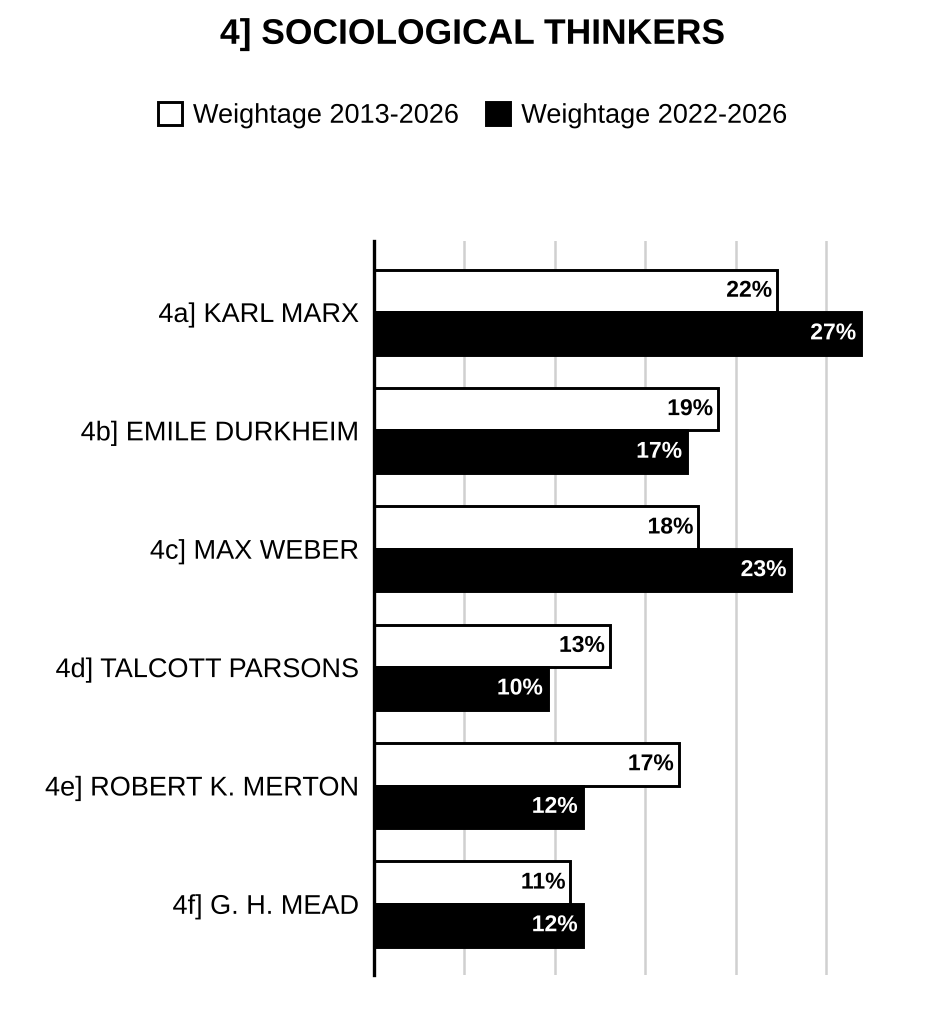
4.1] Karl Marx
31 questions
Describe the impact of capitalist mode of production on society. [2026/20m/2a]
Highlight the main features of historical materialism as propounded by Marx. How far is this theory relevant in understanding contemporary societies? Explain. [2025/20m/2b]
Critically explain the salient features of ‘alienation’ as propounded by Karl Marx. [2024/10m/3c]
What is historical materialism? Examine its relevance in understanding contemporary societies. [2023/20m/2b]
What characterizes degradation of work in capitalist society according to Marx? [2022/20m/4a]
Critically examine the dialectics involved in each mode of production as propounded by Karl Marx. [2021/20m/3b]
Critically assess the Marxian theory of ‘Alienation’. [2020/10m/7c]
How does Marx view social conflict as an essential element in social change? [2020/20m/8a]
What is the Marxist concept of ‘fetishism of commodities’? [2019/10m/150w/1c]
According to Marx, how are human beings alienated from their human potential and what does he suggest to change this? [2018/20m/4a]
Analyse Marxian conception of historical materialism as a critique of Hegelian dialectics. [2017/20m/3b]
Evaluate Marx’s ideas on mode of production. [2016/10m/150w/1d]
Identify the similarities and differences between Marx’s theory of ‘alienation’ and Durkheim’s theory of ‘anomie’. [2014/20m/2b]
According to Marx, capitalism transforms even the personal relationships between men and women. Critically examine with illustrations from the contemporary Indian context. [2014/10m/7c]
Analyse the salient features of historical materialism. [2013/10m/2c]
Compare Karl Marx with Emile Durkheim with reference to the framework of ‘division of labour’. [2013/20m/3a]
Sometimes workers do not feel attachment for their work. Marx formed a theory for this situation; discuss that theory. [2012/20m/4b]
“Work in capitalism is reduced to mere labour in which the individual does not develop freely his physical and mental energy but mortifies his body and ruins his mind.” Critically evaluate the assertion. [2010/30m/3a]
Compare Karl Marx with Emile Durkheim with reference to the framework of ‘division of labour’. [2010/30m/3b]
Examine Karl Marx’s views on ‘class-in-itself’ and ‘class-for-itself’ with reference to proletarians. [2010/30m/8b]
Comment on the responses of the functionalist school to Karl Marx’s views on social change. [2009/30m/2b]
Explain Karl Marx’s analysis of capitalistic mode of production and class-struggle. What are the intellectual reactions to his views? [2007/60m/2]
Explain Karl Marx’s ‘theory of social change’. What are the reactions of functionalists to his views? [2006/60m/2]
Write a short note on: Class struggle as conceived by Karl Marx. [2005/20m/200w/1c]
Write a short note on: Class-in-itself and class-for-itself. [2003/20m/200w/5b]
Explain Karl Marx’s conception of class-antagonism. How have the functionalists reacted to his views? [2001/60m/2]
Write a short note on: Alienation. [2000/20m/200w/1c]
“It is not the consciousness of men that determines their being, but on the contrary it is their social being that determines their consciousness.” Examine Karl Marx’s notion of mode of production in the light of this statement. [1998/60m/2]
Explain the concept of social change. Critically examine the contribution of Karl Marx’s theory of social change. [1997/60m/8]
Write a short note on: Mode of production. [1996/20m/200w/1c]
“Subjective perception of the objective reality prepares the context for the articulation of class antagonism.” Evaluate this statement with reference to Karl Marx’s contribution. [1995/60m/2]
Contribute to Optional Province
Is every Sociology question under the right topic?
We sorted 1,326 Sociology PYQs topic by topic with AI help, so a few may be in the wrong place. Help us check them: read one question, tell us if its topic is right. It takes about 10 seconds a question.
Start checking Sociology PYQs →4.2] Emile Durkheim
34 questions
How does Emile Durkheim conceptualize religion as a ‘social fact’? Explain. [2026/10m/3c]
Describe various characteristics of a ‘social fact’. How is rate of suicide a social fact according to Durkheim? [2024/10m/150w/5a]
Durkheim argued that society is more than the sum of individual acts. Discuss. [2022/10m/150w/1d]
Critically examine how Durkheim and Merton explicate Anomie. [2022/20m/3b]
Critically examine the relevance of Durkheim’s views on religion in contemporary society. [2022/10m/150w/5a]
Explain whether Durkheim’s theory of Division of Labour is relevant in the present day context. [2021/10m/150w/1d]
Critically analyse Durkheim’s views on elementary forms of religious life and role of religion. Also discuss the consequences of religious revivalism in contemporary society. [2020/20m/3b]
What are the problems in observing social facts in Durkheim’s views? [2020/10m/150w/5c]
Explain Durkheim’s basic arguments on suicide. Can you analyse high suicide rates of contemporary Indian society with Durkheim’s theory? [2018/20m/2b]
What is the difference between anomie in Merton and Durkheim? Explain. [2018/10m/3c]
Does scientific method make sociology a science? Illustrate your answer with Durkheim’s method. [2018/10m/150w/5c]
In what way did Durkheim perceive religion as functional to society? [2018/10m/8c]
Discuss distinct sociological method adopted by Emile Durkheim in his study of ‘suicide’. [2017/20m/3a]
Give an assessment of Durkheimian notion of ‘sacred’ and ‘profane’ in sociology of religion. [2017/10m/5c]
Elaborate the views of Durkheim on ‘The Elementary Forms of Religious Life’. [2015/10m/8c]
Identify the similarities and differences between Marx’s theory of ‘alienation’ and Durkheim’s theory of ‘anomie’. [2014/20m/2b]
“According to Durkheim, the essence of religion in modern society is the same as religion in primitive society.” Comment. [2014/10m/150w/5e]
Compare Karl Marx with Emile Durkheim with reference to the framework of ‘division of labour’. [2013/20m/3a]
Write a short note on: Sacred and profane. [2012/12m/150w/1e]
Show how Durkheim through the study of totemism demonstrates the reality of religion. [2012/30m/2b]
‘Social fact is to be treated as a thing.’ Discuss. [2012/20m/4c]
Compare Karl Marx with Emile Durkheim with reference to the framework of ‘division of labour’. [2010/30m/3b]
Write a short note on: Subject-matter of sociology, according to Emile Durkheim. [2009/20m/200w/1b]
Write a short note on: Social facts. [2007/20m/200w/1c]
Elaborate Emile Durkheim’s analysis of the elementary forms of religious life and role of religion in society. How does he explain existence of religion in modern industrial societies? [2007/60m/4]
What, according to Emile Durkheim, is the nature of relationship between the individual and society? Explain this with the help of his analysis of division of labour in society. [2006/60m/3]
Give a critical review of Emile Durkheim’s theory on religion and society. To what extent does it explain the contemporary scenario in Asia? [2004/60m/2]
Examine the nature of social facts as understood by Durkheim. [2002/60m/2]
What is the focus of sociological analysis in the contributions of Emile Durkheim? Give your answer with the help of any one of his contributions. [2001/60m/3]
Emile Durkheim had argued that the function of division of labour in society is that of the promotion of social solidarity. Elaborate the statement and analyse the distinction between two forms of solidarity discussed by him. [2000/60m/2]
Write a short note on: Division of labour and differentiation of social structure. [1999/20m/200w/5a]
Write a short note on: Anomie. [1997/20m/200w/1c]
“Not all facts about human behaviour are necessarily social facts.” State the meaning of ‘social facts’ and the methods of studying them with reference to this statement. [1996/60m/3]
Write a short note on: Social fact. [1995/20m/200w/1c]
4.3] Max Weber
29 questions
How does Max Weber’s ‘theory of authority’ shape bureaucracy? Analyse. [2026/10m/150w/5d]
According to Weber how do class, status and power interact to produce and sustain social inequality? [2026/20m/7b]
How does Weber’s Verstehen address the objectivity-subjectivity debate in sociology? [2025/10m/150w/5d]
Describe the main idea of Max Weber’s book, ‘The Protestant Ethic and the Spirit of Capitalism’ as a critique of Marxism. [2024/20m/3b]
How is ‘power’ different from ‘authority’? Discuss various types of authorities as theorized by Max Weber. [2024/10m/150w/5d]
Is Weber’s idea of bureaucracy a product of the historical experiences of Europe? Comment. [2023/10m/3c]
Critically examine Max Weber’s theory of Social Stratification. [2021/10m/150w/1e]
Do you agree with Max Weber’s idea that bureaucracy has the potential to become an iron cage? Justify your answer. [2021/10m/3c]
‘Ideal Types’ of Max Weber are mental constructs, they do not correspond to the reality. Give your views. [2020/10m/150w/1d]
Differentiate between ‘Life-chances’ and ‘Life-style’ with suitable examples. [2019/10m/150w/5a]
Distinguish between fact and value in Weber’s Protestant Ethic and Spirit of Capitalism. [2018/10m/150w/1b]
Which concepts did Weber use to analyse the forms of legitimate domination? [2015/10m/150w/1d]
Discuss the role of Calvinist ethic in the development of capitalism. [2015/20m/2a]
“According to Max Weber, ‘class’ and ‘status’ are two different dimensions of power.” Discuss. [2014/20m/3b]
How does Weber use the notion of ‘ideal types’ in his theory of bureaucracy? [2014/20m/4a]
Examine the salient features of Weberian bureaucracy. [2013/10m/3c]
Examine how Weber’s characterization of capitalism is different from that of Marx. [2012/30m/3b]
Write a short note on: The Protestant Ethic and the Spirit of Capitalism. [2011/12m/150w/1d]
Define ideal type and explain Weber’s concept of ‘Verstehen’ for understanding social phenomena. [2011/30m/3b]
What, according to Max Weber, is the role of “particular religious ideas” in the emergence of modern capitalism? [2009/30m/6b]
Using Max Weber’s theory, discuss what ethical and religious ideas produced capitalism in certain societies and how? [2008/60m/4]
What is the subject-matter of sociology according to Max Weber? Which major methods did he suggest for social science research? Illustrate your answer with his sociological contributions. [2007/60m/3]
Write a short note on: Concept of ideal type and its limitations. [2006/20m/200w/1b]
Discuss Max Weber’s ideal types and the role of authority in bureaucracy. [2005/60m/2]
Critically examine Max Weber’s theory of the ‘Protestant ethics and the spirit of the capitalism’. Could it be the otherwise possibility that the tenets of the capitalism must also have effected the emergence of the Protestant ethics? Comment with suitable examples. [2003/60m/4]
Critically examine Weber’s theory of Protestant Ethic and the Spirit of Capitalism. [2002/60m/3]
State the meaning and characteristics of an ideal type. What, according to Max Weber, is the use and significance of the ‘ideal type’ in social science research? [2001/60m/4]
Critically examine Max Weber’s theory of social action and its limitations. [1997/60m/3]
Explain the origin and characteristics of bureaucracy according to Max Weber. Illustrate the structural sources of dysfunctions of bureaucracy. [1996/60m/4]

Preparing for Prelims too?
Our UPSC Prelims Topic-wise PYQ Book covers every Prelims question with detailed explanations, so you can see exactly where UPSC asks from. Now available as a hard copy and an eBook.
Buy Hard Copy on AmazonBuy eBook (PDF)4.4] Talcott Parsons
20 questions
What are the ‘basic and irreducible’ functions of the family as proposed by Talcott Parsons? Explain. [2024/10m/150w/1e]
Critically analyse Parsons’ views on society as a social system. [2022/20m/7a]
Do you think Talcott Parsons gave an adequate theory of social change? Justify your answer. [2021/10m/150w/5e]
Analyse the relevance of ‘Pattern variables’ in the study of social change. [2020/10m/150w/1e]
How can Parsons’ AGIL framework be used to analyse key problems in a society? Discuss. [2018/20m/7a]
Critically analyse Talcott Parsons’ conception of ‘Pattern Variables’. [2017/10m/1d]
Describe the functional prerequisites of social system as given by Talcott Parsons. Examine in the context of a university as a social system. [2016/20m/2b]
How is social equilibrium maintained in Parsonian framework? [2015/20m/4b]
Examine the relevance of Parsonian social system in the present society. [2013/10m/6c]
Universalism vs. particularism. [2012/12m/150w/1c]
Give conceptual meaning of social system. What is cognitive consonance between ‘pattern variables’ and ‘paradigm’? [2011/30m/4a]
Write a short note on: Cybernetic hierarchy of control. [2010/15m/200w/1d]
Write a short note on: Talcott Parsons’ idea of ‘moving equilibrium’ [2009/20m/200w/1d]
Write a short note on: Relevance of pattern variables in social change. [2008/20m/200w/5a]
Write a short note on: Talcott Parsons’ concept of social system. [2007/20m/200w/1b]
Write a short note on: Social system and the pattern variables. [2003/20m/200w/1c]
Write a short note on: Functional problems of the social system. [1999/20m/200w/5d]
Write a short note on: Pattern variables. [1998/20m/200w/1c]
Discuss Talcott Parsons’ contribution to the analysis of social system. [1997/60m/4]
Discuss Talcott Parsons’ contribution to the analysis of social change. [1996/60m/2]
4.5] Robert K. Merton
27 questions
Can Merton’s reference group theory be relevant in understanding ‘identity making’ in digital world? Explain. [2025/10m/150w/1d]
Is reference group theory a universally applicable model? Elucidate. [2023/10m/150w/1d]
Critically examine how Durkheim and Merton explicate Anomie. [2022/20m/3b]
With suitable examples, explain how conformity and deviance coexist in a society as propounded by R. K. Merton. [2021/10m/4c]
What are the reactions of R. K. Merton to the functionalism of social anthropologists? Bring out the limitations of latent functions. [2020/20m/2a]
What, according to Merton, is the difference between ‘unanticipated consequences’ and ‘latent functions’? Give examples to elaborate. [2019/10m/3c]
How, according to Merton, are deviant subcultures generated? [2019/20m/8b]
What is the difference between anomie in Merton and Durkheim? Explain. [2018/10m/3c]
Analyze the manifest and latent functions of ‘security of the tenure of bureaucrats’ in the light of Merton’s theory. [2016/20m/3a]
“Anomie is rooted in social structure.” Explain with reference to R. K. Merton’s contribution. [2015/10m/4c]
How can we use reference group theory to understand fashion in society? [2014/10m/150w/1e]
How could one use Merton’s concept of deviance to understand the traffic problem in urban India? [2014/10m/2c]
Using Merton’s concepts of ‘manifest’ and ‘latent’ functions, explain the persistence of corruption in Indian society. [2014/10m/3c]
Write a short note on: Serendipity. [2010/15m/200w/1c]
To Robert Merton, deviant behaviour is a result of anomie. Analyse his sociological theory of deviant behaviour, with a special reference to his formulation of types of deviance. [2009/60m/4]
What is Merton’s view of relationship between social structure and deviance? In what sense is a deviant also a conformist? [2008/60m/6]
Write a short note on: Robert Merton’s views on manifest and latent functions. [2007/20m/200w/1d]
What are the reactions of Robert Merton to the functionalism pioneered by social anthropologists? Indicate the limitations of his idea of latent functions. [2006/60m/4]
Write a short note on: Primary and reference groups. [2003/20m/200w/1a]
Critically analyse the concept of anomie. Elaborate, with suitable examples, the theoretical relationship between nature of anomie and types of social deviations as have been formulated by R. K. Merton. [2003/60m/8]
Write a short note on: Manifest and latent functions. [2001/20m/200w/1b]
How does social structure produce a strain toward anomie and deviant behaviour? Examine it with reference to Robert K. Merton’s contribution to this field of study. [2000/60m/3]
Write a short note on: Role conflict as a source of deviation. [1999/20m/200w/1b]
Write a short note on: Social structure and Anomie. [1999/20m/200w/5c]
Write a short note on: The idea of functional indispensability. [1996/20m/200w/1d]
Bring out the strength and the weakness of Robert Merton’s advancement over the classical functionalism. [1995/60m/3]
Write a short note on: Middle-range theories. [1995/20m/200w/5a]
4.6] G. H. Mead
9 questions
Explain G. H. Mead’s idea of development of ‘self’ through the ‘generalised other’. [2024/10m/150w/5b]
According to Mead the idea of self develops when the individual becomes self-conscious. Explain. [2022/20m/6a]
According to Mead, “We play a key role in our own socialisation.” Explain. [2019/20m/2a]
Do you think ‘I’ and ‘Me’ are central terms in Mead’s work? [2018/10m/150w/1c]
“Self and society are twin-born.” Examine the statement of Mead. [2015/10m/2c]
Using Mead’s theory of symbolic interactionism, discuss the stages in the formation of gender identity. [2014/10m/4c]
Critically analyse the contributions of G. H. Mead to ‘symbolic interactionism’. [2013/20m/3b]
Critically analyse the contributions of G. H. Mead to ‘symbolic interactionism’. [2010/30m/4a]
Write a short note on: Mead’s notion of self. [2008/20m/200w/5b]

Strengthen your GS papers
Our UPSC Mains Topic-wise & Year-wise PYQ Book (2013–2026) maps every GS question to the syllabus, so you know what UPSC asks and how often. Now available as a hard copy and an eBook.
Buy Hard Copy on AmazonBuy eBook (PDF)« Previous: Research Methods and Analysis | Next: Stratification and Mobility »
Back to: Sociology Optional PYQs – Topic-wise | Also see: Sociology Optional year-wise question papers
Last updated: 30 October 2026