
Here are all 62 Economic Geography questions asked in UPSC Geography Optional Paper I from 1995 to 2026, arranged under the 6 topics of the official syllabus. Within each topic the latest questions come first.
Each question ends with a code such as [2024/15m/3b] – the year, the marks, the word limit (where UPSC set one) and the question number in the paper.
7.1] World economic development: measurement and problems
3 questions
To what extent do the regional patterns of economic development and human development in the world correspond with each other? Highlight situations of departure, in particular. [2002/60m/8]
Examine the spatial patterns of development disparity prevailing in the world. [2001/60m/6]
How far do the patterns of economic development and those of human development correspond with each other in the world? Illustrate your answer with examples. [1999/60m/8]
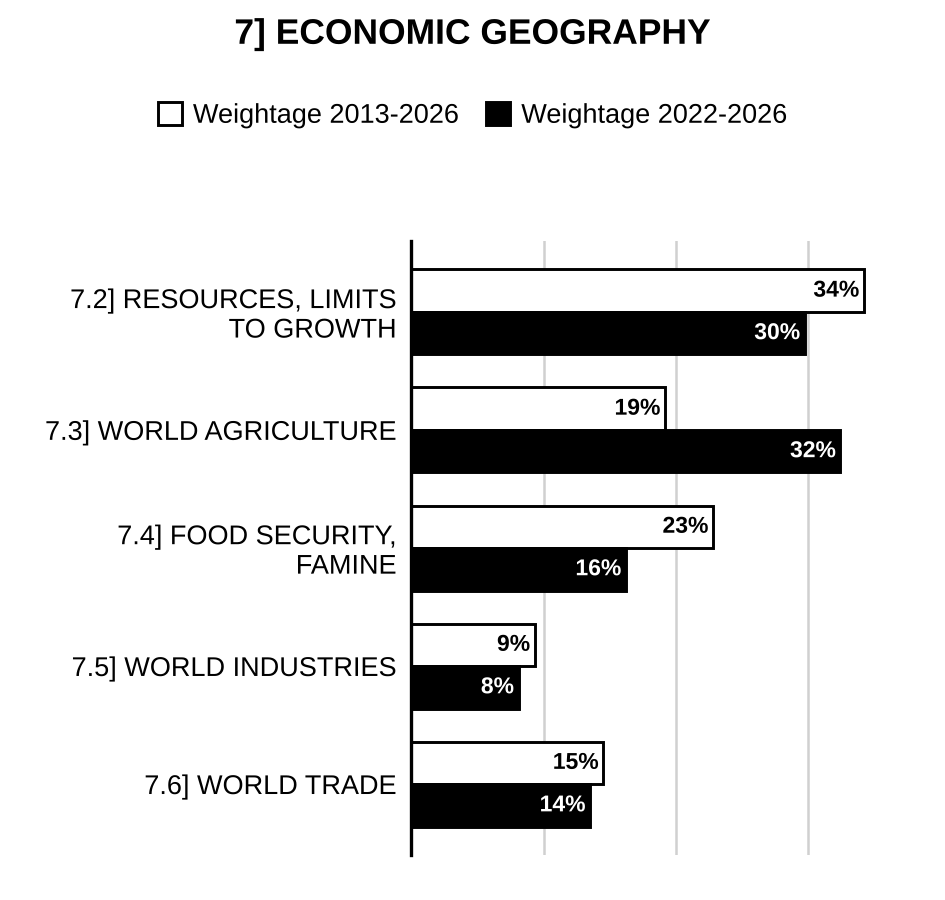
7.2] World resources and their distribution; energy crisis; the limits to growth
18 questions
What are the key environmental and economic challenges linked to the extraction and processing of critical minerals? [2025/10m/150w/5b]
Why is oil important for energy security? What is the role of oil in clean energy transition? [2025/20m/7a]
“While scarcity of water resources are felt locally, but its causes are increasingly global.” Comment. [2024/10m/150w/5b]
Explain population, resource use and development nexus in the Limits to Growth Model. Why has this model been criticized intensively? [2023/15m/6c]
How is energy transition seen as an instrument for achieving zero carbon by 2050? [2021/10m/150w/5b]
Identify the causes and effects of energy crisis, and suggest suitable measures to solve the problem. [2020/10m/150w/5b]
Discuss in brief the main thesis in “Limits to Growth” (1972) and also provide a critique of the same. [2018/15m/8c]
“The intensity of energy crisis varies regionally.” Explain. [2017/15m/6b]
“Energy mix is a step towards sustainability.” Discuss. [2015/10m/150w/5b]
Discuss environmental and economic problems associated with coal production. [2014/15m/6b]
“World is passing through a global resource dilemma.” Comment. [2014/15m/8b]
Write a short note on: Role of Venezuela in the production and export of oil. [2013/10m/150w/5b]
Write a short note on: Countries most affected in case of shut-down of Nuclear power. [2013/10m/150w/5d]
Write a short note on: ‘Limit to Growth’ Model. [2009/20m/200w/5b]
Write a short note on: Concept of limits to growth. [2003/20m/200w/5c]
Write a short note on: The limits to growth. [2000/20m/200w/5d]
Explain the term resource management. Discuss its relevance in the context of global resource scarcity and the future of mankind. [1998/60m/7]
“Water is a scarce resource in plenty.” Comment and discuss its importance in the balanced habitat development. Support your answer with examples from Asia. [1997/60m/6]
7.3] World agriculture: typology of agricultural regions; agricultural inputs and productivity
16 questions
Critically examine the significance of five functioning forms with regard to agricultural regions of the world proposed by D. Whittlesey. [2026/10m/150w/5b]
Discuss agricultural productivity and techniques adopted for computing efficiency in the levels of agricultural productivity. [2026/15m/7b]
Analyze the spatial patterns and regional specialization of plantation crops across tropical and subtropical regions. [2025/15m/6c]
Explain the basis of D. Whittlesey’s classification of agricultural regions of the world. [2024/20m/7a]
Protected cultivation assists in healthier and a larger produce. Justify with examples. [2021/10m/150w/5c]
“Whittlesey’s agricultural regions are relevant even today.” Discuss. [2017/10m/150w/5b]
“Food productivity with purity of ecosystem is the need of the hour.” Elaborate. [2014/15m/8c]
Discuss the changing pattern of production and export of Coffee in the world. [2013/10m/250w/6b]
Mention the agricultural regions as classified by Whittlesey and discuss their relevance. [2011/30m/7b]
Explain the concept of sustainable development and propose a model for agricultural development. [2007/60m/6]
Write down main agriculture types and their associated features with special reference to Whittlesey. Show these regions on the world map provided to you. [2006/60m/8]
Write a short note on: Types of Farming. [1998/20m/200w/2d]
Examine the impact of advanced agricultural technology on environment. Support your answer with examples. [1998/60m/8]
Examine the bases of classification of agricultural regions as proposed by Whittlesey and explain the causes for the essential difference between intensive subsistence tillage with rice dominant and without rice in the crop association. [1996/60m/7]
Write a short note on: Dryland farming. [1995/20m/200w/2d]
‘Man must realize the importance of maximizing agricultural production without destroying the ecological basis on which our entire food production systems rests.’ Explain with examples. [1995/60m/5]

Preparing for Prelims too?
Our UPSC Prelims Topic-wise PYQ eBook covers every Prelims question with detailed explanations, so you can see exactly where UPSC asks from.
View the BookDownload Free Sample7.4] Food and nutrition problems; food security; famine: causes, effects and remedies
12 questions
Discuss critically food and nutrition problems associated with the developing world. [2023/10m/150w/5b]
“Climate change is a serious problem to global food security and poverty eradication.” Critically examine. [2022/20m/7a]
Describe the role of accessibility and affordability in food security of developing world. [2021/15m/6b]
Analyse India’s food security in the context of population growth. [2020/10m/150w/5a]
Define stunting and wasting. Why are these more prevalent among children in developing countries? [2019/10m/150w/5b]
“Famine is a social phenomena rooted in institutional and political economic arrangements, which determine access to food by different classes and strata.” Comment. [2018/20m/7a]
“Man-induced famines are becoming more common than nature-induced ones.” Comment. [2015/15m/6b]
Give an account of food security issues in developing countries. [2014/10m/150w/5b]
Write a short note on: Population and Food security. [2011/12m/5d]
“Famine, to a considerable extent, is a man-made hazard.” Elaborate. [2010/30m/6b]
Comment on: Provide a geographical account of global production and distribution of food. [2009/30m/6a]
Write a short note on: Growth of population and food resources of the world. [1996/20m/200w/2a]
7.5] World industries: locational patterns and problems
5 questions
Analyse the spatial changes and emerging patterns of semiconductor manufacturing in the world. [2024/15m/8b]
Analyse the dynamics of industrial location in the metropolitan cities of India. [2020/15m/7b]
“A large-scale global shift in manufacturing is the outcome of deindustrialization in the developed world matched by industrialization in the developing world.” Analyze this statement. [2019/15m/6b]
Write a short note on: Problems faced by industries which developed due to inertia. [2012/12m/150w/5e]
Write a short note on: Globalization of trade and industry. [1996/20m/200w/2c]
7.6] Patterns of world trade
8 questions
“Shifting global trade patterns create new opportunities.” Examine this statement. [2022/10m/150w/5b]
“Automation is rapidly changing the economies of labour and will affect trade patterns in significant ways.” Clarify. [2022/15m/6b]
“Linkages between resource-endowed regions and resource-utilizing regions determine the pattern of international trade.” Elaborate with suitable examples. [2016/15m/8b]
Discuss the changing pattern of production and export of Coffee in the world. [2013/10m/250w/6b]
Analyse the causes for changes in the pattern of world trade. [2013/25m/400w/8b]
Comment on: Locational significance of Rotterdam in European economy. [2012/20m/250w/8c]
Discuss the role of World Trade Organisation in determining the pattern of world trade. [2010/30m/8a]
Write a short note on: Globalization of trade and industry. [1996/20m/200w/2c]

Strengthen your GS papers
Our UPSC Mains Topic-wise & Year-wise PYQ eBook (2013–2026) maps every GS question to the syllabus, so you know what UPSC asks and how often.
View the BookDownload Free Sample« Previous: Perspectives in Human Geography | Next: Population and Settlement Geography »
Back to: Geography Optional PYQs – Topic-wise | Also see: Geography Optional year-wise question papers
Last updated: 30 October 2026