
Here are all 79 Population and Settlement Geography questions asked in UPSC Geography Optional Paper I from 1995 to 2026, arranged under the 8 topics of the official syllabus. Within each topic the latest questions come first.
Each question ends with a code such as [2024/15m/3b] – the year, the marks, the word limit (where UPSC set one) and the question number in the paper.
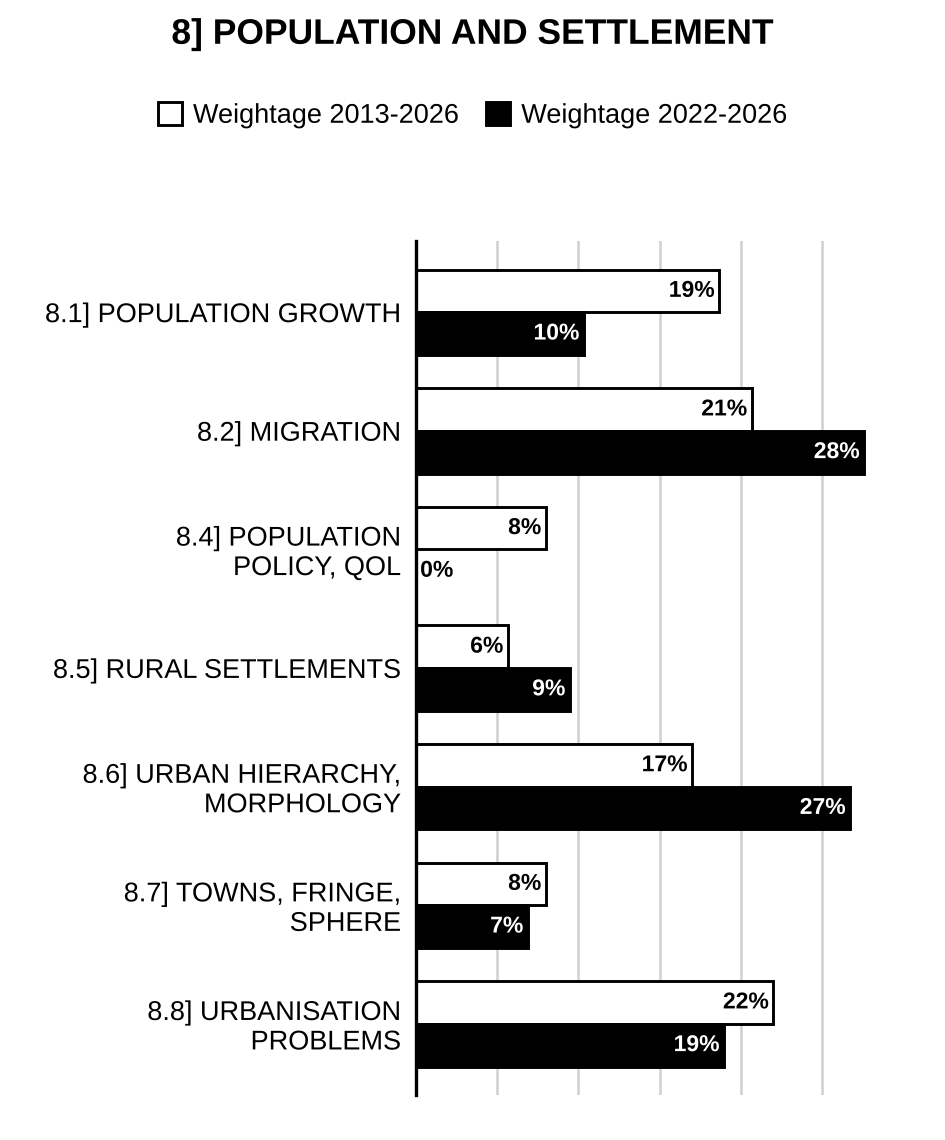
8.1] Growth and distribution of world population; demographic attributes
13 questions
“The global demographic landscape is evolving with rapid population growth in some places and rapid ageing in others.” Elucidate with examples. [2025/15m/7c]
“In developed countries, migration rather than fertility will be the main driver of population dynamics over the next few decades.” Examine the statement. [2024/15m/8c]
Aging population has adverse social and economic consequences. Explain with examples. [2021/15m/8b]
Explain the relationship between net reproductive rate (NRR) and true replacement level of population. [2019/10m/150w/5c]
Assess the challenges for countries with the largest shares of aged populations. [2019/15m/8b]
“There are considerable demographic similarities between West European nations and Japan.” Explain. [2017/15m/7b]
Describe the regional pattern of Life Expectancy in the world and bring out the challenges faced by developing countries due to increasing life expectancy. [2016/20m/7a]
“Vital statistics are necessary ingredients for development planning.” Elaborate. [2015/15m/8c]
What is Geriatrics? What are the problems associated with Geriatric population? [2013/20m/250w/6a]
Write a short note on: Similarities in the population distribution of southern continents and reasons for the same. [2012/12m/150w/5c]
Write a short note on: Status of infant mortality rate in the world. [2012/12m/150w/5d]
Comment on: Impact of changing fertility ratio on world population distribution. [2012/20m/250w/7b]
Write a short note on: Growth of population and food resources of the world. [1996/20m/200w/2a]
8.2] Causes and consequences of migration
13 questions
“The majority of migrants go only a short distance.” Explain with examples. [2026/10m/150w/5c]
Elaborate partition of Indian subcontinent and international migration in detail. [2026/15m/7c]
“Pull factors in internal migration are often based on perceptions rather than reality.” Explain. [2025/10m/150w/5c]
What is Transnationalism? Why has the scale and scope of transnational linkages of diaspora multiplied in recent times? [2024/15m/7b]
Human migration is a reflection of the balance between push and pull factors. Elaborate with reference to the most recent diaspora. [2023/10m/150w/5c]
How migration is affected by push and pull factors? Explain how these factors play a role in understanding new settlement patterns. [2022/20m/8a]
Development-induced displacement poses serious challenges. Mention its causes, consequences and solutions. [2021/20m/6a]
Distinguish between mobility and migration. What are the causes and consequences of rural to urban migration in India? [2020/10m/150w/5c]
What do you mean by ‘climate migrants’? Suggest appropriate policies and programmes for their resettlement. [2019/15m/6c]
Examine the causes and consequences of forced migration of population in the present context. [2017/15m/6c]
Critically examine the theories on population migration. [2015/15m/6c]
Write a short note on: Impact of migration on urban demography. [2012/12m/150w/5b]
Discuss the causes and consequences of population migration in the world. [2000/60m/6]
8.3] Concepts of over-, under- and optimum population; population theories
4 questions
Write a short note on: Optimum population. [2010/12m/5c]
Discuss the social and economic theories of population growth. [2008/60m/6]
Write a short note on: Concept of optimum population. [2001/20m/200w/5c]
Examine the theories about population control and explain the relative merits of these theories in limiting population growth. [1995/60m/7]
8.4] World population problems and policies; social well-being and quality of life; population as social capital
5 questions
“Controlling population growth is the sustainable solution to environmental problems.” Express your views with suitable arguments. [2018/15m/3c]
Citing examples from Asia and Europe, comment upon the contexts within which pronatalist population policies are advanced. What could be the implications of these policies on women’s workforce participation? [2018/15m/6b]
Define the quality of life and explain its parameters with adequate examples. [2017/15m/7c]
Explain the concept of social capital in relation to India. [2017/15m/8c]
“Huge populations of developing countries are not a curse. These may be and also are an asset, if situations are properly managed.” Elaborate on this assertion. [2010/30m/8b]

Preparing for Prelims too?
Our UPSC Prelims Topic-wise PYQ eBook covers every Prelims question with detailed explanations, so you can see exactly where UPSC asks from.
View the BookDownload Free Sample8.5] Types and patterns of rural settlements; environmental issues in rural settlements
3 questions
Analyse the measuring patterns of settlement in relation to the nearest Neighbour Index and Rank-Size-Rule in detail. [2026/15m/6b]
“Rural settlements are expressions of the basic relationships between human beings and their physical and social environment.” Discuss. [2023/20m/8a]
Discuss the role of site in determining the types and patterns of rural settlements. [2016/15m/6b]
8.6] Hierarchy of urban settlements; urban morphology; primate city and rank-size rule
20 questions
Discuss the Geometry of Land Values in Urban Community and delimiting the Central Business District (CBD) in detail. [2026/20m/6a]
Analyse the measuring patterns of settlement in relation to the nearest Neighbour Index and Rank-Size-Rule in detail. [2026/15m/6b]
Critically evaluate the role of primate cities in dominating the urban spheres of influence in developing countries. [2025/15m/7b]
Central Business Districts (CBDs) are in decline as the economic core of metropolitan cities. Critically examine. [2024/10m/150w/5c]
Examine the morphological factors that influence the origin and growth of towns. [2022/10m/150w/5c]
Discuss the concept of ‘Rank-Size-Rule’ given by G.K. Zipf. Is this rule relevant in Indian context? [2022/15m/8c]
Small number of mega cities are playing key role in organisation of global economics and culture. Explain. [2021/15m/7c]
Discuss the major characteristics of ‘CBD’. [2016/10m/150w/5c]
“Urban Geography is nothing but city ‘in’ area and city ‘as’ area.” Elaborate. [2013/25m/400w/8a]
Evaluate the various models on population density distribution in urban centres. [2012/30m/400w/6a]
“Colonial forces resulted in the primate pattern of urban process in most Southeast Asian countries.” Discuss. [2012/20m/250w/7c]
Write a short note on: Secondary cities in the context of urbanization in developing world. [2011/12m/5b]
Bring out the sequential improvements in models of city structure by E.W. Burgess, Homer Hoyt, and Harris and Ullman. [2010/30m/7b]
Write a short note on: Primate Cities. [2008/20m/200w/5b]
In Urban Geography, what are the concept of primate city and Rank size rule? Discuss in detail. [2006/60m/6]
Write a short note on: Concept of primate city. [2005/20m/200w/5d]
Write a short note on: Rank-Size Rule. [2000/20m/200w/5c]
Write a short note on: Primate city. [1999/20m/200w/2d]
Bring out the contrast between the internal structure of the pre-industrial and industrial cities. [1999/60m/7]
Explain and illustrate the models of internal structure of cities as proposed by Burgess and Hoyt. Mention also the limitations of these models. [1995/60m/8]
8.7] Functional classification of towns; sphere of urban influence; rural-urban fringe; satellite towns
8 questions
Explain the problems and prospects of urban expansion in the context of urban fringe in developed and developing nations. [2023/20m/6a]
Discuss Nelson’s method of functional classification of towns. [2015/10m/150w/5c]
Explain the qualitative and quantitative methods of delineation of the sphere of urban influence. [2014/20m/8a]
Write a short note on: Misra’s theoretical stages of Rural – Urban Process. [2013/10m/150w/5c]
Write a short note on: Relevance of distance decay principle in Indian cities. [2012/12m/150w/5a]
Write a short note on: Delineation of Urban Fringe. [2007/20m/200w/5d]
Examine the concept of sphere of urban influence and discuss the qualitative and quantitative methods used in its delimitation. [2003/60m/7]
Write a short note on: Rural-urban fringe. [1997/20m/200w/2d]
8.8] Problems and remedies of urbanization; sustainable development of cities
13 questions
What are the principles of urban planning? Critically analyse town planning in India in the post independence period. [2026/20m/8a]
The urbanisation process is particularly pronounced in Asia and Africa, where too many urban residents grapple with extreme poverty, exclusion, vulnerability and marginalisation. Discuss. [2024/20m/6a]
“Over crowding leads to chronic problem of shortage of housing in Indian cities.” Explain citing relevant examples. [2022/15m/6c]
Discuss the problems associated with the living environment in million plus cities in India. How can these be managed? [2020/10m/150w/1e]
Discuss the concept of urban resilience in the context of planning for sustainable development with reference to towns and cities of India. [2020/20m/7a]
What changes in the current planning, management and governance of human settlements are needed to face the changing environment including climate change and disaster vulnerabilities in cities? [2019/20m/7a]
Explain the concepts of “megalopolis” and “exopolis” with regard to the growth of cities indicating whether the two can and do overlap. [2018/10m/150w/5c]
Discuss the factors responsible for counter-urbanisation. [2014/10m/150w/5c]
“Rural sustainability is necessary for urban sustainability.” Discuss the statement in the backdrop of integrated development approach. [2014/20m/7b]
“Urban Solid Waste Management poses the greatest challenge in Metropolitan planning.” Elaborate. [2013/20m/250w/7a]
“Though 70% of Indian population is rural, urban planning is crucial to the development of India.” Discuss. [2012/30m/400w/6b]
Comment on: Regional shifts in the world urbanization after 1950 and the varied characteristics of urban process. [2012/20m/250w/8a]
Elaborate the concept of Megalopolis and discuss the characteristics and problems related to two such regions selecting one each from North America and Europe. [2009/60m/7]

Strengthen your GS papers
Our UPSC Mains Topic-wise & Year-wise PYQ eBook (2013–2026) maps every GS question to the syllabus, so you know what UPSC asks and how often.
View the BookDownload Free Sample« Previous: Economic Geography | Next: Regional Planning »
Back to: Geography Optional PYQs – Topic-wise | Also see: Geography Optional year-wise question papers
Last updated: 30 October 2026