
Here are all 81 Climatology questions asked in UPSC Geography Optional Paper I from 1995 to 2026, arranged under the 8 topics of the official syllabus. Within each topic the latest questions come first.
Each question ends with a code such as [2024/15m/3b] – the year, the marks, the word limit (where UPSC set one) and the question number in the paper.
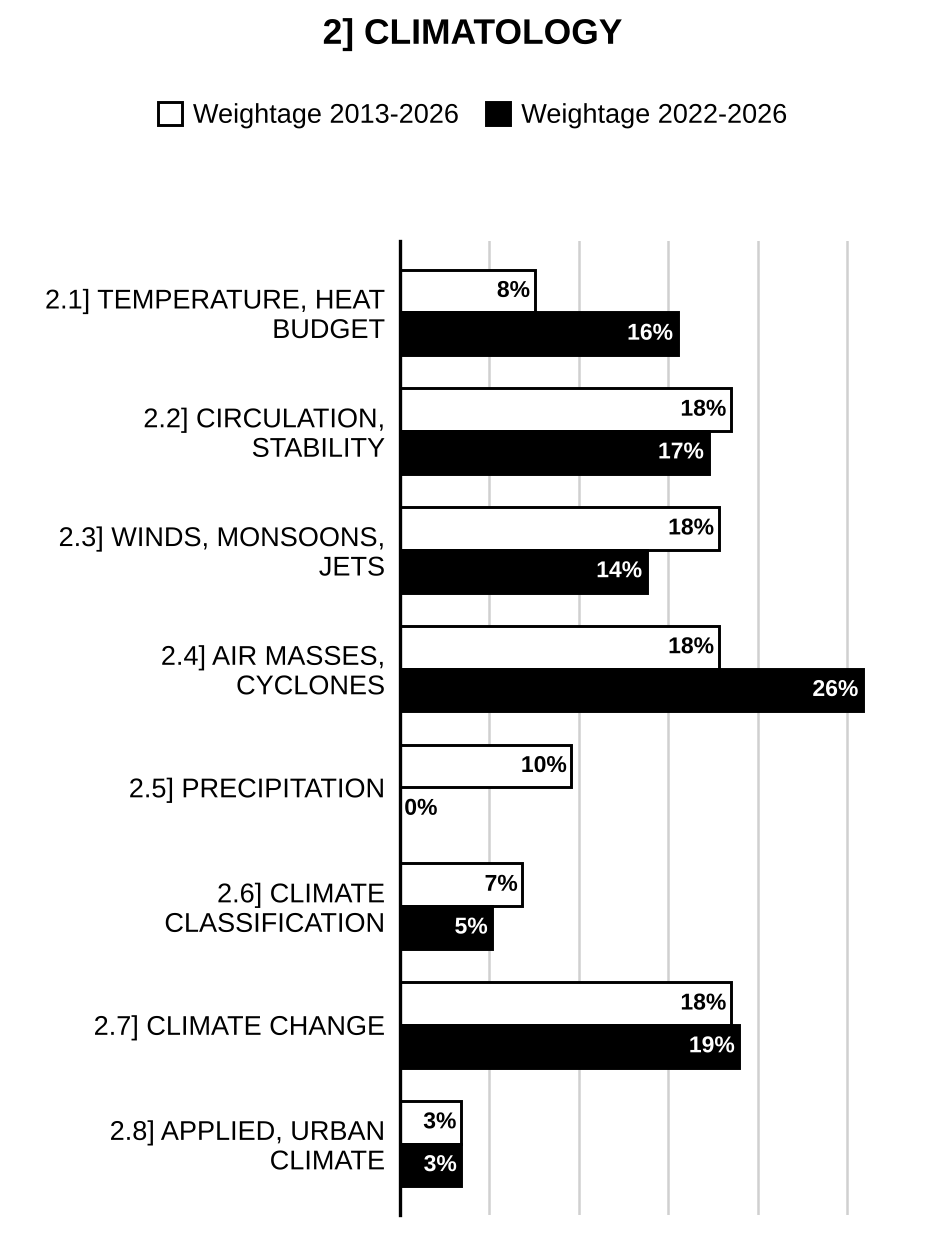
2.1] Temperature and pressure belts of the world; heat budget of the earth
7 questions
Examine the distribution and balance of energy in the Earth’s atmosphere system. [2025/15m/4b]
How does inversion of temperature occur? Explain its significance on local weather with suitable examples. [2023/15m/4c]
Describe how short term variations in temperature are related to the processes of receiving energy from the sun to the Earth’s surface and dissipating it to the atmosphere. [2022/15m/4b]
Differentiate between insolation and temperature and explain anomalous temperature. [2016/10m/150w/1b]
Write a short note on: Inversion of temperature. [2010/15m/200w/1c]
Discuss the nature and composition of earth’s atmosphere. [1998/60m/4]
Write a short note on: Inversion of temperature. [1995/20m/200w/2b]
2.2] Atmospheric circulation; atmospheric stability and instability
10 questions
Describe the general characteristics and structure of a thunderstorm and suggest suitable classification of thunderstorm. [2026/20m/3a]
Examine the formation of atmospheric tricellular circulation system. Describe with example its importance in making the Earth a living planet. [2025/20m/3a]
What is “Geostrophic Wind”? Explain the relationship between barometric slope and air circulation. [2023/10m/150w/1a]
Indicating the causes of lightning, describe the threats associated with it. [2021/15m/4c]
Discuss in detail the tri-cellular model of atmospheric circulation. [2019/20m/3a]
Discuss the forces which govern the air movement on the Earth’s surface. [2017/20m/2a]
Explain the meridional circulation of the atmosphere and its importance in world climate. [2015/15m/4c]
Describe the origin and development of thunderstorms with examples. [2014/15m/2b]
Write a short note on: Tropical atmospheric instability. [2009/20m/200w/5c]
Discuss the mechanism and significance of tricellular meridional circulation of atmosphere. [2003/60m/3]
2.3] Planetary and local winds; monsoons and jet streams
12 questions
Define ‘pseudo monsoon’ and explain its spatial distribution. [2026/10m/150w/1b]
Explain the relationship between air masses and local winds. [2025/10m/150w/1d]
What are the causes of origin of local winds? Discuss their significance on prevailing weather and climate in various regions, with suitable examples. [2023/20m/3a]
Explain how various factors influence the origin and development of the Indian monsoon system. [2020/20m/3a]
Explain the origin, progress and retreat of the Indian monsoon and discuss its impact on the Indian economy. [2018/20m/3a]
Discuss the salient features of ‘sirocco’ and ‘mistral’. [2014/10m/150w/1b]
Discuss the nature and origin of Indian monsoon and recent techniques of its prediction. [2014/20m/3a]
Comment on: With suitable examples, bring out the impact of local winds on the climate of an area. [2013/20m/250w/2a]
Comment on: Impact of failure of Monsoon on Gujarat Agro-climatic zone. [2012/20m/250w/8b]
Write a short note on: Rossby waves and Jet Stream. [2011/12m/150w/1b]
Discuss the mechanics and origin of the monsoon winds and explain the role of El Nino on Monsoon circulation. [2008/60m/3]
Discuss the development of local winds, and their influence on local weather, giving three examples of the well-known local winds in the world. [2007/60m/2]
2.4] Air masses and fronts; temperate and tropical cyclones
18 questions
Examine the importance of axis of dilation of airmasses in frontogenesis and the origin of Temperate cyclones. [2026/15m/4b]
Formation of temperate cyclone depends on the condition of axis of dilation. Elucidate. [2024/10m/150w/1b]
Explain air masses and associated weather dynamics. How do air masses influence the weather conditions of the Northern Hemisphere? [2024/20m/3a]
Explain the characteristics and weather conditions associated with ‘Anticyclones’ giving suitable examples. [2023/15m/2b]
With suitable examples describe the impacts of movement of airmasses on weather and winds in different parts of the continents. [2022/15m/3b]
What are the important factors responsible for airmass modifications? [2021/10m/150w/1b]
Explain the characteristic features of Frontogenesis and Frontolysis. [2020/15m/3c]
Discuss the impacts of ocean currents on air mass behaviour. [2017/10m/150w/1c]
Compare the origin and weather conditions associated with the tropical and temperate cyclones. [2016/15m/2b]
Discuss as to how frontogenesis contributes to weather instability. [2015/10m/150w/1b]
Compare and contrast tropical cyclone and temperate cyclone. [2012/12m/150w/1c]
Comment on: Classify airmasses and explain how ‘cP’ airmass affects global climate. [2012/30m/400w/2b]
What is ‘polar front’? How does cyclone develop along this front? Describe the weather conditions associated with it. [2010/30m/3a]
Compare the structure and associated weather conditions of tropical cyclone with that of temperate cyclone. [2006/60m/3]
Discuss the concept of air masses and present their classification. [2001/60m/3]
Make a comparative study of the tropical and temperate cyclones. [1999/60m/4]
Define air masses. How do they originate? Classify them and state the characteristics of any one type. [1997/60m/4]
Explain the life-cycle of a temperate cyclone and also describe the weather associated with it. [1995/60m/4]

Preparing for Prelims too?
Our UPSC Prelims Topic-wise PYQ eBook covers every Prelims question with detailed explanations, so you can see exactly where UPSC asks from.
View the BookDownload Free Sample2.5] Types and distribution of precipitation; hydrological cycle
9 questions
Examine major influencing factors for varied patterns of precipitations on the continents. [2021/20m/3a]
Explain the techniques to calculate potential evapotranspiration suggested by Thornthwaite. [2019/10m/150w/1b]
Explain the role of evaporation in the hydrologic cycle. [2018/10m/150w/1b]
What is Potential Evapotranspiration? Explain how it is used in assessing the water balance in an area. [2015/15m/2b]
Discuss Dew point and the various forms of condensation. [2013/15m/250w/3b]
Give an account of global distribution of precipitation. [2011/30m/3a]
Examine the various kinds of atmospheric humidity and their associated forms. [2010/30m/3b]
Write a short note on: Potential evapotranspiration. [2004/20m/200w/5c]
Give an account of the types and distribution of precipitation on the surface of the earth. [2000/60m/3]
2.6] Weather and climate; Koppen’s, Thornthwaite’s and Trewartha’s classification of world climate
7 questions
Describe latitudinal distribution of Koppen’s classification of world climate. [2024/15m/2b]
Critically examine the basis and scheme of climatic classification proposed by G.T. Trewartha. [2018/15m/2b]
Discuss the basis of Koppen’s climatic classification. Bring out the salient characteristics of ‘Cs’ type of climate. [2015/20m/3a]
Discuss the main features of the climatic classification system evolved by Koppen. Also point out its anomalies. [2005/60m/3]
Discuss the criteria which Thornthwaite adopted for his 1948 classification of world climates. [2002/60m/3]
Write a short note on: Cs type of climate, as per Koeppen’s classification. [1999/20m/200w/2a]
Examine critically the drawbacks of Koppen’s Classification of climates. Explain how Thornthwaite attempted to overcome Koppen’s limitations. [1996/60m/4]
2.7] Global climatic change and role and response of man in climatic changes
16 questions
Write an essay on disease and global warming according to the report of Intergovernmental Panel on Climate Change (IPCC). [2026/15m/6c]
How is carbon neutrality essential for future environmental conservation? Describe various efforts taken by nations in this regard. [2024/20m/4a]
Rise of surface temperature brings severe consequences. Elaborate the potential changes and threats associated with it in the world. [2022/20m/4a]
Explaining the concept of carbon neutrality, describe the measures taken by carbon positive and negative nations. [2021/15m/3c]
Explain the concept of micro carbon sink and its relevance. [2017/10m/150w/1e]
“Climate change is a reality.” Explain with suitable examples. [2017/20m/3a]
Give a reasoned account on how the impact of Global Warming differs from one part of the Earth to the other. [2016/15m/2c]
Discuss the significance of World Climate Research Programme (WCRP) and its core projects in the understanding of climatic change. [2016/20m/3a]
Write a short note on: Major components of IGBP. [2012/12m/150w/1d]
Comment on: Impact of Cryosphere on global climate. [2012/20m/250w/3c]
Comment on: Programmes initiated by the International Council of Science on Earth System studies. [2012/20m/250w/4b]
“Contemporary global climate change is an anthropogenic phenomenon.” Discuss. [2011/30m/3b]
Explain factors contributing to the global climate change. [2009/20m/4a]
Discuss the consequences of Climate Change on agriculture and food security, and on the Coastal Zones of the world. [2009/20m/4b]
How does Climate change affect urban areas? [2009/20m/4c]
How would the impact of global warming differ from one part of the earth to another? Give a reasoned account. [2004/60m/3]
2.8] Applied climatology and urban climate
2 questions
What is pollution dome? Discuss its formation and impacts. [2022/10m/150w/1c]
Explain the nature of urban climates and their impact on global environmental change. [2019/15m/2c]

Strengthen your GS papers
Our UPSC Mains Topic-wise & Year-wise PYQ eBook (2013–2026) maps every GS question to the syllabus, so you know what UPSC asks and how often.
View the BookDownload Free Sample« Previous: Geomorphology | Next: Oceanography »
Back to: Geography Optional PYQs – Topic-wise | Also see: Geography Optional year-wise question papers
Last updated: 30 October 2026