
Here are all 87 Geomorphology questions asked in UPSC Geography Optional Paper I from 1995 to 2026, arranged under the 9 topics of the official syllabus. Within each topic the latest questions come first.
Each question ends with a code such as [2024/15m/3b] – the year, the marks, the word limit (where UPSC set one) and the question number in the paper.
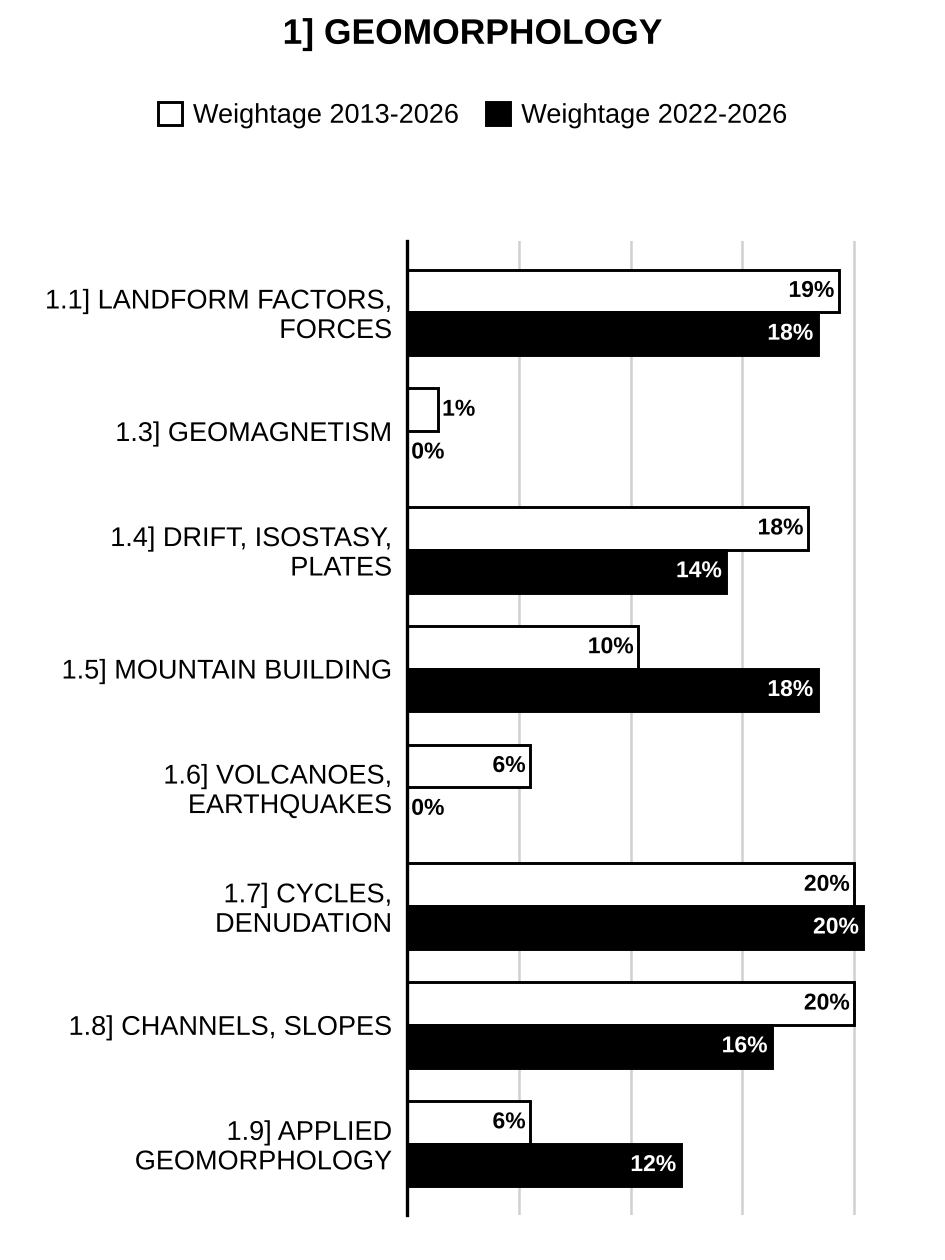
1.1] Factors controlling landform development; endogenetic and exogenetic forces
21 questions
What is solifluction? What are its impacts? [2025/10m/150w/1b]
Describe the process of formation of barrier islands and explain their significance. [2025/15m/4c]
What are ‘truncated spurs’? Where and how are they formed? [2024/10m/150w/1a]
Define ‘speleothem’. Discuss the various forms and features of speleothems. [2022/10m/150w/1a]
Describe the concept of ‘Altiplanation’. [2021/10m/150w/1a]
How are sandspits and tombolos formed? [2019/10m/150w/1c]
Distinguish between low energy coasts and coral coasts. [2017/10m/150w/1b]
Describe the “Basket of eggs topography”. [2016/10m/150w/1a]
“Geological structure has a dominant control on landforms and is reflected on them.” Discuss. [2016/15m/4b]
Comment on: Attempt a classification of geomorphic processes from the zonal point of view. [2015/10m/150w/1a]
Explain weathering and mass wasting, and describe their geomorphic significance. [2014/20m/4a]
What is ‘Base level’? Explain the types of base level. [2013/15m/250w/2c]
Name the climatically controlled agents of erosion. Explain how they differ in terms of properties of matter. Compare the landforms produced by each one of them. [2011/30m/2a]
Write a short note on: Essential conditions for the development of karst topography. [2010/15m/200w/1a]
“Weathering is a complex phenomenon involving a number of processes and is influenced by various factors.” Elaborate. [2010/30m/2b]
“Structure is a dominant control factor in the evolution of landforms.” Discuss with suitable examples. [2005/60m/2]
Describe the landforms which are products of endogenetic forces. [2004/60m/2]
Write a short note on: Peneplain. [2004/20m/200w/5a]
Write a short note on: Geomorphic processes. [1998/20m/200w/2b]
Write a short note on: Weathering and soil formation. [1997/20m/200w/2c]
Discuss the processes of mechanical and chemical weathering and show their relationship with soil formation. [1996/60m/3]
1.2] Origin and evolution of the earth’s crust; physical conditions of the earth’s interior
2 questions
Bring out the relevance of seismic study in determining the structure of the interior of the earth. [2010/30m/2a]
Write a short note on: Role of seismic waves in the study of earth’s interior. [2005/20m/200w/5a]
1.3] Fundamentals of geomagnetism
2 questions
Write a geographical note on Halloween Storm. [2020/10m/150w/1a]
Write a short note on: Geomagnetism and paleomagnetism. [2011/12m/150w/1a]
1.4] Geosynclines; continental drift; isostasy; plate tectonics
20 questions
“The Himalaya is still rising.” Expand this statement and describe the processes involved in it with suitable sketches and examples. [2025/15m/3c]
“Evidences from palaeomagnetism and sea floor spreading have validated that continents and ocean basins have never been stationary.” Elucidate with suitable diagrams. [2023/20m/2a]
The concept of Plate tectonics has been derived from the isostasy and continental drift theory. Elaborate citing suitable examples. [2021/20m/2a]
Write an essay on the evolution of continents and oceans using various theories and models. [2020/20m/2a]
Compare and contrast different types of plate boundaries. [2019/15m/2b]
State the concept of plate tectonics. How does it help in explaining the formation of the Himalayas and Appalachian Mountains? [2014/20m/2a]
Write a short note on: Impact of Pleistocene Ice Age on the crust of the Earth. [2013/10m/150w/1d]
“Offshore Acoustic Study helped the development of the concept of sea floor spreading.” Explain. [2013/20m/250w/3a]
Write a short note on: Palaeozoic glacial evidence for Continental Drift. [2012/12m/150w/1a]
Write a short note on: Geomagnetism and paleomagnetism. [2011/12m/150w/1a]
Explain the concept of Isostasy as postulated by Airy and Pratt. [2011/30m/2b]
Write a short note on: Seafloor spreading theory. [2008/20m/200w/5c]
Define the concept of isostasy and discuss the postulation of Airy and Pratt. [2007/60m/4]
Critically evaluate the continental drift hypothesis of A. Wegener. [2006/60m/2]
Write a short note on: Geosyncline. [2002/20m/200w/5a]
Present a critical analysis of the theory of Isostasy. [2001/60m/2]
With reference to the theory of Plate Tectonics, explain the origin and growth of the young Fold Mountain Systems of the world. [2000/60m/2]
Bring out the distinctions between the ‘continental drift’ theory and the ‘plate tectonics’ theory. [1999/60m/3]
Discuss the concept of volcanicity and show how the theory of Plate Tectonics explains the mechanism of volcanism and volcanic eruptions. [1998/60m/3]
Discuss the limitations of the theory of Continental Drift and show how the theory of Plate Tectonics is an improvement over it. [1995/60m/3]

Preparing for Prelims too?
Our UPSC Prelims Topic-wise PYQ eBook covers every Prelims question with detailed explanations, so you can see exactly where UPSC asks from.
View the BookDownload Free Sample1.5] Recent views on mountain building
6 questions
What geological and tectonic processes lead to the formation of nappes in orogenic belts? [2025/10m/150w/1c]
Examine the recent views on mountain building process and divide the world mountains on the basis of their genesis. [2024/20m/2a]
With the help of suitable sketches describe the mountain genesis and mountain types. Give suitable examples from various mountain systems of the world. [2022/15m/4c]
Evaluate how far Kober’s geosynclinal theory explains the mountain building process. [2018/20m/2a]
State the concept of plate tectonics. How does it help in explaining the formation of the Himalayas and Appalachian Mountains? [2014/20m/2a]
With reference to the theory of Plate Tectonics, explain the origin and growth of the young Fold Mountain Systems of the world. [2000/60m/2]
1.6] Volcanicity; earthquakes and tsunamis
4 questions
Describe phreatic eruptions and their consequences. [2019/10m/150w/1a]
Discuss the methods of measuring the intensity and magnitude of earthquakes. How are seismic zones demarcated? [2019/20m/4a]
Write a note on pseudovolcanic features. [2017/10m/150w/1a]
Discuss the concept of volcanicity and show how the theory of Plate Tectonics explains the mechanism of volcanism and volcanic eruptions. [1998/60m/3]
1.7] Concepts of geomorphic cycles and landscape development; denudation chronology
16 questions
How does denudation chronology help in understanding the sequential development of landscapes and landforms? Elucidate. [2025/20m/2a]
Define Peneplains. Describe the landscape features associated with peneplains under different geomorphic cycles. [2023/15m/3b]
Discuss the role of Slope, Altitude and Relief (SAR) in landscape development. [2022/15m/3c]
Comment on: “Landscape is a function of structure, process and stage.” Critique the statement. [2018/10m/150w/1a]
Discuss the concept of Periglacial cycle as propounded by Peltier. [2017/20m/4a]
“In explaining the concept of ‘Pediplanation’, King combined the ideas of Davis, Penck and Wood with his own.” Elaborate. [2016/20m/2a]
Discuss the contributions of the American School of Subaerial Denudation in geomorphology. [2015/20m/2a]
“Present-day landforms bear more complexity than simplicity.” Elucidate. [2015/15m/4b]
Write a short note on: Differences between Normal cycle and Arid cycle of Davis. [2013/10m/150w/1a]
Write a short note on: Systems approach to landform analysis. [2012/12m/150w/1b]
Comment on: Characteristics of the standard epigene cycle of erosion. [2012/20m/250w/4a]
Highlight the geomorphic features essentially found in topographies under the second cycle of Erosion. [2009/20m/200w/1a]
Critically examine the concept of geomorphic cycle and discuss the views of W.M. Davis and W. Penck. [2008/60m/2]
Explain the sequential development of landforms associated with the coastal areas. [2003/60m/2]
Provide a critique of the ‘geographical cycle’ model, propounded by Davis. [2002/60m/2]
Discuss the concept of polycyclic landforms and present an analytical study of the polycyclic landforms of a selected region. [1997/60m/3]
1.8] Channel morphology; erosion surfaces; slope development
12 questions
What is ‘Helical’ flow? How Helical flow accounts for meander modifications? [2026/10m/150w/1a]
What is a Yazoo stream? Why are Yazoo basins the areas of repeated flooding? Give examples of Yazoo stream/areas from various parts of the world. [2024/15m/4b]
Explain how various aspects of channel morphology are used in transportation, settlement and land use planning, flood control and flood management? [2022/15m/2b]
Stream basins and drainage divides are important components to delineate a watershed area. Explain. [2021/15m/4b]
Discuss the problems of erosional surfaces and explain the different methods to identify them with suitable diagrams. [2020/20m/4a]
“The knowledge of slope analysis has limited field application in the slope management.” Explain. [2017/15m/2b]
“Climate, slope gradient and rock structure influence the avulsion of channels.” Explain. [2017/15m/4b]
Explain with examples as to how channel dynamics has been responsible for the development of alluvial fans and cones. [2015/15m/3b]
Define the term ‘meander’ and describe the basic characteristics of entrenched meander and ingrown meander. [2014/10m/150w/1a]
State the concept of erosion surfaces and highlight the factors responsible for their development. [2014/15m/3b]
Explain how Böschung and Haldenhang lead to the Theory of Slope Replacement. [2012/30m/400w/2a]
Discuss views on slope development provided by L.C. King. [2009/20m/200w/1c]
1.9] Applied geomorphology: geohydrology, economic geology and environment
4 questions
“Environmental geomorphology deals with the impact of natural landforms and processes.” Elucidate with suitable examples. [2026/20m/2a]
What are the environmental implications of economic geology? Discuss. [2023/10m/150w/1e]
Why is mapping important for analysing geo-hydrological investigations? Explain with relevant examples. [2020/10m/150w/1b]
Discuss how different types of mining lead to different types of environmental problems. [2012/20m/250w/3a]

Strengthen your GS papers
Our UPSC Mains Topic-wise & Year-wise PYQ eBook (2013–2026) maps every GS question to the syllabus, so you know what UPSC asks and how often.
View the BookDownload Free SampleNext: Climatology »
Back to: Geography Optional PYQs – Topic-wise | Also see: Geography Optional year-wise question papers
Last updated: 30 October 2026