
Every question in this collection of Aryans and Vedic Period History Optional PYQs (1995–2026) is given below with its year, marks and question number. It is unit 5 of Paper 1, Section A – Ancient India, with 32 questions, the latest from 2026.
Aryans and Vedic Period – History Optional PYQs (1995–2026)
5.1] Expansion of Aryans in India
1. How do the comparative study of languages, archaeological sources and vast corpus of Vedic literature help to determine the Aryan problem in Indian history? Discuss. [2023/15m/2c]
2. Critically examine various views regarding the Vedic-Harappan relationship in light of the latest discoveries. [2017/15m/3a]
3. “Archaeology knows of no Aryans; only literature knows of Aryans.” Examine critically. [2015/15m/2c]
5.2] Vedic period: religious and philosophic literature
1. Though some of the ideas of Buddhism may have had their origin in Vedic-Upanishadic traditions but it was an altogether new religion with its own specific principles and institutions. Discuss. [2022/15m/2c]
2. Do you consider that the Upanishadic principles embody the high point of Vedic religious thought? Comment. [2021/15m/2b]
3. Throw light on the nature of religion and classification of gods mentioned in the Rigveda. [2020/20m/2c]
4. There are no literary sources for the Harappan culture and no archaeological evidence for the Vedic period. Explain the phenomenon. [2019/20m/3c]
5. The concept of Shramanic religions, with particular reference to Buddhism, had their roots in Upanisadic ideas. Discuss. [2018/15m/3b]
6. How far can the ancient Indian Sruti literature be used as historical sources? [2015/15m/2a]
7. “The Upanishadic principles embody the epitome of the Vedic thought.” Discuss. [2014/15m/2b]
8. Evaluate the conceptual basis of the Vedic deities. [2011/30m/3a]
9. Examine the view that the sacrifice was a ritual and a form of social exchange in Vedic India. [2010/30m/3a]
10. Evaluate the various approaches to the understanding of Vedic religion. [2009/30m/3a]
11. Write a short essay on: Vedic rituals. [1997/20m/200w/1a]
12. Write a short essay on: Vedic literature. [1995/20m/200w/1a]

Preparing for Prelims too?
Our UPSC Prelims Topic-wise PYQ eBook covers every Prelims question with detailed explanations, so you can see exactly where UPSC asks from.
View the BookDownload Free Sample5.3] Transformation from Rig Vedic period to the later Vedic period
1. Examine how the transformation of the Varna system from the Rigvedic to the Later-Vedic period affected the position of women. [2019/15m/3b]
2. In what way was the egalitarian character of the early Vedic society changed during the later Vedic period? [2016/15m/2c]
3. Evaluate the introduction of iron technology in the development of human history of ancient India. [2011/20m/4a]
4. Describe the social life of the later Vedic people. How was it different from the Rig-Vedic life? [2004/60m/2]
5. Give a brief account of the social and economic conditions of the Later Vedic Aryans. What role did iron play in changing their political and economic life? [1998/60m/2]
5.4] Political, social and economic life
1. Discuss the evolution of State institution and taxation system from Rigvedic period to later Vedic period. [2024/15m/3c]
2. Evaluate various views regarding human settlements as gleaned from the Vedic sources. [2013/15m/2a]
3. Examine the view that the sacrifice was a ritual and a form of social exchange in Vedic India. [2010/30m/3a]
4. Describe the social life of the later Vedic people. How was it different from the Rig-Vedic life? [2004/60m/2]
5. Give a brief account of the social and economic conditions of the Later Vedic Aryans. What role did iron play in changing their political and economic life? [1998/60m/2]
5.5] Significance of the Vedic Age
1. Analyze the significance of the Vedic Age in shaping the social institutions, religious thoughts and intellectual traditions of ancient India. [2026/15m/4b]
5.6] Evolution of Monarchy and Varna system
1. Discuss the evolution of State institution and taxation system from Rigvedic period to later Vedic period. [2024/15m/3c]
2. Examine how the transformation of the Varna system from the Rigvedic to the Later-Vedic period affected the position of women. [2019/15m/3b]
3. In what way was the egalitarian character of the early Vedic society changed during the later Vedic period? [2016/15m/2c]
4. “The copious references to the preservation of Varnashrama system by the kings eulogized in inscriptions are mere reflection of the Smriti tradition.” Discuss. [2016/15m/4b]
5. Social norms for women in the Dharmasastra and Arthasastra tradition were framed in accordance with the Varnashrama tradition. Evaluate critically. [2013/20m/3b]
6. “The varna concept may always have been largely a theoretical model and never an actual description of society.” Comment in the context of Ancient India. [2013/15m/3c]
Summary of Aryans and Vedic Period PYQs (1995–2026)
| Total questions (1995–2026) | 32 (26 unique – a few questions are listed under more than one sub-topic) |
| Total marks asked | 555 (unique questions) |
| Questions in last 5 years (2022–2026) | 5 (4 unique) |
| Most recent year asked | 2026 |
| Sub-topics | 6 (5.1 to 5.6) |
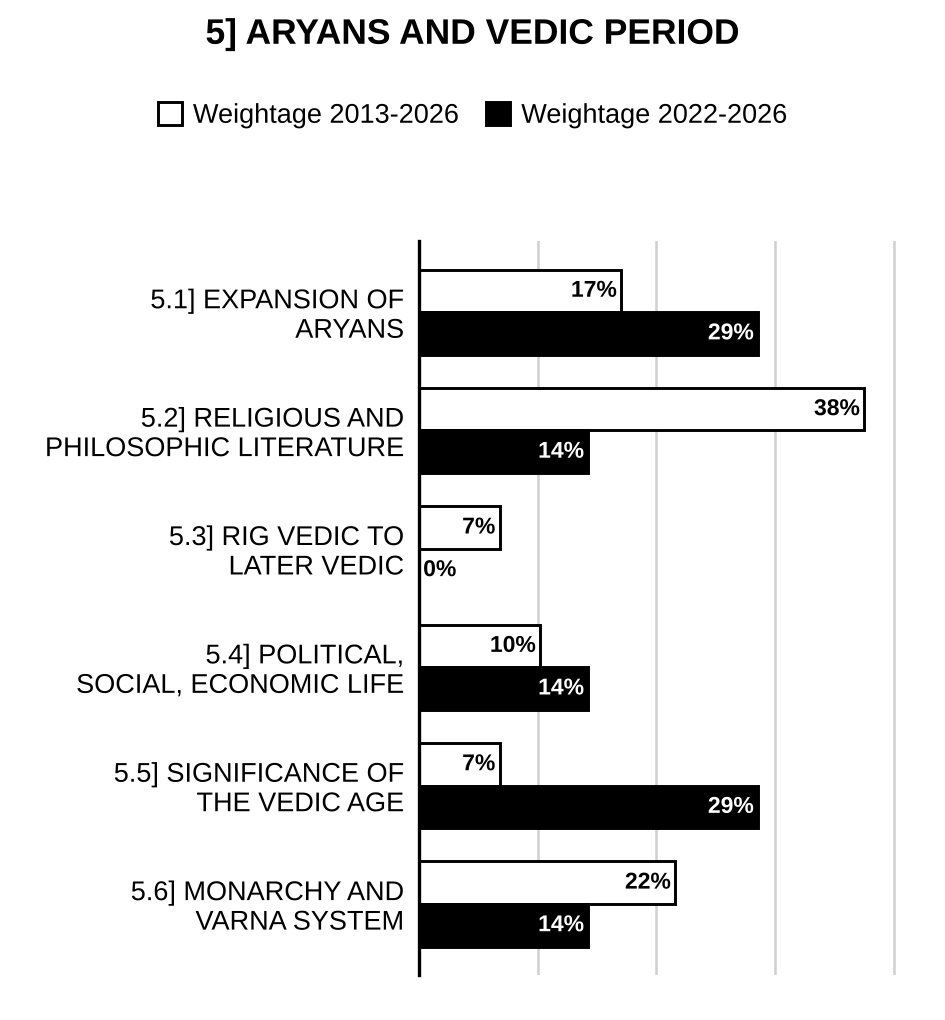
The earliest question here dates from 1995 and the latest from 2026; UPSC has drawn on this unit in 20 of the 32 years. In the last five years (2022–2026), 5 questions were set from it.
Official Syllabus
5. Aryans and Vedic Period: Expansions of Aryans in India. Vedic Period: Religious and philosophic literature; Transformation from Rig Vedic period to the later Vedic period; Political, social and economical life; Significance of the Vedic Age; Evolution of Monarchy and Varna system.
Source: UPSC Civil Services Examination 2026 notification.
Where this unit stands in Ancient India
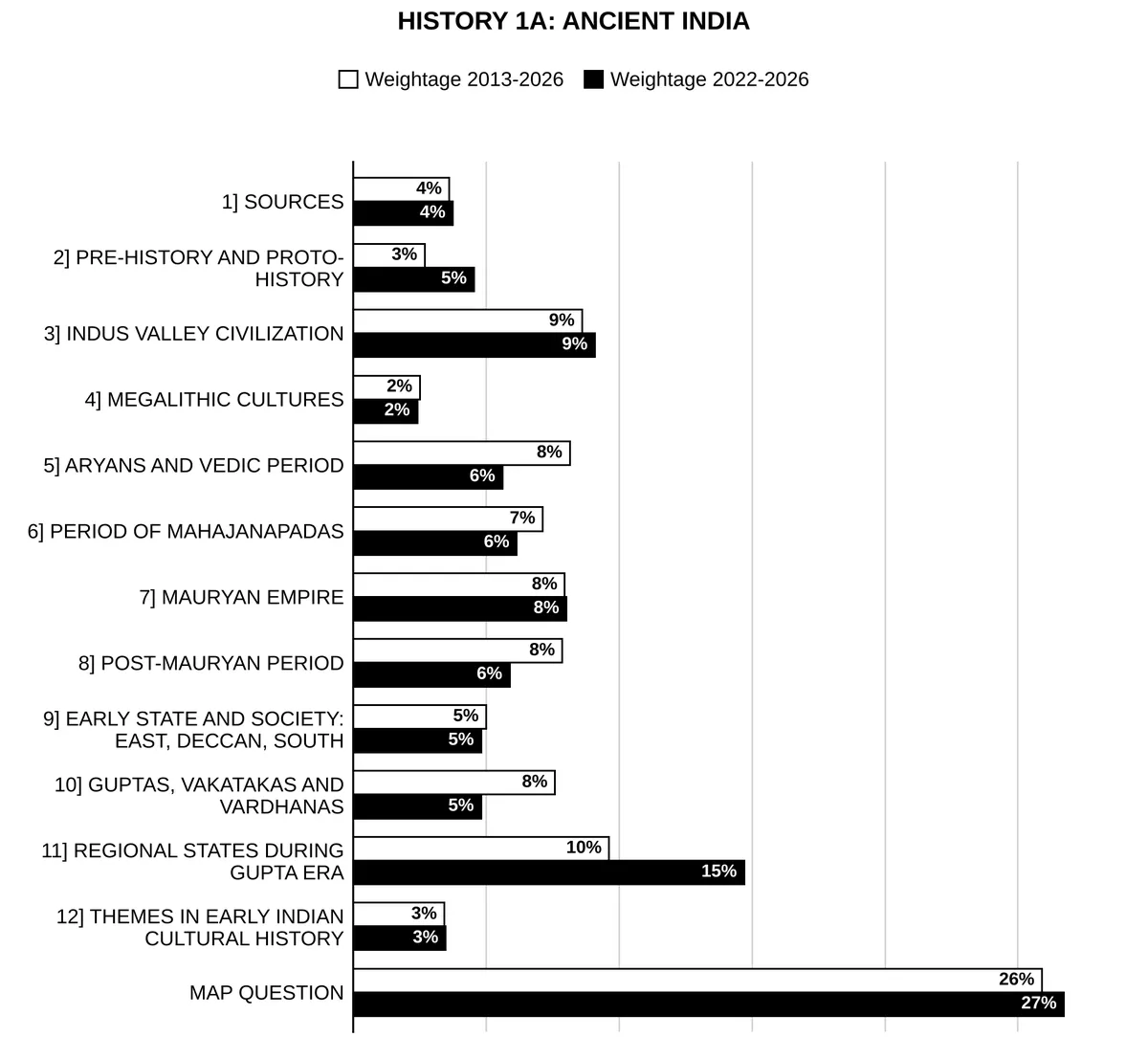
Aryans and Vedic Period accounted for about 6% of the marks asked in Ancient India (the map question included) in 2022–2026, down from 8% over 2013–2026, ranking 6th of the 12 units in the section by recent weightage.
How to use these PYQs
- Compare the questions with the official syllabus wording above – themes that recur across years deserve the deepest notes.
- Give priority to the recent questions (2013 onwards follow the present 250-mark paper pattern); use the pre-2013 questions to test your depth of content.
- Practise answers within the word limit shown in the question code (for example 150w or 250w) and under timed conditions, then revise them after a week.
Frequently Asked Questions
How many History Optional questions have been asked from Aryans and Vedic Period?
This collection lists 32 question entries from Aryans and Vedic Period (unit 5 of Paper 1) between 1995 and 2026, of which 26 are unique questions; the rest are listed under more than one sub-topic. They were asked in 20 of the 32 years and 5 came in 2022–2026.
When was Aryans and Vedic Period last asked in History Optional?
Most recently in 2026, with 1 question (2026/15m/4b). Before that, it was asked in 2024.
Where can I find all History Optional PYQs topic-wise?
All units of Paper 1 and Paper 2, the map question and the earlier-syllabus questions are linked from History Optional PYQs Topic-wise (1995–2026).
« Previous: Megalithic Cultures – History Optional PYQs (1995–2026)
Next: Period of Mahajanapadas – History Optional PYQs (1995–2026) »
Back to: History Optional PYQs Topic-wise (1995–2026) | Also see: History Optional year-wise question papers (1995–2026)