
This page brings together all Period of Mahajanapadas History Optional PYQs asked in UPSC Civil Services Mains from 1995 to 2026, arranged topic-wise. It is unit 6 of Paper 1, Section A – Ancient India, with 27 questions, the latest from 2026.
Period of Mahajanapadas – History Optional PYQs (1995–2026)
6.1] Formation of States (Mahajanapada): Republics and monarchies
1. “The origin of the territorial republics has been traced to the reaction against the pattern of life that evolved in the later Vedic period.” Analyse. [2025/15m/3a]
2. Give an account of gana-sanghas (non-monarchical state systems)? Why did they decline? [2018/15m/2c]
3. Examine the relationship among economic growth, urbanization and State formation from c. 7th century BCE to 3rd century BCE. [2016/15m/3a]
6.2] Rise of urban centres, trade routes and economic growth
1. “The ideological challenge posed by Jainism and Buddhism was deeply rooted in the socio-economic transformations brought about by the expansion of agrarian settlements in eastern India.” Explain. [2025/20m/2c]
2. Discuss the factors that played an important role in the process of urbanisation after the Later-Vedic period. [2020/15m/2b]
3. Examine the relationship among economic growth, urbanization and State formation from c. 7th century BCE to 3rd century BCE. [2016/15m/3a]
4. How far is it correct to say that changes in the post-Vedic economy gave birth to new religious movements in India? [2015/20m/3a]
5. Trace the role of guilds and trade organisations in the development of early Indian economy. [2015/15m/4a]
6. Trace the development of urbanization from the third millennium B.C.E. to 6th century B.C.E. [2011/60m/2]
7. Assess the role of guilds and trade organizations in the development of early Indian economy. [2010/30m/3b]
8. “The Sixth century B.C. was a period of religious and economic unrest in India.” Comment. [2003/60m/3]
9. Write a short essay on: Social and economic conditions of North India during the pre-Mauryan period (600–325 B.C.) [1996/20m/200w/1b]

Preparing for Prelims too?
Our UPSC Prelims Topic-wise PYQ eBook covers every Prelims question with detailed explanations, so you can see exactly where UPSC asks from.
View the BookDownload Free Sample6.4] Spread of Jainism and Buddhism
1. “The ideological challenge posed by Jainism and Buddhism was deeply rooted in the socio-economic transformations brought about by the expansion of agrarian settlements in eastern India.” Explain. [2025/20m/2c]
2. Though some of the ideas of Buddhism may have had their origin in Vedic-Upanishadic traditions but it was an altogether new religion with its own specific principles and institutions. Discuss. [2022/15m/2c]
3. “The political and economic needs of rulers, combined with economic and status needs of the merchant class, together provided the receptive cultural milieu in which Buddhism flourished.” Comment. [2021/20m/4a]
4. The concept of Shramanic religions, with particular reference to Buddhism, had their roots in Upanisadic ideas. Discuss. [2018/15m/3b]
5. Buddhism and Jainism were social movements under the umbrella of religion. Comment. [2017/15m/4b]
6. How far is it correct to say that changes in the post-Vedic economy gave birth to new religious movements in India? [2015/20m/3a]
7. Buddha’s teachings to a large extent could be helpful in understanding and resolving the problems of today’s society. Analyse critically. [2014/15m/4a]
8. Assess the importance of Jain tenets and their relevance to humanity. [2011/30m/3b]
9. Write what you know of the rise and spread of Buddhism before the first century A.D. [2007/60m/3]
10. Explain the social aspects of Buddhism and account for its decline in India. [2004/60m/3]
11. “The Sixth century B.C. was a period of religious and economic unrest in India.” Comment. [2003/60m/3]
12. Write a short essay on: Essence of early Jainism. [1995/20m/200w/1b]
6.5] Rise of Magadha and Nandas
1. Analyse the causes of the success of the Magadhan imperialism upto the reign of Ashoka the Great. [2001/60m/2]
6.6] Iranian and Macedonian invasions and their impact
1. “The Iranian and Macedonian invasions reshaped ancient India through administrative influence, political transformation and cultural interaction.” Review. [2026/15m/3a]
2. A number of scholars considered Alexander as ‘The Great’, although long term impacts of Alexander’s invasion on India need to be re-evaluated. Comment. [2020/15m/3b]
Summary of Period of Mahajanapadas PYQs (1995–2026)
| Total questions (1995–2026) | 27 (23 unique – a few questions are listed under more than one sub-topic) |
| Total marks asked | 625 (unique questions) |
| Questions in last 5 years (2022–2026) | 5 (4 unique) |
| Most recent year asked | 2026 |
| Sub-topics | 5 (6.1 to 6.6) |
The earliest question here dates from 1995 and the latest from 2026; UPSC has drawn on this unit in 18 of the 32 years. In the last five years (2022–2026), 5 questions were set from it.
Official Syllabus
6. Period of Mahajanapadas: Formation of States (Mahajanapada): Republics and monarchies; Rise of urban centres; Trade routes; Economic growth; Introduction of coinage; Spread of Jainism and Buddhism; Rise of Magadha and Nandas. Iranian and Macedonian invasions and their impact.
Source: UPSC Civil Services Examination 2026 notification.
Where this unit stands in Ancient India
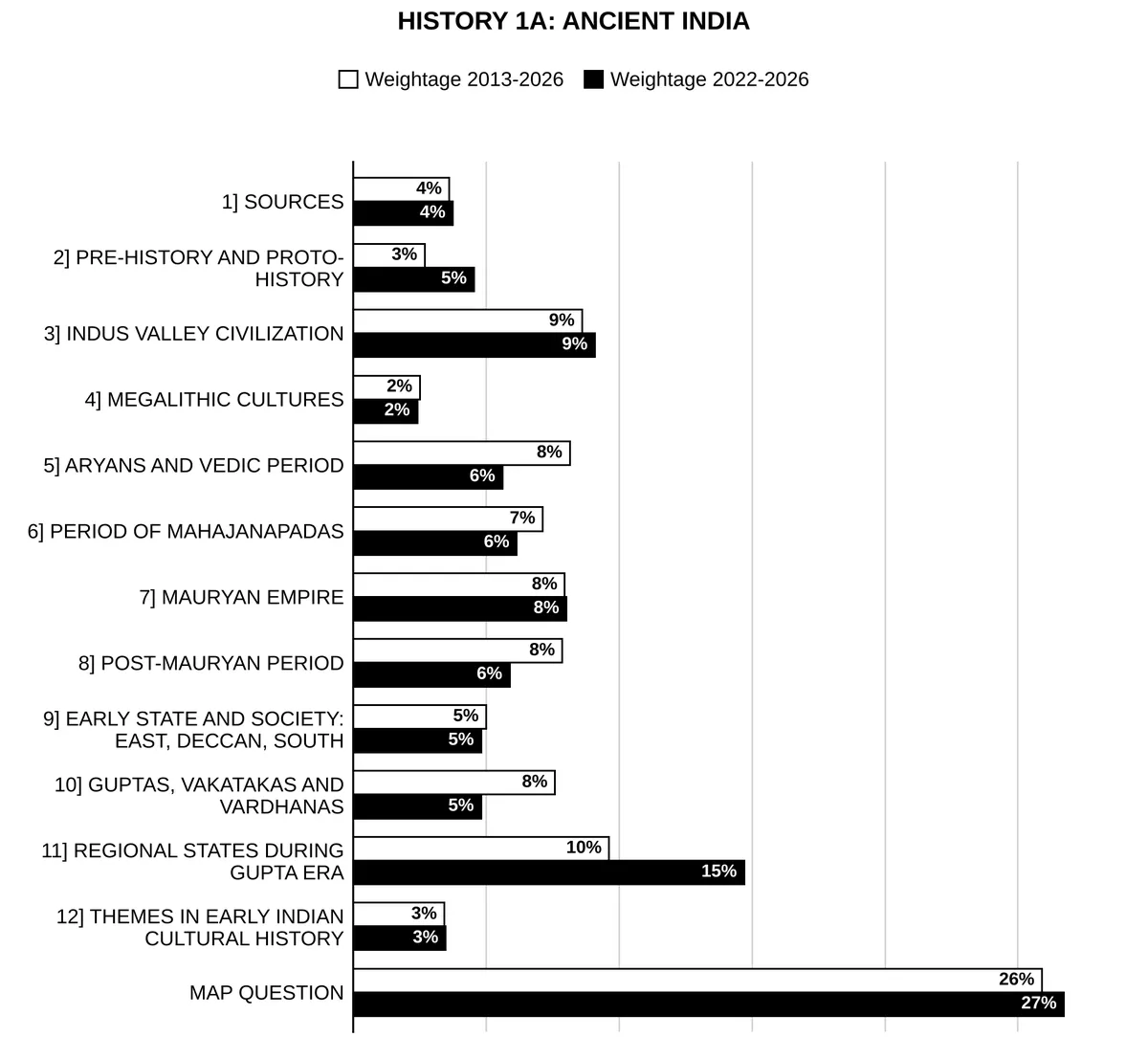
Period of Mahajanapadas accounted for about 6% of the marks asked in Ancient India (the map question included) in 2022–2026, down from 7% over 2013–2026, ranking 4th of the 12 units in the section by recent weightage.
How to use these PYQs
- Map every question to a phrase of the official syllabus shown above; recurring phrases show where UPSC’s interest lies.
- Start with the latest questions at the top of each list to see how UPSC frames this unit today; the older 60-mark questions are still useful for depth and content.
- Write timed answers to a few questions every week, keeping to the marks and word limit in each code, and revisit questions you found difficult.
Frequently Asked Questions
How many History Optional questions have been asked from Period of Mahajanapadas?
This collection lists 27 question entries from Period of Mahajanapadas (unit 6 of Paper 1) between 1995 and 2026, of which 23 are unique questions; the rest are listed under more than one sub-topic. They were asked in 18 of the 32 years and 5 came in 2022–2026.
When was Period of Mahajanapadas last asked in History Optional?
Most recently in 2026, with 1 question (2026/15m/3a). Before that, it was asked in 2025.
Where can I find all History Optional PYQs topic-wise?
All units of Paper 1 and Paper 2, the map question and the earlier-syllabus questions are linked from History Optional PYQs Topic-wise (1995–2026).
« Previous: Aryans and Vedic Period – History Optional PYQs (1995–2026)
Next: Mauryan Empire – History Optional PYQs (1995–2026) »
Back to: History Optional PYQs Topic-wise (1995–2026) | Also see: History Optional year-wise question papers (1995–2026)