
Here is the complete set of Fifteenth and Early Sixteenth Century: Political Developments and Economy History Optional PYQs from UPSC Mains 1995–2026, taken from our topic-wise question bank.
Fifteenth and Early Sixteenth Century: Political Developments and Economy – History Optional PYQs (1995–2026)
18.1] Rise of Provincial Dynasties
1. Discuss the contributions of Bahmani Sultans to the development of Indo-Islamic architecture. [2024/20m/8a]
2. The prolonged conflict between the Vijayanagara Kingdom and the Bahmani successor states was influenced less by cultural factors, and more by strategic and economic considerations. Comment. [2022/20m/7c]
3. Describe village polity and economy of medieval Deccan. [2020/15m/7a]
4. Assess the rule of Zainul Abedin in Kashmir. [2019/10m/150w/5c]
5. Evaluate Jonaraja’s account of the reign of Zain-ul-Abidin. [2016/10m/5c]
6. Assess the contribution of Firoz Shah Bahamani and Mahmud Gawan in the field of education. [2016/15m/7c]
7. Make an estimate of Rana Kumbha as a patron of literature and art. [2015/20m/7a]
8. Discuss the state of society and economy of the Bahmani kingdom as gleaned from historical sources. [2013/10m/150w/5b]
9. Analyze how the political process of state formation of Mewar from 10th–15th century CE was challenged in the 16th century CE by the imperialist policy of Akbar. [2013/15m/8a]
10. Write a short essay on: The Bahamani Kingdom. [2007/20m/200w/5b]
11. Write a short essay on: The Bahmani kingdom. [2005/20m/200w/5b]
18.2] The Vijayanagara Empire
1. From the Portuguese merchant Domingo Paes’ description of Krishnadevaraya’s reign, assess the socio-economic and cultural uniqueness of the Vijayanagara Empire. [2026/15m/7a]
2. The prolonged conflict between the Vijayanagara Kingdom and the Bahmani successor states was influenced less by cultural factors, and more by strategic and economic considerations. Comment. [2022/20m/7c]
3. Describe in detail about the foreign travellers’ accounts which gave information of Vijayanagar kingdom. [2020/10m/150w/5b]
4. Amuktamalyada dwells much upon the relationship of fort, Brahmanas and dispersed tribal groups. Comment. [2020/15m/6b]
5. Do you agree that convergence of political vacuum and impact of Islamicate culture and polity in peninsular India has much to do with the growth of Vijayanagara kingdom? [2018/15m/7a]
6. Evaluate the accounts of foreign travellers about the Vijayanagar Empire. [2017/10m/150w/5b]
7. Mention the salient features of the polity of Vijayanagara Empire under Krishnadevaraya. [2015/10m/150w/5c]
8. To what extent is ‘Segmentary State’ model relevant for defining the Vijayanagar State? Critically examine. [2014/20m/8a]
9. On the basis of contemporary sources evaluate the system of agriculture and irrigation of the Vijayanagar kingdom. [2013/15m/6b]

Preparing for Prelims too?
Our UPSC Prelims Topic-wise PYQ eBook covers every Prelims question with detailed explanations, so you can see exactly where UPSC asks from.
View the BookDownload Free Sample18.3] Lodis
1. Why did the abdication of power by Alauddin Alam Shah in favour of Bahlol Lodi not culminate in the establishment of the Lodi Dynasty? Elucidate. [2026/15m/6b]
2. What factors do you attribute for the decline of the Delhi Sultanate? [2023/10m/150w/5d]
3. Give your assessment of Bahlul Lodi’s relation with his nobility. [2021/15m/6b]
4. How was the Afghan nobility responsible for the decline of the Afghan empires? Discuss. [2012/30m/8b]
18.4] Mughal Empire, first phase
1. Examine the causes of Babur’s success against Ibrahim Lodi in the First Battle of Panipat. [2021/10m/150w/5d]
2. How does Tuzuk-i-Babri testify that Babar had been a cultured man? [2015/10m/150w/5e]
3. Comment on the Turco-Mongol theory of sovereignty. To what extent was it adopted by Babur and Humayun? [2010/30m/7a]
4. Write a short essay on: Hemu Vikramaditya. [2001/20m/200w/5b]
18.5] The Sur Empire: Sher Shah’s administration
1. Evaluate the contribution of Sher Shah towards trade and commerce, administration and agricultural reforms. [2020/15m/8a]
2. How was the Afghan nobility responsible for the decline of the Afghan empires? Discuss. [2012/30m/8b]
3. Write a short essay on: Sher Shah combined in himself qualities of lion and fox. [1999/20m/200w/5b]
4. Make a comparative review of the agrarian reforms of Alauddin Khalji and Sher Shah Suri. [1995/60m/7]
18.6] Portuguese colonial enterprise
1. Portuguese maritime power disrupted the character of trade in the Indian Ocean in the 16th century. Review. [2025/15m/7a]
2. Highlight the features of Portuguese colonial enterprise. [2024/10m/150w/5e]
3. How was Cartaz system used by the Portuguese to maintain their control over the oceanic trade? [2014/10m/150w/5e]
4. Write a short essay on: Significance of the arrival of the Portuguese in India. [2008/20m/200w/5b]
5. Examine the factors which were responsible for opening and development of European trade in India during the 16th and 17th centuries. [2006/60m/8]
18.7] Bhakti and Sufi Movements
1. “The Sufis created a climate in which people belonging to different sects and religions could live in peace and harmony.” Discuss. [2026/10m/150w/5d]
2. “Religious themes inspired a large section of literature in provincial languages in late medieval India.” Comment. [2025/10m/150w/5a]
3. Analyze the tenets, spread and impact of the Bhakti Movement. [2023/20m/4a]
4. The Vaishnava Bhakti tradition of the fifteenth century contributed to the flourishing of provincial literature. Discuss with appropriate examples. [2022/20m/8c]
5. The mission of Kabir was to preach a religion of love which would unite all castes and creeds. Explain. [2020/20m/7c]
6. Sufi and Bhakti thoughts ennobled Indian psyche amidst the vagaries of time. Elucidate. [2019/15m/6c]
7. “Bhakti and Sufi movements served the same social purpose.” Discuss. [2017/15m/6b]
8. Bhakti and mysticism of Lal Ded emerged as a social force in Kashmir. Comment. [2013/10m/150w/5e]
9. Discuss and evaluate critically various trends in the historiography of bhakti. [2013/15m/7c]
10. Write a short essay on: Chaitanyadeva and Vaishnavism. [2005/20m/200w/5d]
11. Discuss the growth of the Nirguna School of Bhakti Movement emphasising the contribution of Kabir and Nanak to it. [2004/60m/7]
12. What impact did Kabir and Nanak leave on Indian Society and Culture? [2003/60m/7]
Summary of Fifteenth and Early Sixteenth Century: Political Developments and Economy PYQs (1995–2026)
| Total questions (1995–2026) | 49 (47 unique – a few questions are listed under more than one sub-topic) |
| Total marks asked | 910 (unique questions) |
| Questions in last 5 years (2022–2026) | 12 (11 unique) |
| Most recent year asked | 2026 |
| Sub-topics | 7 (18.1 to 18.7) |
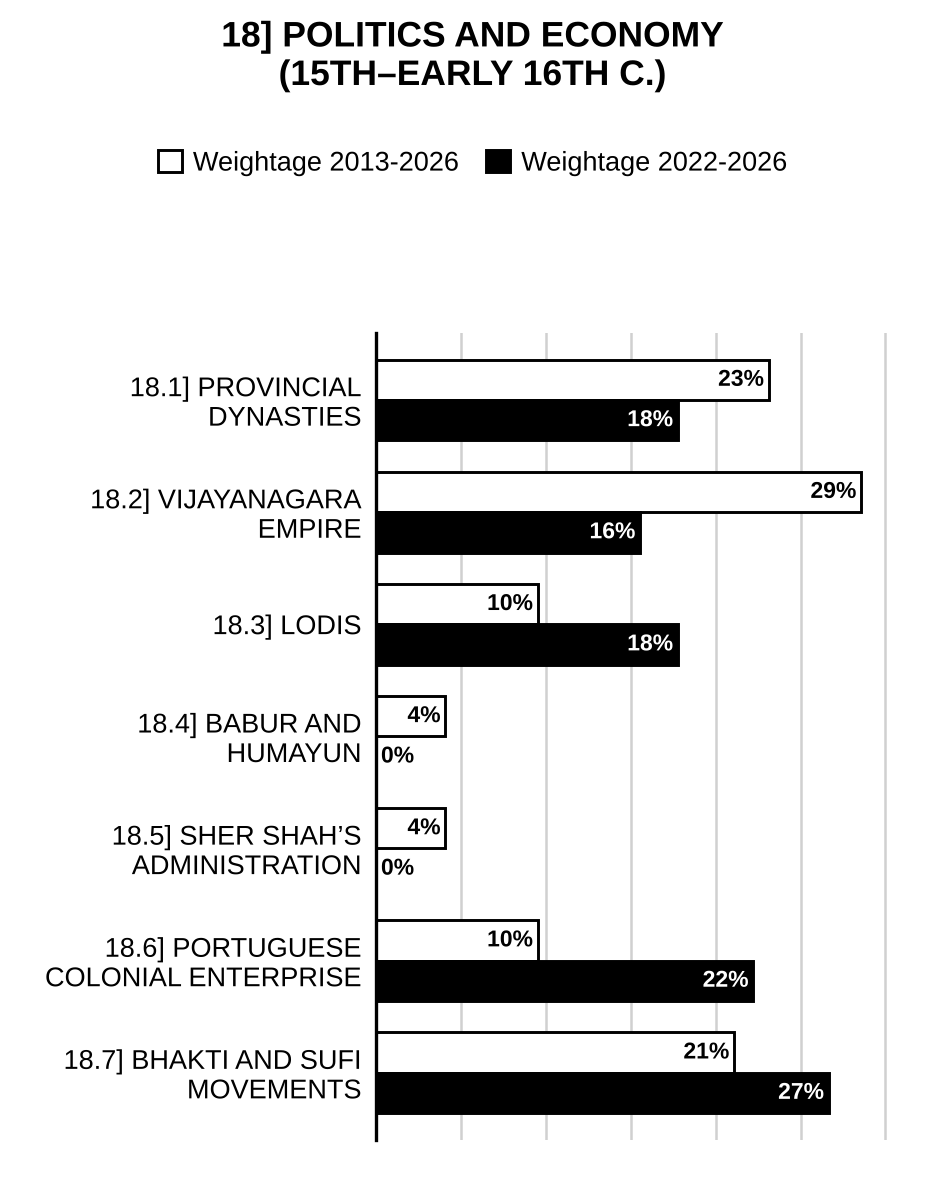
The earliest question here dates from 1995 and the latest from 2026; UPSC has drawn on this unit in 25 of the 32 years. In the last five years (2022–2026), 12 questions were set from it.
Official Syllabus
18. The Fifteenth and Early Sixteenth Century – Political Developments and Economy
- Rise of Provincial Dynasties: Bengal, Kashmir (Zainul Abedin), Gujarat.
- Malwa, Bahmanids.
- The Vijayanagara Empire.
- Lodis.
- Mughal Empire, first phase: Babur, Humayun.
- The Sur Empire: Sher Shah’s administration.
- Portuguese colonial enterprise, Bhakti and Sufi Movements.
Source: UPSC Civil Services Examination 2026 notification.
Where this unit stands in Medieval India
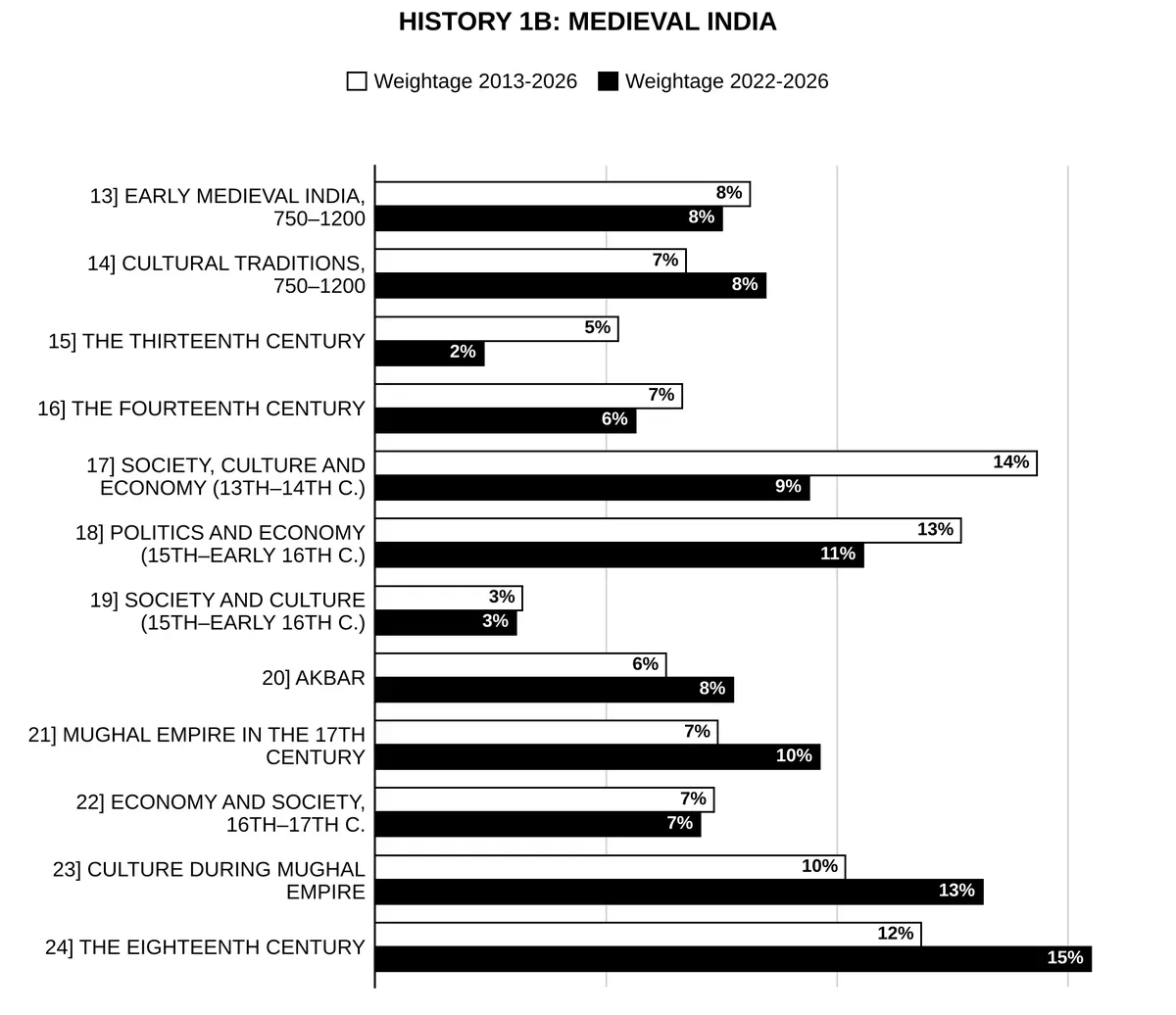
Fifteenth and Early Sixteenth Century: Political Developments and Economy accounted for about 11% of the marks asked in Medieval India in 2022–2026, down from 13% over 2013–2026, ranking 3rd of the 12 units in the section by recent weightage.
How to use these PYQs
- Map every question to a phrase of the official syllabus shown above; recurring phrases show where UPSC’s interest lies.
- Start with the latest questions at the top of each list to see how UPSC frames this unit today; the older 60-mark questions are still useful for depth and content.
- Write timed answers to a few questions every week, keeping to the marks and word limit in each code, and revisit questions you found difficult.
Frequently Asked Questions
How many History Optional questions have been asked from Fifteenth and Early Sixteenth Century: Political Developments and Economy?
This collection lists 49 question entries from Fifteenth and Early Sixteenth Century: Political Developments and Economy (unit 18 of Paper 1) between 1995 and 2026, of which 47 are unique questions; the rest are listed under more than one sub-topic. They were asked in 25 of the 32 years and 12 came in 2022–2026.
When was Fifteenth and Early Sixteenth Century: Political Developments and Economy last asked in History Optional?
Most recently in 2026, with 3 questions (2026/15m/7a, 2026/15m/6b, 2026/10m/150w/5d). Before that, it was asked in 2025.
Where can I find all History Optional PYQs topic-wise?
All units of Paper 1 and Paper 2, the map question and the earlier-syllabus questions are linked from History Optional PYQs Topic-wise (1995–2026).
« Previous: Society, Culture and Economy in the 13th and 14th Centuries – History Optional PYQs (1995–2026)
Next: Fifteenth and Early Sixteenth Century: Society and Culture – History Optional PYQs (1995–2026) »
Back to: History Optional PYQs Topic-wise (1995–2026) | Also see: History Optional year-wise question papers (1995–2026)