
Use this list of Imperialism and Colonialism History Optional PYQs to see how UPSC has examined this part of the syllabus between 1995 and 2026. It is unit 20 of Paper 2, Section B – World History, with 36 questions, the latest from 2026.
Imperialism and Colonialism – History Optional PYQs (1995–2026)
20.1] South and South-East Asia
1. The historical causes for the rise of anti-colonial movement in South-East Asia were cultural differences, spread of western education and the emergence of Communist ideas. Discuss. [2023/20m/8b]
2. What happened to Malaya after it was liberated from Japanese occupation in 1945? Discuss. [2022/10m/7c]
3. Which factors would you attribute to the British colonial intervention in Malaya in the 19th century? How did Malays react to British colonial rule? [2019/20m/7a]
4. Examine the nature of Dutch imperialism in Indonesia. [2017/10m/8c]
5. Critically examine: “The Russo-Japanese War helped in the rise of Japan as a great power.” [2014/10m/150w/5e]
6. Critically examine the socio-cultural and economic impact of migration in Europe and Asia in the 18th and 19th centuries. [2014/20m/7b]
7. Discuss the nature of American overseas expansion in Asia and explain the consequences. [2014/10m/8c]
8. Explain how American imperialism in Philippines differed with European imperialism in Indonesia and Indo-China. [2011/30m/7a]
9. Critically examine the Dutch colonial policy in Indonesia. [2010/30m/7a]
20.2] Latin America and South Africa
1. Critically examine: “The British imperialism in South Africa from 1867 to 1902 was influenced to a large extent by the capitalist mining of diamonds.” [2023/10m/150w/5d]
2. Discuss the circumstances leading to the French exit from Algeria in 1962. [2020/10m/7c]
3. Trace the growth of British imperialism in South Africa from 1800 to 1907. [2016/10m/7c]
4. “History of Africa appears to be simply an extension or mere sub-theme under the broad headings of European and American history. According to this historiography, Africa seems to be without any history before the European scramble.” Elucidate. [2015/20m/6b]
5. To what extent did the expansion of European Powers in the late 19th century help in the modernization of Africa? [2014/10m/6c]
6. What do you understand by Imperialism? State briefly its unique features in the case of Africa. [2010/20m/6b]
7. Comment on: “In all the long annals of Imperialism, the partition of Africa is a remarkable freak.” [2009/20m/200w/5b]
8. Trace the various stages of European imperialism in Africa in the nineteenth century. [2001/60m/7]
9. Trace the stages in the partition of Africa after 1870. How did it affect international relations? [1996/60m/7]

Preparing for Prelims too?
Our UPSC Prelims Topic-wise PYQ eBook covers every Prelims question with detailed explanations, so you can see exactly where UPSC asks from.
View the BookDownload Free Sample20.4] Imperialism and free trade: rise of neo-imperialism
1. Review the features of the ‘New Imperialism’ in the context of the revival of colonialism in the nineteenth century. [2026/10m/6c]
2. Did new imperialism represent a continuation of old colonial practices or did it mark a fundamental shift in global power structure? Discuss critically. [2025/10m/6c]
3. Critically examine: “The commercial and industrial interests created a veritable hothouse atmosphere in Europe for the establishment of colonies.” [2014/10m/150w/5b]
4. To what extent did the expansion of European Powers in the late 19th century help in the modernization of Africa? [2014/10m/6c]
5. Discuss the nature of American overseas expansion in Asia and explain the consequences. [2014/10m/8c]
6. Critically examine: “Colonialism not only deprives a society of its freedom and its wealth, but of its very character, leaving its people intellectually and morally disoriented.” [2013/10m/150w/5c]
7. “New imperialism was a nationalistic, not an economic phenomena.” Critically examine. [2013/25m/7a]
8. What do you understand by Imperialism? State briefly its unique features in the case of Africa. [2010/20m/6b]
9. Comment on: “The capitalism which gave the European empires their apparent solidarity and permanence also hastened their downfall.” [2009/20m/200w/5a]
10. Comment on: “In all the long annals of Imperialism, the partition of Africa is a remarkable freak.” [2009/20m/200w/5b]
11. Discuss the emergence of neo-imperialism in the late nineteenth century. [2009/30m/6a]
12. Comment on: “New imperialism was a nationalistic, not an economic phenomena.” [2007/20m/200w/5b]
13. Comment on: “Colonies are like fruits which cling to the tree only till they ripen.” [2006/20m/200w/5b]
14. Trace the various stages of European imperialism in Africa in the nineteenth century. [2001/60m/7]
15. Comment on: “The simultaneous expansion of European powers overseas during the last quarter of the 19th century brought them into frequent collisions at remote points all over Africa and Asia.” [2000/20m/200w/5d]
16. To what extent did the Western powers bring China under their domination without annexation? [2000/60m/7]
17. Trace the stages in the partition of Africa after 1870. How did it affect international relations? [1996/60m/7]
18. Divided into spheres of influence by foreign powers, China in the 19th century presented a sorry spectacle. How did China react to it? [1995/60m/7]
Summary of Imperialism and Colonialism PYQs (1995–2026)
| Total questions (1995–2026) | 36 (30 unique – a few questions are listed under more than one sub-topic) |
| Total marks asked | 675 (unique questions) |
| Questions in last 5 years (2022–2026) | 5 |
| Most recent year asked | 2026 |
| Sub-topics | 3 (20.1 to 20.4) |
The earliest question here dates from 1995 and the latest from 2026; UPSC has drawn on this unit in 20 of the 32 years. In the last five years (2022–2026), 5 questions were set from it.
Official Syllabus
20. Imperialism and Colonialism
- (i) South and South-East Asia.
- (ii) Latin America and South Africa.
- (iii) Australia.
- (iv) Imperialism and free trade: Rise of neo-imperialism.
Source: UPSC Civil Services Examination 2026 notification.
Where this unit stands in World History
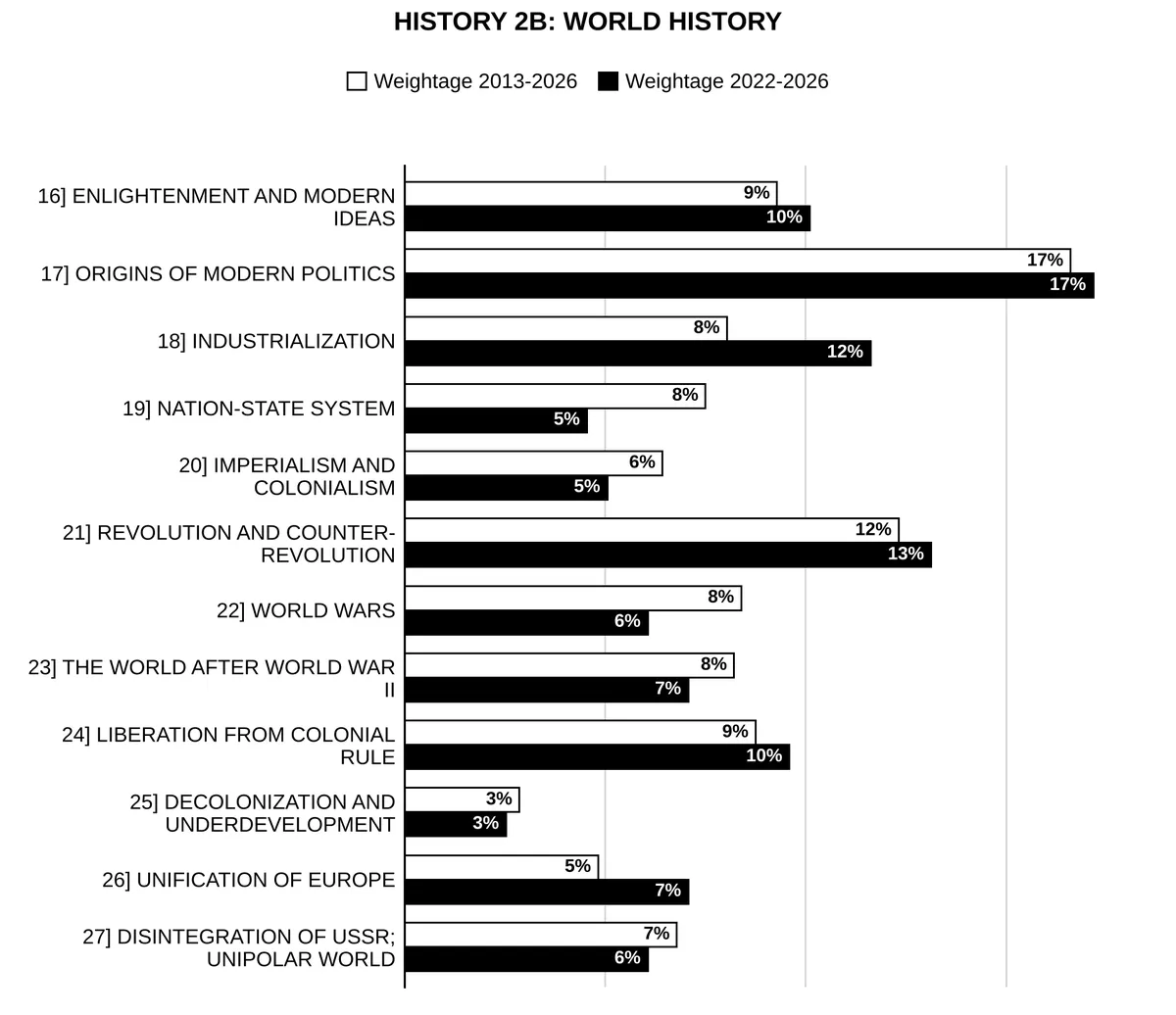
Imperialism and Colonialism accounted for about 5% of the marks asked in World History in 2022–2026, down from 6% over 2013–2026, ranking 10th of the 12 units in the section by recent weightage.
How to use these PYQs
- Compare the questions with the official syllabus wording above – themes that recur across years deserve the deepest notes.
- Give priority to the recent questions (2013 onwards follow the present 250-mark paper pattern); use the pre-2013 questions to test your depth of content.
- Practise answers within the word limit shown in the question code (for example 150w or 250w) and under timed conditions, then revise them after a week.
Frequently Asked Questions
How many History Optional questions have been asked from Imperialism and Colonialism?
This collection lists 36 question entries from Imperialism and Colonialism (unit 20 of Paper 2) between 1995 and 2026, of which 30 are unique questions; the rest are listed under more than one sub-topic. They were asked in 20 of the 32 years and 5 came in 2022–2026.
When was Imperialism and Colonialism last asked in History Optional?
Most recently in 2026, with 1 question (2026/10m/6c). Before that, it was asked in 2025.
Where can I find all History Optional PYQs topic-wise?
All units of Paper 1 and Paper 2, the map question and the earlier-syllabus questions are linked from History Optional PYQs Topic-wise (1995–2026).
« Previous: Nation-State System – History Optional PYQs (1995–2026)
Next: Revolution and Counter-Revolution – History Optional PYQs (1995–2026) »
Back to: History Optional PYQs Topic-wise (1995–2026) | Also see: History Optional year-wise question papers (1995–2026)