
Here is the complete set of Nation-State System History Optional PYQs from UPSC Mains 1995–2026, taken from our topic-wise question bank. It is unit 19 of Paper 2, Section B – World History, with 34 questions, the latest from 2025.
Nation-State System – History Optional PYQs (1995–2026)
19.1] Rise of Nationalism in 19th century
1. “Nationalism in the 19th century was a driving force for both integration and disintegration.” Illustrate with examples from Europe and other parts of the world. [2025/20m/6a]
2. The rise of nationalism across nations shattered the chains which held together the empires of modern Europe. Discuss. [2021/20m/7a]
3. Critically examine: “Mazzini’s conception of Italian nationality was not exclusive and his dominant ideal was the recreation of moral unity of mankind.” [2015/10m/150w/5d]
19.2] Nationalism: state-building in Germany and Italy
1. Critically examine: The unification of Germany was as much a product of coal and iron as it was of blood and iron. [2024/10m/150w/5c]
2. Discuss the different stages of the unification of Italy from 1848 to the occupation of Rome in 1870. [2023/20m/7b]
3. “From Bismarck’s ‘Blood and Iron’ speech and his forceful actions to achieve German unification, Bismarck came to be known as the Iron Chancellor.” Critically examine. [2020/20m/7a]
4. How was Italy transformed from ‘a geographical expression’ to a nation-state? [2019/20m/6b]
5. Critically examine: At the end of the Battle of Sedan (1870), “Europe lost a mistress and gained a master”. [2018/10m/150w/5d]
6. Examine the role of Bismarck in state building in Germany. [2018/20m/7a]
7. Critically examine: “18 January, 1871 had been a day of triumph for the strength and pride of Germany and 28 June, 1919 was the day of chastisement.” [2017/10m/150w/5d]
8. What determinant factors, along with diplomatic, shaped the process of German Unification? [2017/20m/7b]
9. Critically examine: “Mazzini’s conception of Italian nationality was not exclusive and his dominant ideal was the recreation of moral unity of mankind.” [2015/10m/150w/5d]
10. “The language of narrow nationalism held at Frankfurt destroyed the German Revolution; as the fatal idea of aggrandisement of the House of Savoy destroyed the Italian Revolution.” Discuss. [2014/20m/8b]
11. Was German unification achieved more by ‘coal and iron’ than by ‘blood and iron’? [2012/30m/7b]

Preparing for Prelims too?
Our UPSC Prelims Topic-wise PYQ eBook covers every Prelims question with detailed explanations, so you can see exactly where UPSC asks from.
View the BookDownload Free Sample12. Comment on: ‘They have stopped me from making Italy by diplomacy from the North, I will make it by revolution from the South.’ [2005/20m/200w/5c]
13. Comment on: ‘To Bismarck the conclusion of the Treaty of May 20, 1882, was the culmination of this system.’ [2004/20m/200w/5c]
14. Bismarck united Germany not by majority of votes and speeches but by a policy of “Blood and iron”. In the light of this statement assess the contribution of Bismarck to the unification of Germany. [2003/60m/6]
15. “Napoleon kindled the national sentiment, but German unity was achieved by Bismarck.” Discuss. [2002/60m/6]
16. Comment on: “Bismarck created a new Germany with the policy of ‘blood and iron’”. [2001/20m/200w/5b]
17. Comment on: The political unification of Germany was accomplished solely by Bismarck. [1999/20m/200w/5c]
18. Comment on: “The unification of Italy completed … the destruction of the European order.” [1997/20m/200w/5d]
19. Isolation of France constituted the keystone of Bismarck’s foreign policy. Elucidate. [1997/60m/6]
20. Comment on: At the end of the battle of Sedan (1870), “Europe lost a mistress and gained a master.” [1995/20m/200w/5c]
21. The unification of Italy and that of Germany constituted a contrast in respect of the ways they were affected and impact they left on later international politics. Elucidate. [1995/60m/6]
19.3] Disintegration of Empires in the face of the emergence of nationalities across the World
1. “Nationalism in the 19th century was a driving force for both integration and disintegration.” Illustrate with examples from Europe and other parts of the world. [2025/20m/6a]
2. The rise of nationalism across nations shattered the chains which held together the empires of modern Europe. Discuss. [2021/20m/7a]
3. Do you subscribe to the view that the Greek War of Independence was mired in contrasts of the best and the worst episodes? How did it affect the Concert of Europe? [2019/20m/8a]
4. “The Berlin Congress (1878) failed to unlock the Eastern Question. Though there was no major war in Europe for nearly three decades after the Treaty of Berlin, it contained the seeds of many future wars.” Critically evaluate. [2015/20m/6a]
5. “By 1914, the sick man of Europe was no longer just Turkey: it was Europe itself.” Explain. [2011/20m/6c]
6. “The Eastern Question has always been an international question.” Elucidate. [2010/30m/8a]
7. Comment on: ‘The decolonization led to the break-up of empires.’ [2001/20m/200w/5d]
8. Comment on: “The Crimean War was the most useless war ever waged.” [2000/20m/200w/5b]
9. Comment on: Lord Beaconsfield after his return from the Congress of Berlin (1878) boasted: “I have brought peace with honor.” [1998/20m/200w/5c]
10. Turkish renaissance guided by Kemal Pasha revolutionized the Turkish life at many levels. Amplify. [1996/60m/8]
Summary of Nation-State System PYQs (1995–2026)
| Total questions (1995–2026) | 34 (31 unique – a few questions are listed under more than one sub-topic) |
| Total marks asked | 800 (unique questions) |
| Questions in last 5 years (2022–2026) | 4 (3 unique) |
| Most recent year asked | 2025 |
| Sub-topics | 3 (19.1 to 19.3) |
The earliest question here dates from 1995 and the latest from 2025; UPSC has drawn on this unit in 24 of the 32 years. In the last five years (2022–2026), 4 questions were set from it.
Official Syllabus
19. Nation-State System
- (i) Rise of Nationalism in 19th century.
- (ii) Nationalism: State-building in Germany and Italy.
- (iii) Disintegration of Empires in the face of the emergence of nationalities across the World.
Source: UPSC Civil Services Examination 2026 notification.
Where this unit stands in World History
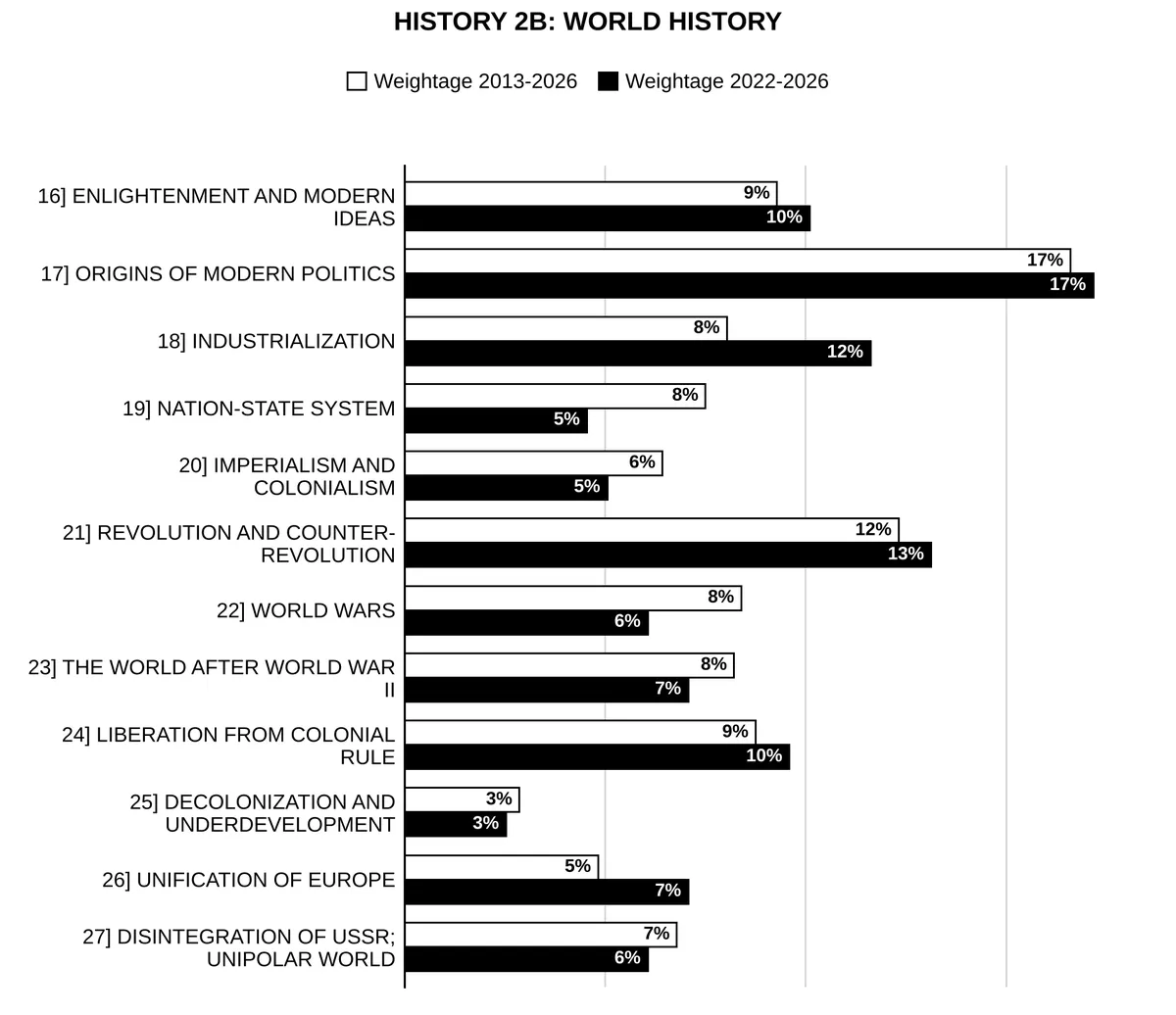
Nation-State System accounted for about 5% of the marks asked in World History in 2022–2026, down from 8% over 2013–2026, ranking 11th of the 12 units in the section by recent weightage.
How to use these PYQs
- Read the syllabus line in the box above alongside the questions and mark which phrases UPSC keeps returning to; those are the areas to prepare first.
- Questions run from the latest year to the oldest, so read the top of each list first for the current pattern, then use older ones for practice of content.
- Use the question code to set the length of your practice answer – marks and word limit tell you how much depth UPSC expected.
Frequently Asked Questions
How many History Optional questions have been asked from Nation-State System?
This collection lists 34 question entries from Nation-State System (unit 19 of Paper 2) between 1995 and 2025, of which 31 are unique questions; the rest are listed under more than one sub-topic. They were asked in 24 of the 32 years and 4 came in 2022–2026.
When was Nation-State System last asked in History Optional?
Most recently in 2025, with 1 question (2025/20m/6a). Before that, it was asked in 2024.
Where can I find all History Optional PYQs topic-wise?
All units of Paper 1 and Paper 2, the map question and the earlier-syllabus questions are linked from History Optional PYQs Topic-wise (1995–2026).
« Previous: Industrialization – History Optional PYQs (1995–2026)
Next: Imperialism and Colonialism – History Optional PYQs (1995–2026) »
Back to: History Optional PYQs Topic-wise (1995–2026) | Also see: History Optional year-wise question papers (1995–2026)