
This page brings together all World Wars History Optional PYQs asked in UPSC Civil Services Mains from 1995 to 2026, arranged topic-wise. It is unit 22 of Paper 2, Section B – World History, with 45 questions, the latest from 2026.
World Wars – History Optional PYQs (1995–2026)
22.1] 1st and 2nd World Wars as Total Wars: societal implications
1. The second world war was a truly global conflict. Discuss. [2024/20m/7a]
2. Critically examine: ‘Roaring Twenties’ in Europe and America had many positive points. It helped women to uplift themselves in the region. [2022/10m/150w/5d]
3. Europe was at war with itself in the first half of the twentieth century with a long cease-fire. Comment. [2021/20m/8a]
4. Do you agree with the statement that the Second World War was history’s most destructive war? Elaborate. [2020/20m/7b]
5. Critically examine: “There are many ways in which the war of 1914–18 was unprecedented, and in human history, entirely novel.” [2019/10m/150w/5b]
6. Why was the first World War termed as the first ‘total’ war in modern history? [2017/20m/6b]
7. “Europe was eclipsed through European folly due to the two world wars.” Elucidate. [2014/20m/8a]
8. Comment on: “The War’s (First World War’s) most permanent contribution to the spirit of the post-War years was disillusion.” [2007/20m/200w/5c]
22.2] World War I: causes and consequences
1. “The League of Nations failed to achieve its objectives of maintaining international peace and security.” Analyse the major factors responsible for its failure during the period 1919–1946. [2026/10m/7c]
2. Critically examine: “The First World War did not produce just political consequences, it also had a deep impact on the ways of thinking.” [2025/10m/150w/5c]
3. The Treaty of Versailles contained in itself the seeds of the Second World War. Examine. [2023/10m/7c]
4. Critically examine: “18 January, 1871 had been a day of triumph for the strength and pride of Germany and 28 June, 1919 was the day of chastisement.” [2017/10m/150w/5d]
5. Why was the first World War termed as the first ‘total’ war in modern history? [2017/20m/6b]
6. “League of Nations is a League of Notions.” Comment. [2016/10m/150w/5c]
7. Do you agree with the view that the Treaty of Versailles was a bad compromise between a treaty based upon force and a treaty based on ideas? [2016/20m/7b]

Preparing for Prelims too?
Our UPSC Prelims Topic-wise PYQ eBook covers every Prelims question with detailed explanations, so you can see exactly where UPSC asks from.
View the BookDownload Free Sample8. How far is it correct to say that the First World War was fought essentially for the preservation of the balance of power? [2015/20m/7a]
9. “Any single explanation for the outbreak of the First World War is likely to be too simple. An amalgam of factors intellectual, social, economic as well as political and diplomatic contributed to this horrifying conflict of monumental proportions.” — Explain. [2012/30m/6b]
10. Critically evaluate: “The peace of Versailles lacked moral validity from the start.” [2011/20m/200w/5b]
11. “By 1914, the sick man of Europe was no longer just Turkey: it was Europe itself.” Explain. [2011/20m/6c]
12. Comment on: “The War’s (First World War’s) most permanent contribution to the spirit of the post-War years was disillusion.” [2007/20m/200w/5c]
13. Comment on: “Treaty of Versailles contained the seeds of future conflict”. [2006/20m/200w/5c]
14. Comment on: ‘The most important single factor … in the years following 1919 was the French demand for security.’ [2004/20m/200w/5d]
15. Comment on: ‘The roots of the rise of Fascism lay in Peace Treaties.’ [2003/20m/200w/5b]
16. Comment on: ‘There was not only a difference of principles at Paris (Peace Conference) but a clash of personalities’. [2001/20m/200w/5c]
17. Analyze the provisions of the Treaty of Versailles of 1919 and examine the validity of Germany’s objections to the treaty. [2000/60m/8]
22.3] World War II: causes and consequences
1. “The League of Nations failed to achieve its objectives of maintaining international peace and security.” Analyse the major factors responsible for its failure during the period 1919–1946. [2026/10m/7c]
2. The second world war was a truly global conflict. Discuss. [2024/20m/7a]
3. The Treaty of Versailles contained in itself the seeds of the Second World War. Examine. [2023/10m/7c]
4. Do you agree with the statement that the Second World War was history’s most destructive war? Elaborate. [2020/20m/7b]
5. Critically examine: “The ineffectiveness of the League of Nations to prevent or to check Japanese aggression against China was the first serious blow to its prestige as an agency for providing security.” [2019/10m/150w/5c]
6. Was Czechoslovakia served on a dish to Hitler at Munich? What were its implications? [2019/20m/8b]
7. Critically examine: “Until December 1941, the battlefield of the Second World War was exclusively European and Atlantic; thereafter it became also Asiatic and Pacific.” [2018/10m/150w/5e]
8. “Europe was eclipsed through European folly due to the two world wars.” Elucidate. [2014/20m/8a]
9. How did the policy of appeasement escalate the problem of Nazi aggrandizement? [2011/30m/7b]
10. “Europe faced peace in 1945 politically disorganized and economically crippled.” Elaborate. [2010/30m/7b]
11. Comment on: “Hitler did not really want a world war. His intention was only a short war with Poland.” (A. J. P. Taylor) [2009/20m/200w/5c]
12. Comment on: “In the long run, the Locarno Treaty (December 1925) was destructive both of the Treaty of Versailles and of the Covenant.” [2008/20m/200w/5c]
13. Comment on: “A clever conqueror will always impose his demands on the conquered by instalments.” [2006/20m/200w/5d]
14. Comment on: The Great Depression (1929–34) was attended by momentous consequences in the economic as well as in the political sphere. [2002/20m/200w/5c]
15. Comment on: “Until December 1941 the battlefield of the Second World War was exclusively European and Atlantic; thereafter it became also Asiatic and Pacific.” [2000/20m/200w/5c]
16. Trace the rise and growth of the New European Society in the inter-war period. [1999/60m/6]
17. Trace the growth of militarism in Japan in the inter-war years. What international reaction did it provoke? [1997/60m/8]
18. Comment on: “The Communist International and the League of Nations both announced the end of the Balance of Power.” [1996/20m/200w/5c]
19. Comment on: The Great Depression (1929–34) was “attended by momentous consequences in the economic as well as in the political sphere.” [1996/20m/200w/5d]
20. Comment on: “There was an element of system in Hitler’s foreign policy. His outlook was continental.” [1995/20m/200w/5d]
Summary of World Wars PYQs (1995–2026)
| Total questions (1995–2026) | 45 (38 unique – a few questions are listed under more than one sub-topic) |
| Total marks asked | 820 (unique questions) |
| Questions in last 5 years (2022–2026) | 8 (5 unique) |
| Most recent year asked | 2026 |
| Sub-topics | 3 (22.1 to 22.3) |
The earliest question here dates from 1995 and the latest from 2026; UPSC has drawn on this unit in 29 of the 32 years. In the last five years (2022–2026), 8 questions were set from it.
Official Syllabus
22. World Wars
- (i) 1st and 2nd World Wars as Total Wars: Societal implications.
- (ii) World War I: Causes and Consequences.
- (iii) World War II: Causes and Consequences.
Source: UPSC Civil Services Examination 2026 notification.
Where this unit stands in World History
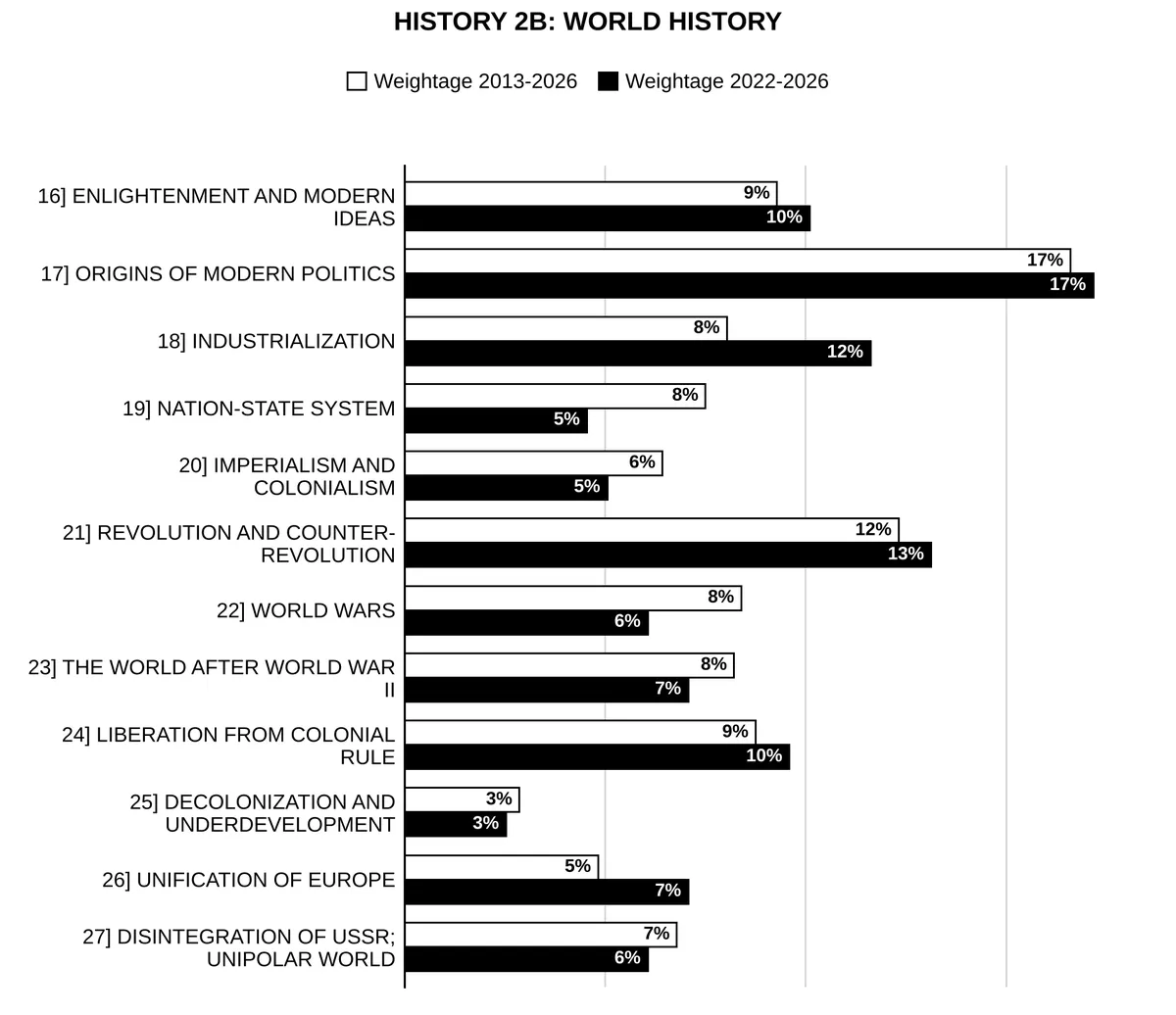
World Wars accounted for about 6% of the marks asked in World History in 2022–2026, down from 8% over 2013–2026, ranking 9th of the 12 units in the section by recent weightage.
How to use these PYQs
- Read the syllabus line in the box above alongside the questions and mark which phrases UPSC keeps returning to; those are the areas to prepare first.
- Questions run from the latest year to the oldest, so read the top of each list first for the current pattern, then use older ones for practice of content.
- Use the question code to set the length of your practice answer – marks and word limit tell you how much depth UPSC expected.
Frequently Asked Questions
How many History Optional questions have been asked from World Wars?
This collection lists 45 question entries from World Wars (unit 22 of Paper 2) between 1995 and 2026, of which 38 are unique questions; the rest are listed under more than one sub-topic. They were asked in 29 of the 32 years and 8 came in 2022–2026.
When was World Wars last asked in History Optional?
Most recently in 2026, with 1 question (2026/10m/7c). Before that, it was asked in 2025.
Where can I find all History Optional PYQs topic-wise?
All units of Paper 1 and Paper 2, the map question and the earlier-syllabus questions are linked from History Optional PYQs Topic-wise (1995–2026).
« Previous: Revolution and Counter-Revolution – History Optional PYQs (1995–2026)
Next: The World after World War II – History Optional PYQs (1995–2026) »
Back to: History Optional PYQs Topic-wise (1995–2026) | Also see: History Optional year-wise question papers (1995–2026)