
The World after World War II History Optional PYQs from 1995 to 2026 are compiled here exactly as UPSC set them in the Mains examination, sorted by syllabus topic.
The World after World War II – History Optional PYQs (1995–2026)
23.1] Emergence of two power blocs
1. The emergence of two power blocs not only symbolised two competing ideologies but also two alternative models of economic growth. Explain. [2024/20m/8a]
2. Outline the circumstances leading to adoption of Marshall Plan. [2018/10m/7c]
3. Outline the circumstances leading to Détente. [2016/10m/8c]
4. “The Truman Doctrine and the Marshall Plan were considered by the Russian Bloc as a weapon against Russia in order to restrict her influence.” Critically examine. [2015/10m/6c]
5. Comment on: “After World War II, the strategy of the West towards Soviet bloc crystallized as a ‘policy of containment’.” [2008/20m/200w/5d]
6. Comment on: “NATO in many ways symbolized the key role that the United States had come to play in Europe” [2007/20m/200w/5d]
7. Critically examine the various dimensions and phases of the cold war between 1947 and 1962. [2005/60m/8]
8. Comment on: “One of the most important consequences of the Second World War was ‘division of Europe’, eastern and western.” [2002/20m/200w/5d]
9. In the post-Second World War scenario friends in war did not remain friends in peace. Examine the truth of this view in the period of your study. [1999/60m/8]
10. Comment on: One of the most important impacts of the Second World War was the “division of Europe”, eastern and western. [1998/20m/200w/5d]
23.2] Emergence of Third World and non-alignment
1. Critically examine: “In the Soviet Union, as also in China, there was a strong belief that anti-imperial movements in the colonies would result in their moving into the socialist orbit.” [2025/10m/150w/5d]
2. Describe the launching of Non-Alignment Movement. Why the small nations wanted to remain aloof from the powerful nations? [2022/20m/8a]
3. Critically examine: During the Cold War, some important leaders of the Non-Aligned Movement wanted to keep the movement away from the military blocs. [2021/10m/150w/5d]
4. Critically examine: “The multitude of newly independent countries came to be known as the ‘Third World’, belonging neither to the First World of capitalist democracies, nor the Communist Second World.” [2020/10m/150w/5d]

Preparing for Prelims too?
Our UPSC Prelims Topic-wise PYQ eBook covers every Prelims question with detailed explanations, so you can see exactly where UPSC asks from.
View the BookDownload Free Sample5. Critically examine: “Non-alignment came to symbolize the struggle of India and other newly independent nations to retain and strengthen their independence from colonialism and imperialism.” [2019/10m/150w/5d]
6. “The role of the Non-Alignment Movement in world affairs has suffered greatly due to the theatre of internecine conflicts among the Third World countries who spearheaded it.” Elucidate. [2015/10m/8c]
7. To what extent did the Freedom Movement in India influence the Liberation Movement in Africa? [2014/10m/4c]
8. Critically examine: “Nehru’s policy of Non-Alignment came to symbolize the struggle of India and other newly independent nations to retain and strengthen their independence from colonialism.” [2012/12m/150w/1e]
9. Would you argue that the Non-Aligned Movement played a crucial role in promoting a climate of peace? [2011/30m/8a]
10. Explain the circumstances leading to the emergence of Third World and analyze its impact on world affairs. [2010/30m/8b]
23.3] UNO and the global disputes
1. “UNO was the necessity of the time when the World War II ended.” Critically examine its achievements and shortcomings. [2023/20m/8a]
2. Do you think that the United Nations Organisation has played a significant role in resolving international disputes and ensuring peace in the world? [2021/10m/8c]
3. Critically examine: “The ineffectiveness of the League of Nations to prevent or to check Japanese aggression against China was the first serious blow to its prestige as an agency for providing security.” [2019/10m/150w/5c]
4. Discuss how far the United Nations has been successful in resolving global disputes from year 1946 to 1991. [2018/20m/8b]
5. “League of Nations is a League of Notions.” Comment. [2016/10m/150w/5c]
6. “The UNO was created in the light of experience of the ‘League of Nations’, but in spite of the mandate contained in the UNO constitution, its effective role in maintaining world peace has lacked cohesiveness and collective approach.” Examine. [2015/20m/8a]
7. Discuss the circumstances leading to the Suez Crisis of 1956 and examine its repercussions on global politics. [2014/10m/7c]
8. “In spite of the careful framing of the Charter, the role of UNO as peacekeeper and international mediator has been somewhat lacklustre and muted and that continues to be so even after the end of Cold War.” Elucidate. [2013/25m/6a]
9. Examine the peace-keeping efforts of the United Nations Organization. [2009/30m/8b]
10. Comment on: ‘The Security Council is the heart of the United Nations’. [2003/20m/200w/5c]
Summary of The World after World War II PYQs (1995–2026)
| Total questions (1995–2026) | 30 |
| Total marks asked | 577 |
| Questions in last 5 years (2022–2026) | 4 |
| Most recent year asked | 2025 |
| Sub-topics | 3 (23.1 to 23.3) |
The earliest question here dates from 1998 and the latest from 2025; UPSC has drawn on this unit in 23 of the 32 years. In the last five years (2022–2026), 4 questions were set from it.
Official Syllabus
23. The World after World War II
- (i) Emergence of Two power blocs.
- (ii) Emergence of Third World and non-alignment.
- (iii) UNO and the global disputes.
Source: UPSC Civil Services Examination 2026 notification.
Where this unit stands in World History
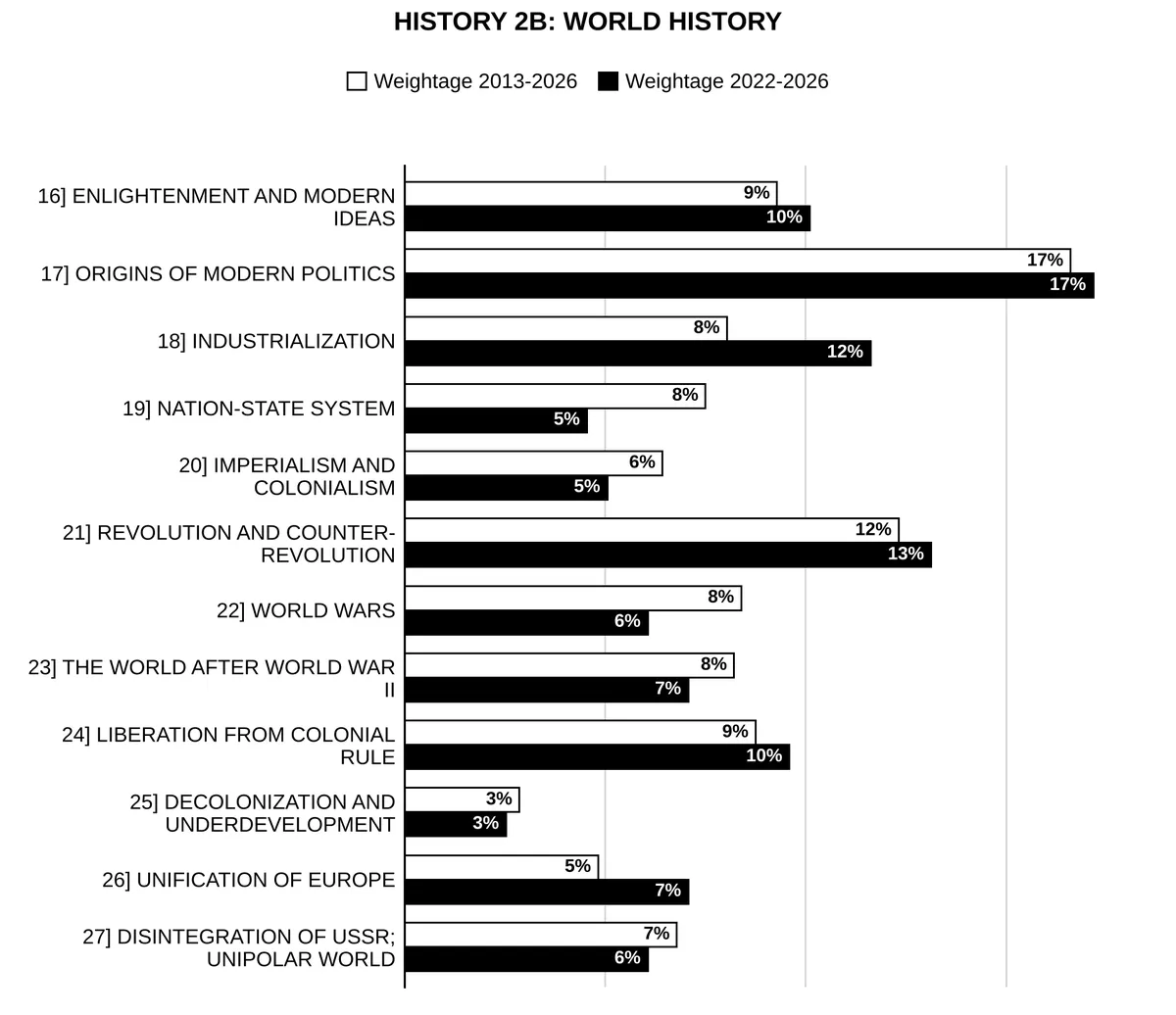
The World after World War II accounted for about 7% of the marks asked in World History in 2022–2026, down from 8% over 2013–2026, ranking 7th of the 12 units in the section by recent weightage.
How to use these PYQs
- Compare the questions with the official syllabus wording above – themes that recur across years deserve the deepest notes.
- Give priority to the recent questions (2013 onwards follow the present 250-mark paper pattern); use the pre-2013 questions to test your depth of content.
- Practise answers within the word limit shown in the question code (for example 150w or 250w) and under timed conditions, then revise them after a week.
Frequently Asked Questions
How many History Optional questions have been asked from The World after World War II?
This collection lists 30 question entries from The World after World War II (unit 23 of Paper 2) between 1998 and 2025. They were asked in 23 of the 32 years and 4 came in 2022–2026.
When was The World after World War II last asked in History Optional?
Most recently in 2025, with 1 question (2025/10m/150w/5d). Before that, it was asked in 2024.
Where can I find all History Optional PYQs topic-wise?
All units of Paper 1 and Paper 2, the map question and the earlier-syllabus questions are linked from History Optional PYQs Topic-wise (1995–2026).
« Previous: World Wars – History Optional PYQs (1995–2026)
Next: Liberation from Colonial Rule – History Optional PYQs (1995–2026) »
Back to: History Optional PYQs Topic-wise (1995–2026) | Also see: History Optional year-wise question papers (1995–2026)