
Here is the complete set of Liberation from Colonial Rule History Optional PYQs from UPSC Mains 1995–2026, taken from our topic-wise question bank. It is unit 24 of Paper 2, Section B – World History, with 28 questions, the latest from 2025.
Liberation from Colonial Rule – History Optional PYQs (1995–2026)
24.1] Latin America – Bolivar
1. How far did Latin American countries overcome centuries of subjugation and foreign intervention? [2022/10m/8c]
2. Explain why Latin America was beset with chronic political instability and endemic military conflicts throughout most of the 19th century. [2019/20m/7b]
3. Explain why Bolivar’s efforts failed to fructify in bringing about united stand of the Latin Americans. [2017/10m/7c]
4. Critically examine: “Decolonization has finished. It definitely belongs to the past. Yet somehow it has refused to become history.” [2013/10m/150w/5e]
5. Comment on: “The capitalism which gave the European empires their apparent solidarity and permanence also hastened their downfall.” [2009/20m/200w/5a]
6. Comment on: ‘The decolonization led to the break-up of empires.’ [2001/20m/200w/5d]
24.2] Arab World – Egypt
1. Arab nationalism was not only a cultural movement, but also an anti-colonial struggle. Comment. [2023/10m/8c]
2. Critically examine: The Arab countries looked up to Nasser as a leader who could withstand the pressure exerted by Western countries on Egypt to make peace with Israel. [2021/10m/150w/5e]
3. Critically examine: “The British were slated to withdraw from Palestine in May 1948, and both sides prepared for that day. Violence between Arabs and Jews, already endemic, escalated.” [2020/10m/150w/5e]
4. Analyse the role of Egypt after the Second World War in bringing about Arab unity. [2019/10m/8c]
5. Trace the growth of Arab nationalism after the First World War. How far was it a reaction to Oil imperialism? [2016/20m/8a]
6. Discuss the circumstances leading to the Suez Crisis of 1956 and examine its repercussions on global politics. [2014/10m/7c]
7. “The Arab nationalism had a peculiar character. It stood for national independence for separate Arab States as well as for the unity of all Arabs irrespective of their state boundaries.” — Examine. [2012/30m/8b]
8. Comment on: “Arab nationalism and oil — these were the principal factors in complicating the relations of middle eastern countries with the outside world.” [2009/20m/200w/5d]
9. Discuss the aims of the establishment of the Arab League and assess its role in safeguarding the interests of the Arab nations. [2001/60m/8]

Preparing for Prelims too?
Our UPSC Prelims Topic-wise PYQ eBook covers every Prelims question with detailed explanations, so you can see exactly where UPSC asks from.
View the BookDownload Free Sample24.3] Africa – Apartheid to Democracy
1. The nature of apartheid regime undermined South Africa’s claim of being a democratic polity. [2024/10m/7c]
2. Why was the apartheid policy introduced in South Africa? What were its main features? [2022/20m/8b]
3. The white-minority government of South Africa treated the natives very badly by denying them fundamental rights and made Apartheid as official policy. How were the people able to end Apartheid policy and establish a transitional rule? [2021/10m/6c]
4. Explain the features of Apartheid in South Africa. [2018/10m/6c]
5. To what extent did the Freedom Movement in India influence the Liberation Movement in Africa? [2014/10m/4c]
6. “There must be an end to white monopoly on political power, and a fundamental restructuring of our political and economic systems to ensure that the inequalities of apartheid are addressed and our society thoroughly democratized.” Discuss. [2013/25m/8b]
7. Give a brief account of the struggle against ‘Apartheid’ in South Africa. [2006/60m/8]
24.4] South-East Asia – Vietnam
1. Why did the non-communist Vietnamese leaders fail to provide successful leadership for Indo-China’s anti-colonial struggle? Discuss. [2025/20m/8a]
2. How did Ho Chi Minh emerge as the central figure in the Vietnamese independence movement? [2024/10m/8c]
3. The historical causes for the rise of anti-colonial movement in South-East Asia were cultural differences, spread of western education and the emergence of Communist ideas. Discuss. [2023/20m/8b]
4. Do you feel that the Vietnamese fought the 20th century’s longest and bloodiest war for their liberation and integration of their country? Analyse. [2022/10m/6c]
5. Trace the significant role played by Ho Chi Minh in Vietnam’s struggle for freedom. [2016/10m/6c]
6. Why did Vietnam go through thirty years of war after the second world war? [2009/30m/7b]
Summary of Liberation from Colonial Rule PYQs (1995–2026)
| Total questions (1995–2026) | 28 |
| Total marks asked | 515 |
| Questions in last 5 years (2022–2026) | 8 |
| Most recent year asked | 2025 |
| Sub-topics | 4 (24.1 to 24.4) |
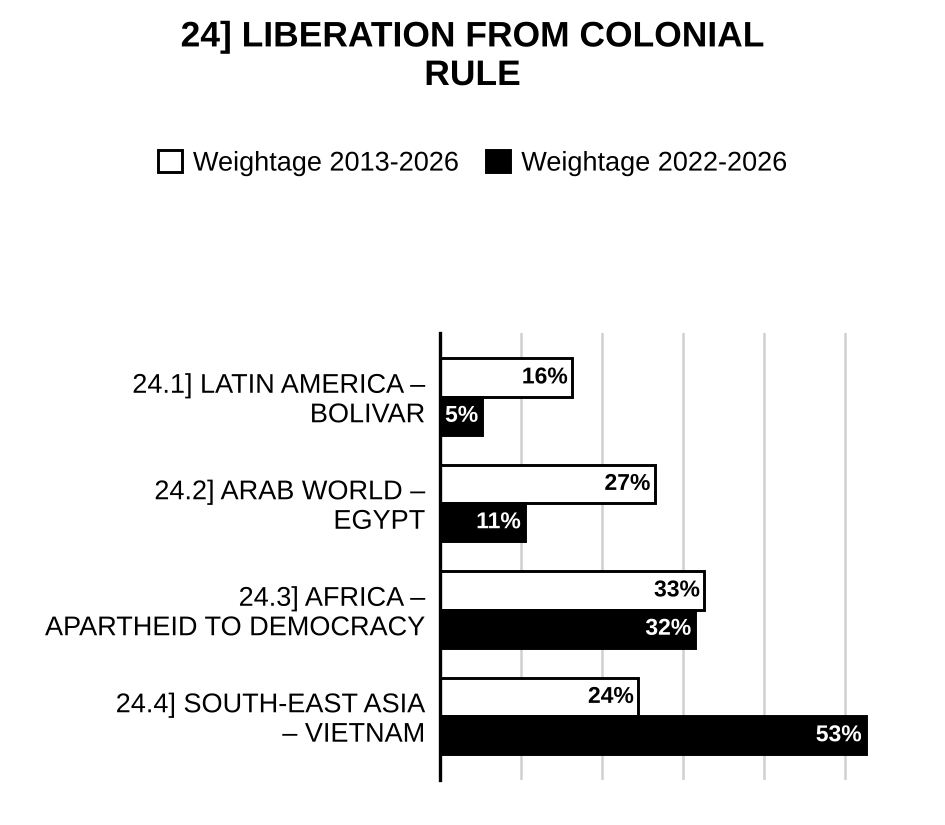
The earliest question here dates from 2001 and the latest from 2025; UPSC has drawn on this unit in 16 of the 32 years. In the last five years (2022–2026), 8 questions were set from it.
Official Syllabus
24. Liberation from Colonial Rule
- (i) Latin America – Bolivar.
- (ii) Arab World – Egypt.
- (iii) Africa – Apartheid to Democracy.
- (iv) South-East Asia – Vietnam.
Source: UPSC Civil Services Examination 2026 notification.
Where this unit stands in World History
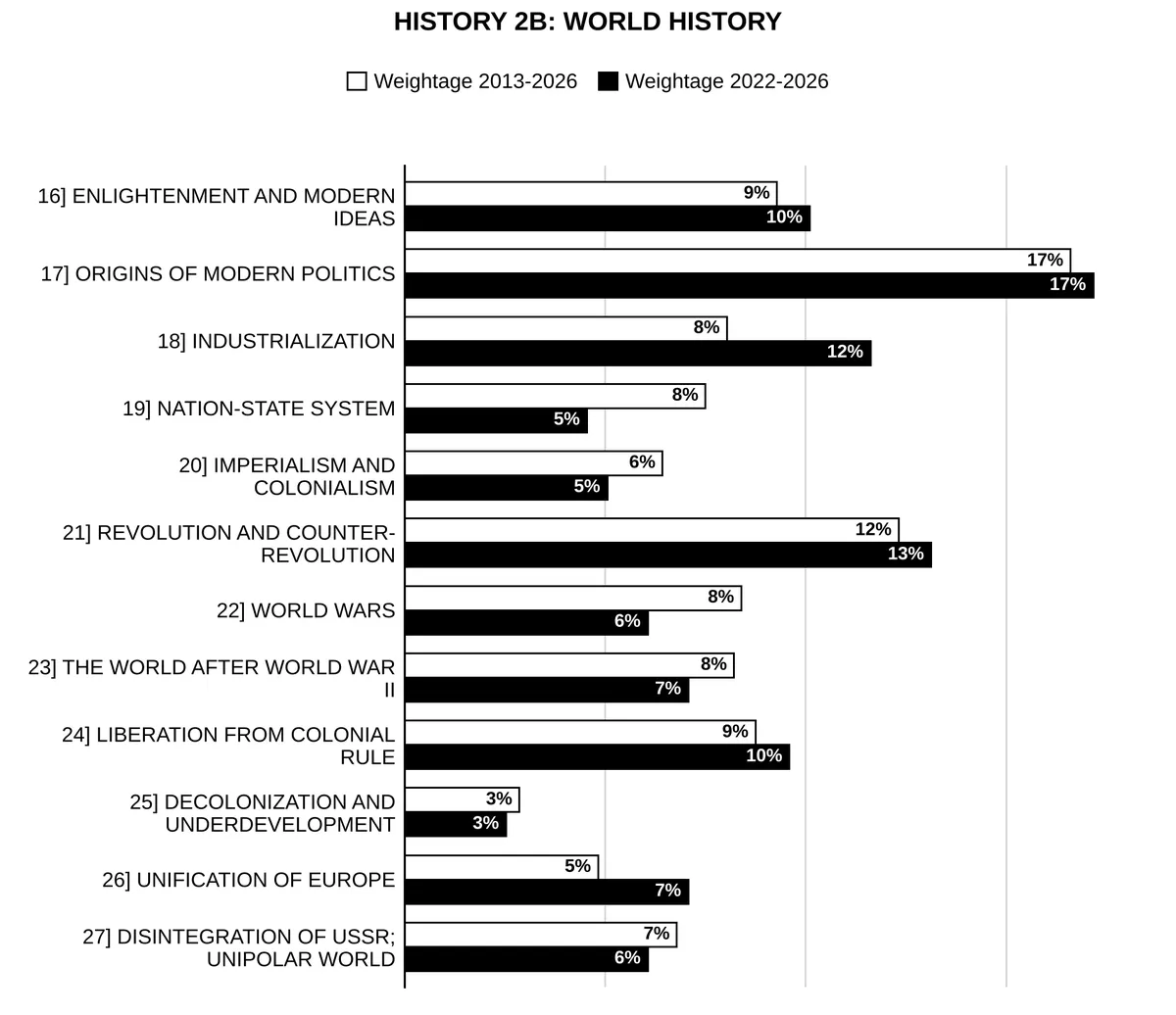
Liberation from Colonial Rule accounted for about 10% of the marks asked in World History in 2022–2026, up from 9% over 2013–2026, ranking 5th of the 12 units in the section by recent weightage.
How to use these PYQs
- Map every question to a phrase of the official syllabus shown above; recurring phrases show where UPSC’s interest lies.
- Start with the latest questions at the top of each list to see how UPSC frames this unit today; the older 60-mark questions are still useful for depth and content.
- Write timed answers to a few questions every week, keeping to the marks and word limit in each code, and revisit questions you found difficult.
Frequently Asked Questions
How many History Optional questions have been asked from Liberation from Colonial Rule?
This collection lists 28 question entries from Liberation from Colonial Rule (unit 24 of Paper 2) between 2001 and 2025. They were asked in 16 of the 32 years and 8 came in 2022–2026.
When was Liberation from Colonial Rule last asked in History Optional?
Most recently in 2025, with 1 question (2025/20m/8a). Before that, it was asked in 2024.
Where can I find all History Optional PYQs topic-wise?
All units of Paper 1 and Paper 2, the map question and the earlier-syllabus questions are linked from History Optional PYQs Topic-wise (1995–2026).
« Previous: The World after World War II – History Optional PYQs (1995–2026)
Next: Decolonization and Underdevelopment – History Optional PYQs (1995–2026) »
Back to: History Optional PYQs Topic-wise (1995–2026) | Also see: History Optional year-wise question papers (1995–2026)