
Here are all 130 Pathology questions asked in UPSC Medical Science Optional Paper I from 1995 to 2026, arranged under the 5 topics of the official syllabus. Within each topic the latest questions come first.
Each question ends with a code such as [2024/15m/3b] – the year, the marks, the word limit (where UPSC set one) and the question number in the paper.
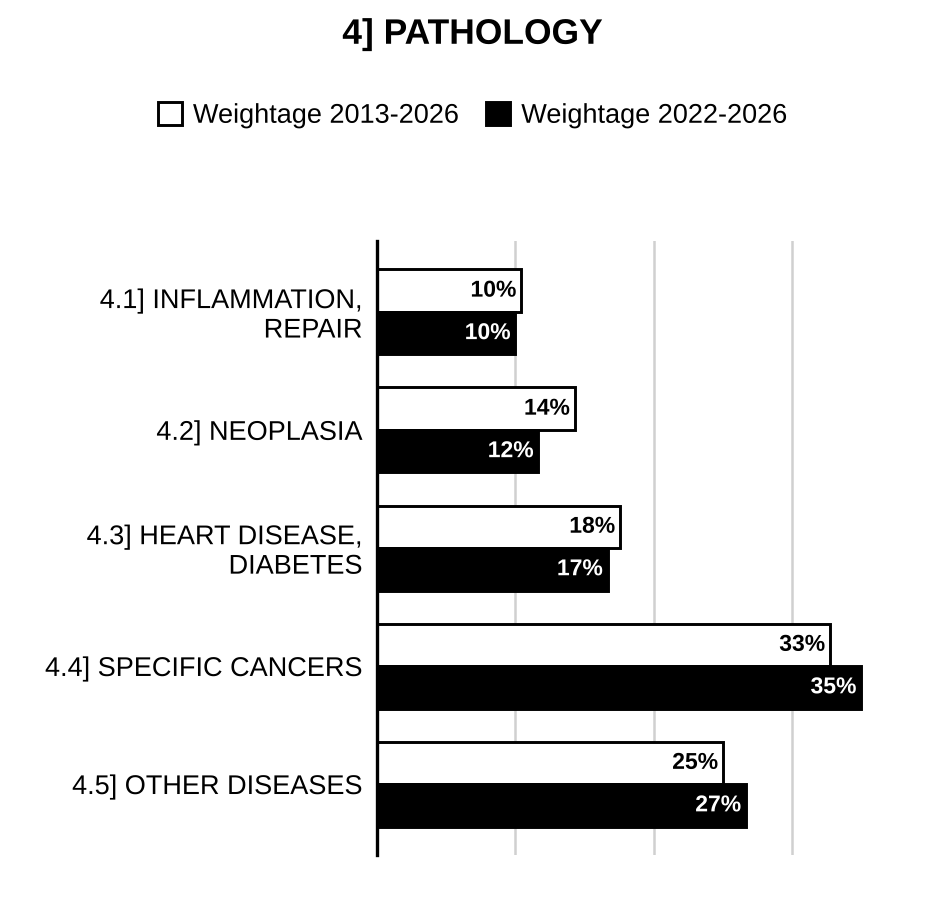
4.1] Inflammation and repair
14 questions
Define inflammation. Describe the cardinal features of acute inflammation. [2026/10m/6a(i)]
Describe steps of wound healing by first intention. Enumerate factors that influence tissue repair. [2025/10m/7b(ii)]
Define granulomatous inflammation. Describe in brief different types of granuloma. [2022/10m/5d]
Define chronic inflammation. Enumerate the causes of chronic inflammation. What is the role of macrophages in chronic inflammation? [2021/10m/5d]
What are the major cell derived mediators of Inflammation? Describe their role in acute Inflammation. [2019/10m/5a]
What are the growth factors involved in Regeneration and repair of tissues? [2019/10m/5d]
Discuss the process of wound healing. What is the significance of stages of wound healing in Medico-legal cases? [2019/15m/7b]
Enumerate the chemical mediators of acute inflammation. Give their mechanisms of action. [2015/10m/150w/5a]
Discuss role of mediators in different reactions of inflammation. [2013/10m/5e]
Define granuloma. Give the mechanism of formation of granuloma and give examples of granulomatous diseases. [2012/12m/5a]
Explain the role of extracellular matrix (ECM) in tissue repair. [2009/15m/5a]
Discuss the type and mechanism of Ischemic cell injury. [2007/20m/5a]
Define a granuloma. Discuss the causes and pathogenesis of granulomatous inflammation. [1998/30m/5a]
Describe irreversible and reversible cell injury. [1997/20m/4a]
4.2] Disturbances of growth and neoplasia
20 questions
Enumerate five differences between benign and malignant tumours. Describe the mechanisms by which the tumour cells evade the immune system. [2026/10m/7b(ii)]
Define cancer. Describe in detail the effects of cancer-related genes on cell growth. [2024/10m/5c]
Enumerate four disturbances of growth. Describe the mechanism of Atrophy. [2023/10m/5c]
Enumerate four differentiating features between benign and malignant tumours. Describe in brief the pathogenesis of cancer cervix. [2022/10m/7b(i)]
Define ‘metastasis’. Enumerate the steps involved in metastasis. Write briefly about the role of stromal elements in metastasis. [2021/10m/5a]
Define cancer. Describe the four most important investigations for lab diagnosis of cancer. [2020/10m/5a]
Define metastasis. What are the different pathways for the spread of cancer? Draw a flowchart describing the sequential steps involved in the hematogenous spread of a tumor. [2018/10m/8b(i)]
Define neoplasm. List five differences between benign and malignant neoplasm. [2017/10m/5a]
What is dysplasia? How will you differentiate it from metaplasia? [2016/20m/6a]
What are the characteristic features of a malignant tumour? Discuss the pathways of cancer spread. [2014/15m/8b]
Discuss differentiating features of primary and metastatic malignancies. [2013/10m/5a]
How will you differentiate between benign and malignant tumours? [2012/20m/7c]
Enumerate the various etiological agents causing neoplasia. Discuss the mechanism of viral carcinogenesis. [2011/12m/5a]
What is carcinogenesis? Classify carcinogens. Write in short about important carcinogens. [2006/20m/5a]
What are precancerous disorders? Describe precancerous disorders of the gastrointestinal tract in short. [2003/20m/6a]
Write differences between benign and malignant tumours and describe the pathways of spread of cancer. [2001/20m/200w/5a]
Explain the terms metaplasia, anaplasia, dysplasia, hyperplasia and hypoplasia with suitable examples. [2000/12m/200w/5a]
Discuss the role of biologic agents in the etiopathogenesis of neoplasia. [2000/12m/200w/5c]
Write in brief about chemical carcinogens. [1996/20m/200w/1a]
Give differences between benign and malignant tumors. Discuss in brief about various methods of tumor diagnosis. [1995/20m/200w/1a]

Preparing for Prelims too?
Our UPSC Prelims Topic-wise PYQ eBook covers every Prelims question with detailed explanations, so you can see exactly where UPSC asks from.
View the BookDownload Free Sample4.3] Heart disease and diabetes
20 questions
Describe the gross and light microscopic changes evolved over two weeks duration in myocardial infarction. Add a note on the role of serum cardiac biomarkers in the diagnosis of myocardial infarction. [2025/10m/6a(ii)]
A 50-year-old male presented with a history of chest pain, polyuria and polydipsia since last 5 years. Investigations showed HbA1c level of 12%, cardiac enzymes were normal, while urinalysis showed proteinuria. (i) What is the most likely diagnosis? (ii) Describe the microscopic findings. (iii) What is the pathogenesis? [2024/10m/5d]
Describe the aetiopathogenesis and microscopic findings in affected heart of rheumatic heart disease. [2023/10m/7b(ii)]
Describe in brief the pathogenesis and histopathological features of rheumatic heart disease. [2022/10m/6a(i)]
Describe in brief the pathogenesis of type I diabetes mellitus. Enumerate two important glomerular lesions of diabetic nephropathy. [2022/10m/7b(ii)]
Define ischemic heart disease. Enumerate four ischemic syndromes. Discuss the pathogenesis of myocardial infarction. Briefly describe infarct modification by reperfusion. [2021/20m/6a]
Define Diabetes mellitus. Describe the morphological changes that occur due to its complications in the following: • Vascular system • Kidney • Eye • Peripheral nerves. [2020/10m/5d]
Define impaired glucose tolerance. Discuss the pathogenesis of Type I diabetes mellitus. [2018/10m/5a]
What are sequential myocardial changes in myocardial infarction? [2016/10m/5a]
Discuss the laboratory investigations in a case of myocardial infarction. [2016/10m/5d]
Name the hormones involved in the regulation of blood glucose level. Discuss the pathophysiology of diabetes mellitus. [2015/15m/4b]
What are the major and minor criteria of rheumatic fever? Give the pathology and sequelae of rheumatic carditis. [2015/15m/8b]
Define and classify Diabetes mellitus. Discuss the pathophysiology of Type-2 diabetes. What are the complications of uncontrolled diabetes? [2014/20m/6a]
Give the incidence, pathogenesis gross and microscopic features of Rheumatic heart disease. [2012/12m/5e]
Describe the renal changes in diabetes mellitus. [2009/15m/6a]
Give the morphological changes and complications in myocardial infarction. [2007/20m/6b]
Discuss the etiology, sequelae and complications of Rheumatic fever. What are the short- and long-term measures taken in the prevention of Rheumatic heart disease? [2002/20m/200w/5b]
Discuss the etiopathogenesis and pathological lesions of rheumatic fever. [2000/30m/6b]
Discuss pathogenesis and pathology of ischaemic heart disease. [1999/30m/4a]
Write pathogenesis and histopathology of Rheumatic heart disease. [1995/30m/5a]
4.4] Specific cancers
42 questions
Describe the laboratory diagnosis and immunophenotypic classification of acute lymphoblastic leukaemia. [2026/10m/5d]
A 60-year-old male presented with an irregular plaque-like lesion at the base of tongue. Biopsy showed a proliferation of atypical cells displaying keratin pearls. 1. What is the most probable diagnosis? 2. Describe the pathogenesis of this condition. [2026/10m/7b(i)]
What are the risk factors for lung carcinoma? Describe the morphological features of three major histological types of lung carcinoma. [2025/10m/5c]
Describe the classification of cervical intraepithelial neoplasia/squamous intraepithelial lesion. Write a note on the role of Human papilloma virus in the pathogenesis of cervical carcinoma. [2025/10m/5d]
Describe the approach to laboratory diagnosis of chronic myeloid leukemia – chronic phase. [2025/10m/6a(i)]
Describe the microscopic features of breast cancer. Enumerate any five major prognostic factors. [2024/10m/6a(i)]
Describe the clinical features and microscopic findings in acute lymphoblastic leukaemia. [2024/10m/7b(ii)]
Enumerate any five risk factors for oral cancer. Describe its morphology. [2023/10m/6a(i)]
A 29-year-old female presented with fever, multiple episodes of epistaxis and gum bleeding since one month. On examination, her temperature was 37.6°C. Skin showed multiple bruises. CBC showed Hb – 8.2 g/dL, WBC count – 60,000/µL. Peripheral smear showed 75% plasts. They had fine cytoplasmic azurophilic granules and Auer rods. (I) What is the most likely diagnosis? (II) Enumerate the cytochemical stains useful in this disease. (III) Write two cytogenetic abnormalities with favourable prognosis. (IV) Mention two cytogenetic abnormalities with unfavourable prognosis. [2023/10m/7b(i)]
Describe the molecular mechanisms of carcinogenesis of breast carcinoma. Describe the salient histopathological features of invasive carcinoma of no special type. [2022/10m/5a]
Enumerate four differentiating features between benign and malignant tumours. Describe in brief the pathogenesis of cancer cervix. [2022/10m/7b(i)]
Enumerate predisposing conditions for oral cancer. Describe the pathogenesis, molecular basis and morphology of oral cancer. [2021/10m/7b(i)]
Describe the aetiopathogenesis and morphological features (gross and microscopy) of Bronchogenic carcinoma. [2020/10m/6a(ii)]
Write the clinical features and lab diagnosis of chronic myeloid leukaemia. [2020/20m/8b]
Give the laboratory findings in a case of Acute Myeloid leukemia (PML/RARA) fusion gene type. [2019/10m/6a(i)]
Describe risk factors identified for breast carcinoma. [2018/5m/5d(i)]
Discuss molecular subtypes of invasive breast carcinoma. [2018/5m/5d(ii)]
Describe the pathogenesis of chronic myeloid leukemia (CML). Discuss clinico-pathological features of CML-chronic phase. [2018/10m/8b(ii)]
Describe in brief the etiopathogenesis of squamous cell carcinoma of cervix. [2017/10m/6a(ii)]
Classify acute myeloid leukemia by FAB classification. What is the blood picture in a case of acute promyelocytic leukemia? [2016/15m/8b]
Enumerate the major etiological factors associated with carcinoma of lung. Give the gross, microscopic features and spread of squamous cell carcinoma lung. [2015/10m/150w/5d]
Give etiopathogenesis of carcinoma cervix. What are the tests employed for diagnosis of carcinoma cervix? Give the stages of carcinoma cervix. [2015/20m/6a]
Describe the pre-malignant lesions in oral mucosa. [2014/10m/5a]
Discuss pathogenesis of oral cancer. Briefly describe the malignant lesions that are likely to affect the oral cavity. [2013/15m/6a]
What are the possible contributing factors in pathogenesis of carcinoma breast? Describe briefly histopathology of different types of breast carcinoma. [2013/20m/7c]
Give the FAB classification of acute myeloid leukaemia and discuss the laboratory findings in a case of AML. [2012/20m/6b]
What is the role of genetic marker in diagnosis of Chronic Myeloid Leukemia (CML)? Give clinical features and blood picture of CML. [2011/12m/5e]
What is intraepithelial neoplasia (carcinoma in situ)? Give the pathology of carcinoma cervix. How can you make an early diagnosis of carcinoma cervix? [2011/20m/7c]
Discuss the role of FNAC and biopsy in the diagnosis of neoplasms of Breast. Briefly mention the different histopathological types of breast carcinoma. [2010/12m/5a]
What are the predisposing factors in the etiology of oral cancer? Briefly describe the malignant lesions that are likely to affect the oral cavity. [2010/12m/5b]
What are the possible contributing factors in the genesis of Bronchogenic Carcinoma? Briefly describe the pathologic features of the different carcinomas of the bronchus. What are the problems in early diagnosis of this disease? [2010/15m/6b]
Give the pathogenesis of corneal neoplasia. [2009/15m/6b]
Discuss the colorectal carcinogenesis. [2007/20m/6a]
What is the current histopathological classification and grading system applied in meningiomas? [2004/20m/200w/5a]
Discuss the histopathological features that play a role in the prognosis of breast carcinomas. [2004/20m/6a]
What are the etiological factors in the genesis of oral cancer? Enumerate the malignant lesions that are likely to affect the oral cavity. Briefly describe their histopathological features. [2002/20m/200w/5a]
Classify malignant lymphomas. Describe the histological distinguishing features between Hodgkin’s and non-Hodgkin’s lymphomas. How is the prognosis of malignant lymphomas related to the histological type’s? [2002/20m/6a]
Describe carcinoma colon. Name its pre-cancerous conditions. [1999/30m/5a]
Discuss the morphology and manifestations of carcinoid tumour. [1998/20m/200w/1b]
Describe briefly the pathology of malignancies associated with Epstein-Barr virus. [1997/20m/200w/1c]
Classify carcinoma of the breast and write in brief about histopathology of each type. [1996/30m/5a]
Write pathogenesis and histopathology of bronchogenic carcinoma. [1995/30m/4a]
4.5] Other diseases
34 questions
A 16-year-old boy presented with fever, chills and malaise. On history, he revealed intense throbbing pain around the right knee. X-ray of the knee revealed a lytic focus of bone destruction surrounded by a zone of sclerosis. (i) What is the most probable diagnosis? (ii) Describe the pathogenesis of this condition. (iii) Enumerate four complications. [2026/10m/5c]
Describe the pathogenesis of secondary tuberculosis. Enumerate five microscopic features of tuberculosis in AIDS. [2026/10m/6a(ii)]
Enumerate four major primary glomerulonephritides presenting with nephrotic syndrome. Describe pathogenesis, light microscopic, immunofluorescence microscopy and electron microscopic findings of post-infectious glomerulonephritis. [2025/10m/7b(i)]
Enumerate any five differences between primary tuberculosis and secondary tuberculosis. [2024/10m/6a(ii)]
A 55-year-old female presented with haematemesis. On physical examination, she was afebrile and pale. No organomegaly was noted. Serological tests for hepatitis B were positive. 1. What is the most likely diagnosis? 2. Describe the microscopic findings. 3. What is the pathogenesis? [2024/10m/7b(i)]
A 25-year-old male presented to emergency with history of fever, neck stiffness, headache and vomiting. On examination, patient was in altered sensorium. Neck rigidity was present. CSF examination showed cobweb formation. Microscopy showed lymphocytosis. Biochemical examination showed decreased glucose and increased protein. (i) What is the likely diagnosis? (ii) Name the special stain on CSF useful in confirmation of diagnosis and write the finding. (iii) Describe the diagnostic gross pathology of likely affected organ. [2023/10m/5d]
Enumerate five causes of membranous glomerulonephritis. Describe its morphology. [2023/10m/6a(ii)]
Enumerate two important causes of cirrhosis. Describe the key histopathological features of cirrhosis. [2022/10m/6a(ii)]
Describe the pathologic responses of the glomerulus to injury and pathogenesis of glomerulonephritis. [2021/10m/7b(ii)]
Define cirrhosis. Enumerate four common causes of cirrhosis. [2020/10m/6a(i)]
Give the etiopathogenesis, Gross and microscopic picture of Acute bacterial osteomyelitis. [2019/10m/6a(ii)]
Give the pathogenesis, Urinary findings and Immunoflorescence picture in Acute Post infection glomerulonephritis. [2019/20m/8b]
Define nephrotic syndrome and enumerate its components. Discuss pathogenesis, histopathological, electron microscopic and immunofluorescence findings of membranous nephropathy. [2018/10m/6a(i)]
Describe the pathogenesis of granulomatous immune response in tuberculosis. Discuss gross and histomorphological features of central nervous system (CNS) tuberculosis. [2018/10m/6a(ii)]
Describe the gross and microscopic appearance of post-primary tuberculosis of lung. [2017/10m/5d]
Describe the gross and microscopic features of acute proliferative glomerulonephritis. [2017/10m/6a(i)]
A 40-year-old chronic alcoholic male presents himself with ascites, splenomegaly, jaundice and hematemesis.
(i) What is the likely disease in the liver? [2017/2m/8b(i)]
(ii) What is the reason for hematemesis? [2017/3m/8b(ii)]
(iii) Describe the gross and microscopic features of the liver in this case. [2017/10m/8b(iii)]
Describe the pathological changes and complications of Acute Osteomyelitis. [2014/10m/5d]
Discuss etiopathogenesis of alcoholic cirrhosis. Describe its gross and microscopic appearance. [2013/15m/6b]
Give the etiopathogenesis and gross and microscopic features of acute osteomyelitis. [2012/20m/6a]
Define nephrotic syndrome. Give the various causes of nephrotic syndrome. Give the microscopic and E/M (Electron Microscopy) picture in a case of Membranous glomerulonephritis. [2011/20m/6c]
Define Cirrhosis of Liver. Classify the different cirrhotic conditions of the liver. Discuss the etiopathogenesis and pathology of primary biliary cirrhosis. [2010/15m/6a]
Give the etiopathogenesis and morphology of membranoproliferative glomerulonephritis. [2009/15m/5b]
Describe aetiopathogenesis of glomerulonephritis in brief. Describe different types of glomerulonephritis in short. [2006/20m/6a]
Describe the salient gross and microscopic features in Tuberculous meningitis. [2005/20m/5a]
Discuss the aetiology and pathology of membranous glomerulonephritis. [2005/20m/6a]
Discuss the causes and pathology of drug-induced hepatitis. [2005/20m/6b]
Describe aetiopathology of hepatic cirrhosis. [2003/20m/200w/5a]
Discuss etiopathogenesis and pathology of peptic ulcer. [2001/20m/6a]
Define cirrhosis of liver. Classify cirrhotic conditions of liver. Discuss the etiopathogenesis and pathology of primary biliary cirrhosis. [2000/30m/6a]
Describe the aetiopathogenesis of chronic hepatitis. [1999/20m/200w/1f]
Classify glomerulonephritis. Give etiopathogenesis and pathology of kidney in rapidly progressive glomerulonephritis. [1998/30m/4a]
Define nephrotic syndrome. Enumerate its causes. Give gross and microscopic picture of kidney amyloidosis. [1997/30m/5a]
Define peptic ulcer. Write in brief about its pathogenesis and histopathology. [1996/30m/4a]

Strengthen your GS papers
Our UPSC Mains Topic-wise & Year-wise PYQ eBook (2013–2026) maps every GS question to the syllabus, so you know what UPSC asks and how often.
View the BookDownload Free Sample« Previous: Biochemistry | Next: Microbiology »
Back to: Medical Science Optional PYQs – Topic-wise | Also see: Medical Science Optional year-wise question papers
Last updated: 31 October 2026