
Here are all 183 Human Anatomy questions asked in UPSC Medical Science Optional Paper I from 1995 to 2026, arranged under the 6 topics of the official syllabus. Within each topic the latest questions come first.
Each question ends with a code such as [2024/15m/3b] – the year, the marks, the word limit (where UPSC set one) and the question number in the paper.
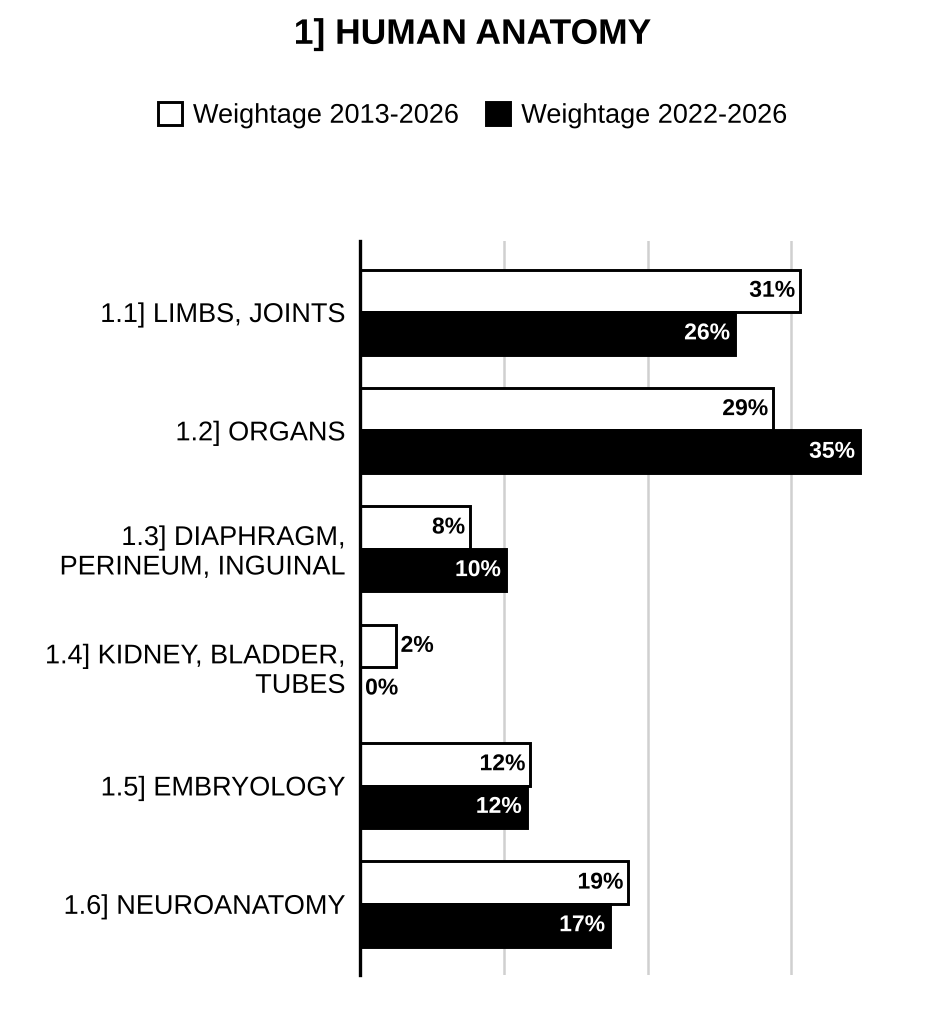
1.1] Limbs and joints
35 questions
Describe the hip joint under the following headings: (i) Factors responsible for its stability (ii) Arterial supply of upper end of femur along with mechanism of avascular necrosis of femoral head. [2026/10m/1a]
A 32-year-old male is brought to the emergency department following a road traffic accident. His clinical examination shows that his arm is adducted and medially rotated, elbow is extended and forearm is pronated. Sensory loss is also noted on lateral aspect of his forearm. His MR scan shows involvement of upper part of brachial plexus. Based on this clinical scenario, answer the following: (i) Identify the site of involvement of brachial plexus, using a diagram. (ii) Explain the anatomical basis of motor and sensory loss. [2026/15m/2a]
Describe the formation, course and branches of ulnar nerve. Which muscles do each of the branches supply? Why is ulnar nerve called the “musician’s nerve”? [2025/10m/1a]
Name the nerves and their branches that supply the sole of the foot stating the specific area of their distribution. Explain in brief what is Morton’s metatarsalgia. [2025/10m/1b]
A 45-year-old man presents at orthopaedic OPD with swollen and painful right knee. He gives a history of fall while playing cricket two weeks ago. On examination, his right knee has tenderness, swelling, decreased range of mobility and anterior joint instability. His MRI scan reveals damage to one of the major knee joint stabilizers. (I) Name all the ligaments and write their specific roles in stabilization of the knee joint. (II) Name the most likely structure involved in the given case and write two points to support your viewpoint. [2025/10m/4a(ii)]
Describe the radial nerve under the following headings: (i) Origin and course (ii) Branches and muscles supplied (iii) Applied aspects. [2024/10m/1a]
Describe the following regarding the knee joint: (I) All movements including locking and unlocking with muscles responsible for each (II) Role of cruciate ligaments in movement and stability. [2023/10m/3a(i)]
Describe Carpal Tunnel Syndrome under the following headings: (I) Causes and structure(s) involved (II) Clinical features. [2023/10m/3a(ii)]
Discuss the attachments and applied aspects of rotator cuff muscles of the shoulder joint. [2022/5m/3c(ii)]
Discuss the formation, course and branches of ulnar nerve. [2021/5m/3c(i)]
Describe shoulder joint under the following headings: (i) Type and articulating surfaces (ii) Movements and muscles responsible for each (iii) Painful arc syndrome. [2020/15m/3c]
Describe Erb’s palsy under the following headings: (i) Causes (ii) Structures involved (iii) Attitude of limb. [2020/10m/4c(i)]
Enumerate palmar spaces of Hand. [2019/5m/1d(i)]
Describe the knee joint under the following headings: 1. Types, Articular surface 2. Ligaments 3. Relations 4. Blood supply and nerve supply 5. Movements. [2019/20m/2a]
Classify Arches of foot. Write in details about medial longitudinal Arch. [2018/10m/1d]
Describe Hip Joint under the following headings: 1. Articular surface and Types 2. Ligaments 3. Relations 4. Blood supply and Nerve supply 5. Movement. [2018/20m/2a]
Describe the shoulder joint under the following headings: I. Movement II. Blood Supply III. Ligaments. [2017/15m/4a(i)]
Describe dermatomes of lower limb. [2016/10m/1a]
Give a brief account of ulnar nerve. [2016/15m/2c]
Describe the cutaneous nerve supply of dorsum of foot. [2016/15m/3b]
Describe the hip joint under the following headings: (i) Classification (ii) Movements (iii) Blood supply (iv) Ligaments. [2016/20m/4a]
Describe in detail about the origin and distribution of the sciatic nerve. Add a note on its clinical importance. [2015/15m/3b]
Give a brief account of the mechanism of locking and unlocking of knee joint. [2014/10m/1d]
Describe the effects of damage to radial nerve at the level of deltoid tuberosity. [2014/15m/3b]
Describe the shoulder joint under the following headings:– (i) Type (ii) Movements (iii) Muscles (iv) Applied anatomy. [2013/10m/1a]
Define a dermatome. Illustrate by means of labelled diagram(s) dermatomes of lower limb. [2013/10m/2c]
Describe the shoulder joint under the following headings: (i) Type of joint (Classification of joint) (ii) Movements occurring at this joint (iii) List main ligaments (iv) Name the muscles acting at this joint (Do not describe each muscle) (v) Applied anatomy of dislocation of shoulder joint (vi) What is meant by the term “frozen shoulder”? [2012/30m/2a]
Describe venous drainage of lower limb and its applied anatomy. [2011/15m/2a]
Describe Carpal tunnel syndrome, its manifestations and the causes. [2011/15m/2c]
Describe course, relations and distribution of ulnar nerve in hand. Add a note on its applied anatomy. [2005/20m/1b]
Discuss gross and applied anatomy of Knee Joint. [2005/20m/2a]
Write short notes on: (i) Broncho-pulmonary segments of lungs. (ii) Mechanism of locking and unlocking of knee joint. [1999/20m/3a]
Write notes on: (i) Arterial supply to head and neck of femur (ii) Descent of testis. [1998/20m/3c]
Describe the hip joint under the following headings: (i) ligaments (ii) relations (iii) movements (iv) applied anatomy. [1997/20m/200w/1a]
(i) Write a short note on pelvic diaphragm. (ii) Describe briefly the movement of knee joint mentioning the role of various ligaments, menisci and muscles. [1995/20m/3c]
1.2] Gross anatomy of organs
49 questions
1. Name the ligaments of ovary and their role in ovarian torsion and its complications. 2. Explain the surgical importance of anatomical relations of structures in ovarian fossa. [2026/10m/3a(i)]
Describe the major anatomical sites of portosystemic anastomosis, listing the veins involved. [2026/10m/3a(ii)]
A 55-year-old lady visits surgery OPD with a three month old history of a painless hard swelling in her left breast. On examination, it is found that the swelling is firm, immovable and is located in upper inner quadrant, along with retraction of nipple. She is advised to undergo pre-operative sentinel lymph node biopsy and surgery. Explain the anatomical basis of pre-operative sentinel node biopsy in this case. [2025/5m/4a(i)]
A middle-aged female notices a lump in the midline of the neck. She notices it moves with swallowing. The surgeon gives a tentative diagnosis of goitre. Describe the thyroid gland under the following headings: (i) Gross anatomy and relations (ii) Blood supply and lymphatic drainage (iii) Surgical anatomy of thyroid gland. [2024/15m/2a]
Describe the uterus under the following headings: (i) Gross anatomy (ii) Ligaments and supports (iii) Relations of uterus (iv) Blood supply (v) Lymphatic drainage (vi) Applied aspects. [2024/20m/3a]
A 35-year-old male smoker with complaints of difficulty in swallowing and ulcer on tip of his tongue for last one month, visits an ENT surgeon. Based on his clinical examination and histopathological investigation of tongue lesion, he is diagnosed as a case of carcinoma of tongue with cervical lymphadenopathy. (i) Using a flowchart, show the principal lymph node involved and its further distribution. (ii) Explain the role of tongue in swallowing. [2023/10m/1a]
A 56-year-old male visits a surgery OPD with complaints of difficulty in passage of urine especially on straining. Based on his clinical examination and ultrasound findings, he is diagnosed with Benign hypertrophy of Prostate. (i) What is the anatomical basis of his urinary problems? (ii) Describe the relations of Prostate gland. (iii) Describe the blood supply and lymphatic drainage of Prostate gland. [2023/15m/2a]
Discuss the stomach under the following headings: (i) Peritoneal relations (ii) Blood supply (iii) Lymphatic drainage. [2022/15m/1a]
Describe the anatomy of uterus under the following headings: (i) Gross features (ii) Relations of uterus (iii) Ligaments and supports (iv) Blood supply (v) Lymphatic drainage (vi) Applied aspects. [2022/15m/2a]
Discuss the lymphatic drainage of the mammary gland and its clinical significance. [2022/5m/4c(i)]
Describe the formation, course, tributaries and termination of coronary sinus. [2021/10m/1a]
Describe the prostate under the following headings: (i) Gross features (ii) Lobes (iii) Capsules and ligaments (iv) Blood supply (v) Lymphatic drainage (vi) Age changes. [2021/15m/2a]
Describe the formation and tributaries of portal vein. List the sites of portacaval anastomosis. [2021/10m/3c(ii)]
Write in brief about hepatic segments. [2021/5m/4c(i)]
Describe the anatomy of the Mammary gland under the following headings: (i) Extent – vertical and horizontal (ii) Blood supply (iii) Anatomical basis of metastatic dissemination to abdomen and cranium (iv) Sentinel lymph node mapping method and its role in breast surgery. [2020/20m/2a]
Describe Bronchopulmonary segment of lungs. Add a note on the importance of organ transplantation. [2019/10m/1e]
Describe stomach under the following headings: 1. Position 2. Gross features 3. Peritoneal and visceral relation 4. Blood supply and lymphatic drainage 5. Clinical anatomy. [2019/15m/3c]
Describe the gross anatomy, blood supply and applied importance of Thyroid gland. [2019/8m/4c(i)]
Describe the Coronary Arteries. Add a note on cardiac dominance. [2018/8m/4c(ii)]
Describe the developmental component and nerve supply of the tongue. [2017/10m/1c]
Describe in detail about hepatic spaces in relation to peritoneal reflection. Add a note on its applied importance. [2017/10m/2c(i)]
Give the anatomic basis of black eye. [2017/5m/4a(ii)]
Describe stomach under the following headings: (i) Location (ii) External features (iii) Arterial supply (iv) Clinical anatomy. [2015/10m/150w/1a]
Describe tongue under the following subheadings: (i) Mucous membrane and its nerve supply (ii) Muscles, movements produced by them and their nerve supply (iii) Lymphatic drainage (iv) Clinical anatomy. [2015/20m/4a]
Describe the zones and lobes of prostate gland. Add a note on applied anatomy of benign prostatic hypertrophy. [2014/10m/1a]
Describe the thyroid gland under the following headings:– (i) Lobes (ii) Relations (iii) Surgical anatomy. [2013/10m/1b]
Describe the nerve supply of tongue correlating it with its development. Add a note on its Blood supply and lymphatic drainage along with applied anatomy. [2011/10m/1a]
Define porto caval anastomosis. What are their sites? Write also the anastomosing vessels on each site with its applied anatomy. [2011/10m/1b]
Discuss relations and supports of uterus. Add a note on its applied anatomy. [2011/15m/2b]
Describe the blood supply and lymphatic drainage of stomach. Add a note on the applied anatomy of both. [2010/12m/1b]
Describe the blood supply, nerve supply and lymphatic drainage of the mammary gland. [2009/15m/1a]
Draw a schematic labelled diagram of a transverse section of thorax passing through the sternal angle. Also enumerate branches of thoracic aorta. [2007/20m/1b]
Describe the gross anatomy of caecum and vermiform appendix. Add a brief note on its applied anatomy. [2006/20m/1b]
Give an account of blood supply of heart. Add a brief note on its applied anatomy. [2006/20m/2a]
Describe the lymphatic drainage of Mammary Gland (Breast). Give an account of its applied anatomy. [2006/20m/2c]
Write gross anatomy of uterus. Add notes on supports of uterus, its histological structure and development. [2005/20m/1a]
Write in brief anatomy of RIGHT ATRIUM. Discuss errors in development leading to various congenital malformations of heart. [2004/20m/2a]
Describe broncho-pulmonary segments of lungs. Mention their clinical importance. [2003/20m/200w/1a]
Describe the layers of the scalp and its blood supply. Why does it bleed profusely when cut? [2002/20m/2a]
Discuss the development of thyroid gland and its blood supply. [2002/20m/2c]
Describe the gross and microscopic anatomy of lung. Add a note on developmental anomalies of lung. [2001/20m/200w/1a]
Describe the structure and functions of ovary. [2001/20m/200w/1b]
Write short notes on: (i) Broncho-pulmonary segments of lungs. (ii) Mechanism of locking and unlocking of knee joint. [1999/20m/3a]
Write short notes on: (i) Human placenta (ii) Draw and label a diagram of cross section of thorax through the angle of Louis. [1998/20m/2c]
Draw and label a transverse section of abdomen at the level of lumbar one vertebra. [1997/20m/2a]
Describe the coronary circulation of heart and add a note on its applied anatomy. [1997/20m/3a]
Describe the topographical anatomy of uterus. Give an outline of its development. What are its common congenital anomalies? [1996/20m/2c]
Write short notes on: (i) Right atrium of heart. (ii) Synovial membrane. [1996/20m/3c]
Draw and label a transverse section (horizontal section) of thorax through the roots of lungs. [1995/20m/2c]
1.3] Diaphragm, perineum and inguinal region
14 questions
A 55-year-old male is operated for a lung tumour. During the postoperative stay, he develops shortness of breath. His examination shows paradoxical movement of right hemidiaphragm during inspiration and same was also recorded on MR imaging. In the above case– (i) explain the anatomical basis of his clinical findings; (ii) enumerate the major openings of diaphragm and their vertebral levels, along with all the structures passing through each of them. [2026/10m/1b]
A 36-year-old cyclist suffered pelvic injury while riding into a pothole on the road. Following this incident, he has severe pelvic pain and is unable to pass urine. His retrograde urethrogram shows contrast limited to superficial perineal pouch. (i) What is the most likely structure and its site of involvement, which is responsible for his inability to pass urine? (ii) What are the parts of the principal structure involved? (iii) With the help of a labelled diagram, illustrate the difference in the contents of superficial perineal pouch in males and females. [2025/20m/3a]
Differentiate between indirect and direct inguinal hernia. [2024/5m/4a(ii)]
Describe the typical intercostal space. [2021/10m/1d]
Describe indirect inguinal hernia under the following headings: (i) Coverings and course of complete hernia (ii) Anatomical safety mechanism of inguinal canal (iii) Clinical features. [2020/10m/1e]
Enumerate the Developmental Components of thoraco Abdominal Diaphragm. [2019/5m/1d(ii)]
Describe the boundaries of inguinal canal. Add a note on the anatomy of different types of inguinal hernias. [2014/20m/4a]
Describe the gross anatomy of the thoraco-abdominal diaphragm. Mention the structures that pass through it. [2009/15m/1b]
Describe pelvic diaphragm, write in brief about its applied anatomy. [2007/20m/1a]
Discuss boundaries and contents of superficial and deep perineal spaces (pouches). Add a note on their applied Anatomy. [2004/20m/200w/1b]
Describe pelvic diaphragm. Add a note on supports of uterus. [2001/20m/2a]
Describe the formation of inguinal canal. Add a note on inguinal hernias. [2000/30m/2a]
Describe in brief the anatomy and applied significance of inguinal canal. Add a note on descent of testis. [1995/20m/200w/1f]
(i) Write a short note on pelvic diaphragm. (ii) Describe briefly the movement of knee joint mentioning the role of various ligaments, menisci and muscles. [1995/20m/3c]

Preparing for Prelims too?
Our UPSC Prelims Topic-wise PYQ eBook covers every Prelims question with detailed explanations, so you can see exactly where UPSC asks from.
View the BookDownload Free Sample1.4] Kidney, bladder, uterine tubes and vas deferens
4 questions
Describe the gross anatomy, innervation and applied importance of the urinary bladder. Add a note on autonomous bladder. [2017/15m/3b]
Describe the morphological features of kidney. Add a note on relations of right kidney. [2013/10m/2a]
Describe the gross anatomical features and relations of kidney. Explain its arterial supply and vascular segments. Add a note on the development of kidney. [2010/20m/2c]
Describe microscopic anatomy and fine structure of NEPHRON. Add a note on its applied anatomy. [2004/20m/200w/1a]
1.5] Embryology
43 questions
Describe the development of ventricles of the heart. Add a note on Fallot’s tetralogy. [2024/10m/1b]
Describe the role of SRY (Sex-determining region on Y gene) transcription factors in testicular development. [2023/10m/4a(i)]
Describe Vitelline duct abnormalities. [2023/5m/4a(ii)]
Discuss in brief the developmental anomalies of the kidney and the ureters. [2022/5m/1d]
Describe the development of the interventricular septum and write briefly about the congenital anomaly of the heart related to this structure. [2022/10m/4c(ii)]
Describe the developmental causes of “primum” and “secundum” types of Atrial septal defects. [2020/5m/1d(i)]
(a) Name the structures that constitute the placental membrane. (b) List the changes taking place in placental membrane in the later stages of pregnancy, which makes it more efficient. [2020/5m/1d(ii)]
Describe the embryological basis of Horse-shoe kidney. [2020/5m/4c(ii)]
Enumerate the Developmental Components of thoraco Abdominal Diaphragm. [2019/5m/1d(ii)]
Enumerate the Developmental Components of Inferior vena cava. [2019/3m/4c(iii)]
Write down the Development of placenta, discuss the functions and anomalies of it. [2018/7m/4c(i)]
Describe microscopically, the cellular components of lungs. Add a note on fetal distress syndrome. [2017/10m/1b]
Describe the developmental component and nerve supply of the tongue. [2017/10m/1c]
Describe the development of interatrial septum. [2016/10m/1b]
What are the functions of placenta? What do you mean by feto-placental unit? [2014/15m/4b]
Describe the steps in development of uterus. Name any four congenital malformations of uterus. [2013/10m/2b]
Name the functions of placenta. List any four malformations of placenta. [2013/10m/2d]
Describe the morphological features of full term placenta. Name any five congenital malformations of placenta. [2012/12m/1a]
Describe the development of heart chambers. Mention the common congenital anomalies and explain the developmental reasons for them. [2010/20m/2b]
Describe the gross anatomical features and relations of kidney. Explain its arterial supply and vascular segments. Add a note on the development of kidney. [2010/20m/2c]
Describe the development of the testis. [2009/20m/2a]
Explain its descent into the scrotal sac. [2009/20m/2b]
Add a note on its anomalies. [2009/20m/2c]
Describe in short the normal and anomalous development of urinary bladder. [2007/20m/2b]
Describe the functions of the placenta including some description of their clinical relevance. [2007/30m/7a]
Describe the development of FACE with the help of a diagram. Mention the anomalies associated with it. [2006/20m/1a]
Write gross anatomy of uterus. Add notes on supports of uterus, its histological structure and development. [2005/20m/1a]
Write in brief anatomy of RIGHT ATRIUM. Discuss errors in development leading to various congenital malformations of heart. [2004/20m/2a]
Describe the development of Kidney. Mention the anomalies associated with it. [2003/20m/200w/1b]
Describe the formation of placenta and its anomalies. State the functions of the placenta. [2003/20m/2c]
Discuss the development of face in brief and give its common developmental anomalies. [2002/20m/200w/1b]
Discuss the development of thyroid gland and its blood supply. [2002/20m/2c]
Describe the gross and microscopic anatomy of lung. Add a note on developmental anomalies of lung. [2001/20m/200w/1a]
Describe optic pathways and write a note on development of eyeball. [2001/20m/2b]
Write a short note on genotype and phenotype of Turner’s syndrome. [2001/20m/2c]
Describe the microscopic anatomy of testis. Add a note on spermatogenesis. [2000/12m/200w/1a]
Describe structure and functions of placenta at term. [2000/12m/200w/1b]
Describe the development of right and left Atria. Mention the congenital malformations associated with its development. [1999/20m/200w/1a]
Write short notes on: (i) Development of uterus and its congenital anomalies. (ii) Distribution of facial nerve. [1999/20m/2a]
Write short notes on: (i) Human placenta (ii) Draw and label a diagram of cross section of thorax through the angle of Louis. [1998/20m/2c]
Write notes on: (i) Arterial supply to head and neck of femur (ii) Descent of testis. [1998/20m/3c]
Describe the topographical anatomy of uterus. Give an outline of its development. What are its common congenital anomalies? [1996/20m/2c]
Describe in brief the anatomy and applied significance of inguinal canal. Add a note on descent of testis. [1995/20m/200w/1f]
1.6] Neuroanatomy
38 questions
Describe the cerebrospinal fluid (CSF) flow from site of production to its absorption. Write a note on the mechanism of its absorption. [2026/5m/4a(i)]
A 62-year-old hypertensive male is brought to medical OPD with the complaints of sudden onset of visual loss in both his eyes. His ophthalmologic examination reveals right homonymous hemianopia with macular sparing, and his MR scan shows cerebral hemorrhage involving left occipital lobe. Based on the above findings, explain the anatomical basis of visual loss in this patient using a diagram depicting the entire visual pathway. [2026/10m/4a(ii)]
Using a well labelled diagram, trace the taste pathway from circumvallate papillae of tongue to the cerebral cortex. [2025/15m/2a]
Describe the facial nerve under the following headings: 1. Functional columns and nuclei of origin 2. Course and branches 3. Bell’s palsy. [2024/10m/4a(i)]
Describe the following in the context of ‘Auditory pathway’: (i) Its course from internal ear to auditory cortex (ii) Blood supply of the auditory cortex. [2023/10m/1b]
Describe the functional components, course, branches and applied aspects of the facial nerve. [2022/10m/3c(i)]
Enumerate all cranial nerve nuclei with their functional components. [2021/10m/4c(ii)]
Describe otic ganglion under following headings: (i) Location (ii) Roots (iii) Branches (iv) Role of its fibers in Frey’s syndrome. [2020/10m/1a]
Discuss the Functional Components, Nucleus, Course, Distribution of Seventh Cranial Nerve. [2019/10m/1a]
Enumerate the different types of myelineted fibers in the cerebral white matter. [2019/4m/4c(ii)]
Discuss the Functional components, Nucleus, course and distribution of 4th cranial nerve. Add a note on its clinical significance. [2018/10m/1a]
Describe the External, Internal features, parts of cerebellum. Add a note on the constitution of cerebellar peduncles. [2018/15m/3c]
Describe blood supply of brain stem and add a note on its applied importance. [2017/5m/2c(ii)]
Describe the cervical part of the sympathetic chain. [2015/10m/150w/1d]
Describe the projection fibres of cerebrum. [2015/15m/2c]
Name the lateral descending tracts. List the effects of their lesion. What will happen to sensory loss in the lesion around central canal of spinal cord? [2014/10m/1b]
Enumerate the branches of facial nerve and write a brief note on Bell’s palsy. [2014/15m/2c]
What is the mechanism of accommodation in eye? Why near point recedes in old age? [2013/10m/1d]
Describe the structures forming floor of fourth ventricle of brain. [2013/10m/2e]
Tabulate the extrinsic and intrinsic muscles of eyeball along with their nerve supply and action(s). [2012/12m/1b]
Explain the origin and course of Facial Nerve. Describe its functional components and distribution. What is Bell’s palsy and give the anatomical reasons for the presenting signs? [2010/12m/1a]
Describe the ventricles of brain. Add a note on the circulation of CSF. Mention the usual site of collection of CSF and state the anatomical reason for selecting this site. [2010/20m/2a]
What are the differences between sympathetic and parasympathetic divisions of autonomic nervous system? Why are parasympathetic nerves called nerves of tomorrow? [2009/15m/1d]
Give an outline of anatomy of facial nerve mentioning its clinical significance. [2007/20m/2a]
What is accommodation of eye? How is the eye accommodated for near vision? Why does a person start having difficulty in reading after the age of 40 years though the visual acuity is 6/6? [2006/20m/2b]
Which sensations are carried by Dorsal columns of spinal cord? What changes occur in their lesion? [2005/20m/2b]
Describe visual pathway. Discuss various visual impairments involving visual pathway at different levels. [2005/20m/2c]
What is the role of middle ear in hearing? Why there is need for two ears. [2004/20m/200w/1c]
How sympathetic stimulation prepares the person for flight and fight reaction? [2004/20m/2b]
Describe functional components, origin, course and distribution of THIRD CRANIAL nerve. [2004/20m/2c]
Trace the pathway of pain and thermal sensations with the help of a diagram. [2003/20m/2a]
What are the general features of parasympathetic division of autonomic nervous system. Why is it known as ‘anabolic division’? [2003/20m/2b]
Describe the course, relations and structures supplied by the recurrent laryngeal nerve. Name the most important single muscle of the body supplied by this nerve. [2002/20m/200w/1a]
Describe optic pathways and write a note on development of eyeball. [2001/20m/2b]
Describe the course and distribution of mandibular branch of fifth cranial nerve. [2000/30m/2b]
Write short notes on: (i) Development of uterus and its congenital anomalies. (ii) Distribution of facial nerve. [1999/20m/2a]
Name the different cranial nerves. Describe the anatomy of autonomic nervous system with special reference to Gastro-intestinal Tract. [1998/20m/200w/1f]
Give a brief account of the nerves supplying the eyeball. [1996/20m/200w/1f]

Strengthen your GS papers
Our UPSC Mains Topic-wise & Year-wise PYQ eBook (2013–2026) maps every GS question to the syllabus, so you know what UPSC asks and how often.
View the BookDownload Free SampleNext: Human Physiology »
Back to: Medical Science Optional PYQs – Topic-wise | Also see: Medical Science Optional year-wise question papers
Last updated: 31 October 2026