
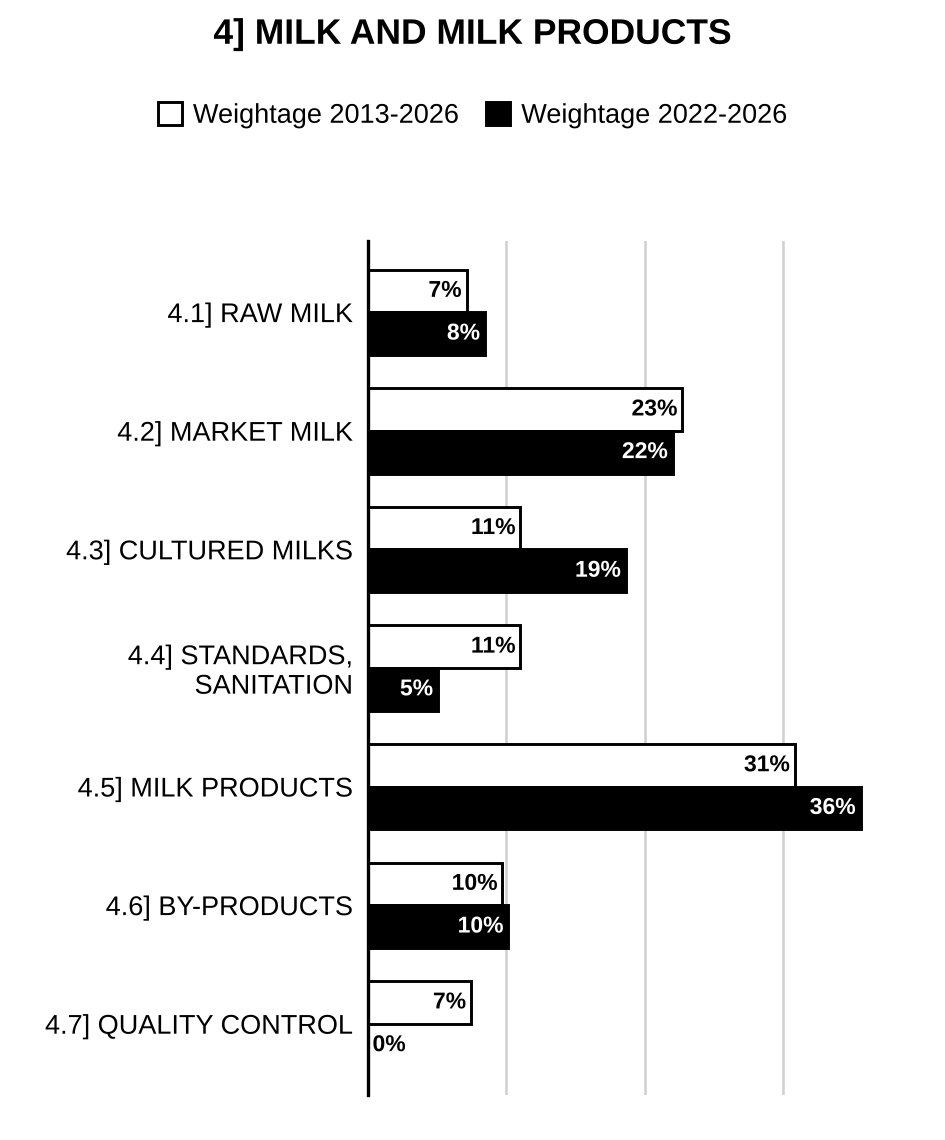
Here are all 83 Milk and Milk Products Technology questions asked in UPSC Animal Husbandry and Veterinary Science Optional Paper II from 1995 to 2026, arranged under the 7 topics of the official syllabus. Within each topic the latest questions come first.
Each question ends with a code such as [2024/15m/3b] – the year, the marks, the word limit (where UPSC set one) and the question number in the paper.
4.1] Quality, testing and grading of raw milk
8 questions
Platform tests for determination of milk quality. [2022/10m/150w/5b]
Discuss the different types of microbial spoilage in milk. [2022/15m/7b]
Collection and transportation of raw milk. [2021/10m/150w/1d]
Grading of raw milk. [2016/10m/150w/5d]
Write the procedure of testing and grading of raw milk at primary milk collection centre. [2014/10m/2c]
Platform tests for milk quality. [2010/15m/150w/5a]
Grading of milk and milk products. [2005/20m/200w/5b]
Organization of rural milk procurement. [2004/20m/200w/5a]
4.2] Market milk processing
20 questions
Various procedures for the pasteurization of market milk. [2024/10m/150w/5c]
Explain the manufacturing processes of reconstituted and recombined milks, and compare their attributes. [2024/15m/6b]
Enlist various flavour defects in the market milk, their causes and preventions. [2024/15m/8c]
Preparation of flavoured and sterilized milk. [2023/10m/150w/5b]
Define homogenisation. Explain in detail the method of manufacture of homogenised milk along with its merits and demerits. [2022/15m/6b]
Define homogenized milk and mention its advantages and disadvantages. Describe the methods of manufacture of homogenized milk. [2020/20m/6a]
Define pasteurization of milk. Write its objectives and basis of formulation of time-temperature standards. Enlist different methods of milk pasteurization and discuss in detail about the method used in modern commercial dairy plants. [2019/20m/8a]
Causes of flavour defects in milk. [2017/10m/150w/1e]
Explain with the help of flow diagrams, the manufacture of sterilized, homogenized and flavoured milk. [2017/20m/6b]
Discuss the methods of pasteurization of milk. [2016/10m/150w/1d]
What are reconstituted milk and recombined milk? Describe the preparation of Srikhand, Lassi and Yogurt. [2016/20m/8b]
What is U.H.T. processing of milk? How do we achieve commercial sterility in aseptic packaging of milk? [2015/20m/4a]
Bacteriological, physical, chemical and nutritional effects of processing on milk. [2012/12m/150w/5c]
Reverse osmosis, ultra filtration, nano filtration and micro filtration technology in milk processing. [2012/20m/6c]
Give a detailed account on: Fortified, reconstituted and flavoured milks. [2012/20m/7c]
Discuss the principles of heat exchange and process of High Temperature-Short Time (HTST) method of milk pasteurization including the functions of each component of HTST equipment. [2010/25m/7c]
Sterilized milk. [2006/20m/200w/5a]
Describe the different steps and precautions that are required to be taken while establishing a large scale milk processing plant. What cost cutting and administrative measures do you recommend to make the plant economically viable and successful? [1997/60m/6]
Milk homogenisation and its use. [1996/20m/200w/1d]
Give the BIS standards for standard milk, toned milk and double toned milk. State how each one is processed in a dairy plant. Give ways and means to reduce the operational costs of a medium sized dairy plant. [1996/60m/6]
4.3] Cultured milks
11 questions
Preparation and nutritive value of Shrikhand. [2026/10m/150w/5b]
Describe the processing of yoghurt and cultured buttermilk along with flow diagrams. [2026/20m/6a]
How is the processing of Acidophilus milk and Bulgarian butter milk done? [2025/10m/150w/5c]
Describe the process of manufacture of ‘mother starter’ and ‘bulk starter’ cultures. What are the defects encountered in ‘starter’ and what measures are to be taken to avoid these defects. [2025/15m/7b]
Define fermented milk and state its advantages. Describe the complete manufacturing process involved in the production of cultured buttermilk. [2018/20m/7b]
What are reconstituted milk and recombined milk? Describe the preparation of Srikhand, Lassi and Yogurt. [2016/20m/8b]
Probiotics and their usage in milk products. [2012/12m/150w/5b]
Procedure for preparation of cultured milk products of yoghurt and ‘srikhand’. [2009/20m/200w/5c]
Write an account on various cultured milks. [2006/30m/6a]
Explain the preparation of different cultured milks. [2006/30m/6b]
Yoghurt. [2001/20m/200w/5a]

Preparing for Prelims too?
Our UPSC Prelims Topic-wise PYQ eBook covers every Prelims question with detailed explanations, so you can see exactly where UPSC asks from.
View the BookDownload Free Sample4.4] Legal standards and dairy sanitation
12 questions
Discuss the sanitation requirements of clean and safe milk production. [2023/15m/6b]
Describe in detail about the cleaning and sanitation of dairy plant for processing of clean and safe milk. [2021/20m/6a]
Write down FSSAI standards for different types of milk. [2020/10m/5b]
Application of HACCP and GMP in market milk production in a dairy plant with a capacity of one lakh litres per day. [2019/10m/150w/1d]
Legal standards for whole milk powder and skim milk powder. [2018/10m/150w/1e]
What are indigenous milk products? Describe in detail about the sanitation requirement in dairy plant for clean and safe milk. [2016/20m/3b]
Sanitation requirements for clean and safe milk production. [2015/10m/150w/1d]
Narrate the plan for supply of hygienic and nutritive milk products from rural, to urban areas. [2004/60m/6]
Disease free milk products. [2002/20m/200w/5a]
Narrate the plan for supply of hygienic and nutritive milk from rural sector to major cities in India. [2002/60m/6]
Elaborate the various critical control point in the production, transport, processing, storage and marketing [?] of fluid milk. Mention the steps you will recommend for monitoring them. [1998/60m/6]
Give the BIS standards for standard milk, toned milk and double toned milk. State how each one is processed in a dairy plant. Give ways and means to reduce the operational costs of a medium sized dairy plant. [1996/60m/6]
4.5] Milk products
19 questions
Give a detailed account of processing of Cheddar cheese with a flow diagram and write its nutritive value. [2026/20m/7b]
Neutralization of cream. [2025/10m/150w/5b]
List out different defects encountered in condensed and evaporated milk, their causes and preventive measures. [2025/15m/6b]
Discuss the production and physico-chemical properties of cream. Enumerate the common defects encountered during its manufacture and storage. [2024/20m/7b]
Difference in the physical quality and chemical composition of cow and buffalo khoa. [2023/10m/150w/5c]
Defects of whole milk powder and skim milk powder, their causes and prevention. [2022/10m/150w/5e]
Explain in detail the preparation of ice-cream with a flowchart and give the legal standards and various defects of ice-cream. [2022/20m/8a]
Discuss the various methods of Ghee manufacture along with their merits and demerits. Write down the FSSAI and Agmark standards of Ghee. [2021/15m/3b]
Discuss in detail about the processing of butter along with flow diagram. Enumerate the defects encountered in stored butter. [2021/20m/8b]
Define cheese. Explain the manufacture of cheddar cheese with suitable flow diagram. [2020/20m/7a]
What is the need for drying of milk? Discuss the principle and process of spray drying of milk including its advantages and disadvantages. [2019/10m/3c]
Processing of cheddar cheese with a flow chart. [2019/10m/150w/5c]
Describe the method of manufacturing, packaging and storage of butter. [2017/15m/3c]
What are indigenous milk products? Describe in detail about the sanitation requirement in dairy plant for clean and safe milk. [2016/20m/3b]
Compare the physical and sensory properties of buffalo and cow milk khoa. [2015/10m/4c]
What are the different drying methods, their advantages and disadvantages for manufacturing of milk powders including their packaging and storage? [2013/20m/7b]
Describe in detail the processing technology of cheddar cheese including their packaging and storage. [2013/10m/7c]
Role of various ingredients used in manufacturing ice-cream. [2010/15m/150w/1d]
Salting of cheese. [1995/20m/200w/5d]
4.6] Dairy by-products
5 questions
Classify industrial casein derived from skim milk. Describe the method of manufacture of acid casein. [2025/15m/8c]
Enlist the different by-products of Indian dairy industry. Describe the broad principles of their utilization. [2023/15m/6c]
Enlist different byproducts produced during the preparation of milk products, and write in detail about their utilization. [2020/20m/8a]
Classify dairy industry by-products and explain the general method of preparing acid casein. [2017/15m/8b]
Various approaches for utilization of whey. [2015/10m/150w/5d]
4.7] Quality control of milk products
8 questions
Discuss the various methods of Ghee manufacture along with their merits and demerits. Write down the FSSAI and Agmark standards of Ghee. [2021/15m/3b]
Packaging of milk and milk products. [2021/10m/150w/5d]
What are the functions of packaging milk and milk products? Describe various types and forms of packaging materials used for milk and milk products. [2018/20m/6a]
Describe the marketing system of milk products in India. [2014/10m/4c]
Describe the quality assurance programme in milk and meat industry. [2013/20m/7a]
Total quality management in processing of milk products. [2012/20m/8c]
Grading of milk and milk products. [2005/20m/200w/5b]
Describe the different steps and precautions that are required to be taken while establishing a large scale milk processing plant. What cost cutting and administrative measures do you recommend to make the plant economically viable and successful? [1997/60m/6]

Strengthen your GS papers
Our UPSC Mains Topic-wise & Year-wise PYQ eBook (2013–2026) maps every GS question to the syllabus, so you know what UPSC asks and how often.
View the BookDownload Free Sample« Previous: Veterinary Public Health | Next: Meat Hygiene and Technology »
Back to: Animal Husbandry and Veterinary Science Optional PYQs – Topic-wise | Also see: Animal Husbandry and Veterinary Science Optional year-wise question papers
Last updated: 31 October 2026