
Here are all 97 Veterinary Public Health questions asked in UPSC Animal Husbandry and Veterinary Science Optional Paper II from 1995 to 2026, arranged under the 4 topics of the official syllabus. Within each topic the latest questions come first.
Each question ends with a code such as [2024/15m/3b] – the year, the marks, the word limit (where UPSC set one) and the question number in the paper.
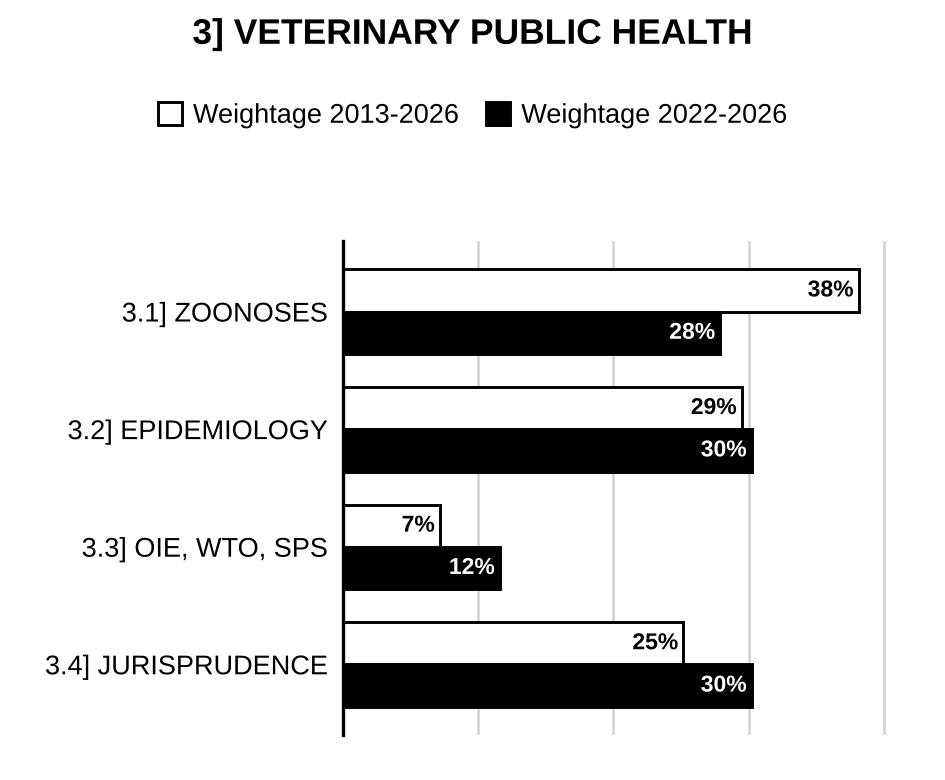
3.1] Zoonoses
38 questions
Role of animals and birds in the propagation of zoonotic diseases in humans. [2026/10m/150w/5a]
Describe the effect of Avian Influenza Virus on Poultry industry and suggest the control measures to be adopted for effective control of Avian Influenza. Mention the WHO’s guidelines for addressing the pandemic situation. [2025/10m/4a(i)]
Discuss about emerging zoonotic diseases, their prevalence and effects on animal and human population. [2025/10m/6a(i)]
Classification of zoonoses based on etiological agents. [2024/10m/150w/5a]
Explain the role of birds in the transmission of zoonotic diseases. [2023/15m/3c]
Occupational zoonotic health hazards. [2022/10m/150w/5c]
Socio-economic impact of zoonotic diseases on public health. [2021/10m/150w/1c]
Enlist the occupational zoonotic diseases and their causative agents, which are transmitted from animals to human beings. [2020/10m/5a]
Role of public health veterinarians in maintaining rural health. [2019/10m/150w/1c]
Emerging zoonotic diseases of International concern with specific remarks on prevalence, control and preventive measures for Influenza. [2019/10m/150w/5b]
Write the salient features (aetiology, non human principal host, mode of infection, symptoms and class of zoonoses) for the following zoonotic diseases: (i) Brucellosis (ii) Tuberculosis (iii) Leptospirosis. [2019/10m/7c]
Causes and principal ruminants involved in bacterial zoonotic diseases. [2018/10m/150w/1d]
Write in detail etiology, pathogenesis, clinical symptoms, diagnosis and control of rabies in dogs. [2018/20m/4a]
Explain zoonoses. Discuss the routes of transmission of various zoonotic diseases. [2017/20m/3a]
What is Mediterranean fever? Describe the diagnosis, treatment and prevention of the same. [2016/10m/150w/1c]
Write in detail about zoonoses associated with meat and milk. [2016/20m/2b]
Describe the role of animals and birds in prevalence and transmission of zoonotic diseases. [2016/15m/4b]
Diagnosis and prevention of rabies. [2016/10m/150w/5b]
Occupational zoonotic diseases in meat handlers. [2015/10m/150w/1c]
Discuss the socio-economic impact of zoonotic diseases on public health. [2015/10m/2c]
Discuss the latest national guidelines on post-exposure prophylaxis (PEP) in suspected rabid dog bites in humans. [2015/20m/8a]
Write the factors for the emergence and re-emergence of zoonotic diseases and describe the major zoonoses in relation to meat production. [2013/10m/5a]
Animal diseases of public health significance and need for one health programme. [2012/20m/8a]
Why RABIES in humans is also called HYDROPHOBIA? Explain the reasons for recent high incidence of deaths due to RABIES in Humans in India. [2011/30m/3a]
Explain the epidemiology, diagnosis, prophylaxis and control of RABIES in canines. [2011/30m/3b]
Occupational zoonotic diseases. [2009/20m/200w/5d]
Describe etiology, transmission, diagnosis, prevention and control of rabies. Discuss its public-health significance/importance. [2007/60m/3]
Role of Veterinarian in Public Health. [2007/20m/200w/5a]
Describe the etiology, epidemiology, pathogenesis, symptoms, diagnosis, prevention and control of bird flu. Elucidate its zoonotic and economic significance. [2006/60m/4]
Occupational zoonotic health hazards. [2005/20m/200w/5c]
Classify the zoonotic diseases and describe various factors responsible for their prevalence and transmission. [2003/60m/3]
Discuss the modes of spread of zoonotic diseases through vectors, animals, birds and human beings. [2002/60m/3]
Rickettsial zoonotic diseases. [2001/20m/200w/1a]
Discuss epidemiology, role of vectors in transmission, pathogenesis, latest methods of diagnosis and control of rabies in animals by using modern vaccines. [2001/60m/6]
Occupational zoonotic diseases. [1999/20m/200w/5a]
Cyclozoonoses. [1998/20m/200w/1a]
Give definition and classification of zoonotic diseases. Explaining the role of animals and birds in prevalence and transmission of zoonotic diseases. What practical steps do you recommend to tackle these diseases? [1997/60m/8]
Fish borne zoonosis. [1995/20m/200w/1d]
3.2] Epidemiology
28 questions
Discuss the methods of disease transmission and disease control measures. [2025/10m/6a(ii)]
Write in detail about milk and meat borne diseases and their control. [2025/10m/7a(i)]
Significance of the cohort, case-control and cross-sectional epidemiological studies in animals. [2024/10m/150w/5b]
What are the main epidemiological principles of animal disease control? [2023/20m/6a]
Discuss the epidemiological tools to study the control of air- and water-borne diseases. [2022/15m/7c]
Discuss the epidemiological principles, methods of investigation and control of food-borne diseases. [2021/15m/3c]
Describe through flow diagrams the steps involved in investigating a propagating epidemic and a point epidemic. [2020/15m/6b]
Describe the methods to measure disease occurrence. [2020/10m/8c]
Enlist meat and milk borne diseases. Discuss on their epidemiology, prevention and control. [2019/20m/6b]
Explain the epidemiological measures in the investigation of FMD outbreak. [2016/10m/6c]
How are case-control and cohort studies useful in epidemiological disease investigation? Explain their application in the study of infectious diseases. [2015/20m/6a]
Discuss how disease transmission occurs at ecological interfaces. [2015/10m/6c]
How does Landscape epidemiology help in disease predictions? [2015/10m/8c]
Epidemiological tools to study control of infectious diseases. [2014/10m/150w/5b]
Risk factors for diseases: BEINGS model. [2013/10m/1b]
How is epidemiological survey helpful in disease control programme? [2013/10m/5d]
Animal origin food products and food poisoning in man. [2012/12m/150w/5e]
Give a detailed account on: Methodology of epidemiological investigations for disease forecasting. [2012/20m/7b]
Hazard Analysis Critical Control Points (HACCP) and its role in preventing/reducing Food borne zoonotic diseases. [2011/15m/150w/1c]
Different patterns of occurrence of diseases in a population. [2011/15m/150w/1d]
Application of epidemiological measures in the study of diseases and disease control. [2007/30m/6b]
Discuss the application of epidemiological measures in prevention and control of air and water borne infections. [2005/60m/7]
Describe the role of epidemiology for investigation and control of animal diseases under Indian conditions. [2004/60m/4]
Epidemiological tools to study control of infectious diseases. [2003/30m/2b]
Epidemiological study of diseases. [2002/20m/200w/1c]
Discuss the role of various milk products in transmission of diseases in human beings. [2000/60m/3]
Discuss the epidemiological features of food-borne infections. What are the epidemiological tools you will use for investigation tools you will use for investigation of a suspected water-borne disease outbreak? [1996/60m/2]
Animal disease associated with water supply. [1995/20m/200w/5a]

Preparing for Prelims too?
Our UPSC Prelims Topic-wise PYQ eBook covers every Prelims question with detailed explanations, so you can see exactly where UPSC asks from.
View the BookDownload Free Sample3.3] OIE, WTO and sanitary and phytosanitary measures
5 questions
Discuss the role of the WTO in implementation of sanitary and phytosanitary measures related to milk and meat products. [2026/15m/6b]
OIE standard setting procedure for animal disease control. [2025/10m/150w/5a]
Discuss the role of OIE, WTO and sanitary and phytosanitary measures needed in improving the international trade in foods of animal origin. [2021/15m/6c]
OIE regulations on food-borne infections of animal origin. [2016/10m/150w/5c]
OIE guidelines for control of bird flu in India. [2012/12m/150w/5d]
3.4] Veterinary jurisprudence
26 questions
Describe the procedure for conducting post-mortem examination of a cow in a vetero-legal case. [2026/20m/7a]
Discuss in detail the vetero legal aspects of sudden death of a cow. [2025/10m/7a(ii)]
Describe the physical, chemical and microbiological examination of blood stains required for veterolegal purposes. [2024/20m/6a]
Discuss the various legislations for protecting animal rights in India. [2022/15m/6c]
Discuss the role of SPCA in animal welfare. [2021/10m/2c]
Determination of time of death (TOD) in animals in veterolegal cases. [2021/10m/150w/5c]
Enumerate different poisons, which are commonly suspected in animals. Mention the material along with its quantity to be collected in order of its importance. [2020/10m/5c]
Rules for the post-mortem examination of a veterolegal case. [2018/10m/150w/5d]
Describe in detail the legal aspects of wounds. [2017/10m/2c]
Rules and regulations for prevention of animal diseases. [2017/10m/150w/5e]
Discuss the regulations for improvement of animal quality in maintaining human health. [2014/20m/3b]
Rules and regulations for prevention of cruelty to animals. [2014/10m/150w/5a]
Give an account of the materials and methods of collection of samples for vetero-legal investigation. [2014/20m/7a]
Veterolegal aspects of post mortem examinations in animals. [2012/20m/6b]
SPCA in animal welfare. [2011/30m/7a]
DNA fingerprinting in FORENSIC MEDICINE. [2011/30m/7b]
Give an account of the following:– Rules observed in conduction of post-mortem examination of vetero-legal case. [2010/20m/3b]
Describe the provisions of Glanders and Farcy Act, 1899. [2010/15m/7b]
Notifiable diseases under Dourine Act 1910. [2009/20m/200w/5a]
Materials and methods for collections of samples for veterolegal investigation. [2007/20m/200w/5c]
Veterolegal cases. [2006/20m/200w/1d]
Regulations for animal health and wealth. [2004/20m/200w/1d]
Rules and regulations for prevention of cruelty to animals. [2003/30m/2a]
Laws relating to animals. [2002/20m/200w/1b]
Discuss the rules and regulations for improvement of animal quality and disease prevention. [1999/60m/2]
S.P.C.A. [?]. [1999/20m/200w/5d]

Strengthen your GS papers
Our UPSC Mains Topic-wise & Year-wise PYQ eBook (2013–2026) maps every GS question to the syllabus, so you know what UPSC asks and how often.
View the BookDownload Free Sample« Previous: Animal Diseases | Next: Milk and Milk Products Technology »
Back to: Animal Husbandry and Veterinary Science Optional PYQs – Topic-wise | Also see: Animal Husbandry and Veterinary Science Optional year-wise question papers
Last updated: 31 October 2026