
Here are all 140 Meat Hygiene and Technology questions asked in UPSC Animal Husbandry and Veterinary Science Optional Paper II from 1995 to 2026, arranged under the 8 topics of the official syllabus. Within each topic the latest questions come first.
Each question ends with a code such as [2024/15m/3b] – the year, the marks, the word limit (where UPSC set one) and the question number in the paper.
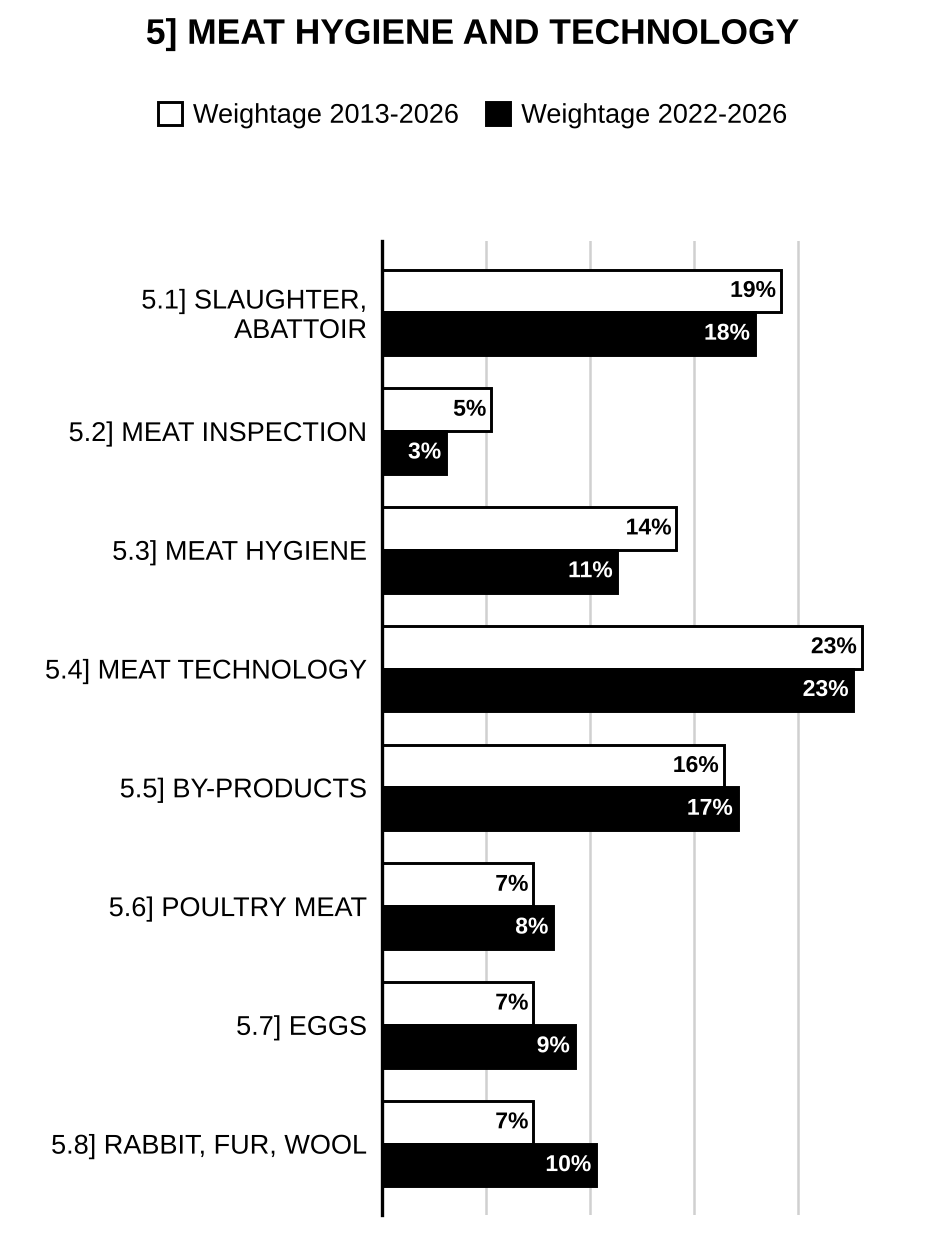
5.1] Ante-mortem care and slaughter
18 questions
Differentiate between a service abattoir and a commercial abattoir. Write down the general principles for efficient abattoir management in Indian conditions. [2026/20m/8a]
What are the purpose and procedure of ante-mortem inspection of animals? Write about categorization of animals based on ante-mortem inspection. [2025/15m/6c]
Write a note on abattoir effluent treatment. [2025/7m/8b(i)]
Describe various stunning techniques employed for humane slaughter of animals. [2024/15m/6c]
Describe the basic requirements and main components in the establishment of a modern slaughterhouse. [2023/20m/7a]
Preslaughter care of food animals. [2022/10m/150w/5d]
Discuss about preslaughter care and handling of food animals. [2019/10m/2c]
Write in detail the ante-mortem inspection procedure in a slaughter house. [2018/20m/3b]
Scalding technique in poultry and pig slaughtering. [2017/10m/150w/1d]
Write down the methods of stunning and explain electrical stunning in small and large animals. [2017/20m/7a]
What are satellite slaughterhouses? Give your suggestion on improving the distribution of safe meat in the Indian context. [2016/10m/3c]
Explain in detail about the important building components in abattoir for wholesome meat production and discuss about the significance of automation in meat processing. [2016/20m/4a]
Discuss the importance of ante-mortem care of animals in controlling health hazards. [2014/20m/4a]
Write the importance of antemortem inspection of meat animals. List the most common diseases encountered during AM examination. Also write the procedure to conduct the AM inspection. [2013/20m/6a]
Describe the legal requirements for setting up a modern abattoir and meat plant. [2013/20m/8b]
Humane slaughter methods and application of HACCP, GMP and ISO 9000 in meat processing industries. [2012/12m/150w/5a]
Discuss the role of manager of slaughter house for wholesome meat production and utilization of byproducts. [2002/60m/7]
Methods for increasing carcass yield. [2000/20m/200w/5c]
5.2] Meat inspection and carcass grading
8 questions
What are the duties and functions of veterinarian in wholesome meat production? [2023/15m/8c]
Grading and fabrication of sheep carcass. [2021/10m/150w/1e]
What are the objectives of meat inspection? Write in detail the procedure of postmortem inspection. [2020/10m/8d]
Explain the role of public health veterinarian in relation to meat hygiene. [2015/10m/7c]
Write the etiology, gross lesions and judgment in respect of viral diseases during postmortem inspection of meat animals’ carcasses. [2013/20m/6b]
Wholesale cuts of lamb carcass. [2011/15m/150w/5b]
Describe duties and functions of veterinarian of slaughter house for production of standard meat. [2004/60m/7]
Given an account of: Grading of pig carcasses. [2003/30m/6b]
5.3] Meat hygiene
25 questions
Describe the measures to be adopted for production and handling of hygienic meat from farm to fork. [2026/15m/8b]
Mechanism of rigor mortis in the goat carcass. [2024/10m/150w/5d]
Physico-chemical changes in meat after slaughter. [2023/10m/150w/5e]
What is fraudulent substitution of meat? Discuss the various methods to detect meat adulteration. [2022/20m/7a]
Discuss the steps involved in conversion of muscle into meat and the factors affecting meat quality. [2021/20m/7b]
Differentiate between PSE and DFD meat. Also write a short note on methods of fraudulent substitution of meat. [2020/10m/5e]
What are the measures do you suggest to improve the quality of meat for domestic consumption? [2019/10m/4c]
Factors influencing the microbial growth on meat causing spoilage and the control measures to retard microbial growth. [2019/10m/150w/5d]
Sources of contamination of meat in a slaughter house. [2018/10m/150w/5e]
Explain the post-slaughter physico-chemical changes in meat and the factors affecting it. [2017/20m/8a]
Adulteration in meat trade and the techniques to identify it. [2016/10m/150w/5e]
What is adulteration of meat? Describe in detail about the methods of detecting adulteration of beef. [2014/20m/2b]
Describe the quality assurance programme in milk and meat industry. [2013/20m/7a]
Humane slaughter methods and application of HACCP, GMP and ISO 9000 in meat processing industries. [2012/12m/150w/5a]
Meat adulteration and techniques to differentiate meat from different species. [2012/20m/6a]
Write briefly about the various provisions of Meat Food Products Order (MFPO). [2011/20m/6b]
What do you understand by the term RIGOR MORTIS? Write about the changes that take place during the conversion of muscle to meat after slaughter. [2011/30m/8a]
Extrinsic and Intrinsic factors responsible for the spoilage of meat. [2010/15m/150w/1c]
What are the different techniques in meat speciation? [2009/15m/7c]
Regulatory provisions in meat trade industry. [2007/30m/6a]
Meat adulteration and its detection. [2004/20m/200w/5c]
Adulteration of meat and its detection. [1999/20m/200w/1d]
What is meant by ‘Organoleptic Qualities’ of meat? Discuss the various methods that can be adopted for the ‘quality’ improvement of meat. [1998/60m/2]
Regulatory system in Meat Trade and Industry. [1998/20m/200w/5d]
What is meant by ‘HACCP’? Discuss its relevance in relation to production, processing and marketing of wholesome meat. Describe the various byproducts of the meat industry and their economic importance. [1995/60m/4]
5.4] Meat technology
30 questions
Preparation of meat emulsion and precautions required during the process. [2026/10m/150w/5d]
Elaborate the functions of different curing ingredients used in meat processing. Write down the advantages and limitations of various curing methods. [2026/15m/6c]
Principles and methods of low temperature preservation of meat. [2025/10m/150w/5d]
Discuss the modern processing technologies to improve quality of meat and meat products. [2025/10m/8a(i)]
Packaging is a very important tool for successful marketing of meat and meat products – discuss the topic in light of traditional and modern packaging techniques. [2025/10m/8a(ii)]
Explain the basic processing procedures for the preparation of convenience meat products. [2024/20m/7a]
Define sausage. Describe the processing steps in the preparation of ready-to-cook sausages. [2023/20m/8a]
Discuss in detail the various steps in canning of meat and various defects in cans. [2022/15m/8c]
Eating quality of meat. [2021/10m/150w/5e]
Discuss in detail meat curing. [2020/10m/5d]
Explain in detail the principle and different methods of meat preservation. [2020/15m/6c]
Meat from spent/aged animals and birds are tough. How the meat from such animals and birds can be utilised economically and profitably? [2019/20m/3b]
Briefly describe the physical changes that occur in preserved meat. [2018/10m/4c]
Discuss the methods for preservation of meat and meat products. [2017/20m/4a]
Irradiation preservation of meat. [2015/10m/150w/1e]
What are the advantages of value addition in meat? Describe the steps involved in the processing of cooked sausages. [2015/20m/2b]
What are the advantages of canning of meat products? Detail the various steps in traditional canning. [2015/20m/7a]
Describe the various quality characteristics and storage conditions of fresh meat. [2015/20m/8b]
What is curing? How does it protect spoilage of meat, specially pork? [2014/20m/4b]
What is meant by meat emulsion? How is it prepared? Discuss the advantages of meat extension. [2010/30m/4b]
Modified Atmosphere Packaging (MAP) of meat and meat products. [2010/15m/150w/5c]
What do you mean by value-added meat products? Give examples. Give the classification of different types of sausages. Using a typical flow diagram, describe various processing steps for manufacture of cooked sausages. [2009/60m/6]
Write down the functions of salt, sugar, nitrite, sodium ascorbate, polyphosphates, glucono-δ-lactone and spices in developing cured meat products. [2009/20m/7b]
Distinguish between radurization, radicidation and radapertization. Describe the principle, procedure and application(s) of ionizing radiation of meat products. Briefly comment on the safety perceptions with regard to irradiated meat. [2009/40m/8b]
Meat preservation. [2006/20m/200w/5c]
Cured meat products. [2005/20m/200w/5d]
Canning of meat products. [2003/20m/200w/1a]
Discuss modern methods of preservation and packaging of meat and meat products. [2003/60m/7]
Physical and chemical characteristics of meat. [2002/20m/200w/5c]
Packaging of meat. [2001/20m/200w/5c]

Preparing for Prelims too?
Our UPSC Prelims Topic-wise PYQ eBook covers every Prelims question with detailed explanations, so you can see exactly where UPSC asks from.
View the BookDownload Free Sample5.5] Slaughter house by-products
23 questions
Classification and processing of animal casings. [2026/10m/150w/5c]
What are the uses of animal organs and glandular by-products for food and pharmaceuticals? [2026/10m/7c]
Discuss the methods of processing of condemned carcasses for production of meat-cum-bone meal. [2025/8m/8b(ii)]
Describe the social and economic implications of proper utilization of slaughter-house byproducts. [2024/20m/8a]
Enlist the edible and inedible by-products of meat industry. Give a flowchart for the preparation of gelatine from bones. [2023/20m/7b]
Describe in detail the various methods of rendering of fallen animal carcasses. [2022/15m/8b]
Discuss the various methods of preservation of hides and skin. Elaborate the different steps involved in conversion of hides and skin into leather. [2021/20m/4a]
Explain the methods of collection, preservation and processing of glandular byproducts during slaughter. [2020/10m/7c]
Write about the technology recommended for converting condemned carcasses into meat-cum-bone meal and discuss on the methods employed for the above. [2019/20m/7b]
Give holistic picture of the types of slaughter house byproducts and their potential utilization including the social and economic implications. [2018/20m/2a]
Pharmaceutical uses of glandular parts of slaughtered animals. [2017/10m/150w/5d]
Organ products for food and pharmaceuticals. [2015/10m/150w/5e]
Various uses of horn and hoof of slaughter animals. [2014/10m/150w/1c]
Write about the social and economic implications of proper utilization of slaughterhouse byproducts. [2013/10m/6c]
Describe the processing technology for manufacture of glue and gelatin. [2013/10m/8c]
Physico-chemical characteristics of hide and skin and factors affecting its quality. [2012/20m/8b]
How will you proceed to collect glands/organs from slaughtered animals for PHARMACEUTICAL purpose? What are the pharmaceutical uses of intestines, liver and PITUITARY gland collected from slaughtered animals? [2011/30m/8b]
Slaughter house byproducts for pharmaceuticals use. [2005/20m/200w/1b]
Utilization of slaughter-house by-products. [2004/20m/200w/5b]
Discuss the role of manager of slaughter house for wholesome meat production and utilization of byproducts. [2002/60m/7]
Discuss the economic implications of utilization of slaughter house by-products and organ products for food and pharmaceuticals. [2001/60m/4]
Slaughter house by-products and their utilisation. [1999/20m/200w/5b]
What is meant by ‘HACCP’? Discuss its relevance in relation to production, processing and marketing of wholesome meat. Describe the various byproducts of the meat industry and their economic importance. [1995/60m/4]
5.6] Poultry meat technology
10 questions
Preslaughter handling and transportation of poultry. [2024/10m/150w/5e]
Value-added poultry meat products. [2023/10m/150w/5d]
Discuss in detail the slaughter techniques, meat inspection and preservation of poultry meat. [2022/20m/6a]
Discuss about the processing of “ready to cook” chicken with a flow diagram and BIS grading for dressed chicken. [2019/10m/6c]
Give a brief outline of the chemical composition and nutritional content of poultry meat. [2018/10m/8c]
Describe in detail the slaughtering techniques, meat inspection and preservation of poultry meat and products. [2016/20m/8a]
How can chicken meat compensate for human health? [2014/10m/150w/1e]
Give a detailed account on: Nutritive values of emu meat in comparison to chicken and goat meat. [2012/20m/7a]
The flow diagram with a brief mention of salient features for producing ready-to-cook chicken carcass from live bird. [2009/20m/200w/5b]
Enumerate different diseases encountered during meat inspection of poultry. Discuss the differentiating lesions and the line of action in such cases. [1996/60m/4]
5.7] Eggs
13 questions
Discuss the methods of preservation of shell as well as broken-out/liquid eggs. [2026/15m/8c]
Describe FSSAI standards pertaining to fresh chicken egg, frozen egg products and whole egg powder. [2025/15m/7c]
Write down the structure, composition and nutritive value of chicken egg. [2023/15m/8b]
Explain the antimicrobial components of shell eggs and discuss the different types of microbial spoilage of shell eggs. [2021/10m/8c]
Nutritive value of egg and preservation of shell eggs for marketing. [2019/10m/150w/1e]
Describe in detail the structure, composition and nutritive value of egg. [2017/10m/6c]
Explain in detail the merits and demerits in the system of egg price fixation in India. [2016/15m/7b]
The structure of AVIAN egg along with a labelled diagram. [2011/15m/150w/5a]
What is meant by thermostabilisation and oil treatment techniques of egg preservation? [2010/30m/6b]
What is the antimicrobial defence system of egg? Comment on the fungal spoilage of egg. [2009/25m/7a]
Explain the channels for marketing of poultry meat, eggs and their products. [2006/30m/7a]
Suggest how they can be improved. [2006/30m/7b]
Composition and nutritive value of eggs. [2002/20m/200w/5b]
5.8] Rabbit and fur animal farming
13 questions
Disposal and utilization of rabbit fur. [2026/10m/150w/5e]
Quality control and grading of carpet wool. [2025/10m/150w/5e]
Write down various steps in the processing of wool for woollen apparels. [2024/10m/7c]
Discuss the merits of rabbit as an alternate source of meat. [2023/10m/7c]
Worsted system of wool processing. [2022/10m/150w/5a]
Discuss the various systems of wool grading. [2021/10m/7c]
Classify grades of rabbit wool. [2020/10m/8b]
Processing of wool and its speciality as fibre for garment manufacture. [2019/10m/150w/5e]
Discuss the characteristics that determine the purchase of apparel wool. [2014/10m/3c]
Rabbit wool production. [2006/20m/200w/5b]
Grading of wool. [2003/20m/200w/1b]
Care and management of Angora rabbits. [1999/20m/200w/1c]
Rabbit as a source of meat and fibre. [1996/20m/200w/5a]

Strengthen your GS papers
Our UPSC Mains Topic-wise & Year-wise PYQ eBook (2013–2026) maps every GS question to the syllabus, so you know what UPSC asks and how often.
View the BookDownload Free Sample« Previous: Milk and Milk Products Technology | Next: Other Questions »
Back to: Animal Husbandry and Veterinary Science Optional PYQs – Topic-wise | Also see: Animal Husbandry and Veterinary Science Optional year-wise question papers
Last updated: 31 October 2026