
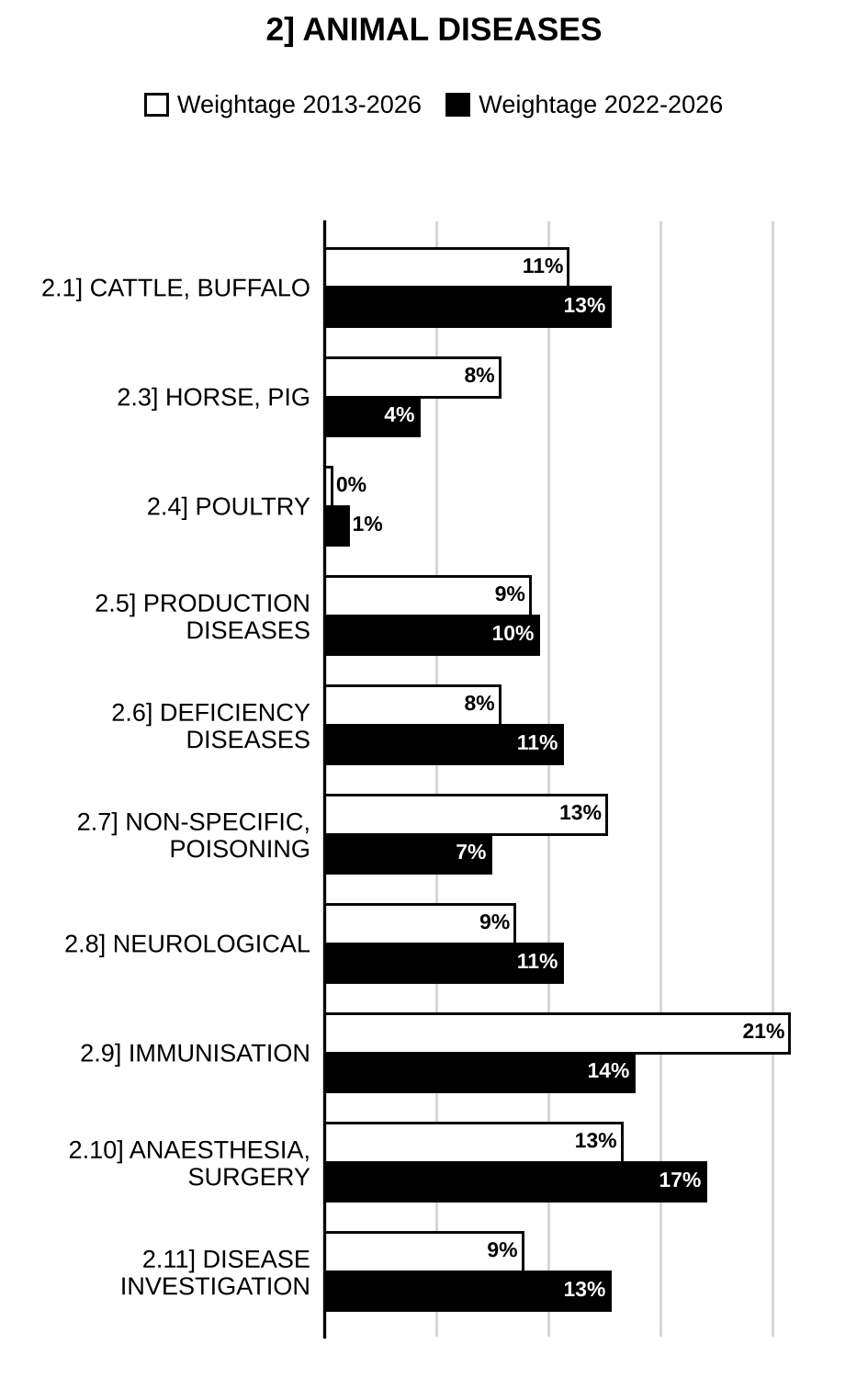
Here are all 176 Animal Diseases questions asked in UPSC Animal Husbandry and Veterinary Science Optional Paper II from 1995 to 2026, arranged under the 10 topics of the official syllabus. Within each topic the latest questions come first.
Each question ends with a code such as [2024/15m/3b] – the year, the marks, the word limit (where UPSC set one) and the question number in the paper.
2.1] Infectious diseases of cattle and buffaloes
22 questions
Describe the etiology, clinical signs, postmortem lesions and control of hemorrhagic septicemia in buffaloes. [2024/20m/2a]
Describe the etiology, pathogenesis, symptoms, diagnosis and control of lumpy skin disease in cattle. [2023/20m/4a]
Discuss the etiology, epidemiology, pathogenesis, symptoms, postmortem lesions, diagnosis and control of Foot and Mouth Disease (FMD) in cattle. [2022/20m/3a]
Discuss in detail the etiology, pathogenesis, symptoms, diagnosis and control of mastitis in a high-yielding crossbred Jersey cow. [2021/20m/4c]
Write in detail the aetiology, pathogenesis, diagnosis and control of Trypanosomiasis in cattle. [2019/20m/2b]
Prevention and control steps for haemorrhagic septicemia in cattle. [2018/10m/150w/5c]
Etiology and treatment of haemoprotozoan diseases in cattle. [2017/10m/150w/5a]
Describe the etiology, clinical findings, diagnosis and control of foot and mouth disease in ruminants. [2017/20m/6a]
Write about the etiology, epidemiology, pathogenesis, clinical findings, diagnosis and control of leptospirosis in livestock. [2015/20m/6b]
Control of bovine tuberculosis and reasons for its failure. [2012/12m/150w/1a]
Control strategy for foot and mouth disease in India along with its limitations. [2012/15m/2d]
Etiology, pathogenesis, clinical signs, treatment and control of haemorrhagic septicemia in buffalo. [2012/15m/4b]
Regular vaccination in livestock is being practiced in bovines for number of years for the prevention, control and eradication of RINDERPEST and FMD. Success has been achieved recently in eradication of RINDERPEST, while FMD remains endemic in more parts of the country. Explain the similarities and differences between the diseases and reasons for success in RINDERPEST and failure in FMD. [2011/40m/6a]
Discuss etiology, pathogenesis, clinical findings, treatment and control of black quarter disease in cattle. [2010/30m/8b]
In spite of advancement in diagnostic techniques due to development in the field of biotechnology and molecular biology why are diseases like Tuberculosis, ‘Jhones disease’, Brucellosis etc. still threatening to the Indian Live-Stock Economy/Industry? [2007/60m/4]
Mastitis. [2006/20m/200w/5d]
Describe etiology, diagnosis and prevention of foot and mouth disease. Also discuss its economic significance. [2005/60m/3]
Describe the symptoms, post-mortem lesions and diagnosis of Brucellosis in cattle. Discuss its economic importance in milk production. [2003/60m/8]
Describe latest diagnostic techniques and control measures of infectious diseases of cattle, suitable to Indian condition. [2002/60m/2]
Describe five important viral diseases in buffaloes. What control measures may be adopted for their prevention? [2000/60m/8]
Name five important contagious diseases of cattle. Describe the diagnostic procedures and control measures to be adopted for control of disease outbreak in rural areas. [1999/60m/7]
How will you assess the prevalence of Brucellosis in a herd? Discuss the measures you will recommend for its eradication. [1995/60m/6]
2.3] Infectious diseases of horses and pigs
11 questions
Porcine stress syndrome. [2026/10m/150w/1d]
Describe the factors responsible for colic in horses and its treatment. [2022/10m/4a(i)]
Monday morning sickness in equines and its management. [2021/10m/150w/1b]
Discuss about the aetiology, epidemiology, symptoms, differential diagnosis, treatment and control of erysipelas of swine. [2019/20m/8b]
Management of “Monday Morning Sickness” in horses. [2017/10m/150w/1a]
Describe the etiology, pathogenesis, symptoms, PM lesions, diagnosis and control of swine fever. [2016/20m/2a]
Write the etiology, pathogenesis and clinical manifestations of Equine myoglobinuria. [2015/15m/3b]
Write about the etiology, epidemiology, clinical findings, symptoms, lesions, diagnosis and control of swine influenza. [2013/20m/2a]
AZOTURIA (Exertional rhabdomyolysis) in horses. [2011/15m/150w/5d]
MMA syndrome (Farrowing fever), occurrence and clinical manifestations. [2010/15m/150w/1a]
Describe the etiology, transmission and epidemiology, pathogenesis, clinical findings, lesions, diagnosis, treatment and control of swine influenza. [2009/60m/3]
2.4] Diseases of poultry
7 questions
Describe the effect of Avian Influenza Virus on Poultry industry and suggest the control measures to be adopted for effective control of Avian Influenza. Mention the WHO’s guidelines for addressing the pandemic situation. [2025/10m/4a(i)]
Discuss the etiology, pathogenesis, gross lesions, diagnosis and prevention of Gumboro disease in poultry. [2010/30m/4a]
Discuss epidemiology, etiology, post-mortem findings, diagnosis and prevention of avian influenza. [2010/30m/6a]
Enumerate viral diseases of poultry. Discuss different vaccines and vaccination schedules used for Ranikhet Disease (RD) and Infectious Bursal Disease (IBD). In spite of regular vaccination why are outbreaks of both the above diseases observed? [2007/60m/7]
Describe the etiology, epidemiology, pathogenesis, symptoms, diagnosis, prevention and control of bird flu. Elucidate its zoonotic and economic significance. [2006/60m/4]
Name the important parasitic diseases of poultry. Discuss the measures to be adopted for prevention and control of disease outbreak in an organised poultry farm. [1998/60m/7]
Immune response to infectious agents play an important role. Discuss the immune response and the mechanism of immunosuppression in poultry due to important vital infections. [1995/60m/7]
2.5] Production (metabolic) diseases
12 questions
Discuss about the factors attributable to acetonaemia in buffalo alongwith its clinical findings, diagnosis, differential diagnosis and line of treatment. [2025/10m/4a(ii)]
Describe the causes, clinical symptoms, diagnosis, prevention and treatment of hypomagnesemic tetany. [2024/15m/3b]
Milk fever and its management in dairy cows. [2023/10m/150w/1e]
Hypocalcemic tetany in milch cattle. [2022/10m/150w/1c]
Describe etio-pathogenesis, clinical signs and management of post parturient haemoglobinurea in buffaloes. [2020/20m/2b]
What is post parturient recumbency? Discuss about its aetiology, pathogenesis, clinical findings and diagnosis. [2019/20m/4b]
Write in detail etiology, symptoms, diagnosis and treatment of ketosis in buffaloes. [2018/20m/6b]
Pathogenesis and control measures of post-parturient haemoglobinuria in cows. [2015/10m/150w/5c]
Discuss the modern concepts of diagnosis and treatment of production diseases of dairy livestock. [2014/20m/8c]
Discuss etiology, epidemiology, clinical signs, clinico-pathology and treatment of ACETONEMIA (KETOSIS) in cattle. [2011/40m/2a]
Discuss modern concept of diagnosis, treatment and prevention of production diseases of poultry. [2004/60m/2]
Production diseases of cattle. [2002/20m/200w/1a]
2.6] Deficiency diseases
14 questions
Enlist the major sources of Vitamin A and its deficiency symptoms in newborn calves, lambs and piglets. What are the factors that interfere with Vitamin A utilization in animals? [2026/20m/3a]
Explain why dietary supplementation of Iodine is essential for Livestock. [2025/10m/3a(ii)]
Important clinical signs exhibited by poultry due to deficiency of vitamin E. [2024/10m/150w/1d]
Thiamine deficiency in poultry. [2022/10m/150w/1d]
Vitamin B complex deficiency in poultry. [2021/10m/150w/5b]
Clinical manifestations of vitamin B complex deficiency diseases in poultry. [2018/10m/150w/1c]
Describe the clinical manifestations of vitamin deficiency in poultry. [2017/15m/8c]
Identify the deficiency disease in a layer flock with the problem of leathery eggs and describe the treatment and control of the same. [2016/10m/150w/1b]
Discuss the metabolism and physio-nutritional role of biotin and choline with particular reference to growing animals. [2013/20m/4a]
Describe and discuss deficiency diseases in pregnant cows, their preventive measures and control. [2005/60m/8]
Deficiency diseases in bovines. [2001/20m/200w/1b]
What are the important deficiency diseases in bovines and how do these diseases affect productivity? [2000/60m/4]
Describe the pathogenesis, diagnosis and control of important deficiency diseases in poultry. [1999/60m/8]
Slipped tendon in poultry. [1996/20m/200w/1c]

Preparing for Prelims too?
Our UPSC Prelims Topic-wise PYQ eBook covers every Prelims question with detailed explanations, so you can see exactly where UPSC asks from.
View the BookDownload Free Sample2.7] Non-specific conditions and poisoning
17 questions
Explain the conditions resulting in dehydration in animals. Write its pathogenesis, clinical symptoms and line of treatment. [2026/15m/4b]
Elucidate the etiology, pathogenesis, clinical findings and line of treatment of esophagitis in cow. [2025/10m/3a(i)]
Clinical symptoms and treatment of impaction in bovines. [2024/10m/150w/1e]
Write about the risk factors, pathogenesis, clinical symptoms and management of organophosphorus poisoning in dairy animals. [2021/20m/7a]
Write about the etiology, risk factors, pathogenesis, clinical symptoms and management of nitrate poisoning in the livestock. [2020/20m/3a]
Discuss in detail about anaemia in animals with its classification, symptoms, clinical pathology and diagnosis. [2019/20m/3a]
Describe in detail the clinical findings, diagnosis and treatment of various types of rumenal disorders. [2018/20m/2b]
Describe about heat stress, its clinical symptoms and management in buffaloes during summer. [2018/20m/8b]
Clinical findings and management of organophosphate toxicity in cattle. [2017/10m/150w/1b]
Explain in detail the mechanism, clinical symptoms and treatment of cyanide poisoning. [2017/20m/2b]
Discuss the management of fore-stomach disorders in ruminants. [2015/20m/7b]
Diagnosis and treatment of ruminal impaction in cattle. [2012/12m/150w/1e]
Clinical manifestations, diagnosis and treatment of copper and CYANOGENIC glycoside toxicosis. [2009/20m/200w/1c]
Differentiate between primary and secondary tympany in cattle. Discuss etiology, predisposing factors, clinical symptoms, diagnosis and treatment of Bloat/ruminal tympany. [2009/60m/2]
The predisposing factors, symptoms, lesions, and prevention of fluorosis and ergotism. [2009/20m/200w/4b]
Indications, diagnosis, treatment and management of ‘cyanide’ poisoning in cattle. [2007/30m/2b]
Given an account of: Diagnosis and treatment of Bloat in cattle. [2003/30m/6a]
2.8] Neurological disorders
10 questions
Briefly describe the etiology, pathogenesis, clinical findings, diagnosis and treatment of meningitis in cattle. [2026/15m/2c]
Explain clinical manifestation of diseases of the nervous system in domestic animals and enlist the methods of Neurological Examination. [2025/15m/4c]
Diagnosis and treatment of epilepsy in dogs. [2023/10m/150w/1c]
Neurological implications of Rabies in domestic animals. [2022/10m/150w/1e]
Define convulsions and describe different conditions in which dairy cows show convulsions. [2020/10m/1d]
Define paralysis and discuss about its classification and line of treatment in domestic animals. [2019/20m/7a]
Clinical examination of cranial nerves in cattle. [2018/10m/150w/5a]
Discuss in detail clinical manifestations of diseases of nervous system in cattle. [2018/20m/8a]
Give an account of the biochemical tests and their importance in the diagnosis of neurological disorders. [2014/15m/8a]
Techniques adopted in the investigation of neurological disorders. [2010/15m/150w/5b]
2.9] Immunisation and disease control
40 questions
Discuss the use of chemoprophylaxis for controlling bacterial, parasitic and vector-borne diseases in animals, along with its advantages and limitations. [2026/15m/4c]
Discuss different types of conventional vaccines and name the animal diseases against which the vaccines are available in India. [2024/15m/4b]
Discuss the preliminary steps required at the field level for controlling an infectious outbreak in animals. [2024/15m/8b]
Quarantine as a measure to prevent the spread of animal disease. [2023/10m/150w/5a]
What are the reasons for the failure of vaccination in animals? [2022/10m/3c]
What are zero disease concept and herd immunity? Discuss in detail about chemoprophylaxis. [2021/20m/3a]
Write a detailed note on types of immunity. Differentiate between attenuated and inactivated vaccines. [2020/20m/4a]
Write in detail the strategies for the control and eradication of infectious disease. [2020/20m/7b]
Immunization schedule for the protection against layer bird diseases. [2018/10m/150w/5b]
Discuss in detail various types of vaccines. Also enlist the diseases against which vaccines are available in India. [2017/15m/4b]
Discuss the modern concepts and immunization schedule at an organized poultry layer farm. [2016/15m/4c]
Disease prevention and disease-free zones. [2015/10m/150w/1a]
What are the problems and challenges in the control and eradication of infectious diseases of livestock and poultry? [2015/20m/3a]
Practical approach for controlling spread of disease after floods, in the flood-affected areas in Jammu and Kashmir. [2014/10m/150w/1a]
Discuss the modern concepts and schedule of immunisation at an organised dairy farm. [2014/20m/2a]
“Zero disease” concept and chemoprophylaxis. [2014/10m/150w/5e]
Explain the current advances in the production of newer vaccines in poultry. [2014/20m/6c]
Discuss the etiology, pathogenesis, symptoms and lesions of secondary immunity deficiency in young animals. [2013/20m/3a]
Describe the strategies in vaccine production. [2013/10m/3c]
Discuss the etiology, pathogenesis, symptoms and lesions in Failure of Passive Transfer (FPT) in calves. [2013/20m/4b]
Meaning of biosecurity and biosecurity measures necessary at cattle and poultry farms. [2012/15m/4a]
What are the recent developments in immunization methods in poultry? [2011/20m/2b]
Mucosal immunity and its role in protection against infectious diseases. [2011/15m/150w/5c]
Regular vaccination in livestock is being practiced in bovines for number of years for the prevention, control and eradication of RINDERPEST and FMD. Success has been achieved recently in eradication of RINDERPEST, while FMD remains endemic in more parts of the country. Explain the similarities and differences between the diseases and reasons for success in RINDERPEST and failure in FMD. [2011/40m/6a]
Give an account of the following:– Reasons for failure of vaccination in animals. [2010/20m/3a]
Give an account of the following:– Role of extrinsic and intrinsic regulation of immunomodulation. [2010/20m/3c]
Zero Disease concept and CHEMOPROPHYLAXIS. [2009/20m/200w/1d]
Reasons for failure of vaccination in animals. [2005/30m/2b]
Vaccination programme against animal diseases. [2004/20m/200w/1c]
CD4 cells. [2003/20m/200w/5d]
Discuss the principles and methods of immunization and chemoprophylaxis against infectious animal diseases. [2001/60m/8]
Zero Rinderpest Programme. [2000/20m/200w/1a]
Zero disease concept. [1999/20m/200w/1a]
Chemoprophylaxis. [1998/20m/200w/1d]
Cell mediated immune response. [1998/20m/200w/5b]
What is ‘Herd Immunity’? Explain the procedures to be followed in developing a diseases-free herd. [1998/60m/8]
B. Cells. [1996/20m/200w/5c]
Successful preventive measures provide economic viability to livestock industry. Outline the important diseases affecting livestock and describe the effective preventive measures to be adopted to keep the livestock population healthy. [1996/60m/8]
T. Cells. [1995/20m/200w/5c]
Immune response to infectious agents play an important role. Discuss the immune response and the mechanism of immunosuppression in poultry due to important vital infections. [1995/60m/7]
2.10] Anaesthesia and veterinary surgery
22 questions
Key aspects of regional anaesthesia in dogs. [2026/10m/150w/1e]
Discuss in detail the procedure to repair femur fracture in an adult Murrah Buffalo. [2025/8m/3b(i)]
Discuss the various factors that lead to non-union of broken bones. [2025/7m/3b(ii)]
Discuss the etiology, clinical signs, diagnosis and treatment of abomasal displacement in cows. [2024/20m/3a]
Write the indications, anaesthetic regimen, surgical procedure and post-operative care of rumenotomy in buffaloes. [2023/20m/4b]
Describe the diagnosis of choke and hernia along with surgical management in cattle. [2022/15m/2c]
Discuss the classification, fixation techniques, complications and management of long bone fractures in animals. [2021/20m/2b]
Give an example of surgical condition requiring general anaesthesia in cattle and discuss briefly about the different stages of general anaesthesia. [2019/10m/8c]
Describe anaesthesia and procedure of Caesarean section in a cow. [2018/10m/3c]
Describe in detail about symptoms and surgical management of hip dislocation in large animals. [2016/20m/6b]
Differentiate between local, general and regional anesthesia. Indicate the sites of operation and organs involved during castration of dogs. [2015/15m/3c]
Describe the surgical intervention as regards Caesarean operation in large animal. [2014/20m/7c]
What is fracture? Give the types of fracture (long bones). Discuss the factors influencing fracture union and management and treatment of fracture. [2013/20m/3b]
Give a detailed account on: Surgical sites for exploratory laparotomy and caesarian section. [2012/15m/3a]
Describe the diagnosis of oesophageal choke and hernia and suggest surgical management in cattle. [2010/30m/2b]
LUXATION – types, predisposing factors, and treatment. [2009/20m/200w/4c]
Significance of preanaesthetic medications. [2007/20m/200w/5b]
Discuss indications and surgical interferences/interventions of hernia in cow, caesarian in buffalo and choking in horse. [2007/60m/8]
Rumenotomy in bovines. [2006/20m/200w/1c]
Give detailed account of the following: Symptoms and surgical interference in fractures. [2005/30m/6b]
Rumenotomy. [2001/20m/200w/5d]
Pre-anaesthetic agents. [1996/20m/200w/5d]
2.11] Disease investigation
21 questions
Discuss the requirements for the establishment of animal health centres in rural areas. [2026/10m/3c]
Write about the collection, methods of preservation and dispatch of samples from the carcass of suspected rabid dog for laboratory diagnosis. [2025/10m/150w/1e]
Explain various biological samples to be collected for laboratory investigation in bovines along with the tests which can be applied on these samples. [2024/20m/4a]
Describe the collection and despatch of materials for disease diagnosis in poultry. [2023/10m/4c]
What is the importance of DNA fingerprinting technique in disease investigation of animals? [2022/10m/4a(ii)]
What are the materials to be sent to the laboratory by field veterinarians for diagnosis of different bacterial and viral diseases of poultry? [2019/20m/6a]
Describe requirements of instruments, buildings and manpower for establishment of Veterinary Hospital at village level. [2018/10m/7c]
Write in detail about the collection of biological samples for laboratory investigation and their procedure. [2017/20m/2a]
Describe in detail the important biochemical, biotechnological and immunological tests for diagnosis of viral diseases. [2014/20m/6b]
Give a detailed account on: Collection of laboratory material for confirmation of rabies, theileriasis and New Castle disease. [2012/15m/3d]
Describe various modern gadgets and biochemical tests used in the diagnosis of animal diseases. [2010/30m/8a]
Investigation techniques for diagnosis of bacterial diseases-especially for collection, preservation and dispatch of materials along with the laboratory procedures to be performed. [2007/30m/2a]
Diagnostic methods for viral diseases. [2005/30m/2a]
Biochemical tests for urinary dysfunction. [2005/20m/200w/5a]
Discuss various biochemical, bio-technological and immunological tests and their significance in the diagnosis of animal diseases. [2003/60m/4]
Discuss the advances in the development of diagnostic techniques of animal diseases. [2001/60m/2]
Justify that ‘liver is a vital organ’. Discuss the tests that may be used for diagnosing hepatic disorders in live animals. [2000/60m/2]
Biochemical tests for renal dysfunction. [1999/20m/200w/1b]
Biochemical tests for hepatic dysfunction. [1998/20m/200w/1c]
Prepare a protocol for the establishment of an Animal [?] Health Centre in your state. What are the informations that are required for the same and how will you gather them? [1998/60m/4]
Describe the advances in the development of diagnosis of animal diseases. Discuss the role of nucleic acid hybridization in disease diagnosis for animal health strategy. [1996/60m/7]

Strengthen your GS papers
Our UPSC Mains Topic-wise & Year-wise PYQ eBook (2013–2026) maps every GS question to the syllabus, so you know what UPSC asks and how often.
View the BookDownload Free Sample« Previous: Anatomy, Pharmacology and Hygiene | Next: Veterinary Public Health »
Back to: Animal Husbandry and Veterinary Science Optional PYQs – Topic-wise | Also see: Animal Husbandry and Veterinary Science Optional year-wise question papers
Last updated: 31 October 2026