
Here are all 172 Anatomy, Pharmacology and Hygiene questions asked in UPSC Animal Husbandry and Veterinary Science Optional Paper II from 1995 to 2026, arranged under the 11 topics of the official syllabus. Within each topic the latest questions come first.
Each question ends with a code such as [2024/15m/3b] – the year, the marks, the word limit (where UPSC set one) and the question number in the paper.
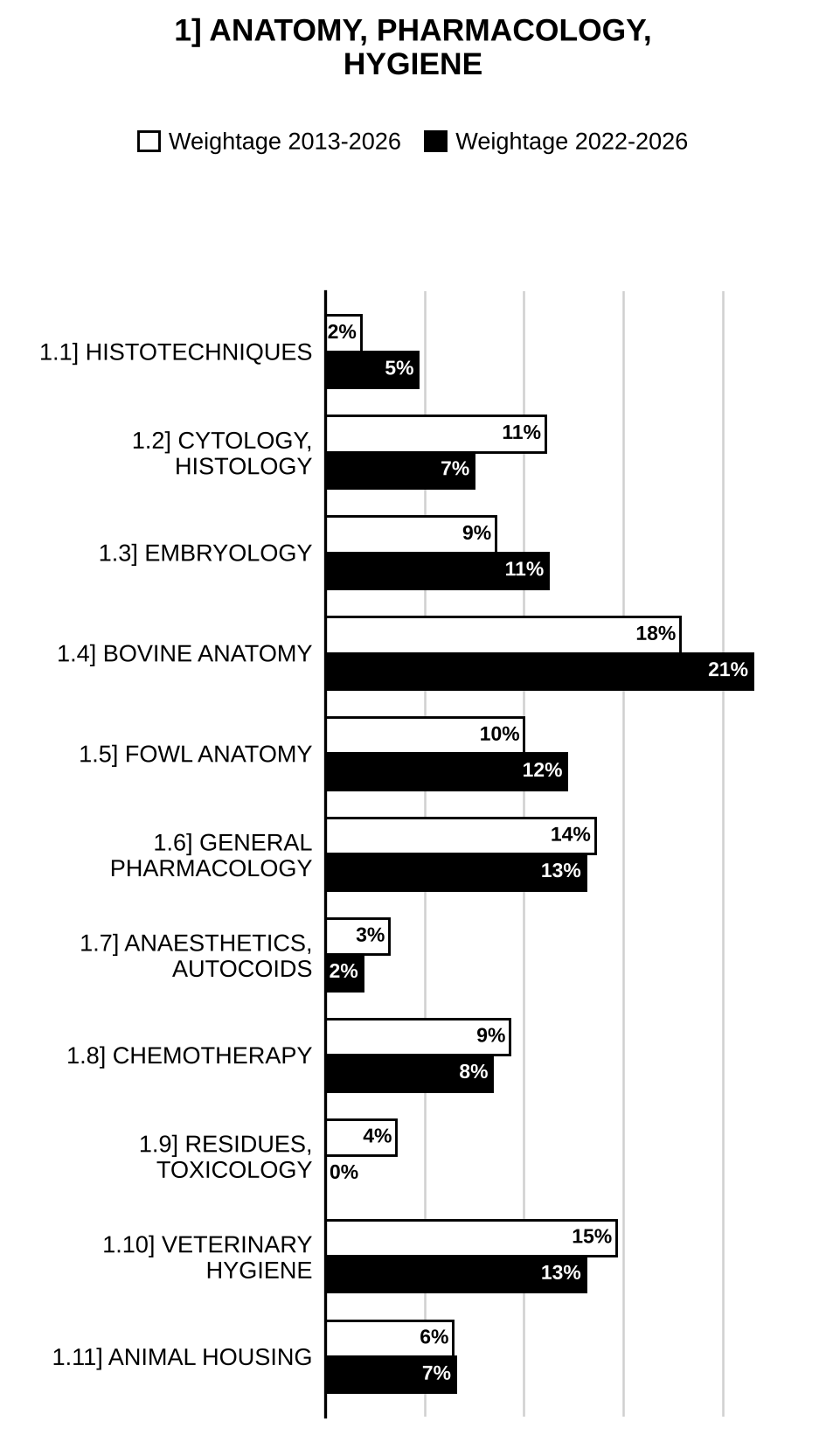
1.1] Histological techniques and microscopy
5 questions
Use of electron microscopy in the study of tissue structure and cytology. [2026/10m/150w/1b]
Describe various methods and procedures for in vitro staining with reference to histological examination. [2024/15m/2b]
Procedure for processing of tissues for paraffin sectioning. [2012/15m/2a]
Differential staining of cytoplasmic elements. [1997/20m/200w/1a]
Role of tissue fixatives. [1996/20m/200w/5b]
1.2] Cytology and histology
22 questions
Write salient Histological Features of Basic tissues of the Body. [2025/10m/150w/1a]
Describe in detail the comparative histology of liver among domestic animals. [2023/20m/2a]
Structure and function of sweat glands. [2022/10m/150w/1a]
Histology of endocrine and exocrine pancreas. [2021/10m/150w/1a]
Histology of adrenal gland. [2019/10m/150w/1b]
Anatomical and Physiological classification of neurons. [2018/10m/150w/1a]
Describe in detail about the histology of testis in bull. [2018/20m/3a]
Formation and function of blood-testis barrier. [2017/10m/150w/1c]
Describe the histological structure of ovary with a suitable diagram. [2017/15m/7c]
Classify the glands in mammals. Describe in detail about features of the glands associated with male and female reproduction. [2016/20m/6a]
Connective tissue cells and immunoregulation. [2015/10m/150w/5b]
What is cell division? Write about the various functions of different body tissues in adult animal. [2014/10m/150w/1d]
Cell cycle and mitosis. [2011/15m/150w/1a]
Structure of sweat glands and their functions. [2007/20m/200w/1a]
Give an account of the structure and function of kidneys. [2006/30m/2a]
Explain the structure & function of sweat glands. [2006/30m/2b]
Cell division. [2003/20m/200w/5a]
Discuss the development of lymphoid organs during post natal stage with emphasis on their role in host defence mechanism. [2000/60m/6]
Metabolism of cardiac muscles. [1997/20m/200w/1c]
Cell differentiation. [1997/20m/200w/1d]
“Basic understanding of meiosis cell division is essential for the understanding of various genetic phenomena.” Explain with diagrams. [1997/60m/2]
Structure of function of kidney. [1997/20m/200w/5b]
1.3] Embryology
19 questions
Explain the formation of Foetal membranes in mammals with the help of suitable diagrams. [2025/20m/2a]
Twinning during embryonic development in animals. [2024/10m/150w/1a]
Development of pituitary gland. [2023/10m/150w/1a]
Define Placenta. Classify Placenta on the basis of histological structure with example. [2022/20m/2a]
Development of bone, fat and muscle tissues in mammalian embryo. [2021/10m/150w/5a]
Ectodermal and endodermal derivatives in mammalian embryo. [2019/10m/150w/5a]
Compare Spermatogenesis and Oogenesis. [2018/10m/150w/1b]
Classification of placenta in domestic animals. [2017/10m/150w/5b]
Types of placenta in domestic animals. [2016/10m/150w/5a]
Write about the development of bone, fat and muscle tissues starting from embryonic stage. [2013/10m/5c]
Anatomical differentiation between foetal and adult circulation; and BLASTOCYST and BLASTODISC. [2009/20m/200w/1a]
Gametogenesis. [2006/20m/200w/1a]
Types of placentation in domestic animals. [2003/20m/200w/1d]
Role of endoderm in development of embryo in bovines. [2001/20m/200w/1c]
Placenta. [1998/20m/200w/5c]
Role of twinning in livestock economics. [1997/20m/200w/1b]
Derivatives of embryonic veins. [1996/20m/200w/1b]
Genetic aberrations. [1995/20m/200w/1a]
Syndesmochorial placenta. [1995/20m/200w/1c]
1.4] Bovine anatomy
21 questions
Paranasal sinuses and their functions in ox. [2026/10m/150w/1a]
Enlist the cranial nerves of bovines. Discuss the origin, distribution and functions of the vagus nerve. [2026/20m/2a]
Location of superficial lymph nodes of ox. [2025/10m/150w/1b]
Explain stay apparatus and Bow and String mechanism in Horse. [2025/15m/4b]
Describe the boundaries and contents of pelvic cavity in male and female bovines. [2024/15m/4c]
Boundaries of thoracic and pelvic cavities of bovines and organs present therein. [2023/10m/150w/1b]
Describe in brief the indications and sites for various nerve blocks in the head region of cattle. [2023/15m/2c]
Describe the boundaries of the abdominal cavity in Ox. Write down its contents (internal organs). How will you divide the abdomen into nine regions by imaginary lines for topographic purposes and what is its clinical importance? [2022/20m/3b]
Enumerate the different compartments of ruminal stomach. Explain the topographic anatomy of rumen and reticulum in relation to causation of diaphragmatic hernia. [2021/20m/2a]
Write short notes on paranasal sinuses of ox. [2020/10m/1a]
Describe in detail the female genitalia of cow in relation to surface anatomy. [2020/20m/2a]
Write indications and procedure of cornual nerve block in bovines. [2020/10m/3c]
List the name, nature (sensory, motor & mixed), and distribution of cranial nerves in bovines. [2020/20m/4b]
Distribution and function of nerves originating from lumbosacral plexus. [2019/10m/150w/1a]
Discuss about the nerve blocks in head region of cattle with emphasis on surgical anatomy. [2018/20m/4b]
Discuss in detail the nerves constituting the brachial plexus. [2017/15m/3b]
Anatomical structure of peripheral nervous system. [2013/10m/1a]
Biomechanics of cortical and trabecular bones in cattle. [2012/12m/150w/1c]
Gross anatomy of brain of dog. [2012/15m/4c]
Importance of hoof management in horses. [2000/20m/200w/1b]
Epidural anaesthesia. [1998/20m/200w/1b]
1.5] Anatomy of fowl
13 questions
Explain the anatomical features of the digestive system of fowl along with a diagram. Describe the functional anatomy of the crop and gizzard in detail. [2026/20m/3b]
Explain gross anatomical features of ovary and oviduct of Fowl with the help of diagrams. [2025/15m/3c]
Explain the anatomical adaptation for flight in birds. [2023/15m/2b]
Explain the functional anatomy of female fowl in relation to its reproductive status. [2022/15m/4b]
Describe the various modifications in musculo-skeletal system of fowl which help them in flight. [2021/15m/6b]
Discuss about airsacs in fowl and its significance. [2018/10m/2c]
Describe the functional anatomy of domestic fowl in relation to egg production. [2016/20m/7c]
Anatomical structures and formation of egg in hen. [2015/10m/150w/1b]
Discuss the musculo-skeletal system of flying birds as a rescue operation of their own. [2014/20m/3a]
Describe the functional anatomy of female fowl in relation to its reproductive system. [2010/30m/2a]
Respiration in birds. [2007/20m/200w/1b]
Respiration in birds. [2005/20m/200w/1d]
Functional anatomy in relation to flying in birds. [2000/20m/200w/1d]

Preparing for Prelims too?
Our UPSC Prelims Topic-wise PYQ eBook covers every Prelims question with detailed explanations, so you can see exactly where UPSC asks from.
View the BookDownload Free Sample1.6] General pharmacology
23 questions
Drugs acting on Fluid Balance. [2025/10m/150w/1c]
Explain the pharmacology and clinical use of atropine in animals. [2024/15m/2c]
Define and classify diuretics. Write about the mechanism of action of high efficiency diuretics. [2023/20m/3a]
Role of antimuscarinic agents in anaesthesia. [2022/10m/150w/1b]
Classify the drugs acting on autonomic nervous system and write their mechanism of action with example. [2022/15m/2b]
Classify diuretics with examples on the basis of efficacy and also write down their mechanism of action. [2021/20m/8a]
Define biotransformation and discuss the pathways of biotransformation of drugs in animal body. [2019/20m/2a]
Describe the drugs acting on fluids and electrolyte balance. [2016/10m/8c]
What do you mean by drug bioavailability? Elaborate the procedure for developing a newer drug. [2015/20m/4b]
Pharmacological role of anticholinergic agents. [2014/10m/150w/5d]
Role of antimuscarinic agents in anaesthesia. [2013/10m/1c]
Mechanisms of drug action: specific and non-specific action. [2013/10m/1e]
Write the role of blood coagulation and blood substitutes in cardiovascular diseases. [2013/10m/2c]
Classify the drugs acting on autonomic nervous system and write their mechanisms of action. [2013/10m/5e]
Pharmacology of appetite stimulant, emetics and anti-emetics drugs. [2012/15m/2b]
Give a detailed account on: Drugs affecting renal functions and fluid electrolyte balance. [2012/15m/3c]
Drugs acting on nervous system. [2011/15m/150w/1b]
Pharmacological role of scavenging enzymes in super oxide formation. [2010/15m/150w/1b]
Role of anorectic agents in animal growth and production. [2010/15m/150w/5d]
Pharmacological role of ANTICHOLINERGIC agents. [2009/20m/200w/1b]
Drugs acting on Autonomous Nervous System. [2007/20m/200w/1c]
Role of blood-brain-barrier in drug metabolism. [2000/20m/200w/5a]
Describe the mechanisms of the drug action along with the concepts of its classification. Discuss the toxicity which may occur due to Sulfonamide treatment. [1996/60m/3]
1.7] Anaesthetics and autocoids
9 questions
Autacoids and their classification. [2026/10m/150w/1c]
Define autocoids and classify them. Describe clinical use of antihistaminic drugs. [2020/10m/1b]
What are the advantages and disadvantages of inhalation anaesthesia in animals? [2020/10m/1e]
Explain in detail the classification and uses of preanaesthetics. Also discuss the advantages and disadvantages of inhalation anaesthesia. [2017/15m/4c]
Comment on the synthesis, breakdown, occurrence and pharmacological actions of histamine on respiration and blood pressure of rabbit and dog, and on allergic reactions. [2010/20m/7a]
Role of HYALURONIDASE and EPINEPHRINE in induction of local anaesthesia. [2009/20m/200w/4a]
Autocoids. [2001/20m/200w/5b]
Describe the modern concept of anaesthesia with reference to dissociative anaesthesia. [1999/60m/3]
Allergic reactions. [1995/20m/200w/1b]
1.8] Chemotherapy
22 questions
Explain the principles of chemotherapy for neoplastic diseases in animals. [2026/15m/2b]
Discuss the properties of an ideal antimicrobial agent. Write about the classification of antimicrobial agents. [2025/20m/2b]
Classification of antimicrobial agents based on the mechanism of action with examples. [2024/10m/150w/1b]
Clinical use and mechanism of action of Ivermectin in controlling parasitic infestations. [2020/10m/2c]
Describe about role of parasites in immunity and mechanism of action of antiparasitic drugs. [2018/20m/7a]
Describe the direct impacts of antibiotic resistance on health care of animals. [2016/15m/7a]
Chemotherapy of ectoparasites infestation. [2014/10m/150w/5c]
Discuss chemotherapy in neoplastic diseases. [2014/10m/7b]
Describe the contribution of Paul Ehrlich postulates in the chemotherapy of infectious diseases. Explain the hypothesis of metal interaction in STD. [2013/20m/2b]
Anti cancer drugs in the treatment of canine neoplasms. [2012/12m/150w/1d]
Discuss the CHEMOTHERAPEUTIC agents and their mode of action for control/treatment of Microbial and Parasitic infections. [2011/40m/4a]
Chemotherapy of neoplastic diseases. [2006/20m/200w/1b]
Chemotherapy in parasitic diseases. [2005/20m/200w/1a]
Give detailed account of the following: Different modes of action of antibacterial antibiotics. [2005/30m/6a]
Hormonal therapy. [2004/20m/200w/1b]
Chemotherapy in neoplastic diseases. [2003/20m/200w/1c]
Antimicrobial agents. [2003/20m/200w/5c]
Antiviral drugs. [2001/20m/200w/1d]
Explain the principles of chemotherapy in microbial and parasitic infections in domestic animals. [1999/60m/4]
Chemotherapy in viral diseases. [1997/20m/200w/5c]
Chemotherapy in neoplasms. [1996/20m/200w/1a]
Describe the mechanisms of the drug action along with the concepts of its classification. Discuss the toxicity which may occur due to Sulfonamide treatment. [1996/60m/3]
1.9] Drug residues and toxicology
7 questions
What are the rapid screening methods for detection of mycotoxin in animal products? [2016/10m/150w/1e]
Role of enzymatic reactivators in organo-phosphorus poisoning in dairy animals. [2015/10m/150w/5a]
What do you mean by toxicity? Explain the various sources of toxicity. [2014/10m/6a]
Describe about the pesticides, veterinary drugs and mycotoxin residues in the edible tissues of the animals and their effects on consumer health. Also mention the Maximum Residue Levels (MRLs) of different pesticides as per legal standards. [2013/20m/8a]
Classification and the chemical constituents of poisonous plants causing poisoning in Indian cattle. [2012/15m/4d]
Name various MYCOTOXINS which can be present as contaminants in poultry feeds and briefly describe various measures for their treatment and control. [2011/20m/4b]
Comment on persistent ecotoxicology and its long term adverse effects. [2009/20m/8a]
1.10] Veterinary hygiene
22 questions
Give a detailed account of the impact of water, air and soil pollution on animal health and production. [2026/20m/4a]
Write about the types of pollution. Also write about sources and signs of water pollution. How to measure the water Quality? [2025/10m/150w/1d]
Justify the enhanced acceptability of indigenous livestock breeds in changing climate scenario. [2024/15m/3c]
Measures to assess the environmental pollution. [2023/10m/150w/1d]
Explain the effect of environment on production and reproductive health of animals. [2022/15m/4c]
Describe major animal welfare issues related to industrialized animal production. [2020/20m/3b]
Elaborate effects of photoperiod on performance of various livestock species. [2020/10m/4c]
Discuss the effects of climate change on the productivity of large ruminants. [2019/20m/4a]
How does heat stress affect the performance of dairy cows? [2017/10m/150w/5c]
Explain the relationship between industrialization and animal agriculture. [2016/10m/2c]
What is AQI? Describe in detail about various environmental pollutants and their control with regards to animal health. [2016/20m/3a]
Write about the major air pollutants in the vicinity of industrial areas and their effects on animal health and production. [2015/20m/2a]
Water pollution may result in a serious problem in chicken. [2014/10m/150w/1b]
Discuss the different types of environmental pollution and its effect on animal production. [2014/15m/8b]
Scientific disposal of animal carcasses. [2012/12m/150w/1b]
Hygienic requirements and standards for animal drinking water. [2012/15m/2c]
Give a detailed account on: Effects of climate on animal production. [2012/15m/3b]
Importance of climate in animal health. [2005/20m/200w/1c]
Mention air, water and soil pollutants. Describe diagnosis, effect and solution of pollution for animal health. [2004/60m/3]
Discuss the effect of environment on animal function and performance. How is the homeostasis maintained? [2001/60m/3]
Describe the different elements of physical environment and their role in livestock health and production. [1997/60m/4]
Physiological adaptation at high altitude. [1995/20m/200w/5b]
1.11] Animal housing
9 questions
Discuss in brief the housing requirements for pregnant cows and milking cows. [2025/10m/2c]
Specific requirements for brooder house of chicken. [2024/10m/150w/1c]
Describe and differentiate the housing requirements of pregnant and milking cows. [2023/15m/3b]
Discuss the different housing systems for poultry and their merits and demerits. [2021/10m/4b]
Key facilities required for farrowing pen and calf pen. [2020/10m/1c]
Discuss the housing requirements for specific categories of cattle in a large dairy farm. [2017/15m/7b]
Describe the housing requirements for 10 sows, 1 boar and their followers. [2016/10m/150w/1a]
Draw a housing plan for keeping 10 kids. Discuss all essential requirements including feeding, watering, medication and other managerial requisites. [2013/10m/4c]
Housing of pregnant sows and cows. [1997/20m/200w/5d]

Strengthen your GS papers
Our UPSC Mains Topic-wise & Year-wise PYQ eBook (2013–2026) maps every GS question to the syllabus, so you know what UPSC asks and how often.
View the BookDownload Free Sample« Previous: Extension | Next: Animal Diseases »
Back to: Animal Husbandry and Veterinary Science Optional PYQs – Topic-wise | Also see: Animal Husbandry and Veterinary Science Optional year-wise question papers
Last updated: 31 October 2026