
Here are all 280 Optimization Techniques questions asked in UPSC Statistics Optional Paper II from 1995 to 2026, arranged under the 9 topics of the official syllabus. Within each topic the latest questions come first.
Each question ends with a code such as [2024/15m/3b] – the year, the marks, the word limit (where UPSC set one) and the question number in the paper.
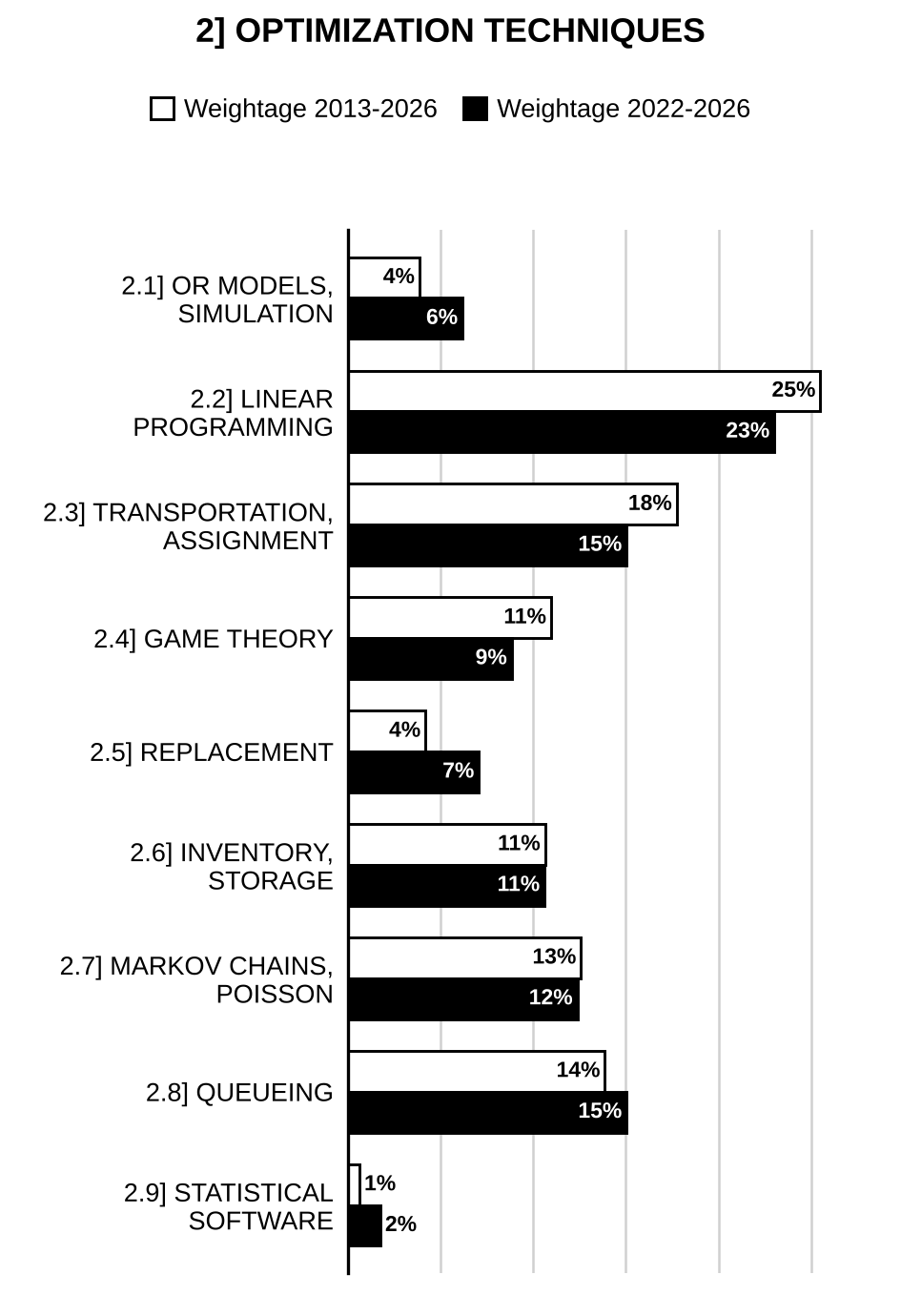
2.1] OR models and simulation
11 questions
A company manufactures 30 items per day. The sale of those items depends upon demand which has the following distribution:
| Sale (units) | 27 | 28 | 29 | 30 | 31 | 32 |
| Probability | 0·10 | 0·15 | 0·20 | 0·35 | 0·15 | 0·05 |
The production cost and selling price of each unit are ₹ 400 and ₹ 500 respectively. Any unsold product is to be disposed off at a loss of ₹ 150 per unit. There is a penalty of ₹ 50 per unit if the demand is not met. Use the following random numbers to estimate total profit/loss for the company for the next 10 days: 23, 99, 65, 99, 95, 01, 79, 11, 16, 10 If the company decides to produce 20 items per day, what is the advantage or disadvantage to the company? [2025/15m/3a]
What is Monte Carlo Simulation? State the uses and applications of Monte Carlo Simulation. [2024/10m/1e]
The management of ABC company is considering the question of marketing a new product. The fixed cost required in the project is ₹ 4,000. Three factors are uncertain, viz., selling price, variable cost and annual sales volume. The product has life of only one year. The management has the data on three factors as under:
| Selling Price (₹) | Probability | Variable Cost (₹) | Probability | Sales Volume (units) | Probability |
| 3 | 0.2 | 1 | 0.3 | 2000 | 0.3 |
| 4 | 0.5 | 2 | 0.6 | 3000 | 0.3 |
| 5 | 0.3 | 3 | 0.1 | 5000 | 0.4 |
Consider the sequence of thirty random numbers 81, 32, 60, 04, 46, 31, 67, 25, 24, 10, 40, 02, 39, 68, 08, 59, 66, 90, 12, 64, 79, 31, 86, 68, 82, 89, 25, 11, 98, 16 and using the sequence (first 3 random numbers for the first trial, etc.), simulate the average profit for the above project on the basis of 10 trials. [2022/10m/1b]
Describe Monte Carlo simulation technique and mention its different steps. Also describe how you would generate random numbers from a Weibull density with parameters . [2018/15m/3b]
Give any three definitions of Operations Research. What are the advantages and disadvantages of operations research models? [2013/10m/1d]
Describe simulation and Monte Carlo simulation. What is the role of random numbers in simulation? Describe how would you select a random sample from a population having exponential distribution. [2009/15m/4a]
Describe the different models used in Operations Research and state the general methods for solving them. [2004/12m/1d]
What are the different types of models used in Operational Research? Explain their general methods of solution. [1999/20m/5a]
Explain the concept, scope and tools of OR as applicable to business and industry. [1998/20m/9a]
What are the basic steps in constructing a model? Describe how to decide whether a model could optimize profits, sales, costs or other trends. Illustrate your answer with suitable examples. [1998/20m/9b]
Explain the scope of Operational Research. [1996/20m/9a]
2.2] Linear programming
68 questions
Distinguish between slack variables and surplus variables. Discuss how they are used in a linear programming problem. [2026/5m/3c(i)]
Use the dual simplex method to solve the following Linear Programming Problem (LPP): subject to and [2026/15m/3c(ii)]
Use the penalty (Big M) method to solve the following linear programming problem: subject to the constraints [2025/15m/4b]
A Linear Programming Problem (LPP) in standard form is as given below: Optimize subject to with Write down the Dual Simplex form and its iterative procedure. [2024/10m/1d]
Use simplex method to solve the following LPP: subject to [2024/20m/2c]
With respect to a given Linear Programming Problem (LPP), explain the following concepts: (i) Extreme Point Solutions (ii) Duality Theorem (iii) Complementary Slackness Principle. [2024/15m/3a]
Solve the following linear programming problem by using graphical approach: Minimize Subject to [2023/10m/1c]
Solve the following Linear Programming problem using Two Phase method: Maximize Subject to [2023/15m/3a]
Write down the dual for the given primal problem. Max Subject to and unrestricted, [2023/5m/3b(ii)]
Use penalty method to solve the following linear programming problem: Maximize subject to the constraints [2022/20m/4a]
Use two-phase method to solve: Maximize subject to the constraints and . [2021/20m/3c]
Solve the following linear programming problem: Maximize subject to the constraints and . Discuss the change in on the optimality of the optimal basic feasible solution. [2021/15m/4a]
Define the concept of duality in Linear Programming Problem (LPP). Write down the dual of the following LPP: Maximize subject to the constraints [2020/10m/1c]
Explain the general Linear Programming Problem. Solve the following LPP by Charnes’ Big-M method: Minimize subject to the constraints [2020/20m/3c]
Give the applications of linear programming problem. A firm produces three products , and . It uses two types of raw material and of which 5000 units and 7500 units respectively are available. The raw material requirements per unit of the products are given below:
| Raw material \ Requirement per unit of product | |||
| 3 | 4 | 5 | |
| 5 | 3 | 5 |
The labour time for each unit of product is twice that of product and three times that of product . The entire labour force of the firm can produce the equivalent of 3000 units of product . The minimum demands of the three products are 600 units, 650 units and 500 units respectively. Also, the ratio of the number of units produced must be equal to . Assume that the profits per unit of , and are ₹ 50, ₹ 50 and ₹ 80 respectively. Formulate the problem as a linear programming model in order to determine the number of units of each product which will maximize the profit. [2019/10m/1d]
Solve the following problem using simplex method: A company sells two types of fertilizers, one is liquid and the other is dry. The liquid fertilizer contains 2 units of chemical and 4 units of chemical per jar and the dry fertilizer contains 3 units of each of chemicals and per carton. The liquid fertilizer sells for ₹ 3 per jar and the dry fertilizer sells for ₹ 4 per carton. A farmer requires at least 90 units of chemical and at least 102 units of chemical for his farm. How many of each type of fertilizers should the farmer purchase to minimize the cost while meeting his requirements? [2019/15m/2a]
If a linear programming problem has an optimal solution, then prove that it attains its optimum solution at an extreme point of the convex set generated by the set of all the feasible solutions to the problem. [2018/10m/1a]
What is the importance of sensitivity analysis? Mention what type of problems can be resolved using it. Using the following linear programming problem, show that the value 6 of the resource vector can be increased to 7: Maximize subject to [2018/20m/4b]
What is a linear programming problem and how it can be represented in the form of matrix notations? Given the following constraints: maximize the objective function using simplex method. [2017/20m/3c]
For the following linear programming problem write the dual problem and solve: [2016/10m/1e]
In the context of linear programming problem (LPP), define the terms (i) basic solution, (ii) feasible solution, and (iii) non-degenerate solution. Show that the set of all the feasible solutions to an LPP is a convex set. [2016/15m/2a]
What is the use of artificial variables in an LPP? Use the artificial variable technique to solve the following LPP: [2016/15m/4c]
Mention the importance of sensitivity analysis. What are the different problems that are resolved through it? [2015/10m/1e]
Explain the meanings of (i) basic solutions and (ii) feasible solutions in a linear programming problem with conditions and variables. Using simplex method, solve the following linear programming problem: [2015/15m/3a]
What do you understand by the term “Sensitivity Analysis”? Discuss the effect of variation in the resource vector in the linear programming problem with set of constraints . In the problem discuss the effect of discrete change in the component so as to maintain the optimality of the current optimum solution. [2014/20m/4a]
What is Linear Programming? Give its advantages and limitations. [2013/10m/1e]
Solve the following LPP: where and is unrestricted in sign. [2013/30m/4c]
Show that in a linear programming problem, the feasible solutions form a convex set. [2012/12m/1e]
A person needs at least 10, 12 and 12 units of chemicals A, B and C respectively for his garden. A liquid product available in the market contains 5, 2 and 1 units of A, B and C respectively per jar. A dry product contains 1, 2 and 4 units of A, B and C per carton. The price of the liquid product is ₹ 3 per jar and that of the dry product is ₹ 2 per carton. How many jars and cartons should be purchased to meet the requirements and to minimize the cost? [2012/30m/2a]
Use simplex method to solve the following LPP: subject to [2011/12m/1d]
Justify the use of artificial variables in obtaining LPP. When should slack and surplus variables be used for solving linear programming problem? [2011/10m/2a]
Solve graphically the following linear programming problem: subject to [2010/12m/1d]
What are the goals achieved through sensitivity analysis? If in the following linear programming problem (L.P.P.): subject to the profit coefficient of is reduced to 2 from 3, determine whether the original solution remains optimal. [2009/12m/1b]
Explain (i) feasible solution and (ii) basic solution in the context of linear programming problem (L.P.P.). Prove that the objective function of a L.P.P. assumes its minimum at an extreme point of the convex set generated by the set of all feasible solutions to the problem, and if it assumes its minimum at more than one extreme point then it takes on the same value for every convex combination of those particular points. [2009/12m/1f]
Describe the M-technique with artificial variables to minimize an objective function in a linear programming problem. What changes will be made in the procedure if the objective function is to be maximized? [2007/12m/1d]
State and prove duality theorem in linear programming. [2007/20m/3a]
What is sensitivity analysis? Explain its use with the help of an example. [2007/15m/4d]
Show that the set of feasible solutions to a linear programming problem is convex. [2006/12m/1d]
Explain the Simplex Algorithm for solving a linear programming problem. [2005/12m/1f]
Solve the following LP problem graphically: Maximise subject to [2005/25m/3a]
Solve by Big-M method the following LP problem: Maximize subject to [2004/25m/3a]
Define the primal LP problem and its dual. Show that the optimal values of objective function under both the primal and dual problems are equal, if they are finite. [2003/12m/1d]
Show that the set of all feasible solutions of a L.P. problem is a convex set, bounded by hyperplanes. [2003/15m/3a]
What is a linear programming problem? What are the assumptions made in a linear programming problem? The manager of an oil refinery company must decide on the optimal mix of two possible blending processes of which the inputs and the outputs per production run are as follows:
| Processes | Input (units): Crude-1 | Input (units): Crude-2 | Output (units): Petrol superior | Output (units): Petrol ordinary |
| A | 10 | 6 | 10 | 16 |
| B | 12 | 15 | 12 | 12 |
The availability of the two varieties is limited to the extent of 400 units and 450 units, respectively, per day. The market demand indicates that at least 200 units and 240 units of superior and ordinary quality petrol, respectively, is required every day. The profitability analysis indicates that the process A contributed Rs. 480 per run while the process B contributed Rs. 400 per run, The manager is interested in determining an optimal product mix to maximize company’s profit. Formulate this as a linear programming problem. [2002/12m/1d]
Write down the dual of the following linear programming problem and solve it by using simplex method [2002/15m/3a]
Discuss briefly sensitivity analysis in the context of a linear programming problem: Maximize subject to , pertaining to instantaneous changes in (i) the coefficients of the objective function, (ii) and (iii) coefficients in the matrix A. [2002/15m/4c]
Formulate a general linear programming problem (LPP). Define slack and surplus variables and explain their role in this context. [2001/12m/1d]
Obtain a necessary and sufficient condition for a basic feasible solution of a LPP to be an optimal solution. [2001/20m/3a]
What do you understand by sensitivity analysis with reference to a Linear Programming Problem? Explain. [2000/12m/1e]
Obtain the rules for choosing the incoming variable and the outgoing variable in the simplex method of solving a linear programming problem. [2000/25m/3a]
Define the dual of a linear programming problem (LPP). Also explain the relationships between the solutions of the primal LPP and its dual. If the primal problem has an unbounded solution what can you say about the solution of the dual? [2000/15m/4c]
For a linear programming problem, explain the following terms (i) Convex cone (ii) Feasible solution (iii) Extreme point (iv) Optimal basic feasible solution (v) Artificial variables. [1999/20m/5b]
For a given linear programming problem, state its dual and show that the dual of the dual is the primal. Also, state the relationship between the nature of the solutions of the primal and the dual problems. [1999/20m/5c]
Explain what you understand by sensitivity analysis in linear programming. [1999/15m/6b]
State the general linear programming problem. Give its mathematical formulation and explain the terms: (i) Basic solution (ii) Feasible solution (iii) Basic feasible solution, and (iv) Optimal solution. [1998/20m/10b]
Show that the optimal solution of a linear programming problem can be found amongst its feasible solutions. [1998/20m/10c]
Show that the objective function of a linear programming problem (LPP) will assume its minimum value at an extreme point of the convex set of feasible solutions of the LPP. If the objective function assumes the minimum value at more than one point then show that it will assume this minimum value at infinite number of points. [1997/20m/10a]
Obtain a necessary and sufficient condition for a basic feasible solution to a LPP to be optimal. [1997/20m/10b]
Discuss the economic interpretation of the primal and the dual problems with suitable examples. [1997/20m/10c]
Define (i) basic feasible solution, (ii) slack and surplus variables and (iii) artificial variables in the context of a linear programming problem (LPP). [1996/20m/10a]
Show that if an optimal solution exists for a LPP then it corresponds to an extreme point of the feasible region. [1996/20m/10b]
Describe the simplex algorithm for solving a LPP. How is this procedure modified when some of the variables are unrestricted? [1996/20m/10c]
Explain the general formulation of a linear programming problem (LPP). Describe an example. [1995/20m/11a]
Define a basic feasible solutions (bfs) and an optimal solution to a LPP. Show that a bfs is an extreme point of the set of feasible solutions and conversely. [1995/20m/11b]
A firm manufactures two items A and B. It purchases castings which are then machined, bored and polished. Castings for items A and B cost Rs. 3 and Rs. 4 each and are sold at Rs. 6 and Rs. 7 each, respectively. Running costs of the processing machines are Rs. 20, Rs. 14 and Rs. 17.50 per hour respectively and their hourly capacities are as follows.
| Item A | Item B | |
| Machining | 25 | 40 |
| Boring | 28 | 35 |
| Polishing | 35 | 25 |
Formulate this problem as a LPP. [1995/20m/11c]
Explain Charne’s M-technique for solving a LPP. [1995/20m/12a]
Define degeneracy in a LPP. When is this encountered and how is this problem overcome? [1995/20m/12b]
Write a note on the duality principle in a LPP. [1995/20m/12c]
2.3] Transportation and assignment problems
36 questions
A company has 4 workers and 4 jobs. Each worker can perform any job, but the cost (in ₹) of assigning a worker to a job varies, as shown in the table given below:
| Worker \ Job | 1 | 2 | 3 | 4 |
| 1 | 9 | 2 | 7 | 8 |
| 2 | 6 | 4 | 3 | 7 |
| 3 | 5 | 8 | 1 | 8 |
| 4 | 7 | 6 | 9 | 4 |
Assign each worker to exactly one job such that the total cost of assignment is minimum. [2026/10m/2c(ii)]
What is a Transportation problem? Give a general mathematical model of a transportation problem. [2026/5m/4b(i)]
Use Vogel’s approximation method to solve the following transportation problem:
| Plant | Distribution Centre | Distribution Centre | Distribution Centre | Distribution Centre | Capacity |
| 2 | 3 | 11 | 7 | 6 | |
| 1 | 0 | 6 | 1 | 1 | |
| 5 | 8 | 15 | 9 | 10 | |
| Demand | 7 | 5 | 3 | 2 |
[2026/10m/4b(ii)]
A company has four plants , , and from which it supplies to three markets , and . Determine the optimal transportation plan from the following data giving the plant to market shifting costs, quantities available at each plant and quantities required at each market:
| Market ↓ | Plant | Plant | Plant | Plant | Required at market |
| 19 | 14 | 23 | 11 | 11 | |
| 15 | 16 | 12 | 21 | 13 | |
| 30 | 25 | 16 | 39 | 19 | |
| Available at plant | 6 | 10 | 12 | 15 | 43 |
[2025/15m/3b]
.
| Jobs \ Machines | I | II | III | IV |
| A | 10 | 12 | 19 | 11 |
| B | 5 | 10 | 7 | 8 |
| C | 12 | 14 | 13 | 11 |
| D | 8 | 15 | 11 | 9 |
Solve the above assignment problem. Cell values represent cost of assigning job and to the machines and . [2023/15m/3b(i)]
A Company ships truckloads of grain from three silos to four mills. The supply (in truckloads) and the demand (also in truckloads) together with the unit transportation costs per truckload on the different routes are summarized in the following table:
| D | E | F | G | Available | |
| A | 11 | 13 | 17 | 14 | 250 |
| B | 16 | 18 | 14 | 10 | 300 |
| C | 21 | 24 | 13 | 10 | 400 |
| Requirement | 200 | 225 | 275 | 250 |
Purpose is to find the minimum-cost shipping schedule between the silos and the mills. Use any method. Obtain the starting basic feasible solution. [2023/15m/4a]
An airline that operates seven days a week has the time-table shown below. Crew must have a minimum layover of 5 hours between flights. Obtain the pairing of flights that minimizes layover time away from home. For any given pairing, crew will be based at the city that results in the smaller layover:
| Delhi–Jaipur Flight No. | Departure | Arrival | Jaipur–Delhi Flight No. | Departure | Arrival |
| 1 | 7:00 AM | 8:00 AM | 101 | 8:00 AM | 9:15 AM |
| 2 | 8:00 AM | 9:00 AM | 102 | 8:30 AM | 9:45 AM |
| 3 | 1:30 PM | 2:30 PM | 103 | 12 Noon | 1:15 PM |
| 4 | 6:30 PM | 7:30 PM | 104 | 5:30 PM | 6:45 PM |
For each pair, also mention the city where the crew should be based. [2022/15m/4b]
.
| Town \ Depot | I | II | III | IV | V |
| A | 160 | 130 | 175 | 190 | 200 |
| B | 135 | 120 | 130 | 160 | 175 |
| C | 140 | 110 | 145 | 170 | 185 |
| D | 50 | 50 | 80 | 80 | 110 |
| E | 55 | 35 | 80 | 80 | 105 |
Solve the above assignment problem. [2021/10m/1b]
.
| Factory \ Store | I | II | III | IV | Supply |
| A | 4 | 6 | 8 | 13 | 50 |
| B | 13 | 11 | 10 | 8 | 70 |
| C | 14 | 4 | 10 | 13 | 30 |
| D | 9 | 11 | 13 | 8 | 50 |
| Demand | 25 | 35 | 105 | 20 |
Use MODI method to solve the above transportation problem. [2021/15m/3b]
Discuss Assignment Problem. Consider the problem of assigning five jobs to five persons. The assignment costs are given as follows:
| Person \ Job | 1 | 2 | 3 | 4 | 5 |
| 8 | 4 | 2 | 6 | 1 | |
| 0 | 9 | 5 | 5 | 4 | |
| 3 | 8 | 9 | 2 | 6 | |
| 4 | 3 | 1 | 0 | 3 | |
| 9 | 5 | 8 | 9 | 5 |
Determine the optimum assignment schedule. [2020/15m/3a]
Solve the following Transportation Problem by MODI method:
| Origin \ Destination | Availability | ||||
| 1 | 2 | 1 | 4 | 30 | |
| 3 | 3 | 2 | 1 | 50 | |
| 4 | 2 | 5 | 9 | 20 | |
| Demand | 20 | 40 | 30 | 10 |
[2020/15m/3b]
Obtain an optimum solution for the following transportation problem:
| Factory \ Warehouse | Supply | |||
| 20 | 40 | 40 | 152 | |
| 80 | 120 | 80 | 164 | |
| 40 | 80 | 120 | 154 | |
| Demand | 144 | 204 | 82 |
[2019/15m/4a]
Discuss a transportation problem (TP) and show that it can be formulated as a linear programming problem. Obtain a necessary and sufficient condition under which a TP has always a feasible solution. Find the first feasible solution of the following TP using Vogel’s approximation method (VAM):
| Port \ Destination | Requirement | ||||||
| 5 | 3 | 7 | 3 | 8 | 5 | 3 | |
| 5 | 6 | 12 | 5 | 7 | 11 | 4 | |
| 2 | 8 | 3 | 4 | 8 | 2 | 2 | |
| 9 | 6 | 10 | 5 | 10 | 9 | 8 | |
| Availability | 3 | 3 | 6 | 2 | 1 | 2 |
Discuss whether the solution is degenerate or non-degenerate. [2018/20m/2c]
Find a necessary and sufficient condition for the existence of a feasible solution to a Transportation Problem (T.P.). Find the solution of the T.P. with following cost matrix:
| Origin \ Destination | Availability | ||||||
| 2 | 1 | 3 | 3 | 2 | 5 | 50 | |
| 3 | 2 | 2 | 4 | 3 | 4 | 40 | |
| 3 | 5 | 4 | 2 | 4 | 1 | 60 | |
| 4 | 2 | 2 | 1 | 2 | 2 | 30 | |
| Demand | 30 | 50 | 20 | 40 | 30 | 10 |
[2017/15m/2a]
State and prove a necessary and sufficient condition for the existence of a solution to a transportation problem. [2016/10m/1a]
There are five jobs to be assigned one each to five machines and the associated cost matrix is as follows:
| Machine \ Job | 1 | 2 | 3 | 4 | 5 |
| A | 25 | 29 | 31 | 42 | 37 |
| B | 22 | 19 | 35 | 18 | 26 |
| C | 39 | 38 | 26 | 20 | 33 |
| D | 34 | 27 | 28 | 40 | 32 |
| E | 24 | 42 | 36 | 23 | 45 |
Solve the problem assuming that the objective is to minimize the total cost. [2016/20m/2c]
What do you understand by an assignment problem? Mentioning the different steps of solving an assignment problem, find the solution of the following assignment problem:
| Employees \ Tasks | |||||
| 25 | 55 | 60 | 45 | 30 | |
| 45 | 65 | 55 | 35 | 40 | |
| 10 | 35 | 45 | 55 | 65 | |
| 40 | 30 | 70 | 40 | 60 | |
| 55 | 45 | 40 | 55 | 10 |
[2015/15m/4b]
A cement factory manager is considering the least way to transport cement from his three factories , and to depots , , and . The weekly production and demands along with transportation costs are given below. What should be the distribution programme?
| Factory | Depot | Depot | Depot | Depot | Production |
| 10 | 8 | 7 | 12 | 500 | |
| 12 | 15 | 6 | 10 | 500 | |
| 8 | 10 | 12 | 14 | 900 | |
| demand | 700 | 550 | 450 | 300 |
[2013/30m/3c]
What is Assignment Problem? With usual notation give its mathematical formulation. Compare this with Mathematical form of Transportation Model. [2013/10m/4b]
The following table shows all the necessary information on the available supply to each warehouse, the requirements for each market and the unit transportation cost from each warehouse to each market:
| Warehouse \ Market | I | II | III | IV | Supply |
| A | 5 | 2 | 4 | 3 | 22 |
| B | 4 | 8 | 1 | 6 | 15 |
| C | 4 | 6 | 7 | 5 | 8 |
| Requirement | 7 | 12 | 17 | 9 |
The shipping clerk has worked out the following schedule from experience: 12 units from to II; 1 unit from to III; 9 units from to IV; 15 units from to III; 1 unit from to III; 7 units from to I. (i) Check and verify if the clerk has the optimal schedule. (ii) Find the optimal schedule and the minimum total shipping cost. [2011/25m/4a]
Explain assignment problem and transportation problem. Give its mathematical formulation. [2010/10m/2a]
A firm manufacturing a single product has three plants , and . The three plants have produced 60, 35 and 40 units respectively during this month. The firm had made commitment to sell 22 units to customer , 45 units to customer , 20 units to customer , 18 units to customer and 30 units to customer . Determine the minimum possible transportation cost of shifting the manufactured products to the five customers. The net per unit cost of transporting from the three plants to five customers is given below:
| Plant \ Customer | A | B | C | D | E |
| X | 4 | 1 | 3 | 4 | 4 |
| Y | 2 | 3 | 2 | 2 | 3 |
| Z | 3 | 5 | 2 | 4 | 4 |
[2010/25m/4a]
Show that an assignment problem (A.P.) is the special case of a transportation problem. Describing the steps of the method you use to solve an A.P., find the solution of the following A.P.:
| Job \ Lathe machines | 1 | 2 | 3 | 4 | 5 | 6 |
| A | 6·0 | 7·0 | 6·0 | 9·0 | 10·0 | 12·0 |
| B | 8·0 | 9·0 | 5·0 | 7·0 | 9·5 | 6·0 |
| C | 1·0 | 1·5 | 1·0 | 1·5 | 1·0 | 1·0 |
| D | 4·5 | 4·5 | 4·0 | 6·0 | 5·0 | 3·0 |
| E | 3·0 | 4·0 | 2·0 | 2·5 | 2·0 | 3·0 |
| F | 3·5 | 3·0 | 1·0 | 4·0 | 2·5 | 2·5 |
[2009/20m/2a]
Explain what you understand by an assignment problem. Solve the following assignment problem for minimizing total time.
| Job | Machine A | Machine B | Machine C | Machine D |
| I | 10 | 14 | 7 | 11 |
| II | 12 | 16 | 10 | 9 |
| III | 14 | 9 | 6 | 10 |
| IV | 11 | 6 | 7 | 5 |
[2006/20m/3a]
Explain the assignment problem. Show that an assignment problem can be solved by the transportation technique. [2005/20m/3b]
Describe the transportation problem. Explain what is meant by (i) the north-west corner method, and (ii) the least cost method of initializing the solution. What are the subsequent steps in each of these methods? [2003/20m/3b]
Apply Vogel approximation method for solving the transportation problem with 3 sources and 4 destinations with the following table of unit transportation costs:
| Source \ Destination | 1 | 2 | 3 | 4 | Supply |
| 1 | 10 | 2 | 20 | 11 | 15 |
| 2 | 12 | 7 | 9 | 20 | 25 |
| 3 | 4 | 14 | 16 | 18 | 10 |
| Demand | 5 | 15 | 15 | 15 |
[2003/15m/4c]
Define a transportation problem. Determine the initial basic feasible solution of the following transportation problem by Vogel’s approximation method. Also, obtain the optimal solution by MODI method:
| Origin \ Destination | Supply | ||||
| 10 | 2 | 20 | 11 | 15 | |
| 12 | 7 | 9 | 20 | 25 | |
| 4 | 14 | 16 | 18 | 10 | |
| Demand | 5 | 15 | 15 | 15 | 50 |
[2002/20m/3b]
Explain the differences between a transportation problem and an assignment problem. Show how the latter can be regarded as a special case of a linear programming problem. [1999/25m/6a]
Define assignment problem and give its mathematical formulation. Also give an algorithm to solve an assignment problem. [1998/25m/11b]
Explain any one method for solving a transportation problem. Would you recommend this method to solve an assignment problem? [1998/20m/11c]
Explain the transportation problem. Show that a finite minimum feasible solution always exists in this case. [1997/20m/11a]
Describe and justify the algorithm used to find the optimal solution for a transportation problem by the modified stepping stone method. [1997/20m/11b]
Define a transportation problem with m sources and n destinations. Show that in such a problem only restrictions are linearly independent. [1996/20m/11a]
Prove that a transportation problem can never have unbounded solutions. [1996/20m/11b]
Outline the Hungarian method of solving an assignment problem. [1996/20m/11c]
2.4] Game theory
25 questions
What is the minimax criterion with respect to a game? Given below is the payoff matrix corresponding to a game:
| –2 | –1 | –2 | 8 | |
| 1 | 0 | –1 | –1 | |
| –3 | 1 | –3 | 1 |
Determine whether the game is stable or not. Also, obtain the optimal strategies and the value of the game. [2026/15m/2b]
Solve the game whose payoff matrix is [2025/15m/4a]
In a two-person zero-sum game, write the payoff matrix in general notation. Consider the two-person zero-sum game where each player tosses an unbiased coin simultaneously. Player pays ₹7 to if occurs or occurs otherwise player pays ₹3 to . Write down ’s payoff matrix. Explain the Max Min criterion for player and hence define the saddle point. [2023/10m/1d]
What are the assumptions made in the theory of games? Describe the maximin principle and minimax principle. Explain the algebraic method for games without saddle point. [2022/10m/1d]
.
| Player A \ Player B | ||||
| 0.25 | 0.20 | 0.14 | 0.30 | |
| 0.27 | 0.16 | 0.12 | 0.14 | |
| 0.35 | 0.08 | 0.15 | 0.19 | |
| 0.08 | 0.13 | 0.00 |
Use algebraic method to solve the above game. [2021/10m/1c]
Write a note on the characteristics of game theory and discuss its limitations. [2020/10m/1b]
Define two-person zero-sum game and saddle point of a payoff matrix. Solve the following game:
| Player A \ Player B | 1 | 2 | 3 | 4 | 5 |
| I | 3 | 5 | 4 | 9 | 6 |
| II | 5 | 6 | 3 | 7 | 8 |
| III | 8 | 7 | 9 | 8 | 7 |
| IV | 4 | 2 | 8 | 5 | 3 |
[2020/15m/4a]
Find the range of values for and that will render the cell a saddle point in the game with the following pay-off matrix:
| Player A \ Player B | |||
| 1 | 6 | ||
| 5 | 10 | ||
| 6 | 2 | 3 |
[2018/10m/1e]
Define a saddle point for any general function in two variables. State and prove a necessary and sufficient condition for the existence of a saddle point in pure strategies for a two-person zero-sum rectangular game. [2017/10m/1b]
What is the dominance principle in game theory? Explain and use it to solve the following rectangular game:
| Player B \ Player A | I | II | III | IV |
| 1 | 18 | 4 | 6 | 4 |
| 2 | 6 | 2 | 13 | 7 |
| 3 | 11 | 5 | 17 | 3 |
| 4 | 7 | 6 | 12 | 2 |
[2016/15m/3b]
In the context of a rectangular game, give the concepts of (i) payoff matrix, (ii) pure strategy of players and (iii) mixed strategy of players. [2015/10m/1c]
Describe a two-person zero-sum game and explain mini-max, max-min and net values of a game. [2014/10m/1e]
State and prove the necessary and sufficient condition for the existence of a saddle point in a two-person zero-sum game. Find the value of the game (rows: Player A; columns: Player B) [2014/20m/2b]
Solve the following game problem graphically:
| Player / Player | I | II | III | IV |
| I | 8 | 5 | −7 | 9 |
| II | −6 | 6 | 4 | −2 |
[2013/10m/3b]
Consider a zero-sum game between two persons A and B, where each player has three strategies and . Player A’s payoff matrix is given below:
| Player A \ Player B | |||
| 15 | 2 | 3 | |
| 6 | 5 | 7 | |
| −7 | 4 | 0 |
Is there a saddle point? What are the optimal strategies for the two players? [2012/15m/2b]
State the limitations for game theory. Following is the pay-off matrix for players and . Using dominance property, obtain the optimum strategies for both the players and determine the value of the game:
| Player A \ Player B | I | II | III | IV | V |
| I | 2 | 4 | 3 | 8 | 4 |
| II | 5 | 6 | 3 | 7 | 8 |
| III | 6 | 7 | 9 | 8 | 7 |
| IV | 4 | 2 | 8 | 4 | 3 |
[2011/10m/2c]
Determine the optimal strategies for the game with the following pay-off matrix:
| A \ B | I | II | III |
| I | 4 | 3 | 1 |
| II | 0 | 1 | 2 |
[2011/25m/3a]
State and prove Fundamental theorem of game theory. [2010/10m/2c]
For any zero-sum two-persons game where the optimal strategies are not pure strategies and for which ’s pay-off matrix is.
| A \ B | I | II |
| I | ||
| II |
Show that the optimal strategies are and given by and the value of the game to is given by [2010/25m/3a]
Explain the principles which are used to find the solution of a rectangular game which does not possess a saddle point. Find the value of the game and mixed strategies of the players for the following game:
| Player A \ Player B | B1 | B2 | B3 | B4 | B5 | B6 |
| A1 | 4 | 2 | 0 | 2 | 1 | 1 |
| A2 | 4 | 3 | 1 | 3 | 2 | 2 |
| A3 | 4 | 3 | 7 | −5 | 1 | 2 |
| A4 | 4 | 3 | 4 | −1 | 2 | 2 |
| A5 | 4 | 3 | 3 | −2 | 2 | 2 |
[2009/25m/4b]
Define pure and mixed strategies in a two person zero sum game. The following is the payoff matrix for player A for such a game between A and B.
| 5.0 | 50.0 | 50.0 | |
| 1.0 | 1.0 | 0.1 | |
| 10.0 | 1.0 | 10.0 |
Show that the mixed strategies (1/6, 0, 5/6) and (49/54, 5/54, 0) are respectively optimal for A and B. [2003/12m/1e]
What is a two-person zero-sum game? Distinguish between pure and mixed strategies. Solve the following game:
| Player – A \ Player – B | ||
| 3 | 5 | |
| 7 | 4 |
[2002/12m/1e]
Explain the graphical method of solving a rectangular game. [2000/12m/1f]
Show that every zero-sum two person game problem can be formulated as a LPP. [2000/15m/4d]
State the minimax theorem for the theory of games. What are optimal strategies? [1999/20m/6c]

Preparing for Prelims too?
Our UPSC Prelims Topic-wise PYQ eBook covers every Prelims question with detailed explanations, so you can see exactly where UPSC asks from.
View the BookDownload Free Sample2.5] Replacement problems
14 questions
A factory has 1000 bulbs installed. Cost of individual replacement is US$3 while cost of that of group replacement is US$1 per bulb respectively. It is decided to replace all the bulbs simultaneously at fixed interval and also to replace the individual bulbs that fall in between. Determine the optimum replacement policy. Failure probability are given below:
| Week | 1 | 2 | 3 | 4 | 5 |
| Failure probability () | 0.10 | 0.25 | 0.50 | 0.70 | 1.00 |
[2023/20m/2c]
It is planned to raise a research team to a strength of 50 chemists, which is to be maintained. The wastage of recruits depends on their length of service which is as follows:
| Year | 1 | 2 | 3 | 4 | 5 | 6 | 7 | 8 | 9 | 10 |
| Total percentage who have left by the end of year | 5 | 36 | 55 | 63 | 68 | 73 | 79 | 87 | 97 | 100 |
What is the required number of recruitments per year necessary to maintain the required strength? There are 8 senior posts for which the length of service is the main criterion. What is the average length of service after which the next entrant expects promotion to one of these posts? [2022/20m/3a]
The following mortality rates have been observed for a special type of lightbulbs:
| Month | 1 | 2 | 3 | 4 | 5 |
| Percent failing at the end of month | 10 | 25 | 50 | 80 | 100 |
In an industrial unit, there are 1000 special types of bulbs in use, and it costs ₹ 10 to replace an individual bulb which was burnt out. If all the bulbs were replaced simultaneously, it would cost ₹ 2.50 per bulb. It is proposed to replace all the bulbs at fixed intervals, whether or not they have burnt out, and to continue replacing burnt-out bulbs as they fail. At what interval of time should the manager replace all the bulbs? [2019/15m/3b]
A truck owner finds from his past records that the maintenance cost of a truck (whose purchase price is Rs. 30,00,000) during the first 8 years of its life and the resale price at the end of each year is as follows:
| Year | 1 | 2 | 3 | 4 | 5 | 6 | 7 | 8 |
| Maintenance Cost (Rs.) | 360000 | 480000 | 600000 | 720000 | 840000 | 960000 | 1080000 | 1200000 |
| Resale Price (Rs.) | 2000000 | 1500000 | 1000000 | 800000 | 700000 | 600000 | 500000 | 400000 |
In which year is the replacement due? [2013/10m/4a]
The cost of maintenance of a machine is given as an increasing function of time and its scrap value is constant. If time is measured continuously, then show that the average cost will be minimized by replacing the machine when the average cost to date becomes equal to the current maintenance cost. [2012/12m/1b]
The following table gives the maintenance cost per year and the resale price in ₹ of a certain machine whose purchase price is ₹ 5,000:
| Year | Maintenance cost | Resale price |
| 1 | 1500 | 3500 |
| 2 | 1600 | 2500 |
| 3 | 1800 | 1700 |
| 4 | 2100 | 1200 |
| 5 | 2500 | 800 |
| 6 | 2900 | 500 |
In which year is the replacement due? [2012/30m/4a]
Explain the replacement policy for item whose running cost increases with time but value of money changes with constant rate during the period. [2010/12m/1f]
At time zero, all items in a system are new. Each item has a probability of failing immediately before the end of the first month of life, and a probability of failing immediately before the end of the second month (i.e., all items fail by the end of the second month). If all items are replaced as they fail, then show that the expected number of failures at the end of month is given by where is the number of items in the system. [2010/20m/2b]
What is replacement problem? How would you determine the replacement policy of items whose maintenance cost increases with time and money carries a rate of interest per year? An auto owner finds from his past record that the cost per year of an auto whose purchase cost is Rs. 60,000 is as given below:
| Year | Running cost (Rs.) | Resale value (Rs.) |
| 1 | 10000 | 30000 |
| 2 | 12000 | 15000 |
| 3 | 14000 | 7500 |
| 4 | 18000 | 3750 |
| 5 | 23000 | 2000 |
| 6 | 28000 | 2000 |
| 7 | 34000 | 2000 |
| 8 | 40000 | 2000 |
Determine at what time is its replacement due. [2009/15m/3a]
What are replacement problems? Discuss such a problem in which items deteriorate with time and the value of money remains the same as per passage of time. [2004/15m/3b]
Outline two different types of replacement models. [2001/12m/1e]
The purchase cost of an equipment is C and denotes the maintenance cost function, where x is the age of the equipment. Assuming the salvage value to be zero, obtain an optimal replacement policy. Also determine the optimal replacement time when and . [2001/20m/3c]
The following mortality rates have been observed for a certain type of light bulbs:
| During week no. | 1 | 2 | 3 | 4 | 5 |
| Proportion of bulbs failing | 0.10 | 0.15 | 0.25 | 0.30 | 0.20 |
Decide on the best replacement policy, it being given that Re. 1.00 and Re. 0.25 are the costs of individual and group replacement per bulb respectively. [1999/20m/7c]
Specify a few replacement policies. [1996/20m/12a]
2.6] Inventory and storage models
29 questions
The PQR retail company has the following data available for one of its items: = 10,000 units, = ₹ 20; = 25% of the acquisition cost of ₹ 25. Find: (I) the economic order quantity, and (II) the total inventory cost. [2026/5m/2c(i)]
A stockist has to supply 400 units of a product every Monday to his customers. He gets the product at ₹ 50 per unit from the manufacturer. The cost of ordering and transportation from the manufacturer is ₹ 75 per order. The cost of carrying inventory is 7·5% per year of the cost of the product. Find (i) the economic lot size, (ii) the total optimal cost (including the capital cost) and (iii) the total weekly profit, if the item is sold for ₹ 55 per unit. [2025/10m/1d]
PQR Electronics produces 300 transistors per day, which go into the inventory. It supplies 150 transistors per day to XYZ Radios. The annual demand is 37,500 units. The inventory holding cost is $ 0·25 per transistor per year and the setup cost per production run is $ 200. Find the following: (i) Economic Order Quantity (EOQ) (ii) Production run length (iii) Number of production runs per year (iv) Maximum Inventory Level. [2024/15m/4b]
What is a basic Economic Order Quantity (EOQ) model in Inventory Control and state the assumption made. A Company estimates that it will sell 12000 units of its products for the forthcoming year. The ordering cost is ₹100 per order and the carrying cost per year is 20% of the purchase price per unit. The purchase price per unit is ₹50. Find (i) EOQ (ii) Number of orders per year (iii) Time between successive orders. [2023/15m/3c]
A company that operates for 50 weeks in a year is concerned about its stocks of copper cable. This costs ₹ 240 a metre and there is a demand for 8000 metres a week. Each replenishment costs ₹ 1,050 for administration and ₹ 1,650 for delivery, while holding costs are estimated at 25 percent of value held a year. Assuming that no shortages are allowed, what is the optimal inventory policy for the company? How would this analysis differ if the company wants to maximize its profits rather than minimize cost? What is the gross profit if the company sells the cable for ₹ 360 a metre? [2022/15m/3c]
A manufacturer has to supply his customers with 600 units of his product per year. Shortages are not allowed and storage amounts to 60 paise per unit per year. The set up cost per run is Rs. 80. Find (i) economic order quantity (ii) optimum period of supply per optimum order and (iii) increase in the total cost associated with ordering 20 per cent more and 40% less. [2021/15m/4b]
Define inventory. What are the advantages and disadvantages of having inventories? A manufacturing company annually uses 25000 units of a raw material. The cost of the raw material is ₹ 1.25 per unit. The ordering cost of the raw material is ₹ 21.6 per order and the carrying cost is 5.4% per year of the average inventory. (i) Find the total inventory cost and the economic lot size. (ii) Should the manager be concerned if he is offered a discount of 6% on the cost price on a single order of 25000 units by the supplier? [2019/10m/1e]
Discuss the single-period continuous probabilistic inventory model with instantaneous demand, shortages and continuous replenishment. The probability distribution of demand is given by The holding cost is Rs. 0.50 per day and the shortage cost is Rs. 3.20 per day. Determine the optimum order level of the inventory. [2017/15m/4c]
What do you mean by probabilistic inventory problems? Discuss the continuous case of a probabilistic inventory model with instantaneous demand and no set-up cost. Let the probability density of demand of a certain item during a day be The demand is assumed to occur with a uniform pattern during the whole day. Let the unit carrying cost of the item in inventory be ₹ 0.5 per day and the unit shortage cost be ₹ 4.5 per day. If ₹ 0.5 be the purchasing cost per unit, determine the optimum order level of the inventory. [2016/20m/4a]
Discuss Economic Lot Size model with constant demand and variable order cycle time. [2015/15m/3b]
What are the different costs involved in an inventory model? Obtain the formulae for optimal order quantity and optimum variable inventory cost for the inventory model with constant demand and instantaneous supply. [2015/15m/4c]
Discuss the inventory model with instantaneous stochastic demand with continuous replenishment unit and obtain the condition for finding the optimum inventory level. [2014/15m/3c]
Discuss an inventory model with probabilistic demand. [2011/12m/1e]
A company uses annually 24000 units of a raw material which costs ₹ 1·25 per unit. Placing each order costs ₹ 22·5 and the carrying cost is 5·4% per year of the average inventory. Find the economic lot-size and the total inventory cost (including cost of material). [2011/15m/3c]
Explain fixed order quantity approach and periodic review approach in Inventory control. [2010/12m/1e]
An aircraft company uses rivets at a constant rate of 2500 per year. Each unit costs Rs. 30 and the company personnel estimate that it costs Rs. 130 to place an order, and that the carrying cost of inventory is 10% per year. How frequently should orders be placed? Also determine the optimum size of each order. [2010/15m/3c]
Derive an expression for finding optimum inventory level in a single-period probabilistic model without set-up cost with continuous demand and discrete replenishment unit. A baking firm makes a profit of Rs. 5·00 per kg of cakes sold on the same day it baked and disposes all unsold cakes at a loss of Rs. 1·20 per kg. The demand follows rectangular distribution between 2000 and 3000. Find optimum quantity to be baked daily. [2009/20m/3c]
Determine the optimal ordering policy in the case of a single period inventory model with no set up cost, instantaneous stock replenishment and the amount demanded is a continuous random variable. [2007/15m/4c]
Discuss the inventory problem when the demand is stochastic having a discrete probability distribution. [2006/15m/3b]
What is an inventory system? Classify and discuss the different types of costs involved in an inventory system. [2005/15m/4c]
Derive the formula for EOQ when (i) demand is deterministic and continuous (ii) shortages are allowed, and (iii) production is deterministic and continuous. State the assumptions made. [2001/20m/3b]
A baking company sells its cakes by weight. It makes a profit of Rs. 0.95 for every kg (kilogram) of cake sold on the day it is baked. It disposes off all cakes not sold on the day they are baked at a loss of Rs. 1.15 per kg. If the demand for the cake is known to have the probability density , find the optimum amount of cake the company should bake daily. [2000/15m/3c]
What is the main problem in inventory management? Discuss the various costs involved in an inventory problem. [1999/20m/7a]
In a certain manufacturing situation the production is instantaneous and the demand per year is R. Show that the optimal order quantity q per run which minimizes the total cost is given by Where = storage cost per unit per year, = shortage cost per unit per year, = set up cost per run. [1999/20m/7b]
Discuss An inventors’ model with probabilistic demand. [1998/15m/11a]
Describe the Moran model for a dam with a finite capacity (discrete case). If the inputs follow the geometric distribution and there is unit release, obtain the stationary distribution of the dam content. [1997/20m/11c]
State the (s, S) policy in an inventory problem. Derive this policy when the demand has a negative exponential distribution. [1995/20m/10a]
Describe a multi-period stochastic inventory model allowing for a discount factor. How would you extend this model to the infinite period case? [1995/20m/10b]
Write a note on dam type storage models. [1995/20m/10c]
2.7] Markov chains and Poisson process
44 questions
Given a transition probability matrix with three states as: Find the value of and . [2026/10m/1d]
Define a Poisson process and state at least three applications of the same. [2026/5m/4c(i)]
On January 1 (this year), brands , and of a commodity had 40, 40 and 20 percent of the market share. Basing upon a market research, it is compiled that brand retains 90 percent of its customers, while gaining 5 percent of ’s customers and 10 percent of ’s customers. Brand retains 85 percent of its customers, while gaining 5 percent of ’s customers and 7 percent of ’s customers. Brand retains 83 percent of its customers and gains 5 percent of ’s customers and 10 percent of ’s customers. What will be each brand’s share on January 1 (next year) and what will be each brand’s share in the market at equilibrium? [2025/20m/3c]
Define a Transition Probability Matrix (TPM). When is it said to be Regular and Ergodic? Check whether the following TPM is Regular or Ergodic. Hence or otherwise obtain the , where . [2024/15m/3b]
Let be the state of a flea at time
[Figure: transition diagram with three states drawn as boxes 1 (bottom left), 2 (top) and 3 (bottom right); arrows: 1 → 1 (self-loop) 0.6, 1 → 2 0.2, 1 → 3 0.2, 2 → 1 0.4, 2 → 3 0.6, 3 → 2 0.8, 3 → 3 (self-loop) 0.2]
Find the transition Matrix . Also obtain . [2023/10m/1e]
If is a Poisson process and , find and comment. [2022/10m/1c]
Consider the Markov Chain with transition probability matrix: Show that the states are periodic and persistent non-null. [2021/10m/1d]
Discuss Markov chain and transition probability matrix with an example. For the following transition probability matrix, determine the market share of brands and from period 0 to 1, when their initial market share breakdown is 50%:
| From \ To | ||
| 0.9 | 0.1 | |
| 0.5 | 0.5 |
[2020/10m/1d]
Show that in an irreducible Markov chain, all the states are of the same type. Define the transition probability of a Markov chain. Find the higher transition matrix of a Markov chain with t.p.m. Hence, obtain . [2019/20m/2c]
Show that the difference of two independent Poisson processes is not a Poisson process. [2019/15m/3a]
Let be a Markov chain having a sample space and transition probability matrix Show that states 3 and 4 are transient states. [2018/10m/1b]
Stating the underlying assumptions, find the expression of the probability of happening events in the time interval in Poisson process. Hence obtain the distribution of inter-arrival times. [2018/15m/3a]
Define a transition probability matrix of a Markov chain and state some of its properties. For a Markov chain with three states 0, 1 and 2, the transition probability matrix is given by.
| State | 0 | 1 | 2 |
| 0 | 0.4 | 0.3 | 0.3 |
| 1 | 0.4 | 0.4 | 0.2 |
| 2 | 0.2 | 0.4 | 0.4 |
Obtain and . [2017/10m/1d]
Define -step transition probability in a Markov chain. Prove the following Chapman-Kolmogorov equation: [2017/15m/4b]
Given the following Transition Probability Matrix of a Markov chain having three states 1, 2 and 3 with initial distribution , find the value of : [2016/10m/1c]
Let be a Markov chain on the state space with initial probability values , , and one-step transition probability matrix given by Compute (i) . (ii) . [2014/10m/1b]
Consider a Markov chain with three states 0, 1 and 2. The state 0 is an absorbing state, while from any of the other two states the chain moves into any of the three states with equal probability (i.e. for and ). Starting from either state 1 or 2, let the number of steps or transitions needed before absorption into state 0 takes place. Derive the probability distribution of . What is the expected number of steps or transitions before absorption into state 0? [2012/30m/4b]
For a finite irreducible aperiodic Markov chain with -step transition probabilities , show that exists and is independent of the initial state. [2011/12m/1a]
Explain the concept of recurrence and transience in the case of finite Markov chains. [2011/20m/2d]
If is a recurrent state with period with a given mean recurrence time , then show that [2010/12m/1a]
Suppose there is a product of brands and respectively. Let each of these two brands have exactly 50 per cent of the total market in same period and let the market be of a fixed size. The transition matrix is given below:
| From \ To | A | B |
| A | 0·9 | 0·1 |
| B | 0·5 | 0·5 |
If the initial market share breakdown is 50% for each brand, then determine their market shares in the steady-state. [2010/20m/2d]
Describe classification of states in a Markov chain. Define -step transition probability. Prove the following Chapman – Kolmogorov equation for the transition probabilities: [2009/12m/1a]
Define transient and persistent states in a Markov chain. Let be a Markov chain with three states and with transition matrix The initial probability distribution is Find (i) and (ii) [2009/20m/2b]
If states i and j of a Markov chain communicate with each other, then show that if state i is recurrent then state j is also recurrent. [2007/12m/1f]
Show that, for a Markov chain, if state j is persistent non-null, then as when state j is periodic with period t; & when state j is aperiodic. [2007/25m/3b]
For the Markov chain with transition probability matrix , obtain . [2006/12m/1f]
Show that in an irreducible Markov chain, all the states are of the same type – these are all transient or all persistent null or all persistent non-null. [2006/25m/3c]
Define irreducible Markov chain. Show that in an irreducible Markov chain, all states are of the same type. [2005/12m/1d]
Consider the Markov chain with the states (0, 1, 2) and with transition probability matrix and the initial distribution Obtain the value of: [2004/12m/1f]
What do you understand by ‘recurrent’ and ‘transient’ states of a discrete parameter Markov chain? Show that a state j is recurrent if and only if & if a state j is transient, then for all i. [2004/20m/3c]
Describe a Poisson process. Obtain the distribution of interarrival times in a Poisson process. [2004/15m/4c]
Consider the following transition probability matrix of a Markov chain Classify the states of the associated MC. [2003/12m/1f]
Let N(t), the number of times a system fails upto time t, be a Poisson process with . Show that the system does not fail in an interval of length with probability [2003/15m/4a]
The following is the transition probability matrix of a Markov chain:
| 1 | 2 | 3 | |
| 1 | 0 | 1 | 0 |
| 2 | 1/2 | 0 | 1/2 |
| 3 | 0 | 1 | 0 |
Examine whether the Markov chain is regular and ergodic. [2002/12m/1f]
Define a Markov chain. How are the states of a Markov chain classified? In a finite Markov chain, can all the states be transient? Justify. [2001/15m/4c]
State and prove Chapman-Kolmogorov equation. [2000/12m/1c]
Show that the inter-occurrence time follows the exponential distribution in the case of a Poisson process. [2000/12m/1d]
For a finite irreducible aperiodic Markov chain with n-step transition probabilities show that exists and is independent of the initial state. [2000/20m/3b]
Write notes on any three of the following (i) Discrete-time Markov Chains (ii) Transition Probability Matrix. (iii) G/M/1 and M/G/1 queues. (iv) Uses of SPSS. [1999/20m/8c]
What do you understand by Markov chains? Explain how it can be used for predicting sales-force needs. [1998/20m/9c]
With reference to a homogeneous Markov chain, define a recurrent state. Also prove that a state i is recurrent if and only if the series is divergent, where is the matrix of n-step transition probabilities of the Markov chain. [1997/20m/9a]
If , , is a Poisson process then obtain the distribution of given , [1997/20m/9b]
Define recurrent and transient states in a finite Markov chain, if C is a communicating class of states, then show that the states of C are either all recurrent or all transient. [1995/20m/9b]
What is an absorbing Markov chain? How is its study useful? [1995/20m/9c]
2.8] Queueing theory
37 questions
In a local post office, a particular service is operated by one person. The arrival pattern of customers on a particular day follows a Poisson distribution with a mean arrival rate of 10 people per hour. Customers are served on a First-Come, First-Served (FCFS) basis and the service time is estimated to be exponentially distributed with an average time of 4 minutes. Determine: (I) Probability (there is no queue) (II) The average size of the queue (III) The expected waiting time in the queue (IV) Probability (a customer will spend less than 12 minutes in the queue) [2026/10m/4c(ii)]
On the average, 96 patients per 24-hour day require the service of an emergency clinic. Also, on the average, a patient requires 10 minutes of active attention. Assume that the facility can handle only one emergency at a time. Suppose that it costs the clinic ₹ 1,000 per patient treated to obtain an average serving time of 10 minutes, and that each minute of decrease in this average time would cost the clinic ₹ 100 per patient treated. How much would have to be budgeted by the clinic to decrease the average size of the queue from patients to patient? [2025/10m/1e]
A manually handled toll-booth has two tellers, who are each capable of handling an average of 60 vehicles per hour, with the actual service times exponentially distributed. Vehicles arrive at the booth according to a Poisson process, at an average rate of 100 per hour. Determine the following: (i) The probability that there are more than three vehicles in the booth at the same time (ii) The probability that a given teller is idle (iii) The probability that a vehicle spends more than 3 minutes in the booth. [2024/15m/4a]
A departmental store operates with three checkout counters. To determine the number of counters in operation based on the number of customers, the manager uses the following schedule:
| Number of customers in store | Number of customers in operation |
| 1 to 3 | 1 |
| 4 to 6 | 2 |
| More than 6 | 3 |
Customers arrive in the counter(s) according to a Poisson distribution with a mean rate of 10 customers/hour. The average checkout time per customer is exponential with mean 12 minutes. Determine the steady state probability of customers in the checkout area. [2023/15m/4c]
Explain the structure of a queuing system. Explain queuing system and obtain steady-state solution. Also calculate busy period distribution. [2022/15m/3b]
Explain model and show that the steady-state arrival point system has a geometric distribution. [2022/20m/8b]
Explain queuing system. Obtain Pollaczek-kinchine formula. [2021/15m/3a]
What do you understand by queuing theory? What are its advantages? Discuss the characteristics of model. [2020/15m/4b]
Explain queues and obtain Pollaczek-Khinchine formula. [2019/20m/4b]
State how a queueing model is completely specified. In this context, explain the meanings of different symbols used in the queueing model . Obtain the steady-state equations under the model and find their solutions. [2017/15m/2b]
For a queue system, compute– (i) expected number of customers in the system; (ii) expected queue length; (iii) expected (average) waiting time of a customer in the system. [2015/10m/1d]
Consider a single-server queue system with Poisson input and exponential service time. Suppose the mean arrival rate is 3 calling units per hour, the expected service time is 0.25 hour and the maximum permissible number of calling units in the system is two. Derive the steady-state probability distribution of the number of calling units in the system and also calculate the expected number in the system. [2015/20m/3c]
To a single server queuing system, the arrivals of customers are according to a Poisson process at the rate of 2 customers per hour. The service time has exponential distribution with mean service time of 12 minutes per customer. The steady state probability distribution for the number of customers is given below:
| 0 | 1 | 2 | 3 | 4 | 5 | 6 and above | |
| 0.08 | 0.1 | 0.4 | 0.2 | 0.2 | 0.02 | 0 |
Compute (i) the expected number of customers in the system and in the queue. (ii) the mean waiting time in the system and in the queue. [2014/10m/1d]
For an queuing system, derive the set of steady-state difference equations and hence find the solution of the system. In a supermarket, the average arrival rate of customers is 5 every 30 minutes. The average time it takes to list and calculate the customers purchases at the cash desk is 4.5 minutes and this time is exponentially distributed. (i) How long will the customers expect to wait for service at the cash desk? (ii) What is the probability that the cashier is working? [2014/15m/3a]
Four counters are being opened on the frontier of a country to check the passports and necessary papers of the tourists. The tourists choose the counter at random. If the arrivals at the frontier are Poisson at the rate and the service time is exponential with parameters , what is the steady state average queue at each counter? [2013/10m/3a]
Arrivals at a telephone booth are considered to be according to a Poisson process with an average time of 10 minutes between two consecutive arrivals. The length of a phone call is assumed to be exponentially distributed with a mean of 3 minutes. What is the probability that a person coming to the booth will have to wait? What is the average length of the queues that form from time to time? [2012/15m/2c]
Describe briefly about the queue system . Obtain the expected number of persons in the system from . [2011/12m/1b]
Explain the economic cost project models used in queueing theory. [2011/20m/2b]
A supermarket has 2 girls ringing up sales at the counters. If the service time for each customer is exponential with mean 4 minutes and if people arrive in a Poisson fashion at the rate of 10 per hour– (i) what is the probability of having to wait for service; (ii) what is the expected percentage of idle time for each girl? [2011/20m/3b]
In queuing model, obtain the expression for the probability that there are units in the system at any time. [2010/12m/1b]
A repairman is to be hired to repair machines that breakdown following a Poisson process with an average rate of four per hour. The cost of non-productive machine is Rs. 90 per hour. The company has the option of choosing either a fast repairman who charges Rs. 60 per hour and repairs machines at the rate of 7 per hour or a slow repairman who charges Rs. 30 per hour and repairs machines at the rate of 5 per hour. Taking the cost in to the consideration find which repairman should be hired. [2010/20m/3b]
Describe M|G|1 and GI|M|1 queues. Derive the Pollaczek-Khinchin mean value formula for the average number of customers in M|G|1 queue. [2007/12m/1e]
State the chief characteristics of a queuing process. For the queuing process (M/M/1 FCFS/), derive its steady state solution. [2006/12m/1e]
For the queuing model M/M/s: FCFS/ obtain (i) the mean queue length and (ii) the average number of units in the system. [2006/15m/4c]
What is an M/M/c queue? Show that the expected number of busy servers in an M/M/c queue in steady state is and that the expected number of idle servers is [2005/12m/1e]
What is queuing process? Obtain the probability generating function for the queue length of M/M/1 queueing model and obtain the mean queue size. [2004/12m/1e]
Explain all the terms in the notation , , ; in the context of queues. Let be the steady state probability of n customers in the above queuing system. Show that , where . [2003/25m/3c]
What are the elements of queueing theory? For the queueing model M/M/1 : FCFS/, derive the steady state solution. The arrivals at a counter in a bank occur in accordance with Poisson law at an average rate of 8 persons per hour. The duration of service of a customer has exponential distribution with a mean of 6 minutes. Find the probability that a customer (i) has to wait on arrival, (ii) finds 4 customers in the queue and (iii) has to spend less than 15 minutes in the bank. Estimate also the fraction of the total time for which the customer is busy. (It is given that ). [2002/25m/3c]
Describe a queueing system. State the measures of performance of the single server exponential queue. [2001/12m/1f]
For an M/M/1 queue, determine in steady state (i) the probability that, at any time, there are n units in the system, and (ii) the expected number of units in the system. [1999/20m/8a]
For the case of k channels, Poisson arrivals with mean arrival rate and exponential service time with mean service rate , determine in steady state: (i) the probability that all the channels are empty, and (ii) the probability that an arrival has to wait. [1999/20m/8b]
Write notes on any three of the following (i) Discrete-time Markov Chains (ii) Transition Probability Matrix. (iii) G/M/1 and M/G/1 queues. (iv) Uses of SPSS. [1999/20m/8c]
Discuss queueing model and find the expected line length in the system. [1998/20m/10a]
Explain the queueing system. For this system obtain the steady state distribution of the number of persons in the system and the average waiting time of a customer in steady state. [1997/20m/9c]
Derive the steady-state results (probabilities, mean numbers and mean waiting times) for an M/M/s queue. [1996/20m/9b]
What is an imbedded Markov chain? For the M/G/1 queue identify the imbedded Markov chain. [1996/20m/9c]
State the chief characteristics of a queueing process. For a queueing system derive the distribution of the waiting time in steady state conditions. [1995/20m/9a]
2.9] Statistical software
16 questions
What are the key features of SPSS software? How does it compare to R software? [2026/10m/1e]
Discuss some statistical problems which can be solved by using well known Statistical Software Packages like SPSS and which otherwise are difficult to solve. [2007/15m/3c]
Describe the use of SPSS software packages with an illustration. [2006/15m/4d]
Let be a random sample from an distribution (, known). Let [?] be a statistic. Explain how the well-known statistical software packages like SPSS can be used to find the distribution of T. [2005/15m/4d]
What are SPSS packages? Explain their uses. [2004/15m/4d]
Describe the salient features of the SPSS package. Explain how to find a multiple linear regression based on p independent variables and n observations. [2003/15m/4d]
Explain the use of SPSS package in solving statistical problems. In particular, how will you carry out two-way analysis of variance for a given data by using SPSS? [2002/15m/4d]
Write briefly on the software package SPSS. [2001/15m/4d]
Describe the inter-relation amongst machine language, FORTRAN compiler, the FORTRAN source program and object code. [1998/20m/12a]
Write a note on library functions available in FORTRAN IV. [1998/20m/12b]
Write a FORTRAN program to evaluate the following sum: [1998/20m/12c]
What are machine, assembly and high level languages? State their merits and limitations,. [1997/20m/12a]
(i) Distinguish between a FUNCTION sub-programme and a SUBROUTINE sub-programme. Also state the rules governing their use. (ii) Explain the uses of ‘Computed GO TO’ and ‘Assigned GO TO’ statements in FORTRAN. Also state the rules governing their use. [1997/20m/12b]
Write a FORTRAN programme to calculate the correlation coefficient on the basis of a set of n pairs of observations , , to be read by the programme. [1997/20m/12c]
Explain the following control statements in FORTRAN language: (i) Unconditional GO TO (ii) Computed GO TO (iii) Arithmetic IF. [1996/20m/12b]
Write a FORTRAN program to compute the coefficient of variation from a data set having n ungrouped observations. [1996/20m/12c]

Strengthen your GS papers
Our UPSC Mains Topic-wise & Year-wise PYQ eBook (2013–2026) maps every GS question to the syllabus, so you know what UPSC asks and how often.
View the BookDownload Free Sample« Previous: Industrial Statistics | Next: Quantitative Economics and Official Statistics »
Back to: Statistics Optional PYQs – Topic-wise | Also see: Statistics Optional year-wise question papers
Last updated: 31 October 2026