
Here are all 88 Sedimentary Petrology questions asked in UPSC Geology Optional Paper II from 1995 to 2026, arranged under the 5 topics of the official syllabus. Within each topic the latest questions come first.
Each question ends with a code such as [2024/15m/3b] – the year, the marks, the word limit (where UPSC set one) and the question number in the paper.
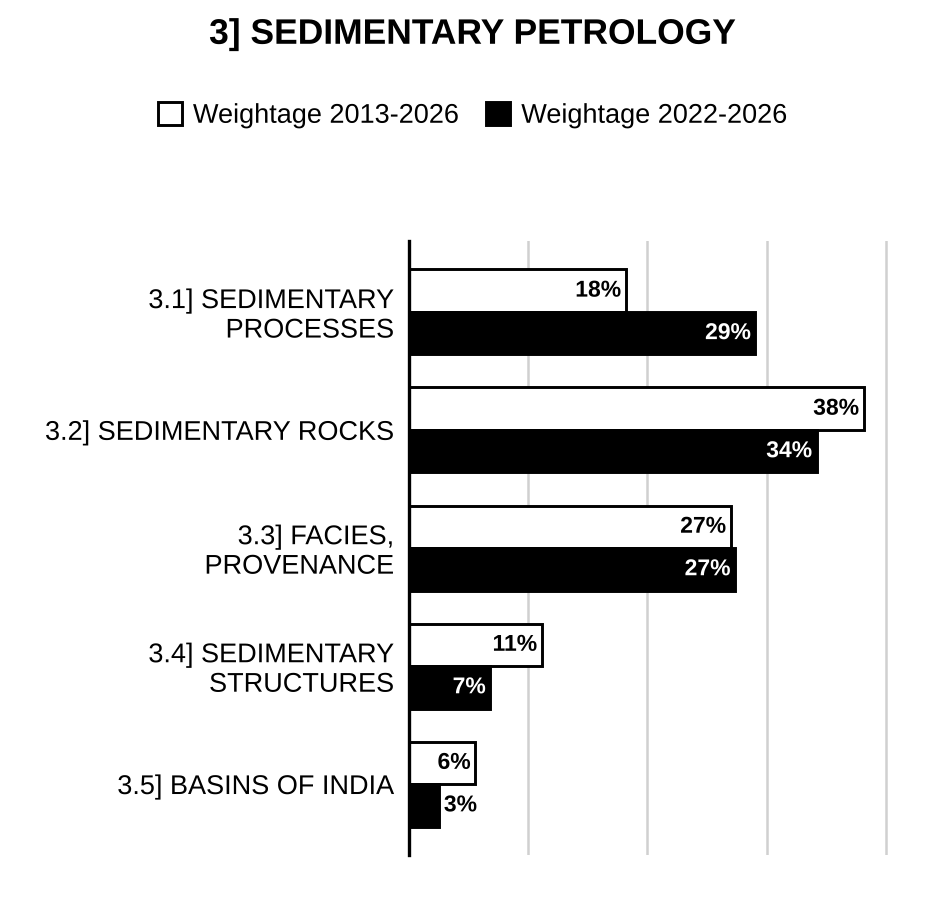
3.1] Sedimentary processes
16 questions
Discuss the primary processes involved in the formation of sedimentary rocks, emphasizing the role of diagenesis and lithification. [2026/20m/4a]
Explain how primary sedimentary processes influence the mineralogical composition and porosity of the resultant rocks. [2026/15m/4b]
With the help of diagrams, describe the various diagenetic textures of carbonate rocks. [2025/10m/150w/1d]
Explain the diagenetic changes in carbonate rocks. [2023/10m/150w/1e]
Briefly describe the mechanisms of gravity-controlled sediment flows and write about their characteristic features in the rocks. [2023/15m/4b]
Explain different processes of diagenesis in clastic sedimentary rocks. Describe common diagenetic structures. [2022/15m/4b]
How would you distinguish burial diagenetic cements in carbonate rocks from petrographic studies? Draw neat sketches in support of your answer. [2020/10m/4c]
Discuss the processes of diagenesis and lithification. [2017/20m/4a]
Explain the process of lithification and diagenesis with special reference to limestones. [2015/20m/4a]
Give an account of the cementing materials in sedimentary rocks. [2014/10m/4b]
Describe the critical differences between porosity and permeability. Add a note on how these two properties of sediments are determined. [2013/10m/1e]
Why is burial necessary to form a sedimentary rock? [2010/5m/3a(ii)]
Why are most beds of sedimentary rocks formed horizontally? [2010/5m/3a(iii)]
How does physical weathering differ from chemical weathering? What common sedimentary minerals are formed from all the chemicals released by the weathering of feldspars, and how. [2005/60m/4]
In about 200 words, explain any three of the following: Diagenesis as a sedimentary process. [2004/20m/200w/1d]
In about 200 words each, write notes on any three of the following: Diagenesis and Lithification. [2000/20m/200w/1d]
3.2] Sedimentary rocks
32 questions
Outline the petrographic features used to identify and classify sedimentary rocks in thin-section analysis. [2026/10m/150w/1e]
What are the major depositional environments of sedimentary rocks? Discuss the characteristic features of rocks formed in different depositional environments. [2026/15m/4c]
What are conglomerates? Describe their fabrics, classification and geological significance. [2025/15m/4c]
With the help of suitable diagrams, describe Folk’s graphic classification of carbonate rocks. [2024/10m/150w/1e]
Classify the conglomerate rocks on the basis of clast composition and grain-matrix ratio and discuss their genetic importance. [2023/20m/4a]
Describe the classification of sandstones on the basis of their composition and matrix. [2022/10m/150w/1e]
What do you understand by sedimentary depositional environment? Describe fluvial environment in detail. [2022/20m/4a]
Give a brief account of Folk’s classification of limestones. [2021/10m/150w/1e]
How are sedimentary rocks classified in general based on their process of formation? [2020/10m/1e]
‘Classification of carbonate rocks based on textural components may be useful for interpretation of depositional environment’. Justify the statement with reasons. [2020/20m/4b]
What are conglomerates? Describe their classification and geological significance. [2019/20m/4b]
Discuss the fabric, composition and geological significance of arkose. [2019/10m/4c]
What are sparry allochemical carbonate rocks? Comment on their depositional environment. [2018/10m/1e]
Give a generalized classification of sandstone. State genetic significance of such classification. [2018/20m/4b]
Enumerate briefly on how the clastic rocks are classified on the basis of their grain-size. [2016/10m/1c]
Briefly discuss the classification of sandstones. What is the general tectonic environment in which quartz arenites are found? [2016/20m/3b]
What are the differences between Banded Iron Formation and Ironstone? Why there is minimum/no detritus found in Banded Iron Formation? [2016/20m/8a]
How are the clastic rocks classified on the basis of their grain-size? [2014/10m/1c]
Distinguish between conglomerate and breccia. [2014/10m/1e]
What is shale? Describe texture, composition and environments of deposition of shales. [2014/15m/4c]
How would you distinguish arkose and greywackes? Comment upon their environment of deposition. [2014/10m/4d]
What are the differences between Banded Iron Formation and Ironstone? Discuss about detrital component of Banded Iron Formation. [2014/10m/5a]
With the help of a neat sketch, briefly discuss the classification of sandstone. What is the general tectonic environment in which quartz arenites are found? [2013/20m/4c]
What is the difference between biogenous and terrigenous sediments? [2010/5m/3a(i)]
What do mud cracks tell about the environment of deposition of a sedimentary rock? How does a graded bed form? How does a sedimentary braccia differ in appearance and origin from a conglomerate? What is an “Evaporite deposit” and how does it form? [2010/30m/4a]
What are the major minerals that constitute carbonate sediments and what physico-chemical factors control their precipitation? What are the basic components of Folk’s classification of carbonate rocks? [2009/30m/3a]
Clastic-Sediments and their depositional environments. [2007/20m/200w/1d]
In about 200 words each, explain any three of the following: Deltaic environment. [2006/20m/200w/1b]
Give the classification of sandstones. Add a note on their depositional environment. [2002/60m/4]
Give the classification of impure carbonate rocks. How are they deposited. [2001/60m/4]
Describe the different environments of sediments deposition. Give examples of rocks formed in each of them. [2000/60m/4]
Discuss classifications of Sedimentary rocks. Which one, in your opinion, is most suitable? [1997/60m/7]

Preparing for Prelims too?
Our UPSC Prelims Topic-wise PYQ eBook covers every Prelims question with detailed explanations, so you can see exactly where UPSC asks from.
View the BookDownload Free Sample3.3] Facies and provenance; Heavy minerals
22 questions
Discuss the concept of facies model and give a brief account of deltaic facies model. [2025/15m/4b]
Discuss the various factors that control the composition of sandstone. [2024/15m/4a]
What do you understand by facies model? Describe the facies and facies association produced in a fluvial environment. [2024/15m/4b]
What are heavy minerals? Describe methods of their separation and comment on the utility of heavy mineral suite in provenance interpretation. [2024/20m/4c]
Explain mineral-based techniques to decipher the source terrains and transport history of sediments. Give a list of minerals diagnostic of igneous and metamorphic provenances. [2023/15m/4c]
What is provenance? How can we use clastic quartz, feldspars and lithic grains in provenance interpretation of sandstones? [2021/20m/4a]
Define a ‘sedimentary facies model’. Illustrate with neat sketches the sedimentary facies and association facies likely to develop in a meandering fluvial depositional environment. [2021/20m/4b]
Illustrate with neat sketches the sedimentary facies and facies associations that are likely to develop in a progradational deltaic environment. [2020/20m/4a]
Define heavy minerals. Describe the different methods of their separation and comment on the utility of heavy mineral suite in provenance determination. [2019/20m/4a]
Why are ‘fining upward’ facies sequences considered as one of the most important criteria for recognizing deposits of meandering fluvial depositional system? [2018/10m/4c]
Differentiate between molasse and flysch facies. [2017/10m/4c]
What are heavy minerals? Discuss their significance in sedimentological studies. [2016/20m/4b]
Sketch and explain different types of sedimentary facies. [2014/15m/4a]
What are turbidites? With a neat sketch, show different units of a Bouma cycle and the flow regimes under which they are formed. [2013/15m/4a]
How are the provenances of heavy minerals in sedimentary rocks identified? [2010/5m/3a(iv)]
What are turbidites? With a neat sketch, show different units of a Bouma cycle and flow regimes under which they are formed. [2009/30m/4a]
Enlist five Heavy minerals reflecting their specific gravities. Explain in detail their significance in deciphering the nature of provenance involved in the formation of sedimentary rocks with suitable examples. [2007/60m/4]
Define sedimentary facies. Describe continental glacial and glacio-fluvial facies giving their salient characteristics with an Indian example. [2004/60m/4]
Define provenance and its importance in Sedimentology. Describe the provenance indicators to identify different source rocks. [2003/60m/4]
In about 200 words each, explain any three of the following: Heavy minerals and their significance. [2002/20m/200w/1d]
Describe the methodology applied to determine composition and location of provenance in the study of a sedimentary basin. [1999/60m/4]
Criteria by which palaeo-environmental conditions of deposition of sediments can be recognised. [1995/20m/8b]
3.4] Sedimentary structures
15 questions
Discuss the genesis of any four sedimentary structures which are helpful in palaeocurrent analysis. How are the palaeocurrent patterns helpful in establishing the depositional environment? [2025/20m/4a]
Describe the genesis of any four sedimentary structures which have significance for palaeocurrent analysis. [2021/10m/4c]
What are ripple marks? Describe the different types of ripple marks and their geological significance. [2019/10m/1e]
Illustrate with neat sketches primary sedimentary structures in sands from bed load transport. How such structures can be used for interpretation of depositional environments? [2018/20m/4a]
Describe the common structures of sedimentary rocks with neat sketches and also comment on their significance. [2017/10m/1e]
Ripple marks are common in sandstones and siltstones. Why are they rare in conglomerates and shales? [2015/10m/1e]
With neat sketches, describe the primary depositional sedimentary structures, with emphasis on their application in determining paleocurrent directions. [2013/15m/4b]
How the direction of flow of the sediment-carrying fluid is determined in a rock? [2012/12m/1d]
Types of sedimentary structures and their significance. [2011/10m/1e]
What do mud cracks tell about the environment of deposition of a sedimentary rock? How does a graded bed form? How does a sedimentary braccia differ in appearance and origin from a conglomerate? What is an “Evaporite deposit” and how does it form? [2010/30m/4a]
Describe the sedimentary structures & their significance. [2006/60m/4]
Describe significant structures of sediments deposited within deltaic environment. [2005/20m/200w/1d]
In about 200 words each, explain any three of the following: Ripples, Dunes and cross-bedding: origin and significance. [2003/20m/200w/1d]
In about 200 words each, explain any three of the following: Primary sedimentary structures. [2001/20m/200w/1d]
Structures of Sedimentary rocks. [1997/20m/200w/5b]
3.5] Sedimentary basins of India
3 questions
Enumerate the sedimentary basins of India based on their petroleum prospects. [2022/15m/4c]
Give an account of the Proterozoic sedimentary basins of India. [2017/20m/4b]
Discuss the evolution and characteristic features of the major sedimentary basins of India. [2015/20m/4b]

Strengthen your GS papers
Our UPSC Mains Topic-wise & Year-wise PYQ eBook (2013–2026) maps every GS question to the syllabus, so you know what UPSC asks and how often.
View the BookDownload Free Sample« Previous: Igneous and Metamorphic Petrology | Next: Economic Geology »
Back to: Geology Optional PYQs – Topic-wise | Also see: Geology Optional year-wise question papers
Last updated: 31 October 2026