
Here are all 163 Indian Stratigraphy questions asked in UPSC Geology Optional Paper I from 1995 to 2026, arranged under the 6 topics of the official syllabus. Within each topic the latest questions come first.
Each question ends with a code such as [2024/15m/3b] – the year, the marks, the word limit (where UPSC set one) and the question number in the paper.
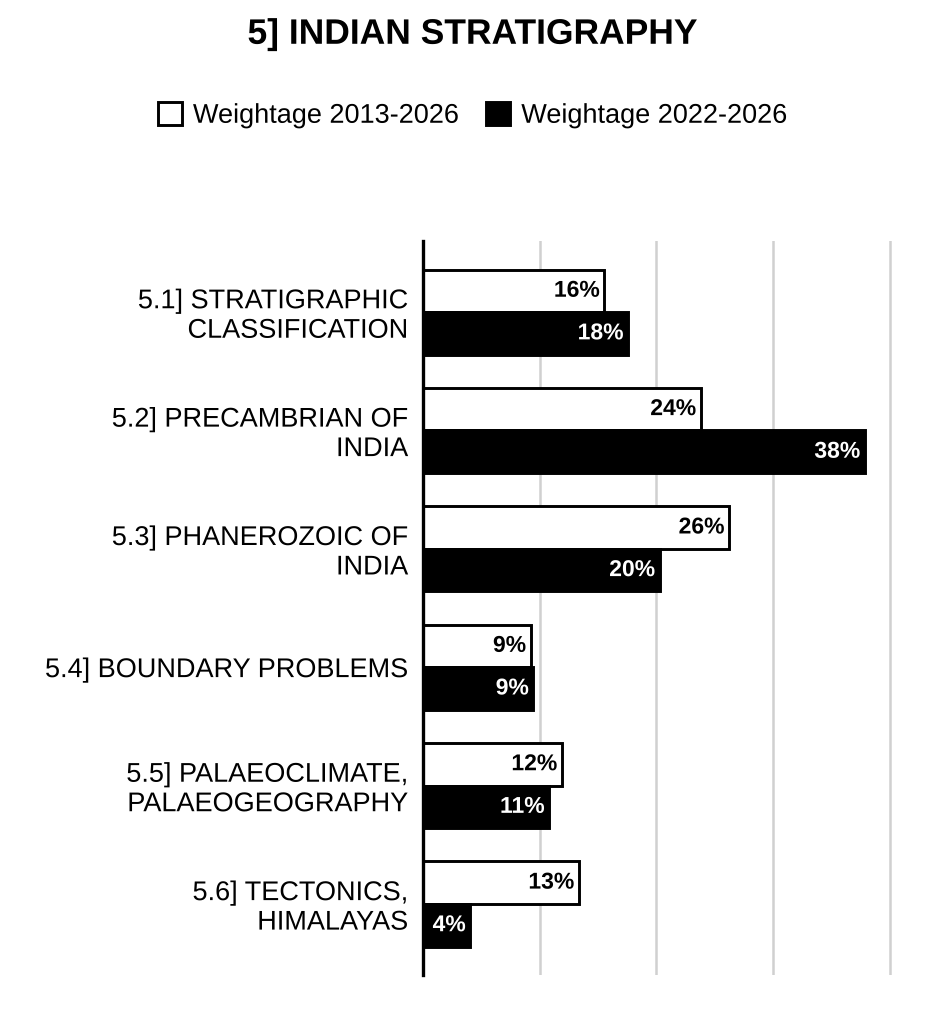
5.1] Stratigraphic classification
25 questions
Discuss the principles of magnetostratigraphy. [2026/10m/150w/5b]
Discuss different concepts of biozonation with neat diagrams. [2025/10m/150w/5b]
Discuss the merits and limitations of different methods of stratigraphic analysis in brief. Comment on the most suitable method of stratigraphic analysis with justification. [2024/20m/7a]
Diagrammatically explain the types of biozonation. [2022/10m/150w/5a]
Describe the chronostratigraphic classification of geological time scale. [2022/15m/8c]
Define lithostratigraphy. Enlist diagnostic properties of lithostratigraphic units giving example from Indian stratigraphy. [2021/10m/150w/5c]
Describe the standard stratigraphic time scale of the earth, beginning from the oldest to youngest. Discuss the principal events that took place during the time units. [2020/20m/7a]
Discuss three indirect methods and three direct methods of dating geological formations and geological events. [2019/10m/150w/1a]
Significance of biostratigraphy and its utility. [2016/10m/150w/5c]
Define biostratigraphy. How does it differ from lithostratigraphy and chronostratigraphy? Discuss various types of ‘Biozones’. [2015/20m/7a]
What are the important features of stratigraphic correlation? [2014/20m/8a]
Discuss types of Lithostratigraphic units with Indian examples. [2013/10m/7c]
Give an account of the relationship between different kinds of stratigraphic units. [2012/20m/250w/7a]
Interrelationship of biostratigraphic and magnetostratigraphic zonations (with Indian examples) [2011/15m/150w/5c]
Chronostratigraphic sequences. [2009/20m/200w/5d]
Biostratigraphic Classification. [2007/20m/200w/5b]
Biostratigraphic correlation. [2006/20m/200w/5b]
Chronostratigraphic classification. [2005/20m/200w/5b]
Lithostratigraphic classification of Sedimentary rocks. [2004/20m/200w/5b]
Principles of stratigraphic correlation. [2003/30m/7a]
Litho-, bio-, chrono- and magneto-stratigraphic studies suggest different aspects of stratigraphy. Comment. [2002/30m/7a]
Write the standard stratigraphic time-scale beginning from the oldest (Give most recent classification). [2000/20m/200w/5b]
How are unfossiliferous rocks of two or more sections correlated? [2000/15m/8a]
Principles of stratigraphic classification. [1999/20m/8c]
What is Stratigraphy? Discuss the principles of stratigraphic correlation. Also briefly explain the basis of reconstruction of standard stratigraphic scale. [1996/60m/8]
5.2] Precambrian of India
34 questions
Draw the cratons and mobile belts of India on the given map. Enlist the major economic minerals associated with each craton and mobile belt. [2026/10m/150w/5c]
Discuss the stratigraphic classification and depositional environment of Cuddapah Supergroup. Add a note on the tectonic evolution of the Cuddapah Basin with suitable sketch. [2026/20m/7a]
Describe the lithology, type locality, age and depositional environment of Blaini Boulder Bed. [2025/10m/150w/5c]
Give the lithostratigraphic classification and distribution of Delhi Supergroup. Also comment on the economic significance of this supergroup. [2025/15m/6b]
Discuss the geological parameters used to subdivide the Dharwar Craton into two subcratons. [2024/10m/150w/5b]
Describe lithostratigraphic classification and shift of depositional environments during deposition of the Vindhyan Supergroup. Comment on the age of the Vindhyan succession. [2024/15m/6b]
Describe the lithology, palaeoenvironment and age of Krol Formation. [2023/10m/150w/5c]
Describe the stratigraphic sequence of Dharwar Supergroup and add a note on its economic importance. [2023/20m/7a]
Describe the lithostratigraphy, palaeoenvironment and age of Blaini Formation. [2022/10m/150w/5c]
Describe the stratigraphy of Singhbhum Craton and discuss its economic significance. [2022/20m/7a]
Give an account of the mineral wealth associated with the Cuddapah Supergroup of rocks. [2020/10m/150w/5b]
What are cratons? Give a brief account of stratigraphy and evolution of any one Indian craton. [2019/15m/6b]
Write short notes on the following: (i) Lower Vindhyan Group (ii) Talchir Formation (iii) Upper Siwalik Group. [2019/15m/7b]
Give an account of stratigraphy of the Aravalli Supergroup. [2019/20m/8a]
Write short notes on the following: (i) Lower Gondwana Group (ii) Karewa Group (iii) Krol Group. [2018/15m/6b]
Give a succinct account of life during Vindhyan times. [2018/15m/6c]
Give a stratigraphic account of Vindhyan Supergroup. Comment upon the life during Vindhyan times. [2017/20m/6c]
How is Proterozoic subdivided? [2013/10m/150w/5c]
Diamondiferous strata of India. [2012/12m/150w/5b]
Charnockite–their types and distribution in India, and their petrological and stratigraphical significance. [2011/20m/7b]
Precambrian banded iron formations. [2010/15m/150w/5b]
Tectonothermal evolution of the South Indian shield. [2009/30m/7a]
Describe the Precambrian stratigraphy of Peninsular India. [2002/30m/7b]
Trace the evolutionary history of Eastern Ghats Mobile Belt. [2001/15m/7c]
What is the origin of the following geological names: (i) Siwalik (ii) Gondwana (iii) Gondite (iv) Khondalite (v) Jurassic. [2000/20m/200w/5d]
Precambrian rocks of Karnataka (Modern views) [1999/20m/8a]
Semri Series of Lower Vindhyans. [1998/20m/200w/5d]
Banded Gneissic Complex. [1998/20m/8b]
Dharwar Super Group. [1997/20m/200w/5a]
Krol-Tal Sequence. [1997/20m/200w/5d]
Sausar Group. [1996/20m/200w/5c]
Banded Gneissic Complex and its basement character. [1995/20m/200w/5a]
Dharwar Super Group of rocks. [1995/30m/7a]
Stratigraphy of the Iron-Ore, Series of Bihar and Orissa. [1995/30m/7b]
5.3] Phanerozoic of India
42 questions
What is Continental Flood Basalt (CFB)? Discuss the stratigraphic classification of Deccan Trap. Comment on the importance of inter-trappean beds. [2026/15m/6b]
Discuss the stratigraphic classification of Siwalik Group. Comment on the paleogeographic setup and fossil assemblage of Siwalik Group. [2026/15m/8c]
Discuss the lithology, fossil content and age of palaeozoic sequence of Spiti Basin of Himachal Pradesh. [2025/15m/8c]
Discuss the palaeozoic sequence of Kumaun and Garhwal (Tethyan sequence) Himalaya. Add a note on its fossil contents. [2023/15m/8c]
Describe the Palaeozoic sequence of Kashmir Valley with fossils content. [2022/15m/6b]
Describe Cenozoic stratigraphy of Kuchh basin. Comment on its fossil content and depositional environment. [2021/15m/6b]
Describe stratigraphy and depositional environment of Gondwana Supergroup and discuss why only certain intervals of Gondwana succession are rich in coal seam? [2021/20m/7a]
Briefly describe the economic mineral deposits associated with the Tertiary rocks of India. [2020/10m/150w/5c]
Give a short geological account of ‘Deccan volcanic province’. [2019/10m/150w/5c]
Write short notes on the following: (i) Lower Vindhyan Group (ii) Talchir Formation (iii) Upper Siwalik Group. [2019/15m/7b]
Write short notes on the following: (i) Lower Gondwana Group (ii) Karewa Group (iii) Krol Group. [2018/15m/6b]
Give a brief account of the stratigraphy of Mesozoic rocks of Kachchh. [2018/15m/7b]
Discuss the stratigraphy of the Siwalik supergroup and comment on its vertebrate fossils. [2018/15m/8c]
Write short notes on the following: (i) Muth Quartzites (ii) Lameta Formation (iii) Tipam Formation. [2017/15m/7a]
Give a geological account of Deccan volcanic province. [2017/15m/8c]
Bagh beds. [2016/10m/150w/5a]
Give an account of the stratigraphy, lithology and environment of deposition of the Jurassic rocks of Kutch. [2016/20m/7b]
Discuss the Maleri Beds, their faunal content and age. [2015/15m/6c]
Discuss the depositional and climatic conditions during the Siwalik times. [2015/15m/8b]
Describe the significance of intratrappean and intertrappean beds of India. [2014/20m/7a]
What are the economic deposits associated with the Tertiary rocks of India? List them and briefly describe each of them. [2012/20m/250w/7b]
Bagh formation–their invertebrate fauna and economic importance. [2011/20m/7c]
The lithostratigraphy, flora, fauna and economic importance of a sedimentary basin of India which has Palaeozoic glacial unit. [2010/30m/7a]
Tertiary formations of India and the fossil fuel deposits. [2009/30m/7b]
Economic importance of Phanerozoic rocks of India. [2004/30m/7a]
What are Outlier, Window, Tatrot beds and Gangamopteris? [2002/20m/200w/5b]
Where do the names ‘Umaria’ and ‘Umia’ arise in the context of Indian stratigraphy? [2001/20m/200w/5c]
What is the origin of the following geological names: (i) Siwalik (ii) Gondwana (iii) Gondite (iv) Khondalite (v) Jurassic. [2000/20m/200w/5d]
Correlation of Gondwanas of India with their world equivalents. [1999/20m/200w/5d]
Briefly give the classification, conditions of deposition and fossil fauna of Siwalik system of India. [1999/60m/7]
Stratigraphy of oil-bearing formations of North-Eastern India. [1999/20m/8b]
Geological succession and fauna of the Cretaceous formations of Narmada Valley. [1999/20m/8d]
Productus Limestone Series of Salt Range. [1998/20m/200w/5a]
Stratigraphic importance of Umia Series of Kutch. [1998/20m/200w/5b]
What is marine transgression? Discuss the Cretaceous rocks of Trichinapalli with special reference to their fossil contents. [1998/60m/6]
Deccan traps. [1997/20m/200w/5c]
Describe the Mesozoic formation of Kachchha (Kutch) with special reference to its sedimentation and fauna. [1997/60m/8]
Classification of the Gondwanas. [1996/20m/200w/5a]
Siwalik sedimentation. [1996/20m/200w/5d]
Inter-trappeans and their importance in Stratigraphy. [1996/20m/7a]
Bagh Beds. [1995/20m/200w/5c]
Age of Deccan Traps. [1995/20m/200w/5d]

Preparing for Prelims too?
Our UPSC Prelims Topic-wise PYQ eBook covers every Prelims question with detailed explanations, so you can see exactly where UPSC asks from.
View the BookDownload Free Sample5.4] Boundary problems
17 questions
What do you understand by boundary problems in stratigraphy? Discuss Cretaceous/Palaeogene (Cretaceous/Tertiary) boundary problem giving Indian examples. [2025/20m/7a]
Discuss the pre-cambrian/cambrian boundary with Indian examples. [2023/15m/6b]
What are mass extinctions? Comment on the various hypothesis proposed for the causes of Permian-Triassic mass extinction. [2021/15m/8c]
Discuss about the Cretaceous-Tertiary boundary (K-T boundary) with examples from India. [2020/15m/8c]
Discuss the Precambrian-Cambrian boundary problem in the Indian geological context. [2018/10m/150w/5e]
Pliocene – Pleistocene boundary. [2013/10m/6c]
Discuss the Permian – Triassic boundary. [2013/10m/8c]
Cretaceous-Tertiary boundary and the mass extinction. [2009/20m/200w/5b]
Cretaceous-Tertiary Boundary. [2007/30m/7a]
K-T boundary succession in India. [2006/30m/7b]
Cambrian-Precambrian Boundary. [2005/30m/7a]
On which age level (in million years) is the Precambrian-Cambrian boundary placed? What are Cambrian fauna? Are they found in the Indian subcontinent and if so, where? [2001/15m/7a]
Which are the most controversial stratigraphic boundaries? [2000/15m/8c]
Boundary problems in Indian stratigraphy. [1999/20m/200w/5c]
K-T boundary. [1997/20m/200w/5b]
Krol-Tal Sequence. [1997/20m/200w/5d]
Cretaceous-Eocene boundary. [1996/20m/200w/5b]
5.5] Palaeoclimate and palaeogeography
27 questions
Explain the various methods used in paleogeographic reconstructions with suitable example. [2026/15m/8b]
Describe the Cretaceous volcanic province in India. [2024/10m/150w/5c]
Establish the ocean palaeobathymetry using marine fossils with the help of labelled diagram. [2023/15m/8b]
What is paleogeography? Discuss various tools employed in paleogeographic reconstruction. [2021/10m/150w/5b]
Discuss the significance of fossils in paleoclimatic studies. [2018/15m/7c]
Discuss the depositional and climatic conditions during the Siwalik times. [2015/15m/8b]
Application of fossils in palaeoclimatic reconstruction of an area. [2014/10m/150w/5e]
Closing and opening of Cenozoic gateways and their implication on paleoclimate. [2013/20m/6b]
Discuss the Paleogeography of India during transition from Paleogene to Neogene. [2013/20m/8b]
Volcanism in India. [2012/12m/150w/5c]
Enumerate the petrological characteristics of the Deccan Traps. [2012/20m/250w/7c]
Igneous activities in India during the Palaeozoic times. [2011/20m/7a]
The cause, effect and petrology of Cretaceous igneous activity in Peninsular India. [2010/30m/7b]
Quaternary climatic changes and evolution of man. [2009/20m/200w/5a]
Volcanic activities in Rajmahal and Deccan igneous provinces. [2006/30m/7a]
Climatic conditions in Gondwana time. [2005/30m/7b]
Paleogeography of the Indian Subcontinent. [2004/30m/7b]
Pleistocene glaciation. [2003/20m/200w/5a]
Upper Cretaceous-Lower Eocene igneous activity in India. [2002/20m/200w/5c]
Fossil-study and Palaeoclimate inference. [2002/15m/6b]
Fossil fauna and flora can indicate paleoclimate. Justify in the Indian context. [2001/20m/200w/5b]
What was the paleogeographic disposition of continents during the Permo-Carboniferous era? [2001/15m/7d]
Discuss the reasons for absence of marine Palaeozoic rocks in Peninsular India, except for a narrow strip in central India. [2000/60m/7]
Palaeogeographic reconstructions. [1998/20m/8a]
Palaeogeography of India during Palaeogene period. [1997/20m/7c]
Marine transgression in Permocarboniferous. [1996/20m/7c]
Pleistocene glaciation. [1995/20m/8c]
5.6] Tectonic framework of India and the Himalayas
18 questions
Discuss the evolution of the Himalayas. Illustrate your answer with suitable labelled sketches. [2024/15m/8c]
Draw the tectonic sub-division map of India and discuss the salient features of each sub-division. [2020/15m/6b]
Draw a cross-section from north to south and discuss the tectonic framework of the Himalaya. [2019/10m/150w/1d]
Compare the geomorphological and geological features of peninsular and extra-peninsular regions of India. [2017/15m/2b]
Discuss the tectonic sub-divisions of Himalaya. [2017/10m/150w/5b]
Describe the evolution of the Himalayas. [2016/20m/8b]
The ‘Great Boundary Fault’. [2015/10m/150w/5c]
Differentiate between the tectonic frameworks of Peninsular and extra-Peninsular India. [2014/20m/7b]
What are the evidences of active tectonism in Himalaya? [2013/10m/150w/5d]
Discuss Indian Ophiolite suites and their significance. [2013/20m/8a]
Great Boundary Fault and its significance. [2011/15m/150w/5a]
Evolution of Himalayas. [2007/30m/7b]
Tectonic framework of India. [2004/20m/200w/5c]
Define Peninsula and Extra-peninsula with reference to India. [2000/20m/200w/1b]
Mobile belts and shields. [2000/15m/2b]
Lineaments with reference to India. [1999/20m/200w/1c]
A brief review of rise of Himalayas. [1998/20m/200w/5c]
Himalayan uplift. [1996/20m/7b]

Strengthen your GS papers
Our UPSC Mains Topic-wise & Year-wise PYQ eBook (2013–2026) maps every GS question to the syllabus, so you know what UPSC asks and how often.
View the BookDownload Free Sample« Previous: Paleontology | Next: Hydrogeology and Engineering Geology »
Back to: Geology Optional PYQs – Topic-wise | Also see: Geology Optional year-wise question papers
Last updated: 31 October 2026