
Here are all 111 Paleontology questions asked in UPSC Geology Optional Paper I from 1995 to 2026, arranged under the 5 topics of the official syllabus. Within each topic the latest questions come first.
Each question ends with a code such as [2024/15m/3b] – the year, the marks, the word limit (where UPSC set one) and the question number in the paper.
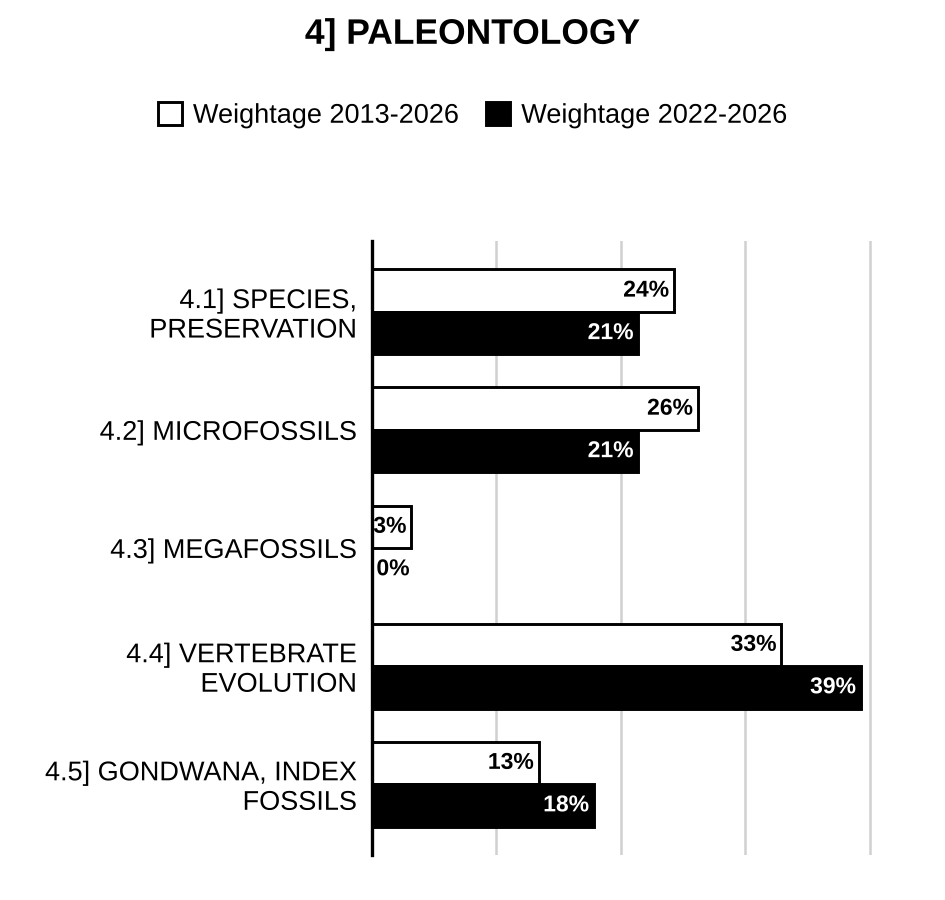
4.1] Species and fossilisation
23 questions
Discuss the conditions required for the preservation of soft parts of fossils. [2026/10m/150w/5a]
Discuss favourable conditions for fossilization. [2025/10m/150w/5a]
Define species and explain how paleontological species are different from biological species. [2024/10m/150w/5a]
Discuss various modes of preservation of fossils. [2024/15m/8b]
Discuss the effects on dead organism after burial. [2022/15m/7b]
What are trace fossils? Describe the modes of preservation of trace fossils and comment on their geological significance. [2021/15m/7b]
Describe three processes by which plant remains and invertebrate shells can be preserved as fossils. [2020/10m/150w/5a]
What are the objectives of the scientific nomenclature of species? Describe the binomial nomenclature. [2019/15m/8c]
Discuss the modes of fossilization of hard parts of an organism. [2018/10m/150w/5a]
Discuss the environment and modes of fossilization. [2017/10m/150w/5a]
How would you differentiate between ‘in-situ’ and ‘derived fossils? [2017/15m/6a]
Describe the significance of trace fossils. [2016/10m/6c]
Differentiate between a cast and a real shell. [2015/10m/150w/5a]
What is petrifaction? How does it differ from permineralisation? [2015/15m/7c]
Differentiate between ‘body’, ‘trace’, ‘index’, ‘in situ’ and ‘derived’ fossils. [2014/10m/150w/5a]
What is understood by species concept in palaeontology? [2014/10m/8c]
Uses of fossils. [2012/20m/250w/6a]
What is cast? How is it produced and how can it be differentiated from a natural shell/test? [2011/20m/200w/6b]
Preservation of fossils. [2004/20m/200w/5a]
Differentiate between body fossil and trace fossil. [2001/20m/200w/5a]
How are the fossils formed? Describe the mechanism by which organic content of the once living matter gets preserved in rock records. [2000/60m/6]
Modes of fossil preservation. [1998/20m/8c]
Methods of preservation of fossils. [1995/20m/8a]
4.2] Microfossils
26 questions
Classify the important groups of microfossils based on their composition. Discuss the application of microfossils in hydrocarbon exploration. [2026/15m/7b]
What are the important groups of microfossils? Add notes on their composition and significance. [2025/15m/7b]
Describe in brief various types of organic-walled microfossils. Add a note on their biostratigraphic and paleogeographic significance. [2024/15m/7b]
Elucidate the different types of microfossils and add a note on their composition and applications. [2023/15m/7b]
What are microfossils? Discuss the application of microfossils in petroleum exploration. [2021/15m/8b]
Name two microfossils and discuss how these are used in reconstructing the palaeoclimatic conditions. [2020/15m/8b]
Define microfossil. Describe the characteristics like ecology, shape, size, composition and age range of Foraminifera. [2019/20m/6a]
“Microfossils are superior to megafossils in correlation.” Comment on the statement. [2018/10m/150w/5b]
Describe the significance of microfossils in petroleum exploration. [2017/15m/7b]
Explain the process of separation of micro-fossils from the matrix. [2016/10m/7c]
Generation of ‘Megalospheric’ and ‘Microspheric’ tests in foraminifers. [2015/10m/150w/5b]
What are conodonts and their major types? Briefly discuss their geological history. [2015/20m/8a]
Describe the significance of microfossils in petroleum exploration. [2014/20m/6a]
How are stable isotope studies useful in paleoceanography? [2013/10m/150w/5b]
Classification of foraminifera based on structure and composition of the shell. [2012/20m/250w/6b]
Enumerate various kinds of microfossils. Add a note on the application of foraminifers in palaeoceanographic studies. [2011/20m/200w/6a]
Application of microfossils in stratigraphic correlation, palaeoclimatic and palaeogeographic analyses. [2010/15m/150w/1d]
Coiling direction(s) in planktonic foraminifers and their climatic significance. [2010/15m/150w/5a]
The methods of separation of foraminifers and calcareous nannoplanktons from calcareous rocks. [2010/30m/6b]
Analysis of palaeo-sea levels using Foraminifera. [2009/30m/6b]
Megafossils and Microfossils. [2007/20m/200w/5a]
Application of microfossils in palaeoclimatic studies. [2006/20m/200w/5a]
Application of microfossils in petroleum exploration. [2005/20m/200w/5a]
Role of microfossils in correlation of rock formations. [2003/20m/200w/5c]
Benthic Foraminifera. [2001/15m/6a]
What are the benthic and planktonic organisms? [2000/20m/200w/5c]

Preparing for Prelims too?
Our UPSC Prelims Topic-wise PYQ eBook covers every Prelims question with detailed explanations, so you can see exactly where UPSC asks from.
View the BookDownload Free Sample4.3] Megafossils
23 questions
What are megafossils? Give names of any three age-diagnostic megafossils indicating their significance in Indian stratigraphy. [2021/10m/150w/5a]
Give an account of the evolutionary changes noticed in the glabella of trilobites. [2016/15m/8c]
Distribution of trilobites in different geological periods. [2012/12m/150w/5a]
Life in pre-Cambrian time. [2012/20m/250w/6c]
Megafossils and Microfossils. [2007/20m/200w/5a]
Discuss the evolutionary trends of Echinoidea. Illustrate your answer with sketches. [2007/60m/6]
Discuss with suitable sketches, the morphology of Brachiopod. Name five brachiopods of stratigraphic significance with their age. [2006/60m/6]
Discuss the evolutionary trends of Trilobita. Illustrate your answer with sketches. [2005/60m/6]
Describe the morphology of Gastropoda shell. [2003/20m/200w/5d]
Discuss the evolutionary changes in the morphology of Ammonoids. [2003/60m/6]
Evolution of suture-lines of Cephalopods. [2002/20m/200w/5a]
Geological history of Graptoloids. [2002/15m/6a]
Brachial skeleton of fossil brachiopods. [2001/15m/6b]
Exoskeleton of trilobites. [2001/15m/6c]
Enumerate characteristic features of Jurassic ammonoids of Kutch basin. [2001/15m/7b]
What are the characteristic morphological differences between the gastropods and brachiopods? [2000/15m/8d]
Evolutionary trends in Trilobites. [1999/20m/200w/5b]
Describe the morphology and classification of Ammonoids and give their distribution in space and time. [1999/60m/6]
Describe the morphology of Echinoids. Mention their classification and add a note on their distribution. [1998/60m/7]
Draw a neat full page labelled sketch of a Trilobite and describe its morphology. Give their geological distribution. [1997/60m/6]
Evolution of life on the Earth. [1997/20m/7a]
Draw neat labelled diagrams to illustrate the morphology of Echinoids. Tabulate the distinction between Regular and Irregular Echinoids. Add notes on their distribution in time. [1996/60m/6]
Draw a large neat labelled diagram of a gastropod shell and describe its morphology. Also give its classification and distribution in time. [1995/60m/6]
4.4] Vertebrate evolution
24 questions
Compare the major morphological characters which differentiate Hominidae from ape-like primates. Discuss the evolutionary trend of Hominidae with example from Indian occurrence. [2026/20m/6a]
Discuss the evolutionary lineage of Equidae and comment on its migration. [2025/20m/6a]
Elucidate the evolutionary trend of Proboscidea with examples. [2024/20m/6a]
Enumerate the different types of siwalik fauna and discuss their palaeoecology. [2023/10m/150w/5a]
Elucidate an evolutionary trend of Equidae with Indian occurrence. [2023/20m/6a]
Elucidate the evolutionary trend of Hominidae with examples of Indian occurrence. [2022/20m/6a]
Discuss the evolutionary trends in the lineage of equidae and give any two examples of their Indian occurrences. [2021/20m/6a]
Discuss the morphological trends in the evolution of Homo sapiens from Proto-hominins. [2020/20m/6a]
Describe the mammalian fauna in the Siwalik Supergroup and add a note on the age. [2019/10m/150w/5b]
Describe the evolution of Equidae from Eohippus to Equus. [2019/15m/7c]
Give an account of evolutionary trends in Proboscidea. [2018/20m/6a]
Discuss the stratigraphy of the Siwalik supergroup and comment on its vertebrate fossils. [2018/15m/8c]
Give an account of evolutionary trends in Equidae. [2017/20m/8b]
Explain the evolutionary trends of Hominidae. [2016/20m/6b]
Give an account of the evolutionary trends in Equidae. [2015/15m/6b]
The ‘Piltdown’ hoax. [2011/15m/150w/5d]
Evolution of Proboscidea and their record in the Siwalik Group. [2010/30m/6a]
Quaternary climatic changes and evolution of man. [2009/20m/200w/5a]
Discuss the evolutionary trends in Hominidae. [2004/60m/6]
Progressive changes in the evolution of horse. [2002/15m/6d]
Neanderthal man. [2001/15m/6d]
Make a list of functional differences between vertebrates and invertebrates. [2000/20m/200w/5a]
Present day horses are different from their geological ancestors. Comment. [1999/20m/200w/5a]
Siwalik Fauna. [1995/20m/200w/5b]
4.5] Gondwana flora and fauna; Index fossils
15 questions
Describe important Lower Gondwana plant fossils with the help of neat diagrams and comment on their palaeobiogeographic significance. [2025/15m/8b]
Define fossil and give examples of two index fossils each from Palaeozoic, Mesozoic and Cenozoic Era and indicate the age of those index fossils. [2023/10m/150w/5b]
Define index fossil and discuss its significance. Give the examples of index fossils of Palaeozoic Era. [2022/10m/150w/5b]
Describe the Lower Gondwana flora of India and their significance. [2022/15m/8b]
Give an account of the Lower Gondwana flora from peninsular and extra-peninsular India. What environmental conditions do they indicate? [2020/15m/7b]
Define index fossils and give the characteristics of a good index fossil. [2019/10m/150w/5a]
Lower Gondwana flora and its significance. [2017/10m/150w/5e]
Importance of index fossils in establishing correlation. [2016/10m/150w/5b]
What are the prerequisites for a fossil to be useful in biostratigraphy? [2013/10m/150w/5a]
Write on Gondwana reptiles in India and their significance. [2011/20m/200w/6c]
Lower Gondwana flora. [2010/15m/150w/5c]
Application of palaeontologic and palaeobotanic methods in the study of Gondwana tectonics. [2009/30m/6a]
Significance of glossopteris and ptylophyllum in the study of Gondwana System. [2003/30m/7b]
Lower Gondwana flora. [2002/15m/6c]
What are the major differences between Lower and Upper Gondwana flora? [2000/15m/8b]

Strengthen your GS papers
Our UPSC Mains Topic-wise & Year-wise PYQ eBook (2013–2026) maps every GS question to the syllabus, so you know what UPSC asks and how often.
View the BookDownload Free Sample« Previous: Structural Geology | Next: Indian Stratigraphy »
Back to: Geology Optional PYQs – Topic-wise | Also see: Geology Optional year-wise question papers
Last updated: 31 October 2026