
Here are all 110 General Geology questions asked in UPSC Geology Optional Paper I from 1995 to 2026, arranged under the 5 topics of the official syllabus. Within each topic the latest questions come first.
Each question ends with a code such as [2024/15m/3b] – the year, the marks, the word limit (where UPSC set one) and the question number in the paper.
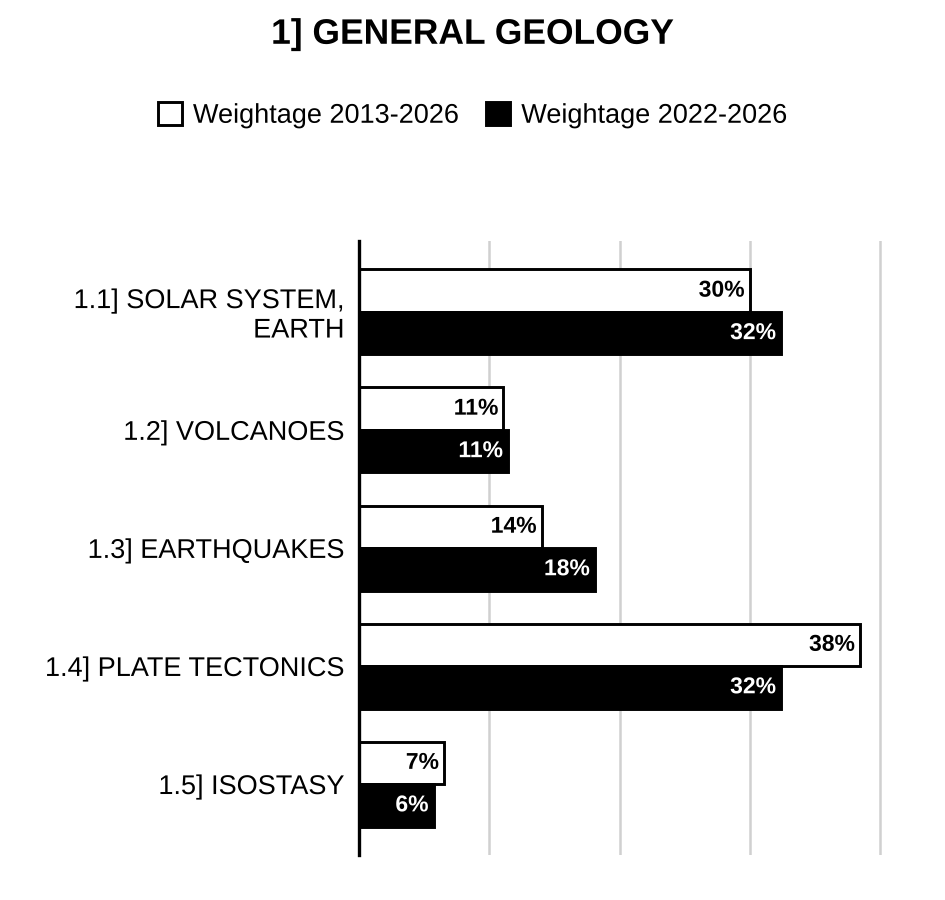
1.1] Solar system and the earth
28 questions
Discuss the most accepted hypothesis regarding the origin of the earth. Add a note on the interior of the earth with sketch. [2026/15m/4b]
Discuss the position of Astroid belt within the solar system and comment on the composition of meteorites. [2025/10m/150w/1a]
Discuss two widely accepted theories of origin of the earth. Elucidate the position of all planets within the solar system and write the important facts of the earth. [2024/10m/150w/1a]
Describe the types of radiometric dating techniques used to establish the age of the Earth. [2023/20m/2a]
Discuss the origin, composition and classification of meteorites. [2023/15m/3b]
Illustrate the discontinuities in the Earth’s interior and discuss the mechanical and compositional layering of the Earth. [2022/15m/3b]
Discuss the different types of meteorites. [2020/10m/150w/1a]
Explain the internal structure of the earth. Add a note on discontinuities with neat sketches. [2020/20m/2a]
Discuss three indirect methods and three direct methods of dating geological formations and geological events. [2019/10m/150w/1a]
What are meteorites? Discuss different types of meteorites. [2018/15m/4c]
Explain the major discontinuities within the Earth’s interior. [2016/10m/4c]
Discuss the characteristics and properties of the lithosphere and the asthenosphere. [2015/10m/150w/1a]
Differentiate between the terrestrial and the Jovian planets. [2015/15m/3b]
Why radiometric methods are preferred for age determination of rocks? [2014/20m/2b]
Earth’s interior as revealed from seismic waves. [2013/10m/150w/1a]
Application of Radioactivity in determining age of rocks. [2013/20m/2a]
Paleomagnetic Reversals. [2013/10m/4c]
Apparent polar-wandering path. [2010/15m/150w/1a]
Solar System. [2007/20m/200w/1a]
Radioactivity and age of the earth. [2005/20m/200w/1a]
Mantle of the earth. [2003/20m/1b]
What is geochronology? How is it used for the benefit of the earth-science studies? [2002/20m/200w/1a]
What is the principle of dating very old rocks on the Earth? [2000/20m/200w/1a]
Lower mantle and Upper mantle. [2000/15m/2c]
Internal Constitution of the earth. [1999/20m/200w/1b]
Geomagnetic reversals. [1998/20m/200w/1a]
Evolution of the crust of the Earth. [1997/20m/7b]
Mohorovicic discontinuity. [1995/12m/4b]
1.2] Volcanoes
17 questions
What are volcanoes? Describe various causes and products of volcanism. [2025/15m/4b]
Describe the different types of volcanoes based on mode of the eruption and its associated products. Add a note on positive and negative relief features associated with volcanoes. [2023/15m/4c]
Explain what is ring of fire? How many plates and geographic areas are associated with ring of fire? [2021/10m/150w/1a]
What is volcano? Discuss four positive relief features and four negative relief features associated with a volcano. [2019/15m/3c]
Discuss about the Circum-Pacific volcanic belt. Which five countries have the highest volcanic threat in terms of human loss? [2018/10m/150w/1c]
Discuss the classification and global distribution of volcanoes and describe various volcanic products. [2016/20m/2c]
Relationship between Volcanic and Earthquake belts. [2013/10m/150w/1b]
Circum-Pacific belt. [2012/20m/250w/2a]
What is a volcanic belt? Discuss the causes of volcanism and products of volcanoes. [2011/30m/2b]
What is a volcanic belt? Discuss causes and products of volcanoes. Illustrate your answer with suitable neat sketches. [2005/60m/2]
Why are volcanoes associated with ‘Ring of fire’ Discuss the genesis of a volcano and write a note on their products. [2002/60m/2]
Hawaiian and Strombolian type volcanic eruptions. [2000/15m/2a]
Caldera and Stratovolcanoes. [1999/20m/200w/1a]
Pacific volcanic belt. [1998/12m/3d]
Are volcanoes and earthquakes related to each other? Explain the various causes and effects of earthquakes. [1998/60m/4]
Causes and products of volcanism. [1997/20m/200w/1a]
Delineate the volcanic belts of the earth in the world outline. [1995/20m/200w/1b]

Preparing for Prelims too?
Our UPSC Prelims Topic-wise PYQ eBook covers every Prelims question with detailed explanations, so you can see exactly where UPSC asks from.
View the BookDownload Free Sample1.3] Earthquakes
16 questions
What is earthquake? How is the epicenter of an earthquake determined? Discuss on the disaster risk associated with earthquakes of different magnitudes. [2026/20m/4a]
Discuss the intensity and magnitude scale commonly used to assess seismic damage. Write a note on the global distribution pattern of earthquake. Mark the different seismic zones of India on the given map and discuss about them. [2024/20m/2a]
How does an Earthquake occur? Describe the construction patterns of earthquake resistant structures. [2023/15m/7c]
Explain the magnitude and intensity as an expression of the size of an earthquake. Add a note on the damage caused by an earthquake. [2020/15m/3b]
Seismic hazard zones of India. [2017/10m/150w/1a]
Explain the utility of establishing seismic zones. [2016/10m/150w/1b]
Explain the nature and effects of seismic waves. [2016/10m/150w/1c]
What are the causes of earthquakes? Why the seismic belts are confined to the plate boundaries? [2014/10m/150w/1a]
Relationship between Volcanic and Earthquake belts. [2013/10m/150w/1b]
Modified seismic zonation map of India. [2012/12m/150w/1a]
Circum-Pacific belt. [2012/20m/250w/2a]
Characteristics of Tsunami waves. [2012/20m/250w/2b]
Write an essay on ‘Seismicity in India’ Discuss your answer with suitable illustrations. [2007/60m/2]
Primary and Secondary seismic waves. [2000/15m/2d]
Are volcanoes and earthquakes related to each other? Explain the various causes and effects of earthquakes. [1998/60m/4]
Causes of earthquakes and their seismic response. [1997/15m/3d]
1.4] Plate tectonics
45 questions
Discuss the different types of plate boundaries with suitable sketches. Add a note on mid-oceanic ridges. [2026/10m/150w/1b]
What do you understand by continental drift? Discuss various geological evidences in favour of continental drift. [2025/20m/2a]
Describe and illustrate different types of plate boundaries, and explain the mechanism of plate motion. [2024/15m/4b]
Describe the tectonic features and evolution of the ‘continental crust’. [2023/10m/150w/1a]
Explain ‘convergent plate boundary’ with suitable examples. Add a note about the characteristics of earthquakes at the convergent boundary. [2022/10m/150w/1a]
Discuss in detail the notion of ‘continental drift’ and the theories of plate tectonics as they relate to palaeogeography. [2022/20m/2a]
Explain what is ring of fire? How many plates and geographic areas are associated with ring of fire? [2021/10m/150w/1a]
What are lithospheric plates? Discuss the theory of plate tectonics. Which plates were involved when a major earthquake caused tsunami in Indian Ocean in 2004? [2021/20m/2a]
Discuss the mechanism of seafloor spreading and give four evidences indicating the expansion in oceanic crust. [2020/15m/4b]
What are the evidences supporting ‘continental drift’ theory and what are its limitations? [2019/15m/2b]
What are ‘island arc’ systems? What are its major characteristics? Draw a schematic section through an island arc system and describe all its components. [2019/20m/4a]
Describe different types of plate boundaries with suitable sketches. [2018/20m/3a]
Discuss different types of plate boundaries and enumerate their characteristic features. [2017/20m/2a]
Describe the types of plate boundaries and comment on the nature of seismicity and volcanism associated with them. [2015/20m/2a]
Discuss the evolution of the foreland basins along the orogenic belts. [2015/15m/4b]
Sea-floor spreading and associated volcanism giving suitable examples. [2014/10m/150w/1b]
What are the main features that led to the formulation of the continental drift theory? [2014/20m/3b]
Oceanic – Oceanic plate convergence boundaries. [2013/20m/2b]
Mechanism of formation of island arcs with examples. [2013/10m/3c]
Spreading ocean ridges. [2012/20m/250w/2c]
Difference between continental drift and plate tectonics. [2011/15m/150w/1a]
Explain the evidences and mechanism of sea-floor spreading. [2011/30m/2a]
Apparent polar-wandering path. [2010/15m/150w/1a]
The relation between depth and age of the oceanic crust near midoceanic ridges. [2010/30m/2a]
Morphotectonic elements, seismicity, heat flow and gravity anomaly patterns of an island-arc type subduction boundary. [2010/30m/3b]
Give accounts of: The present status of the theory of Continental Drift in the light of geological and geophysical evidence. [2010/30m/4a]
Formation of mid-oceanic ridges and trenches. [2009/20m/200w/1a]
What are the different types of plate margins? What types of geologic structures and lithology are associated with each type of margin? [2009/30m/3a]
Mountain building processes. [2006/20m/200w/1a]
What is sea-floor spreading? Discuss its evidences and mechanism. [2006/60m/2]
‘Orogeny’ and ‘Epeirogeny.’ [2004/20m/200w/1a]
Discuss in detail the concept of ‘Plate Tectonics’. Is it synonymous with ‘Continental Drift’? [2004/60m/2]
Discuss the significance and mechanism of sea-floor spreading. [2003/60m/2]
Why are modern island arcs restricted to specific parts of the globe? How would you identify island arc products in ancient rocks records? [2001/20m/200w/1a]
It is said: While new ocean floor is born, old ocean floor dies. Explain. [2001/60m/2]
Describe the steps through which present configuration of the Earth have evolved. Discuss the most recent view, in this regard. [2000/60m/3]
Mid-Atlantic Ridge. [2000/15m/4a]
Origin of oceans and continents. [2000/15m/4b]
Describe: (i) deep sea trenches, (ii) mid-ocean ridges and (iii) sea-floor spreading and discuss their significance. [1999/60m/3]
Guyot. [1999/12m/4a]
American and European views on geosynclines. [1998/20m/200w/1b]
Mid Oceanic ridges and deep sea trenches. [1997/20m/200w/1d]
Island Arcs. [1996/20m/200w/1a]
Trace the evolution of the Plate Tectonic theory and describe its main features. [1996/60m/4]
Sea-floor spreading – a preamble to the plate tectonic theory. [1995/20m/200w/1a]
1.5] Isostasy
4 questions
“At depth of compensation, the pressure generated by all overlying landmass substances on the earth is everywhere equal.” Describe the hypotheses which support this statement. [2024/15m/4c]
What is isostacy and what are the different theories put forward to explain this concept? [2021/15m/3b]
Isostasy. [2013/20m/4b]
Isostasy. [1996/20m/200w/1c]

Strengthen your GS papers
Our UPSC Mains Topic-wise & Year-wise PYQ eBook (2013–2026) maps every GS question to the syllabus, so you know what UPSC asks and how often.
View the BookDownload Free SampleNext: Geomorphology and Remote Sensing »
Back to: Geology Optional PYQs – Topic-wise | Also see: Geology Optional year-wise question papers
Last updated: 31 October 2026