
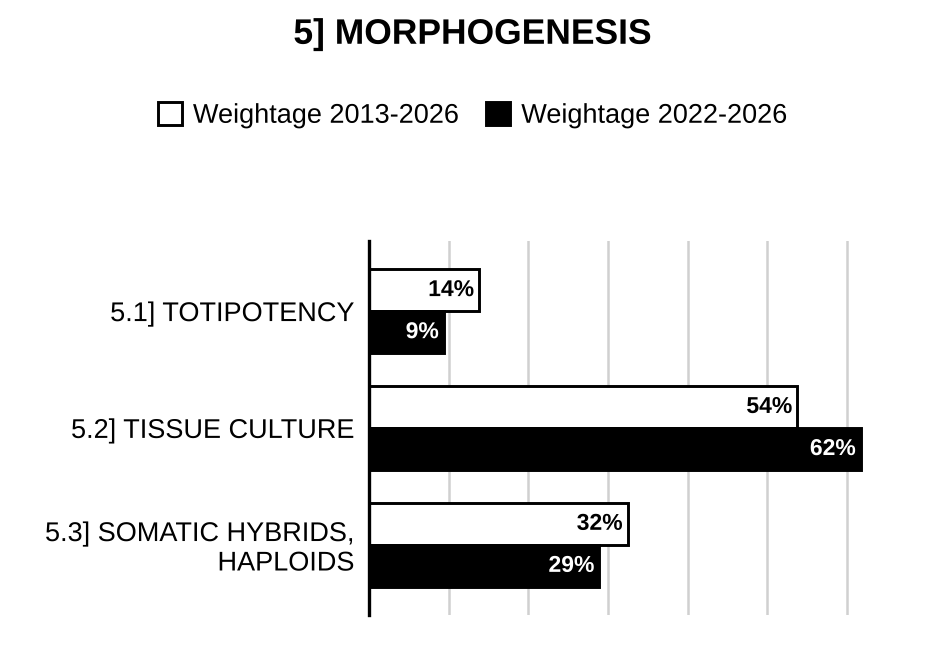
Here are all 96 Morphogenesis questions asked in UPSC Botany Optional Paper I from 1995 to 2026, arranged under the 3 topics of the official syllabus. Within each topic the latest questions come first.
Each question ends with a code such as [2024/15m/3b] – the year, the marks, the word limit (where UPSC set one) and the question number in the paper.
5.1] Totipotency and differentiation
16 questions
Write an account on types, regulation and significance of totipotency. [2026/15m/7b]
“Polarity and symmetry are two essential components of morphogenesis in plants.” Elaborate the statement. [2024/15m/8c]
Discuss the concept of cellular totipotency in higher plants. [2021/10m/150w/5e]
Write notes on the following: (i) Somatic hybrid and cybrid with their significance (ii) Totipotency, polarity and differentiation. [2020/15m/8c]
Define totipotency and discuss cytodifferentiation in plants. [2019/15m/7b]
Write notes on the following: (i) NPC system of classification of pollen grains (ii) Cytodifferentiation and its regulation. [2018/15m/8c]
Symmetry in plants with relation to morphogenesis. [2017/10m/150w/5c]
Concept of totipotency in higher plants. [2015/10m/150w/5b]
Discuss the importance of totipotency in tissue culture. [2013/14m/2c]
Polarity and Symmetry. [2012/12m/4a]
Polarity. [2011/10m/1c]
What cellular/subcellular changes would demonstrate polarity induction in cell suspensions? How can these changes be demonstrated? [2009/20m/200w/1b]
What is polarity and how does it affect differentiation? [2006/20m/200w/1d]
Totipotency. [2003/20m/4c]
Discuss the role of hormones in cell differentiation. [1996/20m/200w/5c]
Write short notes on: (i) Totipotency (ii) Orchid flower (iii) Pollen sterility (iv) Somatic embryo. [1995/20m/7c]

Preparing for Prelims too?
Our UPSC Prelims Topic-wise PYQ eBook covers every Prelims question with detailed explanations, so you can see exactly where UPSC asks from.
View the BookDownload Free Sample5.2] Plant tissue culture
46 questions
Give a detailed account on cell suspension culture and its significance. [2026/10m/150w/5d]
What is the role played by media and growth regulators in micropropagation? How to control exudation and contamination problems during micropropagation? [2026/20m/8a]
Explain the various steps involved in plant protoplast culture. Mention the major limitations of this technique. What is the role of somatic hybridization in crop improvement? [2025/15m/7b]
What is micropropagation and how does it differ from traditional plant propagation methods? Give an account of the applications of micropropagation in crop improvement and conservation of endangered plants. Add a brief note on the challenges of this technique. [2025/20m/8a]
Differentiate between zygotic and somatic embryos. [2024/10m/150w/5e]
What are the causes of variability in regenerated plants in tissue cultures? Give an account of utility of such variants in improvement of crop plants with examples. [2024/15m/7c]
Basal media, growth regulators, sterilization and culture conditions are essential components of plant tissue culture techniques. Write an explanatory note on each of these components. [2024/20m/8a]
How is the isolation of single cells done from intact plant organs and how is the viability of single cells assessed? [2023/10m/150w/5e]
What causes somaclonal variations? How can somaclones be identified and isolated? [2023/15m/7c]
What factors affect in vitro stages of micropropagation? Discuss the applications and limitations of micropropagation. [2023/20m/8a]
Discuss the factors affecting the yield and viability of protoplasts isolated from leaves. How are isolated protoplasts purified? [2023/15m/8c]
Describe the protocol involved in rooting and acclimatization of plants produced using in vitro culture. Elaborate on the various problems and solutions associated with this technique. [2022/20m/8a]
Differentiate between direct and indirect organogenesis. Discuss the merits and demerits of each method. [2022/15m/8b]
Discuss the factors affecting somatic embryogenesis. [2021/20m/7b]
Describe the method of isolation of protoplast from leaf tissue. [2021/10m/7c]
Describe different stages of micropropagation and discuss its advantages over conventional methods of propagation. [2021/20m/8b]
Plant cell, tissue and organ culture. [2020/10m/150w/5a]
Define protoplast. Write the methods of its isolation and factors affecting their yield and viability. [2020/20m/7a]
Define somaclonal variations. How are these produced? Explain its applications in crop improvement. [2020/15m/8b]
What are the different stages of micropropagation? Mention its advantages. [2019/15m/8c]
Describe the process of protoplast isolation and mention the applications of protoplast culture. [2018/15m/6d]
“Clonal micropropagation is useful in Floriculture industry.” Explain the process with some suitable examples. [2017/15m/6c]
Explain the somaclonal variations and their applications in plant breeding. [2017/10m/7c]
Tumour cells and their culture. [2016/10m/150w/5c]
Use of somaclonal variations in crop improvement. [2015/10m/150w/5e]
Give an account of micropropagation and its utility towards ex-situ conservation of rare and endangered plants. [2015/15m/6c]
Discuss the role of tissue culture in crop improvement. [2014/15m/8a]
How are plant protoplasts isolated and fused? [2014/15m/8b]
Somaclonal variations can be used for variety of crop development. How? Explain with suitable examples. [2012/15m/2a]
Describe the enzymatic method of isolation of protoplasts taking the example of Carrot. [2012/15m/2d]
Somaclonal variation. [2011/10m/1a]
Describe to what extent has the technique of micropropagation been successful in achieving our goals. [2011/15m/4b]
How would you test the clonal fidelity of the micropropagated plants? Describe. [2010/15m/150w/1d]
What are somaclonal variations? How are these utilized for crop improvement? [2010/20m/3a]
Name three enzymes commonly used for the isolation of plant protoplasts. Which of the following tissues would give a better yield of enzymatically isolated protoplasts and why? (i) Aerenchyma (ii) Mesophyll. [2009/20m/200w/1a]
Applications of plant tissue culture in forestry and agriculture. [2007/20m/2c]
Protoplast culture and its importance. [2006/20m/3b]
Protoplast culture. [2005/20m/4c]
Tissue culture and its importance. [2004/20m/3b]
What is callus? Describe the process of differentiation from callus. [2002/30m/4b]
What is micro-propagation? List the various ways this technique can be used to practical advantage. [2002/20m/200w/1a]
Give the methodology and applications of tissue culture technique. [1999/20m/200w/5b]
Explain the difference between somatic embryos and sexual embryos. [1998/20m/200w/5a]
What is micropropagation? Describe various routes by which plants are micropropagated through tissue culture. [1996/15m/8a]
Write short notes on: (i) Totipotency (ii) Orchid flower (iii) Pollen sterility (iv) Somatic embryo. [1995/20m/7c]
Briefly describe each of the following: (i) Tetrasporic embryo sac (ii) Somaclonal variation (iii) Wood of Gnetum (iv) Polarity (v) Flower of Umbelliferae. [1995/15m/8d]
5.3] Somatic hybrids, haploids and embryo rescue
34 questions
Write an account on haploid plant production through tissue culture. What are the advantages of homozygous diploid lines? [2026/15m/7c]
What is embryo rescue? How does this method help in crop improvement? State two disadvantages of it. [2025/10m/150w/5e]
Explain the various steps involved in plant protoplast culture. Mention the major limitations of this technique. What is the role of somatic hybridization in crop improvement? [2025/15m/7b]
Give an outline on the process of producing cybrids. How do cybrids differ from hybrids in terms of their genetic composition? Comment on the potential applications of cybrid technology. [2025/15m/8c]
How are pollen haploids produced? What are the methods to diploidize such haploids? Explain the importance of pollen haploids in agricultural research. [2024/15m/8b]
Mention the role of embryo rescue in interspecific hybridization. [2022/10m/150w/5a]
Explain ‘cybridization’. Write one example of economically useful cybrid. Describe the methods to produce cybrids. [2022/10m/150w/5b]
Distinguish between anther culture and microspore culture. Which technique is more advantageous? Give reasons. [2022/10m/150w/5d]
Explain the technique used in producing androgenic haploids and its applications in agriculture. [2021/10m/8c]
Embryo rescue in angiosperms. [2020/10m/150w/5b]
Write notes on the following: (i) Somatic hybrid and cybrid with their significance (ii) Totipotency, polarity and differentiation. [2020/15m/8c]
Importance of haploid plant production from pollen grains. [2019/10m/150w/5a]
Steps in the production of somatic hybrids and their advantages. [2019/10m/150w/5c]
Generation of Symmetric hybrids. [2018/10m/150w/5e]
Androgenic haploid plants. [2017/10m/150w/5e]
Write short notes on the following: (i) Cytoplasmic hybrids (ii) Chemotaxonomy. [2017/15m/8c]
Describe the principles and application of embryo culture techniques, mentioning the protocol for embryo culture. [2016/20m/6a]
How anthers and pollens are cultured in vitro? Discuss its importance in the production of haploid plants. [2016/20m/7c]
“Somatic hybrids can be characterized by a variety of methods.” Substantiate the above statement. [2015/12.5m/7c]
Describe the method of production of Androgenic haploids. [2015/17m/8b]
How are plant protoplasts isolated and fused? [2014/15m/8b]
Cytoplasmic hybrids. [2012/12m/150w/1b]
Citing suitable examples, explain the following: The embryo rescue techniques for successful raising of recombinants. [2011/20m/2c]
Describe various mechanisms employed to raise hybrids between incompatible species. [2011/12m/7b]
How do the following differ from each other: Hybrid from Cybrid. [2006/20m/2a]
Write a critical note on somatic hybrid and cybrid. [2005/20m/3b]
Differentiate between hybrids and cybrids. How are cybrids obtained? [2002/30m/4a]
How are somatic hybrids obtained? [2001/30m/7a]
Critically examine the following alternatives and substantiate with reasons which of the two is preferable: Mutation for breeding versus protoplast fusion for crop improvement. [2001/20m/4c]
Methods of producing somatic hybrids and their application. [2000/30m/4b]
What are somatic hybrids? How are they produced? Discuss the significance of these hybrids. [1997/20m/8a]
What are haploid plants? How do they originate? What is their utility in crop improvement? [1996/20m/7b]
Describe the method of producing somatic hybrid plants. [1995/20m/200w/5c]
Somatic hybridization. [1995/20m/4b]

Strengthen your GS papers
Our UPSC Mains Topic-wise & Year-wise PYQ eBook (2013–2026) maps every GS question to the syllabus, so you know what UPSC asks and how often.
View the BookDownload Free Sample« Previous: Plant Resource Development | Next: Cell Biology »
Back to: Botany Optional PYQs – Topic-wise | Also see: Botany Optional year-wise question papers
Last updated: 31 October 2026