
Here are all 102 Plant Resource Development questions asked in UPSC Botany Optional Paper I from 1995 to 2026, arranged under the 3 topics of the official syllabus. Within each topic the latest questions come first.
Each question ends with a code such as [2024/15m/3b] – the year, the marks, the word limit (where UPSC set one) and the question number in the paper.
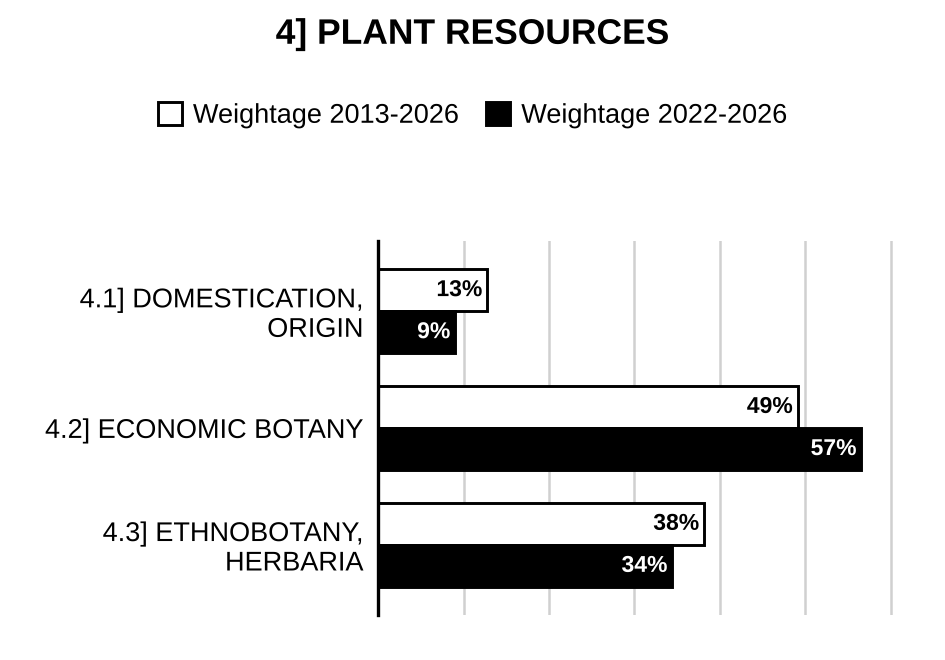
4.1] Domestication and origin of cultivated plants
12 questions
Write an explanatory note on the history of plant domestication. [2026/10m/150w/5e]
Comment on Vavilov’s contributions on the origin of cultivated plants. Write the botanical name and parts used of any three dye-yielding plants of India. [2025/15m/6b]
What are the consequences of domestication of plants? Explain. [2024/10m/150w/5a]
Mention the evolutionary changes that occur during domestication of plants. Also mention its advantages and disadvantages. [2021/10m/150w/5d]
Highlight the main features of Vavilov’s centres of origin of crop plants. [2019/20m/7a]
Vavilov’s centers of origin in plants. [2017/10m/150w/5b]
Give an account of Vavilov’s “Centres of Origin” of the cultivated plants. [2015/17m/8a]
Vavilov’s theory indicates that “a region with the greatest genetic diversity is also the centre of origin of that particular species.” This statement is no longer tenable. Explain with any two examples. [2012/20m/7a]
Origin of cultivated plants with reference to Vavilov’s theory. [2007/20m/6c]
With the help of suitable diagrams explain: Vavilovian centres of origin of crop plants. [2006/30m/6b]
Describe the origin of wheat, maize and rice. [2002/30m/7b]
How is the centre of origin of cultivated plants determined? Discuss the importance of such a study in relation to improvement of crop plants. [1997/20m/200w/5d]

Preparing for Prelims too?
Our UPSC Prelims Topic-wise PYQ eBook covers every Prelims question with detailed explanations, so you can see exactly where UPSC asks from.
View the BookDownload Free Sample4.2] Economic botany
57 questions
Write the botanical names and families of the following economically important plants: (i) Pearl millet (ii) Flax (iii) Pomegranate (iv) Bottle gourd (v) Chickpea. [2026/10m/150w/5c]
Mention the botanical name and family of plants from which Aconite, Isabgol, Ashwagandha, Vasaka and Ipecac are obtained. [2025/10m/150w/5d]
Comment on Vavilov’s contributions on the origin of cultivated plants. Write the botanical name and parts used of any three dye-yielding plants of India. [2025/15m/6b]
Write the botanical name, family, morphology of useful parts and uses of the following plants: (i) Safflower (ii) Fennel (iii) Chicory (iv) Tapioca (v) Teak. [2025/20m/7a]
Write the botanical names, family and parts used of any five fibre-yielding plants. [2024/10m/150w/5d]
Write an explanatory note on nutritional superiority of millets over cereals. Write the botanical names of any five millets grown in India. Mention the advantages of cultivating millets. [2024/15m/6c]
Alphonse de Candolle classified plants of economic importance into various classes. List these classes and state two examples from each. [2023/10m/150w/5a]
Discuss the classification of vegetable fibers (excluding wood fibers) according to their botanical origin and give examples. [2023/10m/150w/5d]
Discuss the growth conditions of groundnut and soybean crops. Compare their oil compositions. [2023/15m/6c]
Describe the botanical features, ecology and propagation of rubber tree. How is rubber obtained and processed from rubber tree? [2023/20m/7a]
Classify and discuss maize varieties on the basis of endosperm and floral or glume characteristics. [2023/15m/7b]
Write an account of plants used as natural dyes. Give binomial name and family of any three dye-yielding plants that are used as food additives. [2022/10m/150w/5c]
Write the uses, botanical name, family and morphology of useful parts of the following plants: (i) Cloves (ii) Saffron (iii) Nutmeg (iv) Date palm (v) Pineapple. [2022/20m/7a]
Describe the economic botany of fibre and gum yielding plants (five species each). [2021/20m/7a]
Plants as source for perfumery. [2020/10m/150w/5e]
Write botanical names and families of the plants yielding timber, insecticides and edible oil. [2020/15m/6c]
Write botanical names and families of the plants yielding beverages, narcotics and gums. [2019/15m/6b]
Write Botanical names and their families of plants yielding spices, drugs and insecticides and mention the parts used therein. [2018/15m/8b]
Describe the plants used as sources of fibres, dyes and resins with suitable examples. [2017/15m/8b]
Give the botanical names of latex yielding plants with narcotic properties and also write the names of the plant-parts used therein. [2016/15m/7b]
Dye yielding plants. [2015/10m/150w/5c]
Describe the oil yielding plants of India and their economic importance. [2015/12.5m/7a]
Give the botanical names of ten important fibre-yielding plants and describe their uses. [2013/25m/8a]
Write the botanical names and the families to which the following plants belong: (i) Flax (ii) Guar (iii) Date Palm (iv) Cocaine (v) Ginseng (vi) Any timber plant. [2012/12m/150w/5a]
Retting. [2011/10m/8e]
Name five edible oil yielding plants. Give their botanical names and families. [2010/15m/150w/5c]
Give the botanical names of the plant species, their families, part used and the uses of annatto and haematoxylin. [2010/20m/7b]
Plants as sources of insecticides (Pyrethrin and Rotenone) [2009/20m/7a]
Botanical name, active constituents and uses of any five commercial medicinal plants of India. [2007/20m/6a]
Describe the commercial importance of gum, resin and dye yielding plants in India. [2007/30m/8b]
Describe the morphological nature of commercial cotton, clove and saffron. [2006/20m/200w/5b]
Give a short account of any two plant fibres. [2005/20m/200w/5d]
Give in short an account of five pulse yielding crops. [2005/20m/8a]
Give an account of plant gums. [2004/20m/200w/5d]
Give an account of beverage yielding plants. [2004/20m/8a]
Give botanical names of ten spice yielding plants and write the name of their families. [2003/30m/8b]
Mention the botanical names and families of ten important drug yielding plants, source from plant parts and the uses of these drugs in human welfare. [2000/30m/8a]
Listed below are a few economic plants. Briefly point out the morphology of useful part, economic products and uses Holarrhena antidysenterica. [1999/12m/8a]
Listed below are a few economic plants. Briefly point out the morphology of useful part, economic products and uses Allium sativa. [1999/12m/8b]
Listed below are a few economic plants. Briefly point out the morphology of useful part, economic products and uses Chrysanthemum cinerarifolium. [1999/12m/8c]
Listed below are a few economic plants. Briefly point out the morphology of useful part, economic products and uses Pinus gerardiana. [1999/12m/8d]
Listed below are a few economic plants. Briefly point out the morphology of useful part, economic products and uses Cannabis sativa. [1999/12m/8e]
Flax. [1998/6m/8a]
Mahogany. [1998/6m/8b]
Saffron. [1998/6m/8c]
Cocoa. [1998/6m/8d]
Aspirin. [1998/6m/8e]
Opium. [1998/6m/8f]
Lavender. [1998/6m/8g]
Senna. [1998/6m/8h]
Hops. [1998/6m/8i]
Indigo. [1998/6m/8j]
Give the botanical name, family, cultivation and processing of any beverage plant you have studied. [1997/20m/200w/1d]
Mention any three timber-yielding plants of India. Give the botanical names, their respective families and distribution. Add a note on seasoning of wood. [1997/30m/8a]
With suitable example enumerate the chief characteristics and importance of the following (i) Essential oils (ii) Fatty oils. [1997/30m/8b]
What are the forest types of India? Write the botanical names of 1. Redwood, 2. Hemp fibre, 3. Linseed, 4. Penicillium and 5. Rye. [1996/20m/200w/1c]
Write the botanical name, family, plant part from which it is obtained and uses of the following: (i) Citronella oil (ii) Atropine (iii) Coco [?] (iv) Sugar. [1995/30m/8b]
4.3] Ethnobotany, energy plantations, gardens and herbaria
33 questions
“Botanical gardens are considered as outdoor laboratories for botanists.” Substantiate the statement. [2026/15m/6b]
Give an outline on the history and progress of ethnobotanical research in India. [2026/15m/8c]
Name three important Indian Botanical Gardens and discuss briefly the role of botanical gardens in modern plant research. [2025/10m/150w/5c]
Write an explanatory account of ethnobotany. Give a critical account of whether ethnobotany is a faith, myth or science. [2024/20m/7a]
Discuss the role of botanical gardens in conserving biodiversity. Write the names of three important botanical gardens in India. [2022/15m/7b]
Write a detailed note on the role of ethnobotany in conserving the Indian traditional knowledge of medicinal plants. [2022/15m/7c]
What are ‘energy plantations’? Narrate the salient features of this energy alternative for the energy security of India. [2022/15m/8c]
Explain the importance of ethnobotany in human welfare. [2021/10m/150w/5c]
Give the botanical name, part used and ethnomedicinal importance of any three species each of Fabaceae, Euphorbiaceae and Liliaceae. [2021/20m/6b]
Compare and contrast ‘preservation’ and ‘conservation’ of plants. Explain the importance of both in the utilization and management of plant resources. [2021/20m/8a]
Write botanical names and ethno-medicinal uses of three medicinally important members in each case of Solanaceae and Apiaceae. [2020/15m/6b]
Hydrocarbon yielding energy crops and advantages of biodiesel. [2019/10m/150w/5b]
Define herbarium and give methods of its preparation and also mention the names of five major herbaria. [2019/20m/6a]
Different types of Herbaria. [2018/10m/150w/5d]
Discuss the essential components of a Botanical garden. Write the names of important Botanical gardens in India. [2018/10m/6c]
Write an account of Ethnobotany in relation to modern day drug discovery. [2017/15m/6b]
Energy plantations. [2016/10m/150w/5e]
Ethnobotanical knowledge and beliefs in species conservation. [2015/10m/150w/5d]
Discuss the components of a full-fledged Botanical garden. [2015/15m/6b]
Energy plantations. [2014/10m/150w/1e]
Ethnobotany has provided important clues to discovery of modern drugs. Give an account of Ethnobotany taking some suitable examples. [2012/15m/8c]
Citing suitable examples, defend the statement that “there is need to combine ethnobotany with IPR”. [2011/12m/7a]
Energy plantations. [2011/10m/8a]
Significance of Energy Plantations. [2009/20m/7c]
Describe the importance of ethnobotany in the welfare of tribal and rural people. [2007/20m/200w/5c]
Ethnobotany and its importance. [2006/20m/7b]
Energy plantation and its importance. [2003/20m/200w/5d]
Discuss the importance of Ethnobotany in India. [2003/30m/8a]
Write an account on Shibpur Botanical Garden and Royal Botanic Gardens, Kew (England). [2002/20m/200w/5d]
Discuss the importance of ethnobotany in India. [2000/30m/8b]
Energy plantations. [1998/20m/200w/5d]
Describe the importance of a Herbarium. Mention two major Herbaria of India. [1997/20m/7c]
Write short notes on energy plantation and agrochemicals. [1996/60m/7]

Strengthen your GS papers
Our UPSC Mains Topic-wise & Year-wise PYQ eBook (2013–2026) maps every GS question to the syllabus, so you know what UPSC asks and how often.
View the BookDownload Free Sample« Previous: Phanerogams | Next: Morphogenesis »
Back to: Botany Optional PYQs – Topic-wise | Also see: Botany Optional year-wise question papers
Last updated: 31 October 2026