
Here are all 122 Cell Biology questions asked in UPSC Botany Optional Paper II from 1995 to 2026, arranged under the 7 topics of the official syllabus. Within each topic the latest questions come first.
Each question ends with a code such as [2024/15m/3b] – the year, the marks, the word limit (where UPSC set one) and the question number in the paper.
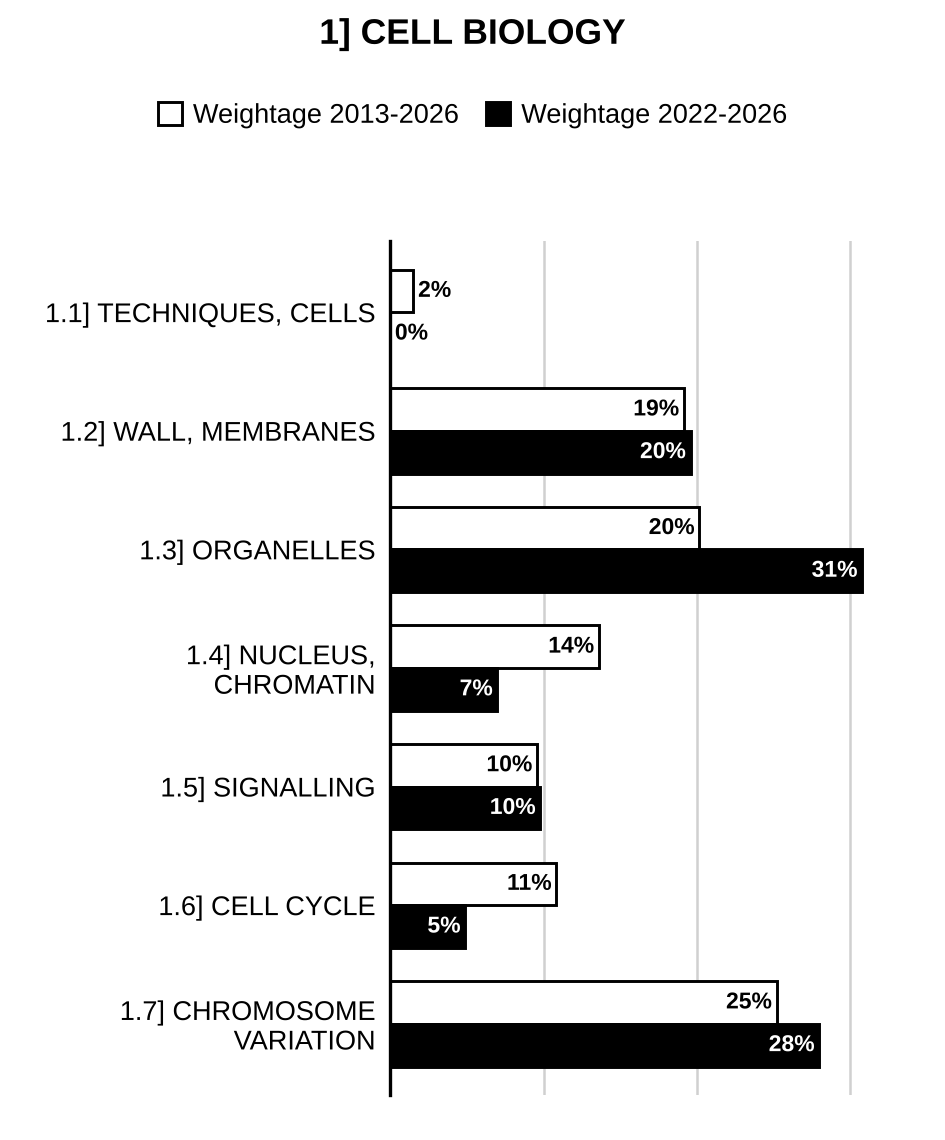
1.1] Cell biology techniques and cell structure
3 questions
Distinguish between prokaryotic and eukaryotic cell. [2015/15m/2a]
With the help of a diagram, throw light on the organization of a cell. [1998/20m/200w/1a]
Describe the sub-microscopic structure of a living plant cell. How does it differ from a prokaryotic cell? [1996/20m/200w/1a]
1.2] Cell wall and membranes
23 questions
Explain the different means of passive transport across the plasma membrane. [2026/15m/3b]
Cell-cell adhesion mechanism. [2023/10m/150w/1a]
Describe the mechanism involved in membrane transport and vesicular transport. [2023/15m/3b]
Cell wall in plants. [2022/10m/150w/1d]
Discuss the different processes by which solute moves across cell membrane. [2022/20m/2a]
Cell adhesion molecules. [2021/10m/1a]
Explain, with required diagrams, the chemical structure and function of primary cell wall and plasma membrane. [2019/10m/1e]
Discuss briefly the general principles of cellular adhesion. Give a note on identification and characterization of adhesion receptors. [2019/20m/3a]
Describe the structure and function of Plasmodesmata. [2018/15m/4c]
Differentiate between primary active transport and secondary active transport. [2017/20m/8a]
Extrinsic and Intrinsic proteins. [2015/10m/1b]
Describe in detail the formation, structure and chemical composition of glycocalyx. [2013/20m/2a]
Describe various sub types of the most abundant biological molecule present in plants. [2013/15m/6b]
Briefly explain the different pathways taken by secreted proteins. [2012/12m/1c]
Distinguish between passive and facilitated diffusion. [2012/12m/5e]
Distinguish between:
(i) Smooth and rough ER [2010/10m/2b(i)]
(ii) Ribosomes and Peroxisomes [2010/10m/2b(ii)]
(iii) Membrane proteins in ion transport. [2010/10m/2b(iii)]
Distinguish between channels and carrier proteins and their roles in regulating membrane transport. [2009/30m/2a]
Structure of plasma membrane. [2006/20m/200w/1a]
Describe in detail the physical properties of cell membrane. [2003/30m/2a]
How does the water and solutes move through the cell membrane? [2003/30m/2b]
Describe the extra cellular matrix of a plant cell. What is the relationship of plasmodesmata to the extracellular matrix? [2002/60m/2]
With suitable diagrams, critically examine the various models of membranes systems in eukaryotic cells and state which one is the most suitable to explain the E.M. structure and functions of the system. [2001/20m/200w/1a]
Biological membranes. [2000/20m/200w/1a]
1.3] Cell organelles and cytoskeleton
27 questions
Write in detail the chemical composition of microtubules. [2026/10m/3a(i)]
Elaborate the functions of cytoplasmic microtubules. [2026/10m/3a(ii)]
Lysosome. [2025/10m/150w/1e]
Describe the structure of chloroplast with labelled diagram and write about its functions. [2025/15m/4b]
Describe along with illustrated diagrams the structure and function of mitochondria and endoplasmic reticulum. [2024/15m/3a]
Structure and functions of cytoskeleton. [2023/10m/150w/1b]
Describe the structure, kinds, chemical nature, origin and functions of lysosomes. [2023/20m/4a]
Semi-autonomous cell organelles. [2022/10m/150w/1a]
Structure and functions of peroxisomes. [2022/10m/150w/1c]
Explain the mode of biogenesis of peroxisomes and discuss their functions. [2020/15m/4a]
Describe the cellular structure and functions of Ribosome and Peroxisome. [2019/10m/4a]
“Organelles bound by membranes in eukaryotic cells have originated from endosymbiosis of prokaryotic cells.” Explain this statement with the help of some suitable diagrams. [2018/10m/1a]
Briefly discuss the cellular function of mitochondria and endoplasmic reticulum with required diagrams. [2018/20m/2a]
Draw a labelled diagram of prokaryotic and eukaryotic chloroplast and describe their functions. [2017/10m/1a]
Mitochondria. [2015/10m/1a]
Describe in detail the structure and chemical composition of ribosomes. [2014/15m/4c]
Compare the different types of RNA and protein components found in the ribosomes of prokaryotes and eukaryotes. [2012/20m/2c]
What are the major functions of cytoskeleton in living cells? [2011/15m/7d]
Origin of mitochondria. [2010/15m/150w/1d]
Distinguish between:
(i) Smooth and rough ER [2010/10m/2b(i)]
(ii) Ribosomes and Peroxisomes [2010/10m/2b(ii)]
(iii) Membrane proteins in ion transport. [2010/10m/2b(iii)]
Structure of mitochondria in relation to function. [2007/20m/200w/1a]
Describe in detail the ultrastructure of Golgi Complex and its function in membrane trafficking. [2005/60m/2]
Describe in detail the structure and functions of mitochondria. [2004/60m/2]
Give a diagrammatic representation of the structure and functions of organelles in eukaryotic cells. [2000/60m/2]
Mitochondria as “powerhouse” of the cell. [1998/20m/200w/1b]
What is the role of Golgi complex in a cell? Describe how Golgi complex is structurally and functionally interconnected with endoplasmic reticulum. [1997/20m/200w/1a]
With the help of a diagram explain the ultra structure of the mitochondrion. [1995/20m/200w/1a]

Preparing for Prelims too?
Our UPSC Prelims Topic-wise PYQ eBook covers every Prelims question with detailed explanations, so you can see exactly where UPSC asks from.
View the BookDownload Free Sample1.4] Nucleus and chromatin
14 questions
Nuclear pore complex. [2025/10m/150w/1a]
Describe the structure of nucleosome and its role in DNA packaging. [2025/15m/3b]
Ribosomal RNA processing in nucleolus. [2021/10m/1b]
Describe types and composition of chromatin. How is DNA packaged in a eukaryotic cell? [2021/20m/2a]
Nuclear pore complex and its functions. [2020/10m/1b]
Discuss the role of Histone in regulating chromatin structure with special emphasis on Histone N-terminal tails as well as nucleosome assembly. [2019/20m/2b]
What is the significance of chromatin organization and packaging in genome? [2017/15m/2b]
C-value paradox. [2016/10m/1d]
Describe the basic structure of a nucleosome. [2016/15m/2b]
Giving reasons explain the consequences of:– Removal of histone from a cell. [2013/10m/1d]
Describe briefly, how RNA molecule transports within the eukaryotic cell. [2011/15m/8c]
Distinguish between Heterochromatin and Euchromatin. [2009/30m/2b]
Euchromatin and Heterochromatin. [1999/15m/3c]
Discuss the chemical organization of a chromosome. [1997/30m/3b]
1.5] Cell signalling
11 questions
Cell signalling and Cell receptors. [2026/10m/150w/1d]
Discuss what are cell receptors and how do they help in cell signalling? Elaborate the answer with the help of at least one example. [2024/10m/150w/1c]
What do you mean by signal transduction? Explain the different types of intracellular signal transduction. [2022/15m/4c]
Explain the process of cell signalling highlighting the role of various signalling molecules. [2021/15m/4c]
Discuss major steps in signal transduction. [2020/15m/2a]
Explain the mechanism of cell signalling and the role of cell receptors in regulating this process. [2019/10m/1c]
How does the Ins /DAG pathway participate in the process of translocation of cellular signals? [2016/20m/3c]
What is an osmosensor? How does a two-component sensing/signalling system contribute to osmosensing? [2011/15m/6d]
Signal transduction in Prokaryotes. [2010/15m/150w/1a]
Signal Transduction. [2005/20m/200w/1b]
Cellular function of oncoproteins. [1999/20m/200w/1a]
1.6] Cell division and cell cycle
14 questions
Synaptonemal complex. [2025/10m/150w/1c]
Explain briefly the process and importance of the following:
(i) Male sterility and heterosis breeding. [2024/5m/2a(i)]
(ii) Molecular basis of cell cycle. [2024/5m/2a(ii)]
(iii) Gene silencing. [2024/5m/2a(iii)]
“Cell cycle is an ordered series of events leading to cell replication.” Discuss. [2020/20m/4c]
Discuss the role of cyclin-dependent protein kinases in controlling the cell cycle. Explain with the help of a diagram. [2018/20m/3a]
Molecular basis of cell cycle. [2017/10m/1d]
What do you understand by the ‘cell cycle’? Mention the important proteins that control the cell cycle. [2014/20m/3b]
Giving reasons explain the consequences of:– Exposing dividing cells to CdkI. [2013/10m/1e]
Pachytene. [2013/10m/4a]
Explain the role of cdk and cyclin proteins in the regulation of cell cycle. [2012/15m/3a]
Describe the molecular basis of cell cycle. [2007/30m/2a]
Meiosis. [2004/20m/200w/1a]
Cell cycle. [1999/20m/7b]
Explain why do you expect differences among cells arising from meiosis and not among those from mitosis. [1998/60m/2]
In genetic language both divisions of meiosis are partly reductional and partly equational – Explain. [1996/60m/2]
1.7] Chromosome variation and special chromosomes
30 questions
Lampbrush chromosome and its significance. [2026/10m/150w/1b]
Explain the structural variations of chromosomes and their significance. [2026/15m/2b]
Amphidiploidy. [2025/10m/150w/1d]
Explain the structure and behaviour of B chromosomes in plants. [2025/15m/2c]
Explain the types of variations found in the structure of chromosomes and discuss their importance and significance. [2024/10m/150w/1a]
Discuss briefly the following and comment on their significance:
(i) In what way the transfer of genes in plants help in their sustainable development? Support the answer with an example. [2024/10m/4a(i)]
(ii) Importance of biosafety aspects of transgenic crops. [2024/5m/4a(ii)]
(iii) Polytene chromosomes. [2024/5m/4a(iii)]
Differentiate between polytene chromosomes and normal chromosomes. [2023/15m/2a]
What are B-chromosomes? Describe their significance. [2022/15m/2b]
Genetic consequences of Inversion. [2021/10m/1c]
Structure and behaviour of B-chromosomes. [2020/10m/1c]
Explain the importance of numerical and structural variations in chromosomes with respect to crop varieties. [2017/20m/2a]
Polyteny differs from polyploidy. [2016/10m/1a]
“The consequences of translocations are profound. They lead not only to a change in gene linkage in the translocated sections but also to easily incurred meiotic abnormalities.” Discuss. [2016/15m/2c]
Describe the structure, behaviour and significance of special types of chromosomes. [2015/15m/3a]
Describe the numerical variation in chromosomes. [2015/15m/4a]
Why do chromosomal aberrations happen? [2014/15m/2a]
Briefly describe the various types of chromosomal aberrations. [2014/20m/4a]
Giving reasons explain the consequences of:– Exposing polytene chromosomes to actinomycin. [2013/10m/1a]
Giving reasons explain the consequences of:– Illegitimate crossing over between a normal and an accessory chromosome. [2013/10m/1b]
Balanced lethal system. [2013/10m/4c]
What do you mean by aneuploidy and what kinds of chromosomal variations are found in aneuploid plants? [2012/20m/2a]
Distinguish between monoploid and haploid and their role in evolution. [2011/15m/4b]
Explain the structure and significance of lampbrush and B-chromosomes. [2007/30m/4b]
Polytene chromosomes. [2006/20m/200w/1b]
Polytene Chromosome. [2005/20m/200w/1a]
Structure and Significance of Lampbrush Chromosomes. [2003/20m/200w/1d]
B-Chromosomes. [2000/20m/200w/5c]
What is polyploidy? How would you differentiate between different kinds of polyploidy? [1998/60m/3]
Write an account of polyploidy and its role in evolution. [1997/30m/3a]
Describe the structural variations in chromosomes. [1995/20m/200w/1c]

Strengthen your GS papers
Our UPSC Mains Topic-wise & Year-wise PYQ eBook (2013–2026) maps every GS question to the syllabus, so you know what UPSC asks and how often.
View the BookDownload Free Sample« Previous: Morphogenesis | Next: Genetics, Molecular Biology and Evolution »
Back to: Botany Optional PYQs – Topic-wise | Also see: Botany Optional year-wise question papers
Last updated: 31 October 2026