
Here are all 40 Instrumentation Methods questions asked in UPSC Zoology Optional Paper I from 2004 to 2026, arranged under the 3 topics of the official syllabus. Within each topic the latest questions come first.
Each question ends with a code such as [2024/15m/3b] – the year, the marks, the word limit (where UPSC set one) and the question number in the paper.
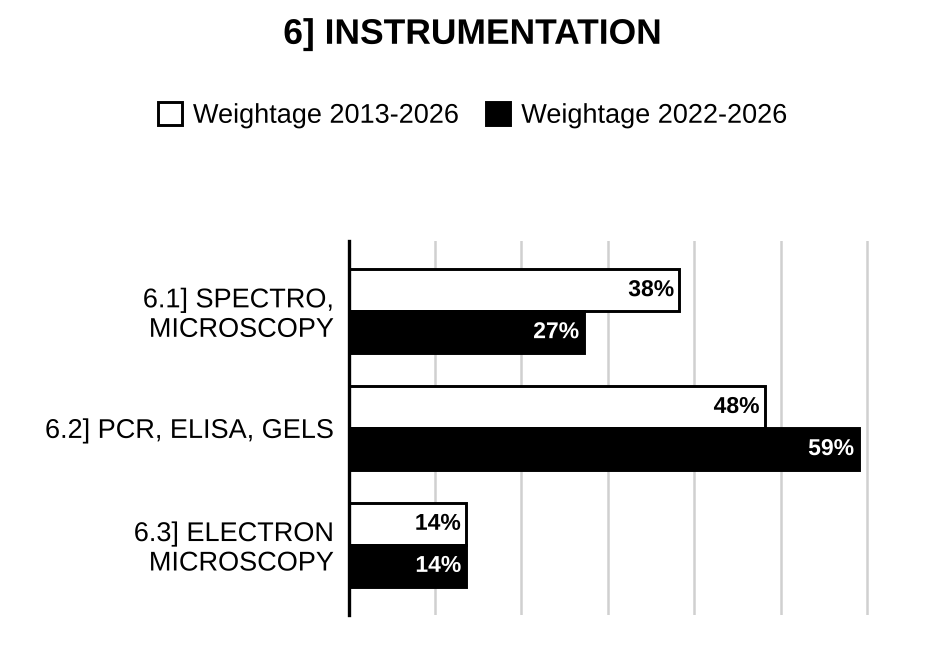
6.1] Spectrophotometry, microscopy and tracers
16 questions
Explain the principle, instrumentation and applications of fluorescence microscope. [2025/15m/7b]
Explain the principle, instrumentation and applications of UV-Visible Spectrophotometer. [2024/15m/7b]
Explain the principle of spectrophotometer and describe its following components: (i) Radiation sources (ii) Phototube (iii) Prism. [2020/15m/6c]
Ultracentrifuge. [2019/10m/150w/5e]
Write about phase contrast and fluorescence microscopy with notes on their principles and applications in Zoology. [2017/15m/6c]
Explain the principle, types and applications of ultracentrifuge. [2017/15m/7c]
Write the principle, working and uses of spectrophotometer. [2016/10m/150w/5b]
Differentiate between the Phase Contrast and Fluorescent Microscopy. [2014/10m/150w/5e]
Describe the principle, structure and function of Liquid scintillation counter and mention its application. [2014/15m/7c]
While using a compound microscope, how will you know how much you are magnifying an object? Through a diagram show the relative working distance under low and high powers. [2013/10m/150w/5a]
What is the principle of spectrophotometry? Discuss the details of instrumentation and application of spectrophotometer. Comment upon the common feature of spectrophotometric assay and ELISA, if any. [2013/25m/8a]
Discuss the theoretical basis of spectrophotometry with reference to the Beer-Lambert law. Write an account of the instrumentation, maintenance and application of spectrophotometer. [2011/30m/8b]
Radioactive Tracers. [2009/20m/200w/5c]
Describe the principle and working of Geiger-Muller counter and its use in Biology. [2006/30m/8b]
what is Lambert-Beer’s Law? Discuss the construction of spectrophotometer. Add a note on the applications of UV-visible spectrophotometry in biological studies. [2005/30m/8a]
Describe the principle and working of a flame photometer. [2004/30m/8b]

Preparing for Prelims too?
Our UPSC Prelims Topic-wise PYQ eBook covers every Prelims question with detailed explanations, so you can see exactly where UPSC asks from.
View the BookDownload Free Sample6.2] Molecular techniques
18 questions
Principle and applications of gel electrophoresis. [2026/10m/150w/5e]
Chromosome Painting. [2024/10m/150w/5d]
What is ELISA? Explain the principle, types, procedure and applications of ELISA. [2023/20m/8a]
Describe principle, working mechanism and applications of gel electrophoresis. [2022/10m/150w/5c]
Write principle, working mechanism and uses of PCR. [2022/15m/7c]
FISH. [2021/10m/150w/5b]
Describe the principle and applications of polymerase chain reaction (PCR). [2021/15m/7b]
Describe chromosome painting and its versatility in modern diagnostics. [2020/15m/7c]
Describe the principle and applications of gel electrophoresis. [2020/15m/8b]
Explain the principle and procedure of “ELISA”. Give a note on its application. [2019/15m/7c]
PCR. [2018/10m/150w/5e]
Describe ‘FISH: Principle, Procedure and Applications’. [2017/10m/150w/5a]
What is ELISA (enzyme linked immunosorbent assay)? Write its principle and procedure. Add a note on its applications. [2016/15m/8c]
Electrophoresis is a valuable tool in resolving cryptic-species complexes. Discuss. [2015/10m/150w/5e]
What is chromosome painting? Comment on its principles and scope. [2015/15m/7a]
What is PCR? Give an illustrated account of various steps of this technique in DNA amplification. [2012/15m/8b]
Gel Electrophoresis. [2009/20m/200w/5b]
Southern blotting technique and Western blotting technique. [2004/20m/200w/1b]
6.3] Electron microscopy
6 questions
Write the principle, working and applications of Transmission Electron Microscope (TEM). [2026/15m/8c]
Differentiate between SEM and TEM. [2021/15m/8c]
TEM. [2020/10m/150w/5e]
What is resolution of a microscope? Comment on the principles of SEM and TEM. Describe the structure, working and applications of any one of the electron microscope in biology. [2018/15m/7c]
What is EM? Mention different types of EM. Describe the structure and function of TEM. Mention its applications in biology. [2010/20m/200w/5d]
what is electron microscopy? Mention different types of electron microscopes and their use in biology. [2007/30m/8b]

Strengthen your GS papers
Our UPSC Mains Topic-wise & Year-wise PYQ eBook (2013–2026) maps every GS question to the syllabus, so you know what UPSC asks and how often.
View the BookDownload Free Sample« Previous: Biostatistics | Next: Cell Biology »
Back to: Zoology Optional PYQs – Topic-wise | Also see: Zoology Optional year-wise question papers
Last updated: 31 October 2026