
Here are all 32 Biostatistics questions asked in UPSC Zoology Optional Paper I from 2004 to 2026, arranged under the 2 topics of the official syllabus. Within each topic the latest questions come first.
Each question ends with a code such as [2024/15m/3b] – the year, the marks, the word limit (where UPSC set one) and the question number in the paper.
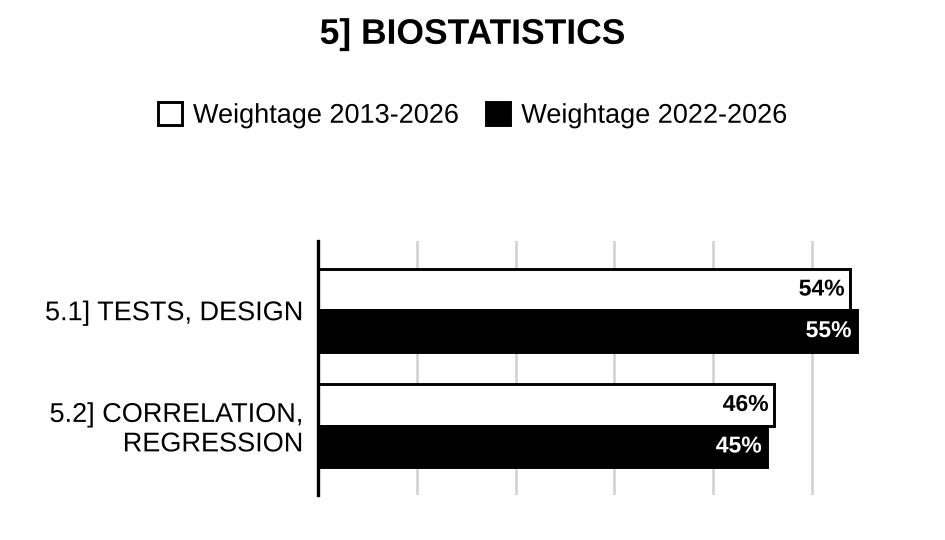
5.1] Experimental design and hypothesis testing
20 questions
Null hypothesis. [2026/10m/150w/5d]
Describe one-way and two-way F-test and its significance in biological research. [2026/15m/6b]
What is Student’s t-test and its significance in biological research? Write the formula of t-test and its various steps using simple data. [2025/20m/7a]
What is Chi-square analysis? Explain its applications in biology. [2022/15m/6c]
Describe the differences between f-test and t-test. [2020/20m/8a]
What is ANOVA? Differentiate between One-way and Two-way ANOVA. Comment on its application in Biostatistics. [2019/15m/8b]
What is Chi-square test? Give a detailed account of the computation of Chi-square for tests of independence, homogeneity and goodness of fit using biological data. [2018/15m/8b]
What is meant by biostatistics? Explain the role of correlation, regression and ANOVA in data analysis in Zoology. [2017/20m/7a]
Differentiate between one-way and two-way analysis of variance (ANOVA). Comment on its applications in biostatistics. [2015/10m/150w/5d]
Give an account of “Analysis of variance” and mention its significance. [2014/10m/150w/5c]
How is the degree of freedom calculated in a chi-square analysis? Use a graph to convert -values to p-values. [2012/12m/150w/5d]
With suitable example(s), enumerate the method for conducting one-way and two-way F-tests. [2012/15m/8a]
What is chi-square () test? Add a detailed account on the computation of chi-square for tests of independence, homogeneity and goodness of fit, using biological data. [2011/30m/7a]
What is student ‘t’ test? Explain the application with example. [2010/30m/7a]
Chi-Square and its importance. [2007/20m/200w/5d]
Null hypothesis. [2006/20m/200w/5d]
what is Student t-test? Explain its application with examples. [2006/30m/8a]
How an experiment is designed? Discuss Null Hypothesis. [2005/20m/200w/5d]
Designing of experiments and its importance. [2004/20m/200w/5d]
Explain the ‘F’ test. How is the one way F-test applied? [2004/30m/8a]

Preparing for Prelims too?
Our UPSC Prelims Topic-wise PYQ eBook covers every Prelims question with detailed explanations, so you can see exactly where UPSC asks from.
View the BookDownload Free Sample5.2] Descriptive statistics, correlation and regression
12 questions
Describe the various measures of central tendency of data with suitable examples and discuss their merits and demerits. [2024/20m/8a]
Define regression. Explain different methods and applications of regression analysis. [2023/20m/6a]
Comment on ‘measures of central tendency of data’. [2022/10m/150w/5b]
Define correlation. Explain its types and methods of computing coefficient of correlation. [2021/20m/6a]
What is meant by biostatistics? Explain the role of correlation, regression and ANOVA in data analysis in Zoology. [2017/20m/7a]
What is correlation? Explain its various types and methods of calculating correlation analysis. [2016/10m/150w/5e]
Describe the measures of central tendency and measures of dispersion. What is their use in biology? [2016/15m/8b]
Give an account on “correlation analysis”, its application and significance. [2014/15m/7b]
Discuss with suitable examples the importance of the measure of central tendency and dispersion. [2011/15m/150w/5d]
Biological examples of Regression Analysis. [2009/20m/200w/5a]
What is mean, median and mode? Explain the relationship between these three measures of central tendency. [2007/30m/8a]
Differentiate between correlation and regression. Discuss the methods used to study correlation. Add a note on the coefficient of correlation. [2005/30m/8b]

Strengthen your GS papers
Our UPSC Mains Topic-wise & Year-wise PYQ eBook (2013–2026) maps every GS question to the syllabus, so you know what UPSC asks and how often.
View the BookDownload Free Sample« Previous: Economic Zoology | Next: Instrumentation Methods »
Back to: Zoology Optional PYQs – Topic-wise | Also see: Zoology Optional year-wise question papers
Last updated: 31 October 2026