
Here are all 61 Economic Zoology questions asked in UPSC Zoology Optional Paper I from 2004 to 2026, arranged under the 7 topics of the official syllabus. Within each topic the latest questions come first.
Each question ends with a code such as [2024/15m/3b] – the year, the marks, the word limit (where UPSC set one) and the question number in the paper.
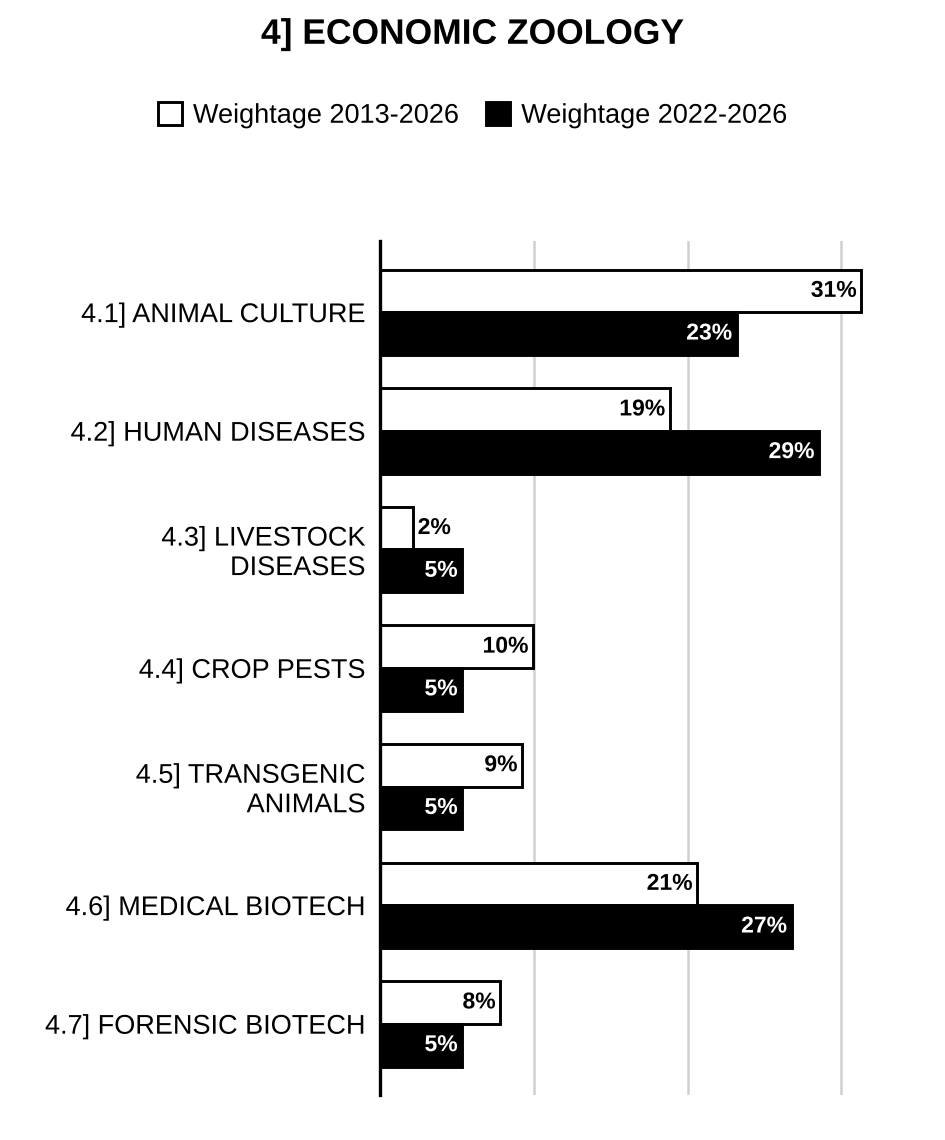
4.1] Animal culture
20 questions
What is sericulture? Describe rearing of mulberry silk worm. Add a note on types of silk cultured in India. [2026/15m/6c]
Describe the different species suitable for prawn culture with emphasis on the methods of prawn cultivation. [2025/15m/7c]
What are the major carps of India? Describe the polyculture methods of rearing the major carps. [2024/15m/6c]
What is lac culture? Explain the life cycle of lac insect and describe cultivation and processing of lac in India. Also add a note on its economic importance. [2023/20m/7a]
Vermiculture. [2021/10m/150w/5a]
What is apiculture? Describe the various methods of beekeeping and also add a note on the uses of honey. [2021/15m/8b]
Describe the names of any four diseases of silkworm and their causal agents (scientific names), sources of infection, symptoms and management. [2020/20m/7a]
Through a labelled diagram show the stages of life history of Mulberry silk worm. Explain various aspects of rearing techniques in sericulture and add a note on different diseases of silk worm. [2019/20m/7a]
What is “Lac-culture”? Explain the methodology employed in lac-culture. Also describe the uses of lac. [2018/15m/7b]
How is ‘Composite Carp Culture’ advantageous over ‘Traditional Carp Culture’? [2017/10m/150w/5d]
What is meant by Vermiculture? Enlist various species suitable for vermiculture. Also explain techniques and importance of vermicomposting. [2016/15m/6c]
Discuss the status and scope of prawn culture in India. Mention commercially viable and cultivable species of fresh water and brackish water prawns. [2015/15m/8b]
How are pearls cultured? Describe the economic importance of Pearl Culture. [2014/10m/150w/5d]
Describe the principal steps in Apiculture and add a note on various aspects of its rearing techniques. [2014/15m/8c]
Through a labelled diagram, show the stages of life-history of Bombyx mori. [2013/10m/150w/5e]
Delineate the principal steps in initiating sericulture. Add a note on various aspects of rearing techniques to get quality product in sericulture. [2012/20m/6c]
What is Lac culture? What are the uses of lac? Explain the methodology employed in lac culture. Discuss its present scenario in India. [2010/20m/200w/5c]
What is sericulture? Describe the tools and materials required for it. Mention different types of silk moth and varieties of silk common in India. [2007/60m/7]
Apiculture and its economic importance. [2006/20m/200w/5c]
What are the various species of silkworm? Describe the life history of mulberry silkworm. Add a note on the requirements for sericulture industry. [2005/60m/7]
4.2] Human infectious diseases
12 questions
What do you mean by infectious and communicable diseases? Mention the causative agent and means of spread of filaria. Also describe the symptoms, diagnosis, treatment and preventive measures of filaria. [2025/20m/8a]
AIDS. [2024/10m/150w/5c]
Mention the causative agent and means of spread of malaria. Also describe symptoms, diagnosis, treatment and preventive measures of malaria. [2024/20m/7a]
Pathogenesis of cholera. [2023/10m/150w/5c]
Mention the causative agent and means of spread of tuberculosis. Also describe symptoms, diagnosis, treatment and preventive measures of tuberculosis. [2022/20m/8a]
Elephantiasis. [2019/10m/150w/5d]
Describe the structure of the pathogen responsible for AIDS. How it is transmitted? Also mention the pathogenesis and prevention of AIDS. [2018/15m/8c]
Give an elaborate account on AIDS. [2014/15m/6b]
What is filariasis? Discuss the structure and life-history of filarial worm. Highlight its pathogenic aspects and preventive measures. [2013/25m/7b]
Write the clinical manifestations, mode of infection, diagnosis and treatment for tuberculosis. [2010/20m/6c]
Malaria: its vector, pathogen and prevention. [2007/20m/200w/5c]
Discuss the vector, pathogen, treatment and prevention of Malaria. [2005/20m/200w/5c]
4.3] Livestock diseases
2 questions
Describe the symptoms, diagnosis, treatment and preventive measures of livestock diseases. [2023/15m/8b]
Identify and write the characteristics of ectoparasites of cattles. Describe the symptoms of their infection and ways to treat them. [2012/20m/7b]

Preparing for Prelims too?
Our UPSC Prelims Topic-wise PYQ eBook covers every Prelims question with detailed explanations, so you can see exactly where UPSC asks from.
View the BookDownload Free Sample4.4] Crop pests
6 questions
Write the systematic position of an oilseed pest. Give an account of its life cycle and the damage caused by this pest. Write a note on its control measures. [2024/15m/8c]
Write scientific names of any three pests of stored grains and describe the nature of damage and management of Sitophilus oryzae. [2020/15m/8c]
Write the systemic position of a sugarcane pest. Give an account of its life-cycle and the damage caused by this pest. Write a note on its control measures. [2019/15m/6c]
What is the systemic position of rice pest? Give an account of its life cycle and the damage caused by this pest. Write a note on the measure for its prevention and control. [2018/15m/6c]
Define a pest. Describe the life cycle of Pyrilla perpusiella. Add notes on the damage caused by it and its control measures. [2016/10m/150w/5c]
Pest of rice, Stilohphilus oryzae and its control. [2004/20m/200w/5c]
4.5] Transgenic animals
5 questions
What are transgenic animals? Mention their applications in applied fields. [2026/15m/7c]
What is transgenesis? Describe the methods and applications of transgenesis in animals. [2021/20m/7a]
Transgenic animals. [2020/10m/150w/5d]
What are transgenic animals? How are they produced? Explain their contributions to human welfare. Comment on ethical concerns in relation to transgenesis. [2015/20m/8c]
What are transgenic animals? Describe their importance in research. [2009/30m/6b]
4.6] Medical biotechnology
10 questions
Gene therapy and its significance. [2026/10m/150w/5c]
Explain the following human genetic diseases: (i) Haemophilia (ii) Thalassemia. [2026/20m/8a]
Sickle cell anaemia. [2025/10m/150w/5c]
Amniocentesis. [2023/10m/150w/5d]
Klinefelter’s syndrome and Turner’s syndrome in humans. [2022/10m/150w/5e]
What is gene therapy? Citing suitable examples explain germline and types of somatic cell gene therapy. [2022/15m/8c]
Discuss the concept and importance of genetic counselling and gene therapy. [2017/15m/6b]
What is medical biotechnology? Discuss its role in human welfare. [2016/15m/7c]
What is Euphenics? Explain its use for improvement of human welfare. [2015/15m/8a]
Name four human genetic diseases. Give an account of human genome research and its applications. [2013/25m/8b]
4.7] Forensic biotechnology
6 questions
What is DNA fingerprinting? Explain the mechanism and applications of DNA fingerprinting in forensic science. [2025/15m/6c]
What are the uses of Biotechnology in Forensic science? [2020/20m/6a]
‘Biotechnology is a vital tool in modern forensic science’. Comment. [2015/10m/150w/5c]
What is forensic biotechnology? Discuss its significance. [2013/10m/150w/5c]
Discuss the role of biotechnology in forensic science giving suitable examples. [2012/20m/7a]
Forensic biotechnology and its applications. [2009/30m/8b]

Strengthen your GS papers
Our UPSC Mains Topic-wise & Year-wise PYQ eBook (2013–2026) maps every GS question to the syllabus, so you know what UPSC asks and how often.
View the BookDownload Free Sample« Previous: Ethology | Next: Biostatistics »
Back to: Zoology Optional PYQs – Topic-wise | Also see: Zoology Optional year-wise question papers
Last updated: 31 October 2026