
Here are all 62 Ethology questions asked in UPSC Zoology Optional Paper I from 2004 to 2026, arranged under the 4 topics of the official syllabus. Within each topic the latest questions come first.
Each question ends with a code such as [2024/15m/3b] – the year, the marks, the word limit (where UPSC set one) and the question number in the paper.
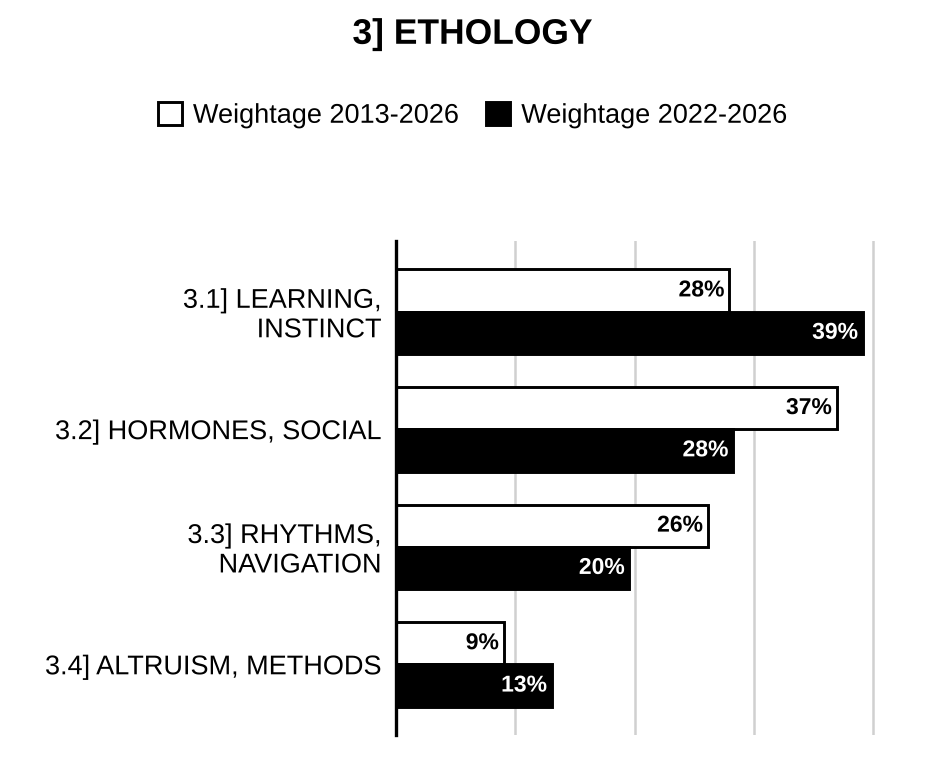
3.1] Behaviour and learning
20 questions
Sign stimuli in animals and their significance. [2026/10m/150w/5b]
Describe instinctive behaviour and learned behaviour in animals taking suitable examples. [2026/15m/7b]
How do animals perceive mechanical and olfactory stimuli from the environment? Explain. [2024/15m/7c]
Instinct behaviour in animals. [2023/10m/150w/5b]
Define imprinting. Describe the mechanism of imprinting in animals with suitable examples. [2023/15m/7c]
‘Conditioned learning’ in animals. [2022/10m/150w/5d]
Describe two basic laws of learning. Explain habituation, trial and error learning and latent learning in animals. [2022/15m/7b]
Explain the process of learning and memory in animals with suitable example. [2021/15m/7c]
Habituation and Conditioning. [2018/10m/150w/5d]
With the help of suitable examples explain conditioning and imprinting in animals. [2016/20m/8a]
What do you understand about conditioning? Explain with relevant examples. [2014/10m/150w/5b]
Define ‘insight’. Explain this behaviour using the example of Chimpanzees. [2013/10m/150w/5b]
Differentiate between conditioning and habituation with suitable examples from primates and rodents. [2012/20m/6a]
Define memory, and discuss how short- and long-term memory are stored. [2011/30m/6b]
What is meant by ‘sign-stimulus’? Mention various types of sign-stimuli and discuss with examples. [2010/20m/200w/5b]
What is imprinting? Discuss salient features and significance of this phenomenon in animals. [2010/30m/8a]
Instinct and Learning. [2009/20m/200w/5d]
Concept of imprinting. [2007/20m/200w/5b]
Describe Pavlov’s experiments on conditioning and learning in animals. [2005/20m/200w/5b]
What is understood by the learning and innate behaviors? Give an account of various methods of studying animal behavior. [2004/60m/7]
3.2] Hormones, pheromones and social behaviour
20 questions
Define pheromones. Discuss the role of pheromones in alarm spreading in animals with suitable examples. [2025/15m/6b]
Explain Aggressive and Territorial behaviour in animals, with suitable examples. [2024/15m/6b]
Define crypsis. Explain the types and mechanism of crypsis in animals with suitable examples. [2023/15m/8c]
Describe various types of social groupings in primates. Write a note on importance of social grouping. [2022/20m/6a]
What are pheromones? Discuss their role in insects. [2021/15m/6c]
Describe the characteristics of social insects with examples. [2020/15m/7b]
Pheromones in alarm spreading. [2019/10m/150w/5c]
Describe different types of social hierarchies in primates. [2019/15m/8c]
What is eusocialism? Describe this phenomenon with reference to Honey Bees. [2018/15m/6b]
Explain the role of chemical signals in alarm spreading. [2017/10m/150w/5e]
Mention the advantages of social living. Describe different types of social hierarchies in primates. [2017/20m/6a]
Explain the role of pheromones in alarm spreading. [2015/10m/150w/5b]
Discuss social hierarchies in Primates. [2015/15m/6a]
Describe the Predator-Prey relationship with suitable examples. [2014/15m/6c]
Differentiate between pheromones and hormones. How do they help in communication and behaviour? [2012/12m/150w/1c]
What is crypsis? Discuss the significance of crypsis in different animals. [2011/15m/150w/5c]
Discuss the effect of hormones on sexual, aggressive and maternal behaviour. [2011/30m/7b]
Social hierarchies in Primates. [2009/20m/200w/7a]
Pheromones. [2005/20m/5c]
Pheromones and their role in alarm signaling. [2004/20m/200w/5b]

Preparing for Prelims too?
Our UPSC Prelims Topic-wise PYQ eBook covers every Prelims question with detailed explanations, so you can see exactly where UPSC asks from.
View the BookDownload Free Sample3.3] Orientation and biological rhythms
15 questions
Explain various biological rhythms with the help of suitable examples. [2026/15m/8b]
Navigation in birds. [2025/10m/150w/5b]
Circadian rhythms. [2025/10m/150w/5d]
Biological Rhythms. [2024/10m/150w/5b]
Biological clock. [2021/10m/150w/5c]
Give an account of biological rhythms. [2020/10m/150w/5b]
Explain orientation and navigation with examples in different animals. Add a note on Homing behaviour. [2019/15m/6b]
What is biological rhythm? Give an account of its types and characteristics. What is the role of different factors in their entrainment? [2018/20m/8a]
Give an account of biological rhythms and discuss the mechanism of their regulation. [2016/15m/6b]
Give an account of Orientation, Navigation and Homing behaviour in animals with suitable examples. [2014/20m/8a]
What is circadian and circannual rhythm? Discuss briefly the influence of exogenous cycles on these rhythms. [2013/10m/150w/1b]
What is biological clock and how does it function? Discuss the role of intrinsic and extrinsic factors in its entrainment. [2012/20m/6b]
How do animals navigate in the dark? Use owl and chiropterans as examples, and highlight the features of their navigational sensory equipment. [2012/20m/7c]
Navigation in birds. [2009/30m/8a]
Give a detailed account of Biological rhythms and Biological clock. [2006/60m/7]
3.4] Methods and evolution of behaviour
7 questions
Describe the phenomenon of sexual conflict and selfishness in studying animal behaviour with suitable examples. [2025/15m/8c]
Describe the phenomenon of altruism and kinship in studying animal behaviour with suitable examples. [2023/15m/6c]
Describe kinship and altruistic behavior in animals. [2016/10m/150w/5d]
Describe the method of studying animal behaviour using T-maze. [2013/10m/150w/5d]
Comment upon “sexual conflicts” in animals. [2010/30m/8b]
Methods of studying animal behavior. [2006/20m/200w/5b]
What is understood by the learning and innate behaviors? Give an account of various methods of studying animal behavior. [2004/60m/7]

Strengthen your GS papers
Our UPSC Mains Topic-wise & Year-wise PYQ eBook (2013–2026) maps every GS question to the syllabus, so you know what UPSC asks and how often.
View the BookDownload Free Sample« Previous: Ecology | Next: Economic Zoology »
Back to: Zoology Optional PYQs – Topic-wise | Also see: Zoology Optional year-wise question papers
Last updated: 31 October 2026