
Here are all 455 Reaction Mechanisms questions asked in UPSC Chemistry Optional Paper II from 2000 to 2026, arranged under the 8 topics of the official syllabus. Within each topic the latest questions come first.
Each question ends with a code such as [2024/15m/3b] – the year, the marks, the word limit (where UPSC set one) and the question number in the paper.
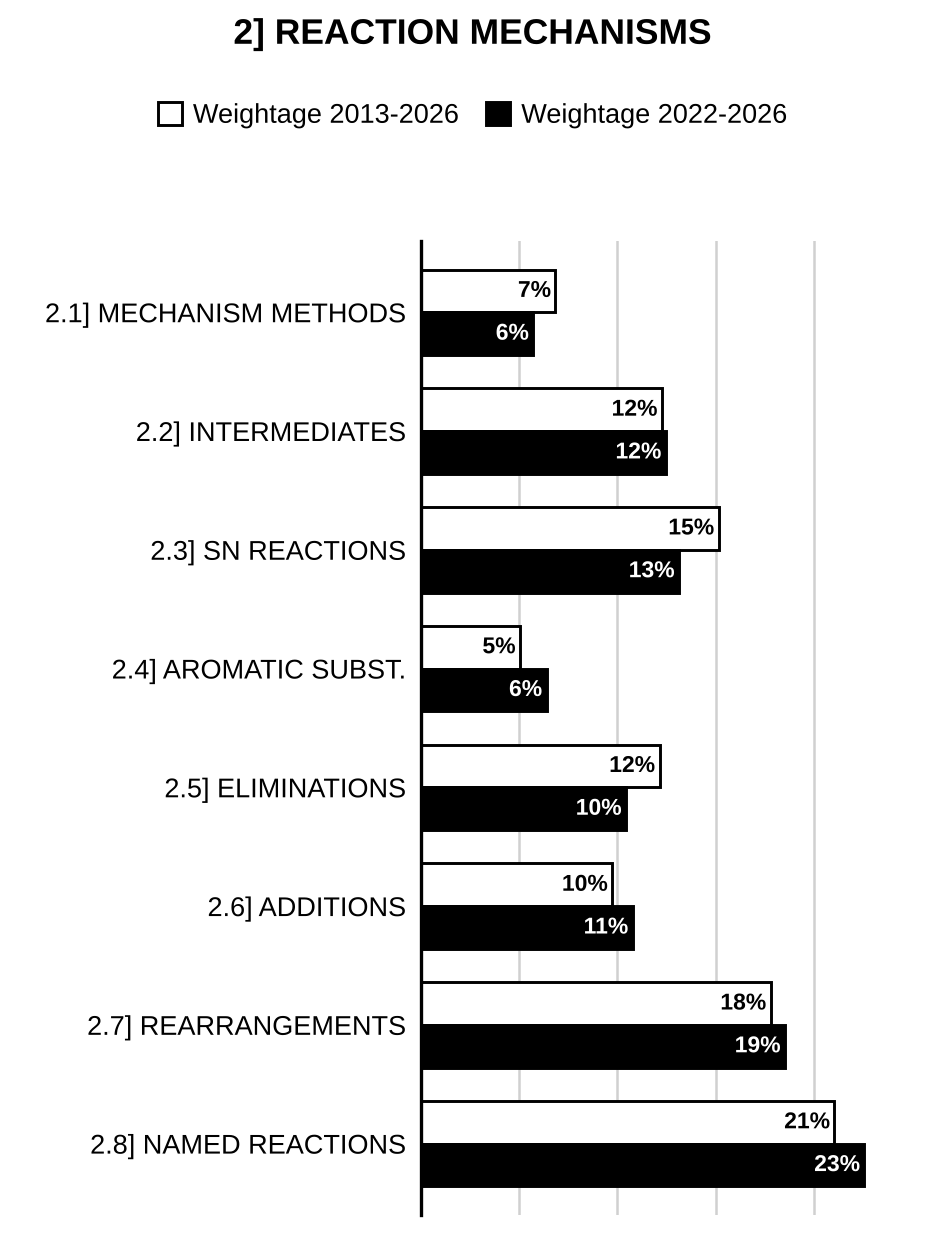
2.1] Methods of study of mechanisms
26 questions
The following reaction gives two products X and Y: X + Y.
[Figure: X: Ph(Cl)C=CH(CH3) with Cl and H on the same side (Cl top-left, Ph bottom-left; H top-right, CH3 bottom-right). Y: Ph(Cl)C=CH(CH3) with Ph and H on the same side (Ph top-left, Cl bottom-left; H top-right, CH3 bottom-right)]
(i) Assign E/Z configuration to the products X and Y. (ii) Between X and Y, identify the kinetic and thermodynamic products. [2026/5m/1d(i)]
(iii) Under the reaction conditions, the kinetic product slowly gets converted to a thermodynamic product, until the equilibrium is reached. Propose a probable mechanism for this conversion. [2026/5m/1d(iii)]
Write the structures of the products formed in the following reactions. Which one of these two reactions would proceed faster? Justify your answer.
[Figure: Reaction 1: bromobenzene –NaNH2, NH3 (l)→ ?; Reaction 2: 2-bromo-1,3-dideuteriobenzene (Br flanked by D on both ortho positions) –NaNH2, NH3 (l)→ ?] [2026/10m/3c(i)]
Identify the major product in the following reactions and justify your answer:
[Figure: Scheme: 1-cyclohexylpropan-1-one (cyclohexyl–CO–CH2CH3) in the middle; to the left –1) LDA/THF; 2) D2O→ Q; to the right –1) Excess NaOH; 2) D2O→ P] [2025/10m/4c(ii)]
Consider the following reactions: It was observed that . Based on this data, predict the mechanism and justify your answer.
[Figure: Reactions: (1) PhCH2–CH2Br (2-phenylethyl bromide, the benzylic CH2 drawn with both H shown) –EtO, Rate = k_H→ styrene PhCH=CH2 (the α-H shown); (2) PhCD2–CH2Br (both benzylic H replaced by D) –EtO, Rate = k_D→ PhCD=CH2 (α-D shown)] [2024/10m/2a(i)]
Consider the following reaction: At –80 °C, 1,2-addition product predominates while at –45 °C, 1,4-addition product prefers. Justify. [2024/5m/2a(ii)]
Consider the following reaction: How would you confirm that the above reaction is intramolecular by crossover experiment?
[Figure: Reaction: allyl phenyl ether (C6H5–O–CH2–CH=CH2) –Δ→ 2-allylphenol (OH and CH2–CH=CH2 ortho to each other)] [2024/10m/4b(i)]
Identify the above reactions that show primary kinetic isotope effect and secondary kinetic isotope effect.
[Figure: (A) ; (B) 4-methoxybenzaldehyde with the aldehyde H labelled H* + HCN → 4-CH3O–C6H4–C(OH)(H*)(CN) (cyanohydrin retaining H*); (C) 9,10-dihydro-9,10-ethanoanthracene with one H on the ethano bridge labelled H* → anthracene + ethylene H2C=CHH* (one H labelled H*); (D) cyclopentyltrimethylammonium (ring carbon bearing , adjacent ring carbon bearing H*) + → cyclopentene + Me3N + H*–OH] [2023/5m/2a(ii)]
Identify (A) and (B) in the above reactions and explain the mechanism.
[Figure: Reaction scheme: butan-2-one (CH3CH2COCH3) in the centre; to the left –NaOMe, MeOH→ (A); to the right –LDA, THF, −78 °C→ (B)] [2023/5m/2a(iii)]
In the reaction What is the origin of –CN group in the product? Explain by using isotopic labelling technique. [2021/10m/1a]
(i) Identify the kinetically favoured product from the reaction given below. Justify your choice of the product:
[Figure: Reaction: 10-methyl-trans-octalin (trans-fused bicyclo[4.4.0]decene: angular CH3 at the upper ring-fusion carbon on a wedged bond, angular H at the lower ring-fusion carbon on a hashed bond; C=C in the left ring on the left edge, i.e. between C2 and C3 counting from the ring fusion) + → choices A–D, each the 2,3-dibromo-10-methyl-trans-decalin with the same angular CH3 (wedged) and H (hashed): A = upper Br wedged, lower Br wedged; B = upper Br hashed, lower Br hashed; C = upper Br hashed, lower Br wedged; D = upper Br wedged, lower Br hashed]
(ii) Write the kinetic as well as thermodynamic product(s) of the reaction of DBr with 1,3-cyclohexadiene. Which product (kinetic or thermodynamic) would be formed more readily at higher temperature? Identify the more stable product and justify your choice of the more stable product. [2020/20m/3c]
Two substitution products result from the reaction of 3-chloro-3-methyl-1-butene with sodium acetate () in acetic acid under conditions. Identify the products. Indicate the thermodynamic product and kinetic product. [2018/10m/5b]
Give the structures of and and account for their formation.
[Figure: Reaction scheme: 2-phenylcyclohexanone (cyclohexanone with C6H5 on the α-carbon) –lithium diisopropylamide (drawn as (iPr)2N–Li), THF, −78°C→ C –MeI→ D (major)] [2017/10m/1d]
Give the structures of to showing the position of the labelled carbon [*] in each.
[Figure: Reaction scheme: allyl 2,6-dimethylphenyl ether (benzene ring with O–CH2–CH=CH2 and Me groups at both ortho positions; the terminal =CH2 carbon of the allyl group is marked *) ⇌(Δ) [E] → [F] → G. From [E] a downward arrow with maleic anhydride beside it leads to [H]; [H] –Δ→ G + maleic anhydride] [2017/10m/2a]
In the sulfonation of naphthalene, discuss the formation of kinetically and thermodynamically controlled products under different conditions with energy level diagram. [2016/15m/2a]
Design a suitable experiment to establish the presence of possible intermediate in the following reaction: Identify the non-isolable intermediate.
[Figure: Reaction: benzenediazonium-2-carboxylate (benzene ring bearing and, ortho to it, ) + cyclopentadiene –Δ→ 1,4-dihydro-1,4-methanonaphthalene (benzonorbornadiene: benzene ring fused to a bicyclo[2.2.1]heptadiene, with a CH2 bridge and a C=C in the other two-carbon bridge)] [2015/10m/1d]
2-methylcyclohexanone gives different enolates under kinetic and thermodynamic conditions. While 2-tetralone gives only one (same) enolate under kinetic and thermodynamic conditions. Predict the structures of enolates in each case and account for the same.
[Figure: 2-methylcyclohexanone (cyclohexanone with CH3 on the α-carbon) and 2-tetralone (3,4-dihydronaphthalen-2(1H)-one: benzene ring fused to a cyclohexanone ring, C=O at C2 so that C1 is a benzylic CH2 between the ring and the carbonyl)] [2015/10m/2a]
Prove the existence of intramolecular mechanism, when allyl phenyl ether on heating yields o-allyl phenol. [2015/10m/4c]
2-Methylcyclohexanone can be converted to two different enolates by appropriate choice of reaction conditions. These on further treatment with methyl iodide can yield 2, 6-dimethylcyclohexanone and 2, 2-dimethylcyclohexanone. Account for the formation of these products. [2014/10m/1b]
The reaction of 1, 3-butadiene with HCl produces a mixture of products. Write those products. Among the products which one is formed preferentially in the early stages of the reaction? What does this indicate? What will happen to the product mixture as a function of time? [2014/15m/2d]
Suggest suitable experiment/technique to establish the following with suitable example: (i) Detection of suspected intermediate (ii) Differentiate between intramolecular and intermolecular mechanisms. [2014/15m/4c]
Explain the difference between kinetic control and thermodynamic control of a reaction with the help of a potential energy diagram. [2007/20m/1b(ii)]
Explain the relative magnitudes of the following pairs of β-deuterium isotope effects (per deuterium) for solvolysis:
[Figure: two vinyl triflates: , ; and (4-nitrophenyl), ] [2006/15m/2a]
Explain the following observations with respect ot yields of products:
[Figure: Two reactions of cyclopropyldiazonium ions with azide ion ( over the arrow). First: cyclopropyl– (label 15 and the + charge on the N bonded to the cyclopropyl ring) → cyclopropyl– (3%) + cyclopropyl–(15)– (the 15 label on the N⁻ bonded to the ring) (97%). Second: cyclopropyl– (+ on the N bonded to the ring, 15 label on the terminal N) → cyclopropyl– (23%) + cyclopropyl–– (the 15 label on the middle N⁺) (77%)] [2005/20m/1c]
The transformation of hydrazobenzene (A) to benzidine (B) in the presence of acids is considered to be an intermolecular rearrangement. How will you verify it by cross-over experiment?
[Figure: (labelled (B) as printed) –→ (4,4′-diaminobiphenyl, benzidine) (B)] [2003/20m/4c]
Following two mechanisms are among those which have been postulated for the decomposition of aryl diazonium salts in aqueous solutions containing nucleophilic anion
[Figure: Mechanism A: transition state in which the ipso carbon carries both and . Mechanism B: ; ]
Indicate how the following method might be applied to distinguish between the two mechanisms: (i) Kinetic studies (ii) Study of rate & product composition as a function of (iii) Solvent isotope studies (iv) Study of isotope effect resulting from substitution of D from H at ortho position (v) Substituent effect studies [2002/20m/2a]
When bromoketone (A) is treated with potassium-t-butoxide in t-butyl alcohol at room temperature it gives B. But when A is treated with LDA in THF at −72°C followed by heating it gives C. Explain why different reaction conditions give different products.
[Figure: A = 1-[2-(3-bromopropyl)cyclopentyl]ethan-1-one (cyclopentane with –C(=O)CH3 on C1 and –CH2CH2CH2Br on C2) –1. (CH3)3COK, (CH3)3COH, 25° C; 2. H2O→ B = 1-acetylbicyclo[3.3.0]octane (acetyl, C(=O)CH3, on a ring-fusion carbon of two fused cyclopentanes); A –1. LDA/THF, −72° C [?]; 2. Δ; 3. H2O→ C = bicyclo[5.3.0]decan-2-one (cyclopentane fused to cycloheptanone, C=O adjacent to a ring-fusion carbon)] [2002/15m/7d(ii)]
2.2] Reactive intermediates
53 questions
Intermediate [A] is formed in the following reaction:
(i) Identify the intermediate [A]. [2026/2m/2c(i)]
(ii) Write the products of the following reactions with the correct stereochemistry.
[Figure: Reaction 1: cis-2-butene (Me, Me on the same side; H, H on the same side) –[A]→ ?; Reaction 2: trans-2-butene (Me top-left, H top-right; H bottom-left, Me bottom-right) –[A]→ ?] [2026/5m/2c(ii)]
(iii) Are reactions 1 and 2 stereospecific or stereoselective? [2026/3m/2c(iii)]
(iv) Write the structure of the major product formed in the following reaction:
[Figure: Reaction: phenol –(i) NaOH; (ii) [A], 70°C; (iii) H→ ?] [2026/5m/2c(iv)]
(v) Write the major product formed in the following reaction:
[Figure: Reaction: 2,3,4,7-tetrahydro-1H-indene (bicyclic: cyclopentane fused to a cyclohexa-1,4-diene, one C=C being the ring-fusion bond and the other C=C on the far side of the six-membered ring) –[A] (one equiv.)→ ?] [2026/5m/2c(v)]
Write the structures of the products formed in the following reactions. Which one of these two reactions would proceed faster? Justify your answer.
[Figure: Reaction 1: bromobenzene –NaNH2, NH3 (l)→ ?; Reaction 2: 2-bromo-1,3-dideuteriobenzene (Br flanked by D on both ortho positions) –NaNH2, NH3 (l)→ ?] [2026/10m/3c(i)]
(i) Discuss in detail how the reaction of a carbene with cis-2-butene can be used to define the spin state (S/T) of carbene. (ii) para-Bromophenol on reaction with (l) followed by acidic workup yields one major product. Explain the reaction by writing the steps involved. [2025/10m/1d]
Write the structure of the product formed in the following reactions:
[Figure: (1) 2-bromocyclohexan-1-one –OMe→ ?]
[Figure: (2) (Z)-pent-2-ene (cis CH3–CH=CH–CH2CH3) –EtO–C(=O)–NH–OSO2–C6H4–NO2 (para-nitrophenyl; ethyl N-(4-nitrobenzenesulfonyloxy)carbamate) in excess, above the arrow; NEt3 below the arrow→ ?] [2025/10m/3a(i)]
What is the intermediate formed during the following reaction? Explain any one experimental proof for the formation of the intermediate.
[Figure: Reaction: bromobenzene + :NH2 (amide ion, drawn with lone pair and negative charge) –Δ→ aniline] [2024/10m/1b]
Consider the following conversion: Show that the above conversion involves the formation of nitrene intermediate. Draw the orbital pictures of singlet and triplet states of nitrene. [2024/10m/3c(i)]
Write the structure of the product in the following reaction and describe the steps involved:
[Figure: Reaction: 2-chloro-2,2-difluoro-1-phenylethan-1-one (ClF2C–CO–Ph, drawn as ClF2C and Ph on a C=O) –Ac2O, Δ; AcONa→ ?] [2024/10m/4c(ii)]
Arrange the above radicals in ascending order of their dimerisation ability.
[Figure: (A) (triphenylmethyl radical); (B) tris(4-fluorophenyl)methyl radical, a central bearing three benzene rings each with F at the para position; (C) –C(CH3)3, a central radical carbon bearing two phenyl groups and one tert-butyl group] [2023/5m/1b(ii)]
Write the major product of the above reaction showing proper stereochemistry and explain the mechanism.
[Figure: Reaction: ketene –(i) hν; (ii) cis-but-2-ene→ ?] [2023/10m/2b(iii)]
Predict the products and in the following reactions:
[Figure: (i) 1-allyl-2,2-dimethylcyclopropan-1-ol (cyclopropane carbon bearing HO and CH2–CH=CH2; adjacent ring carbon bearing two methyls, one drawn on a wedge) –(1) O3; (2) H2O2→ ; (ii) bicyclo[2.2.2]octane-2-carboxylic acid (COOH on a ring CH2 carbon next to a bridgehead) –PBr3, Br2 (57%)→ ; (iii) (isobutane) –, 127 °C→ ] [2022/15m/2a]
The compound is optically active and upon treating with alcoholic sodium ethoxide, it looses its optical activity. Justify:
[Figure: = : a stereocentre bearing Ph, Me (hashed), H (wedge) and N, the N double-bonded to a carbon bearing two Ph groups (N-(1-phenylethyl)benzophenone imine)] [2022/5m/4a(ii)]
If more than one equivalent of at high temperature are allowed to react with cyclopentane, how many dibromocyclopentanes would you expect as products? Draw their structures and name them. [2022/10m/4b(i)]
(i) Comment upon the structure and stability of cyclopropylmethyl carbocation. (ii) Which one of the above compound is more acidic and why? (iii) Write the product(s) in the above reaction.
[Figure: (ii) cyclohexane-1,3-dione and bicyclo[2.2.2]octane-2,6-dione (both carbonyls on ring carbons adjacent to the same bridgehead); (iii) Reaction: cyclohexane + (tert-butyl diazoacetate) –△→] [2021/15m/2b]
Write down the products in the above reactions.
[Figure: Scheme: cyclohexanone –NaH, THF→ [P] –→ Q; [P] –→ R] [2021/5m/2c(ii)]
Define carbonium ion. Is it identical or different with respect to carbocation? Explain giving suitable examples. [2020/10m/1b]
Mention the reagent(s) and write the mechanism for the following conversion:
[Figure: Conversion –[A]→: starting material: benzene ring bearing COOH, NH2 ortho to it, then an O–CH2 ether ortho to the NH2, and Me ortho to the ether (i.e. 2-amino-3-(alkoxy)-4-methylbenzoic acid); the O–CH2 is attached to a quaternary carbon that is a 1,3-dioxolane ketal carbon (ethylene ketal) also bearing a 5-methylfuran-2-yl group. Product: intramolecular benzyne–furan Diels–Alder adduct: the former aromatic ring (now carrying Me and the ring O–CH2) fused to a 1,4-dihydro-1,4-epoxynaphthalene unit (oxa-bridged bicyclic with a C=C), the bridgehead remote from the tether bearing Me, the other bridgehead joined to the spiro 1,3-dioxolane ketal carbon, which is linked through CH2–O back to the aromatic ring (a new six-membered O-containing ring)] [2020/15m/3b]
1,2-dichlorobenzene and 1,3-dichlorobenzene upon treatment with give same product. Account for this. [2019/10m/1b]
Predict the product(s) with mechanism and justify your answer.
[Figure: Reaction: 3-bromoanisole (benzene ring with OMe at C1 and Br at C3) –NH2⁻/liq. NH3→ ?] [2017/10m/4b]
Write the product for the following reaction and give the mechanism along with type of addition at the bond.
[Figure: Reaction: bicyclic allylic alcohol: a decalin-type (octahydronaphthalene) skeleton; the upper ring-fusion carbon bears an angular CH3; the left ring carries two methyl groups (gem-dimethyl) on the carbon next to the lower ring-fusion carbon; in the right ring a C=C runs from the lower ring-fusion carbon to the adjacent CH, which is bonded to the CH–OH carbon (OH on a bold wedge) –CH2I2, Zn–Cu; C2H5–O–C2H5→ ?] [2017/10m/5c]
Identify the intermediate and the products and in the given reaction:
[Figure: Reaction scheme: anthranilic acid (2-aminobenzoic acid: benzene ring with NH2 and COOH ortho) –1) Amyl nitrate; 2) Δ→ (X); (X) then branches: with furan (drawn above the upper arrow) → (Y); with C6H5COOH (on the lower arrow) → (Z)] [2016/15m/2b]
Discuss the stereospecificity of addition of singlet and triplet carbenes to cis-2-pentene. [2016/10m/2c]
How will you carry out the following conversion? Write the steps involved in it:
[Figure: 1-(2-methylbutyl)-2-nitrocyclohexane (cyclohexane ring bearing NO2 and, on the adjacent carbon, CH2–CH(CH3)–CH2CH3) → 2-ethyl-2-methyloctahydroindole (cyclohexane ring fused to a five-membered ring containing N; the ring carbon next to N bears a methyl and an ethyl group; no H drawn on N)] [2016/10m/5c]
Design a suitable experiment to establish the presence of possible intermediate in the following reaction: Identify the non-isolable intermediate.
[Figure: Reaction: benzenediazonium-2-carboxylate (benzene ring bearing and, ortho to it, ) + cyclopentadiene –Δ→ 1,4-dihydro-1,4-methanonaphthalene (benzonorbornadiene: benzene ring fused to a bicyclo[2.2.1]heptadiene, with a CH2 bridge and a C=C in the other two-carbon bridge)] [2015/10m/1d]
Which of the carbo-cations will be more stable in each of the following pairs? Give reasons.
[Figure: Pair 1: (1-methoxy-1-methyl-2-phenylethyl cation) and (1-cyano-1-methyl-2-phenylethyl cation); Pair 2: 2-norbornyl cation (bicyclo[2.2.1]hept-2-yl cation, + on C2 of a two-carbon bridge) and 1-norbornyl cation (bicyclo[2.2.1]hept-1-yl cation, + on the bridgehead carbon)] [2015/10m/2b]
Briefly explain the important methods of generation of carbenes. Explain what are singlet and triplet carbenes. Predict the product/s in the reaction of cis-2-butene with singlet and triplet carbenes. [2015/10m/3a]
Give the geometry and the hybridization state involved in singlet and triplet carbenes. Predict the product in the following reaction:
[Figure: Reaction scheme: norbornene (bicyclo[2.2.1]hept-2-ene) + –0.5 equiv. CuCN→ ?] [2014/10m/1c]
Give two important methods of generation of free radicals and explain why allylic and benzylic radicals are both more stable than non-allylic radicals. [2014/10m/2b]
1-chloromethyl cyclopropane on hydrolysis chiefly gives three products. Write a mechanism to show their formation. [2013/15m/2b]
(i) Isobutylene after reaction with at 80 °C, is hydrogenated using Ni-catalyst. Write the structure of final product and mechanism of its formation. (ii) Camphene hydrochloride (I) on heating in polar solvent produces isobornyl chloride (II). Write the mechanism of the conversion.
[Figure: (I) camphene hydrochloride = 2-chloro-2,3,3-trimethylbicyclo[2.2.1]heptane: norbornane skeleton with one ring carbon bearing Cl and CH3 and the adjacent ring carbon bearing two CH3 groups; (II) isobornyl chloride = exo-2-chloro-1,7,7-trimethylbicyclo[2.2.1]heptane: norbornane skeleton with two CH3 groups on the one-carbon bridge (C-7), a CH3 on bridgehead C-1 and Cl on C-2 (exo)] [2012/12m/1e]
Show the most likely steps in the following transformations: [2012/15m/3b]
Show the most likely steps in the following transformations:
[Figure: Reaction scheme: 1,2-dichlorobenzene + furan –Li→ 1,4-dihydro-1,4-epoxynaphthalene (benzene ring fused to a six-membered ring containing a CH=CH double bond, with an O bridge across the two sp3 bridgehead carbons)] [2012/15m/3c]
A or B when treated with in diethyl amine, it produces only . What is the product? Write mechanism of its formation.
[Figure: A = 1-chloro-2-[2-(methylamino)ethyl]benzene: benzene ring with and Cl on adjacent (ortho) carbons; B = 1-chloro-3-[2-(methylamino)ethyl]benzene: benzene ring with and Cl meta to each other] [2012/15m/6a]
Write the products of the reaction (i) (ii) (iii) trans-2-butene [R] → (S) and (T) (branching arrow from [R] to (S) and (T)) [2010/15m/3d]
(i) What kind of substitution on benzene ring stabilizes the phenyl carbanion and where is it most effective? Explain mechanistically. (ii) Which has higher dipole moment between and and why?
[Figure: (ii) first compound: sesquifulvalene — a cyclopentadiene ring (two ring C=C) joined by an exocyclic C=C to a cycloheptatriene ring (three ring C=C), i.e. cyclopentadienylidene=cycloheptatrienylidene; “and”; second compound: 6,6-dimethylfulvene — cyclopentadiene ring with exocyclic ] [2009/20m/1b]
Fusion of with gives two derivatives (m & p). Explain mechanistically.
[Figure: benzene ring bearing and Cl para to each other (4-chlorotoluene)] [2009/15m/2a]
Why does produce colour when dissolved in any polar solvent? [2009/10m/7d]
What are the products formed when reacts with and NaOH? [2008/20m/1c(ii)]
-Cl on reaction with NaOH in an autoclave produces phenol (major), diphenyl ether and p-phenyl phenol. Explain the mechanism of formation. [2008/20m/2c]
Give explanations for the following observations (i) In the reaction of 3-phenyl-1-propene with HI, the major product formed is 1-phenyl-1-iodopropane. (ii) Treatment of o-chlorotoluene with sodamide in liquid ammonia yields a mixture of o- and m-toluidines. (iii) Pyrrole is a much weaker base compared to pyridine (by several powers of 10). [2007/30m/2a]
Give mechanisms for the following conversions:
[Figure: (i) 4-methylbenzaldehyde ( para to CHO) –reagent printed illegibly as “Al?/RT” [?]→ 4-methylbenzoic acid ( para to COOH; the ring is only partly printed); (ii) phenyl 1-ethylallyl ether, –Δ/200°C→ 2-substituted phenol: OH on C-1 and on C-2 of the benzene ring; (iii) indene –/t-/RT→ 2-chloronaphthalene]
What evidence you can present in support of your mechanism for the above reactions? [2007/30m/2b]
Explain why carbene (A) does not react with cyclohexene in a manner of ordinary carbenes but does react with dimethyl fumarate (B) and maleate (C) to yield spiropentanes (D)
[Figure: A = diphenylcyclopropenylidene (three-membered ring with C=C bearing two Ph groups, the third carbon the carbene centre); B = dimethyl fumarate ( and trans); C = dimethyl maleate (both cis); D = spiro compound: diphenylcyclopropene ring (Ph, Ph on the C=C) spiro-fused to a cyclopropane bearing two groups] [2006/15m/2d]
2, 4, 6-Trimethyl benzoic acid (mesitoic acid) undergoes acid catalysed esterification very slowly. However when it is dissolved in concentrated and the solution is poured into excess of alcohol, good yields of mesitoic esters are obtained. Explain. [2006/10m/8c(i)]
In the following reactions (i) and (ii), the major product of the reaction is A with very little amount of B. Rationalize the observations:
[Figure: (i) (5-bromo-3,3-dimethylpentan-2-one) –Base, Ether→ A: 3,3-dimethyl-2-methylenetetrahydrofuran (five-membered ring O–C(=CH2)–C(CH3)2–CH2–CH2, = on the carbon next to O) + B: 2,2-dimethylcyclopentanone. (ii) (6-bromo-3,3-dimethylhexan-2-one) –Base, Ether→ A: 2,2-dimethylcyclohexanone + B: 3,3-dimethyl-2-methylenetetrahydropyran (six-membered ring O–C(=CH2)–C(CH3)2–CH2–CH2–CH2)] [2005/15m/3a]
The optically active Ketone (A) undergoes recemisation on treatment with NaOEt as well as dil. . Explain the observation with mechanism.
[Figure: (A) 2-methylcyclopentanone with H on a wedge and on a hashed bond at C-2] [2003/20m/3b]
Illustrate the following terms: (i) Carbocation (ii) Non-classical carbocation (iii) Carbonium ion (iv) Carbenium ion (v) Carbenes. [2002/20m/1c]
Decomposition of a diazocompound A in methanol gives an alkene B(), whose NMR spectrum shows following signals: ppm. = 3.50 (3H, s) 5.50 (1H, dd, J = 17.9 and 7.9 Hz), 5.80 (1H, ddd, J = 17.9, 9.2 and 4.3 Hz) 4.20 (1H, m) and 1.3–2.7 (8H, m). What is its structure? (i) B is unstable and isomerises at room temperature to another compound C. (ii) When the diazocompound A is decomposed in presence of a diene (D) it is trapped as an adduct E. Explain the reactions which give the products B, C and E.
[Figure: A = 7-diazobicyclo[4.1.0]heptane (cyclohexane fused to a cyclopropane whose free carbon bears =N2) –MeOH→ B [C8H14O] –Δ→ C = 3-methoxycycloheptene (cycloheptene with OMe on the allylic carbon). A –MeOH, in presence of D (2,3-dimethylbuta-1,3-diene)→ E = bicyclic adduct: a cyclohexene ring bearing two methyls on its C=C, fused to a cycloheptane ring; the two ring-fusion H atoms drawn one up (wedge) and one down (hashed), i.e. trans-fused; OMe on the cycloheptane carbon adjacent to the upper ring-fusion carbon] [2002/20m/1d]
Provide plausible mechanisms for the following transformations.
[Figure: (i) A = CH3(CH2)4–C≡CH –CCl4, ROOR, 77 °C→ B = Cl(CH3–(CH2)4)C=CHCCl3 (1,1,1,3-tetrachlorooct-2-ene) + C = cyclopentane carrying CH3 and =CCl2 (dichloromethylene) on adjacent carbons [?]. (ii) A = α-santonin (cross-conjugated cyclohexadienone ring with angular CH3 and a ring CH3 next to C=O, fused to a ring bearing a γ-lactone with CH3 on the α-carbon) –H+→ B = desmotroposantonin (the dienone ring now an aromatic phenol: HO on the aromatic ring, two aromatic CH3 groups; the lactone ring with CH3 retained)] [2002/13m/3c]
Explain how the following products could be formed in these reactions:
[Figure: (i) A = bicyclo[2.2.1]heptane bearing H and CH2NH2 on C2 –HNO2, H+, H2O→ B (bicyclic alcohol, HO and H shown; yield %[?]) + C (bicyclic alcohol, H and OH; %[?]) + D (bicyclic tertiary alcohol, H and OH; %[?]) – the structures and percentages are illegible in the source [?]. (ii) A = styrene –MCPBA→ B = styrene oxide (phenyloxirane) –BF3→ C = phenylacetaldehyde (C6H5–CH2–CHO). (iii) A = cyclohexanecarbonyl chloride (C6H11–COCl) –Et3N→ B = dispiro 1,3-cyclobutanedione (two cyclohexane rings spiro-fused at the 2- and 4-positions of a cyclobutane-1,3-dione; ketene dimer). (iv) A = cis-cyclooctene (H, H shown on the C=C) –(i) CHBr3, Pot. t-butoxide; (ii) [reagent illegible] [?]→ B = nine-membered ring product with two H shown (cyclononene/cyclonona-1,2-diene [?])] [2002/20m/4a]
Explain the following: (i) o-deuteriofluorobenzene reacts with sodium amide in liquid ammonia to yield aniline more slowly than does o-deuteriobromobenzene, When the reaction of the fluorocompound is stopped at 50% conversion to aniline the starting material is found to be largely devoid of deuterium. When the reaction of the bromo-compound is stopped at 50% conversion to aniline, the starting material still contains large amount of deuterium. (ii) Hexylbenzenesulphonate reacts with sodium methoxide to give hexylmethylether in over 90% yield with only a trace of 1-hexene being formed. With potassium-t-butoxide however, the yield of t-butylhexylether is 69% and 20% of 1-hexene is formed. [2002/20m/4b]
Treatment of phthalimide 1 with bromine in aqueous sodium hydroxide followed by acidification with acetic acid affords compound 2. Spectral data of 2 are summarised below. Deduce the structure of 2 and provide a mechanism for its formation. Compound 2 reacts with to give an unstable product 3. When 3 is treated with trans-trans-2,4-hexadiene (4), it forms an adduct 5. Identify 3 and explain how 5 is formed from 3.
[Figure: phthalimide (1) –(i) Br2 + KOH; (ii) AcOH→ 2 –HNO2→ 3 –4→ 5]
Compound 2: M/S, m/z: = 137 (59%), 119 (100%) 93 (79%), 92 (59%); IR (KBr) = 3940 (m), 3380 (m) 3300–2400 (br), 1665 (s), 1245 (s), 765 (m) ; NMR () = 6.52 (1H, t, J = 8.0 Hz), 6.77 (1H, d, J = 8.0 Hz), 7.23 (1H, t, J = 8.0 Hz), 7.72 (1H, d, J = 8.0 Hz), 8.60 (3H, br.S, disappears on addition of ) [2002/20m/5d]
Formulate a mechanism for the depletion of atmospheric ozone layer by CFC. [2001/20m/1d]
Predict the product(s) of the following reactions and give the mechanism of their formation.
[Figure: (i) acetaldehyde phenylhydrazone () –→ A –DMF + → B. (ii) anthranilic acid (2-aminobenzoic acid) –RONO, → A –Heat in 1,2-dichloro ethane→ B; B –Dimerization→ C; B –→ D; B –furan→ E. (iii) 1-methylcyclopentene –THF : → A –Heat 160°→ B –, → C. (iv) cyclohexanone + methyl vinyl ketone () –Base→ A –Aldol Condensation (Base)→ B –→ C] [2001/30m/3a]
Account for the fact that treatment of p-bromotoluene with NaOH at 300° yields a mixture of two products but treatment of m-bromotoluene with NaOH yields a mixture of three products. Give mechanism of the reaction and also give evidences in support of your answer. [2000/15m/2a]
2.3] Aliphatic nucleophilic substitution
63 questions
Through a proper mechanism, explain the difference in the reactivity of M and N in the following solvolysis reactions.
[Figure: Reaction 1: M = anti-7-norbornenyl tosylate (bicyclo[2.2.1]hept-2-ene; bridge carbon C7 bears H (up) and OTs on the side away from the C=C) –CH3COOH→ 7-norbornenyl acetate with the same configuration (C7 bearing H and OAc, OAc anti to the C=C) (Reaction 1). Reaction 2: N = syn-7-norbornenyl tosylate (C7 bears OTs on the same side as the C=C, and H) –CH3COOH→ bicyclo[3.2.0]hept-3-en-2-yl acetate (cyclopentene fused to a cyclobutane; OAc on the sp3 carbon of the five-membered ring between the ring-fusion carbon and the C=C) (Reaction 2)] [2026/10m/1b]
Compounds 1 and 2 on reaction with yield same product but compound 1 reacts at room temperature while compound 2 reacts at 200 °C. Identify the product formed and explain the reasons for different reactivities of compounds 1 and 2:
[Figure: Compounds 1 and 2: two stereoisomers of 2,6-dichloro-9-thiabicyclo[3.3.1]nonane drawn in perspective (two fused chair rings bridged by S). In 1 the upper CHCl has Cl pointing up (H to the left) and the lower CHCl has Cl pointing right (H pointing down). In 2 the upper CHCl has H pointing up and Cl to the left, and the lower CHCl has H pointing right and Cl pointing down] [2025/10m/4c(i)]
Deduce the structure of the starting material (A) and all the intermediates formed in each step that would lead to the formation of the following product through the defined reactions:
[Figure: Scheme: A –1) NaNH2, EtI; 2) Lindlar’s cat., H2; 3) NBS, ROOR, Δ; 4) NaOMe, MeOH→ (E)-2-methoxy-5,5-dimethylhex-3-ene (CH3–CH(OMe)–CH=CH–C(CH3)3, C=C drawn trans)] [2025/10m/5b]
How is the following conversion brought about? Explain its mechanism.
[Figure: Conversion: (S)-2-Butanol, drawn as C bearing Et (up), OH (right), H (hashed) and CH3 (wedge) → (S)-2-Butyl chloride, drawn as C bearing Et (up), Cl (right, in place of OH), H (hashed) and CH3 (wedge), i.e. with retention of configuration] [2024/10m/1c]
Indicate the major products of the following reactions and point out the mechanism as , , E1 or E2: (1) (2) [2024/5m/4a(ii)]
The reaction of methyl iodide with sodium azide is faster in N,N-dimethyl formamide (DMF) than in methanol. Explain. [2023/10m/1c]
The rate of hydrolysis ( and ) of the reaction (A) is much faster than that of (B). Explain.
[Figure: (A) (bis(2-chloroethyl) sulfide to bis(2-hydroxyethyl) sulfide); (B) (1,5-dichloropentane to pentane-1,5-diol)] [2023/5m/2b(i)]
The reaction of the compounds (A) and (B) with in MeOH gives the same product (C). Explain.
[Figure: (A) and (B) are 2,3,4,6-tetra-O-acetyl pyranosyl bromides drawn as chairs: ring O at upper right; C-5 bearing CH2OAc (pointing up); C-4 and C-3 each bearing AcO (pointing left); C-2 bearing an acetate group O–C(=O)CH3 on a bond pointing straight down; C-1 (anomeric carbon, next to ring O) bearing Br. In (A) the C-1 Br points to the right (equatorial); in (B) the C-1 Br points straight down (axial). Both react with AgClO4, MeOH → (C), the same chair with OMe at C-1 pointing to the right (equatorial) and the other substituents unchanged (C-2 OAc down, C-3/C-4 AcO, C-5 CH2OAc)] [2023/5m/2b(ii)]
Write the structure of the product of the above reaction and provide suitable mechanism.
[Figure: Reaction: cyclopent-3-en-1-yl–CH2CH2OTs (2-(cyclopent-3-en-1-yl)ethyl tosylate; ring C=C on the side opposite the attachment carbon) –AcOH, heat (Solvolysis)→ ?] [2023/10m/2c(i)]
Predict the structures of and , and also mention the major product:
[Figure: Reaction: (4-nitrophenyl)oxirane (2-(4-nitrophenyl)oxirane: an epoxide ring whose substituted carbon bears H on a hashed bond and the 4-nitrophenyl ring on a wedged bond; O2N para on the benzene ring) –, MeOH→ ] [2022/10m/1b]
What happens when the compound is heated with one equivalent of HI? Give the structure of the product. Justify your answer:
[Figure: = 2,2-dimethyltetrahydrofuran (five-membered ring with O; the carbon next to O bears two CH3 groups)] [2022/5m/2b(i)]
Arrange the following compounds in order of their increasing reactivity towards nucleophilic substitution through mechanism. Assign the reason for the same also:
[Figure: = 1-bromobicyclo[2.2.1]heptane (bridgehead Br); = 1-bromobicyclo[2.2.2]octane (bridgehead Br); = tert-butyl bromide ; = 9-bromo-9-phenyl-9,10-dihydroanthracene (Br and Ph on C-9 of the central ring)] [2022/10m/3c(ii)]
A compound () containing C, H and O has molecular weight 102 and displays two signals in the NMR spectrum at 1.1 (d) and 3.55 (septet) in the integral ratio of 6 : 1. Treatment of with 1 mole of HI gives rise to and . In the IR spectrum, gives a strong absorption band at , whereas its NMR spectrum shows signals at 1.05 (d, 6H), 3.6 (septet, 1H) and 4.4 (s, 1H, disappeared with ). The NMR spectrum of gives signals at 1.9 (d, 6H) and 4.25 (septet, 1H). Reaction of with excess of HI gives only . Identify , and . Write all the reactions involved. [2022/10m/7c(i)]
Indicating the stereochemistry of the product, complete the above reaction with mechanism.
[Figure: Reaction: 1-phenylethanol drawn with the stereocentre C bearing Ph (up), H (hashed), CH3 (wedge) and OH –, Pyridine→ ?] [2021/10m/2c(i)]
[2021/10m/3c(ii)]
(i) Identify the product and briefly discuss the steps involved in the following reaction:
[Figure: Reaction: 3-(2,5-dimethoxy-3-nitrophenyl)-2-methylbutanoic acid: benzene ring with the side chain at C1, at C2, at C3 and at C5; side chain Ar–CH()–CH()–COOH with both CH3 groups on hashed bonds –1) ; 2) ; 3) → ?]
(ii) The rate constant for the reaction of diphenylchloromethane with pyridine and triethylamine is same. Write the structure of the major product in the following reaction. Justify your answer:
[Figure: Reaction: diphenylchloromethane () + pyridine + (1 : 1, Large excess) → Major product] [2020/20m/4c]
Neopentyl tosylate on solvolysis gives 2-methylbutan-2-ol. Write the mechanism of its formation. [2019/10m/1c]
Formulate the following reactions and propose mechanism: (i) trans-2-bromocyclopentanol Cyclopentene oxide (ii) cis-2-bromocyclopentanol trans-1,2-cyclopentanediol. [2019/15m/3a]
Predict the product(s) with mechanism for the following:
[Figure: (i) chiral 1-phenylethyl chlorosulfite: stereocentre bearing Ph (up), CH3 (wedged, down), H (hashed) and –1,4-dioxane, Δ→; (ii) 4a-(tosyloxymethyl)-4,4a,5,6,7,8-hexahydronaphthalen-2(3H)-one (octalone with angular , enone C=O at C2 conjugated with C1=C8a) –1) Li/liq. , Tetrahydrofuran; 2) →; (iii) naphthalene –Na, 6-bromohex-1-ene (, drawn below the arrow)→] [2018/15m/3d]
Two substitution products result from the reaction of 3-chloro-3-methyl-1-butene with sodium acetate () in acetic acid under conditions. Identify the products. Indicate the thermodynamic product and kinetic product. [2018/10m/5b]
Write the product(s) with proper stereochemical outcome of acetolysis of each of threo- and erythro-3-phenyl-2-butyltosylate giving the reaction pathway in each case. [2018/15m/6b]
Arrange the following compounds in order of their decreasing reaction rate of substitution with aqueous formic acid and justify your answer:
[Figure: 1-bromo-1-methylcyclohexane; 1-bromo-1,2,3,4-tetrahydronaphthalene (Br on the benzylic carbon); bromodiphenylmethane (); 1-bromo-3-methylbutane ()] [2018/10m/6d]
Write the stereo structures of to and comment on the specific rotation of . Specific rotation of the starting alcohol is + x.
[Figure: Reaction scheme: 1-phenylpropan-2-ol drawn with the stereocentre bearing C6H5CH2 (upper left, in plane), H (upper right, in plane), OH (hashed bond, right) and Me (bold wedge, down) (1-phenylpropan-2-ol), printed below it: –p-toluenesulfonyl chloride (p-Me–C6H4–SO2Cl), Py→ L –KOAc, DMF, Δ→ M –OH⁻→ N] [2017/10m/3c]
Predict the final product obtained after the following sequence of reactions and also suggest the corresponding plausible mechanistic pathway.
[Figure: Reaction: (E)-2-ethylhept-5-enenitrile (Me–CH=CH–CH2–CH2–CH(CN)–CH2–Me, trans double bond) –(i) mCPBA; (ii) LiN(iPr)2, −78°C, THF; (iii) H3O+→ ?] [2017/10m/4a]
Explain why hydrolysis of 3-chloro-N-phenylpiperidine (I) is times faster than cyclohexylchloride (II):
[Figure: (I) 3-chloro-N-phenylpiperidine drawn as a chair: ring N bears C6H5 (H5C6–N), Cl axial (pointing down) on C3; (II) cyclohexyl chloride drawn as a chair with Cl axial (pointing down) at the corresponding position] [2016/10m/1c]
For the reaction given below, write the structures of major and minor products, and discuss the mechanism of their formation:
[Figure: Reaction: ?] [2016/10m/1d]
Predict the major products in the following reactions and write the mechanism:
[Figure: (i) 2,3-dimethylbut-2-ene (Me2C=CMe2) –CH2I2, Zn-Cu→ ?; (ii) ?; (iii) acetophenone () –1) NH2OH; 2) PCl5→ ?] [2016/30m/3c]
Enumerate the reasons for different rates of acetolysis for the following compounds:
[Figure: Three bicyclo[2.2.1] brosylates with their relative rates printed below: (1) 7-norbornyl brosylate (saturated bicyclo[2.2.1]heptane, OBs on the one-carbon bridge C7), rate ; (2) syn-7-norbornenyl brosylate (bicyclo[2.2.1]hept-2-ene, BsO on C7 drawn pointing towards the side of the C2=C3 double bond), rate ; (3) anti-7-norbornenyl brosylate (bicyclo[2.2.1]hept-2-ene, OBs on C7 drawn pointing away from the double bond), rate ] [2015/10m/1b]
Account for the stereoselectivity and propose a suitable mechanism for the following reaction:
[Figure: Reaction: threo isomer of 3-(4-methoxyphenyl)butan-2-yl brosylate drawn in sawhorse projection: rear carbon bears H, CH3 and OBs; front carbon bears H, CH3 and the para-substituted benzene ring (the para substituent printed only as “O”) –Acetolysis→ threo isomer of 3-(4-methoxyphenyl)butan-2-yl acetate in the same sawhorse projection (rear carbon H, CH3, OAc; front carbon H, CH3 and 4-CH3O–C6H4)] [2015/10m/3e]
How do you account for the fact that 3-bromo-1-butene and 1-bromo-2-butene undergo reaction at the same rate although one is a secondary halide and the other is primary? [2014/10m/2a]
In NGP reactions enhancement of rate and retention of configuration is observed. Explain why. Also predict the product/s in the following reactions with justification.
[Figure: Two reactions: (1) 2-norbornyl brosylate with OBs exo and H endo (H drawn pointing down) –Acetolysis→ ?; (2) 2-norbornyl brosylate with OBs endo (drawn pointing down) and H exo –Acetolysis→ ?; [Bs = , Br para]] [2014/20m/3a]
Explain why the rate of the reaction: gradually decreases with the progress of reaction. [2013/5m/1c(i)]
An organic compound (X) reacts with aq. . Write the following: (i) If (X) is dextro, comment on the optical activity of the product. (ii) If concentration of is doubled, how rate of the reaction will change? (iii) Draw energy profile diagram for the reaction. (iv) Write the mechanism of the reaction. (v) If and in (X) are replaced by H, comment on the optical activity of the product.
[Figure: Structure printed after the first sentence: (X) = a central C bonded to CH3, C2H5, C6H5 and Cl (2-chloro-2-phenylbutane), labelled (X); no stereochemistry shown] [2013/15m/2c]
Write the steps involved in the conversion of 4-bromobutanal to 4-methoxybutanal. [2013/15m/6b]
Phthalimide is treated with alcoholic KOH and it produces a product A. A is treated with n-butyl bromide producing B. The product B is boiled with excess NaOH producing a volatile liquid C. After removal of C, the solution on acidification gives a solid organic acid D. What are A, B, C and D? Write with equations. [2012/20m/2a]
Optically active exo-norbornyl tosylate (I) produces racemic products of exo-norbornyl acetate (II) in presence of KOAc in HOAc. Explain the mechanism of conversion.
[Figure: (I) exo-2-norbornyl tosylate (bicyclo[2.2.1]heptane with exo OTs on C-2); (II) exo-2-norbornyl acetate (exo OAc on C-2); (II) its mirror image, exo-norbornyl acetate drawn with AcO on the left-hand carbon (the enantiomer)] [2012/20m/4a]
(i) [structure 1] on heating produces trans 9,10-Dihydronaphthalene. What is the mechanism of this transformation? (ii) β-Lactone [structure 2] can be obtained by treatment of sodium maleate with -water. Explain the mechanism of its formation.
[Figure: structure 1 = bicyclo[6.2.0]deca-2,4,6,9-tetraene: eight-membered ring with three C=C double bonds fused to a cyclobutene ring (C=C in the four-membered ring), the two ring-fusion carbons each marked with a dot (H); structure 2 = β-lactone drawn as a four-membered ring O–CH(CO2H)–CHBr–C(=O), i.e. ring O bonded to a CH bearing CO2H and to a C=O carbon, with CHBr between the CH and the C=O (3-bromo-4-oxooxetane-2-carboxylic acid)] [2012/12m/5b]
On treatment with aqueous HBr, both cis and trans 2-bromocyclohexanol are converted into the same product. What is the product? Explain with mechanism of conversion. [2012/15m/7c]
Acetolysis of compound (A) is times faster than that of (B) with retention of configuration. Account for this observation.
[Figure: (A) anti-7-norbornenyl tosylate: bicyclo[2.2.1]hept-2-ene with OTs and H on the C7 bridge carbon, TsO drawn on the side away from the C2=C3 double bond (anti) and H on the side of the double bond; (B) 7-norbornyl tosylate: bicyclo[2.2.1]heptane with TsO and H on C7] [2011/10m/1c]
“dl-pair of threo-3-bromo-2-butanol when treated with HBr furnished dl-pair of 2,3-dibromobutane whereas the dl-pair of erythro compound gave the meso isomer.” Explain with mechanism. [2011/20m/4a]
Alkaline hydrolysis of produces easily. Account for the observation. [2011/10m/4c]
Optically active on refluxing in polar solvent like THF or DMF recemizes but it does not occur in cyclohexane. Explain.
[Figure: 2-bromobutane drawn as a stereocentre C marked with an asterisk, bearing , Br, H and ] [2009/15m/2b]
Formulate the following sequence of reactions and give mechanism for the formation of product in each step.
[Figure: Reaction scheme: –/AcOH/RT→ A –Ethylene glycol/p-TSA/Δ/→ B –KCN→ C –→ ]
What is the role of ethylene glycol in the above sequence of reactions? [2007/20m/1c]
Formulate the reactions and give mechanistic explanation for each step of the following: Reaction of (R)-2-Butanol with thionyl chloride yields (R)2-chlorobutane which with sodium azide under conditions gives an azido derivative. The latter on catalytic hydrogenation leads to (S)-2-aminobutane which with excess MeI and subsequent Hofmann elimination gives 1-butene. [2007/30m/3b]
Alcohols react with thionyl chloride to yield the unstable chlorosulfite (A) which reacts further to give the alkyl chlorides and . In dioxane, the product B with retention of configuration is formed but if pyridinium hydrochloride is present, the configuration is inverted to give C in this reaction. Explain the observations.
[Figure: Scheme: (stereocentre with on a plain bond up, hashed, wedged, OH to the right) –→ A = (same configuration) → B = with Cl to the right in the same spatial arrangement (retention) and C = drawn as the configurational alternative (inversion); the labels on B and C are partly hidden by the watermark] [2006/20m/1a]
Suggest an explanation for the fact that the order of reactivity of the halides towards n-butyl brosylate in acetone of when is the cation of the halide but the order is when is the cation. [2006/20m/1c]
Experimental attempts to prepare the acid chloride of A by treatment with thionyl chloride gave B instead. Explain what might have happened:
[Figure: A = 1-tert-butylaziridine-2-carboxylic acid (t-Bu–N in a three-membered ring, on a ring carbon); B = 1-tert-butyl-3-chloroazetidin-2-one (four-membered β-lactam: N bearing t-Bu, C=O next to N, Cl on the adjacent ring carbon)] [2006/15m/7c]
The stereochemistry of nucleophilic substitution by the mechanism is almost always racemization. However the stereochemistry of substitution of A by thiophenoxide ion is dependent upon the concentration of nucleophile. When it is low, the product is almost racemic but when it is high, the product is of retained stereochemistry. Explain. [2005/20m/1a]
Halide A solvolyzes ten times faster than halide B. Both give C as the product of solvolysis in aqueous ethanol. Explain.
[Figure: A = bicyclo[2.2.1]hept-5-en-2-yl halide (norbornenyl halide) with X drawn exo; B = the same norbornenyl halide with X drawn endo (pointing down); C = tricyclo[2.2.1.0^{2,6}]heptan-3-ol (3-hydroxynortricyclene), HO on the carbon next to the cyclopropane ring] [2005/20m/1d]
The order of reactivity of the following to solvolysis in 80% ethanol decreases in the same as they are written. Explain.
[Figure: (i) ; (ii) 1-bromoadamantane; (iii) 1-bromobicyclo[2.2.2]octane (Br at a bridgehead); (iv) 1-bromobicyclo[2.2.1]heptane (1-bromonorbornane, Br at a bridgehead)] [2005/15m/2a(ii)]
Explain why A reacts with sodium ethoxide to give B, but with sodium acetate and sodium phenoxide, it gives C and D respectively.
[Figure: A = β-propiolactone (oxetan-2-one: four-membered ring –CH2–CH2–C(=O)–O–); B = ; C = ; D = ] [2005/10m/4c]
Explain how can A be converted to B on treatment with silver perchlorate in methanol.
[Figure: A = 2,3,4,6-tetra-O-acetyl glucopyranosyl bromide drawn in chair form: AcO on C-6 (), C-4 and C-3, the C-2 acetoxy group (O–C(=O)–) drawn axial-down, and Br at C-1 axial-down (α-bromide), ring O; B = the corresponding methyl glycoside with at C-1 equatorial (β), AcO at C-6, C-4, C-3 and the C-2 O–C(=O)– group drawn down] [2005/20m/6a]
Propose a rational mechanism for the following transformation:
[Figure: benzofuran-2(3H)-one (five-membered lactone: ring O attached to the benzene ring, C-2 = C=O) bearing at C-3 both and –→ 3,4-dihydrocoumarin (chroman-2-one: six-membered lactone, ring O attached to the benzene ring, C-2 = C=O, C-3 = ) bearing at C-4 both and ] [2004/20m/1d]
Arrange compounds in each of the following sets according to the specified order and give reasons for your choice: Decreasing order of hydrolysis by aqueous KOH. . . [2004/15m/2d]
With suitable mechanism explain how optically active cis-2-acetoxycyclohexyl tosylate (A) on heating with acetic acid and K-acetate gives the optically active transdiacetate (B) with a slow rate whereas its optically active trans isomer (C) furnishes the optically inactive trans-diacetate.
[Figure: (A) chair cyclohexane with OTs axial (up) on C-1 and OAC equatorial on the adjacent C-2 –KOAC, HOAC→ (B) chair with OAC on C-1 and OAC on C-2 (both drawn equatorial). (C) chair with OTs axial up on C-1 and OAC axial down on C-2 –KOAC, HOAC→ (D) chair with OAC axial up on C-1 and OAC axial down on C-2 & (D) chair with both OAC equatorial on C-1 and C-2] [2003/20m/3a]
The threo-3-phenyl-2-butylamine (A) undergoes deamination with nitrous acid in acetic acid and gave the following results:
[Figure: (A) Newman projection: front carbon bearing (as printed; up), (lower left), H (lower right); rear carbon bearing (down), (upper left), H (upper right) –, → 32% + 44% (mixture of threo and erythro acetate) + 24%]
Interprete the observation. [2003/20m/4a]
Among the norbornane derivatives the acetolysis of the anti-tosylate (III) is times faster than I while the acetolysis of the syn-isomer (II) is only times faster than I. Explain.
[Figure: I = 7-norbornyl tosylate (bicyclo[2.2.1]heptane with OTs on C7); II = syn-7-norbornenyl tosylate (bicyclo[2.2.1]hept-2-ene with OTs on C7 on the side of the C=C, drawn TsO); III = anti-7-norbornenyl tosylate (OTs on C7 away from the C=C)] [2002/0m/2b(i)]
3-bromocyclohexene reacts with NaOH more rapidly than 4-bromocyclohexene, which in turn reacts more rapidly than bromocyclohexane. Explain. [2002/20m/2b(ii)]
Why does the acetolysis of threo-3-phenyl-2-butyl tosylate give the threo racemic products, while that of erythro isomer gives the product with the retention of configuration? Explain. [2002/20m/5b(ii)]
Explain the following: (i) When cis-2-chlorocyclohexanol is treated with a base, the product is cyclohexanone. (ii) Why does trans-1-bromo-4-t-butyl cyclohexane undergo reaction in presence of OEt ion much more slowly than corresponding cis-isomer? [2001/30m/2b]
Which compound in the following pairs will hydrolyse faster.
[Figure: (i) OR p- (OMe para). (ii) two chair cyclohexanes, each with on C1 and Cl on C2: left = axial (up) and Cl axial (down), H equatorial on both carbons (trans-diaxial); OR right = equatorial (H axial up) and Cl axial (down) (cis)] [2001/30m/3b]
Explain the following: (i) Optically active cis-2, 3-dimethylcyclobutane on reaction with diazomethane yields an optically inactive meso product. (ii) Solvolysis of optically active 3-phenyl-4-bromobutane in hot acetic acid yields an optically inactive ester. [2001/20m/5b]
Predict the mechanism of the following reactions:
[Figure: (i) 2-(1-chloroethyl)-1-methylpyrrolidine (N–CH3; ring C2 bearing CH(CH3)Cl) –Heat→ 3-chloro-1,2-dimethylpiperidine (N–CH3, C2–CH3, C3–Cl). (ii) partial steroid D-ring (brackets indicate the rest of the molecule; angular methyl at the ring junction) as a cyclopentanone bearing an α-oximino group (C=N–OH next to C=O) –, pyridine→ six-membered ring (ring-expanded) containing C=O, N and C–OAc (the N in the ring between the C=O carbon and a C bearing OAc) [?]] [2001/12m/7e]
2.4] Aromatic substitution and heterocycles
37 questions
Write the major products formed in the following reactions:
[Figure: Reaction 1: indole (N–H) –(i) nBuLi; (ii) CO2; (iii) H→ ?; Reaction 2: indole –(i) nBuMgBr; (ii) CO2; (iii) H→ ?] [2026/5m/4c(iii)]
Account for the following: (1) Indole undergoes electrophilic substitution to give 3-substituted product, but not 2-substituted product. (2) Chlorobenzene does not undergo nucleophilic substitution reaction readily. [2024/10m/3c(ii)]
Consider the following reaction: Name the product X and outline the mechanism indicating the rate-determining step.
[Figure: Reaction: furan –(CH3CO)2O over the arrow; BF3, CH3COOH below→ X] [2024/10m/4a(i)]
Draw the energy profile diagram for the conversion of benzene to chlorobenzene giving structures of transition states. [2024/5m/4b(ii)]
Write the preferred position (C-2 or C-3) in electrophilic substitution of indole. Explain your observation with the help of resonance structures. [2023/5m/2c(ii)]
Write the reaction sequence for the synthesis of L-dopa (), a drug for the treatment of Parkinson’s disease, from L-tyrosine (), an -amino acid:
[Figure: = L-tyrosine: 4-HO–C6H4–CH2–CH(NH2)–CO2H with NH2 on a wedge; = L-dopa: 3,4-(HO)2C6H3–CH2–CH(NH2)–CO2H with NH2 on a wedge] [2022/10m/2c(ii)]
How will you convert p-nitrotoluene to m-nitrotoluene? [2022/5m/4b(ii)]
Identify the product and the name reaction involved in the following conversion. Also write the mechanism involved offering suitable explanation for the choice of for this reaction:
[Figure: Reaction: tricyclic substrate: central benzene ring fused on one side to a 2,3-dihydro-1H-indole (NH) ring whose C2 carries (wedged bond) and Me (hashed bond) and whose C3 carries OH (hashed bond), and fused on the other side to a second indoline ring (N–R) whose C3 carries a group (hashed bond); the benzene ring carbon ortho to the NH-indoline nitrogen carries O–C(=O)–(4-methylpiperazin-1-yl) (carbamate, piperazine N–CH3); – (2.5 equiv.), DCE, 50 °C→ [A]; DCE = (Dichloroethane)] [2020/15m/4a]
Carry out the following transformations:
[Figure: (i) indole → 2-(1H-indol-2-yl)ethan-1-ol (indole bearing at C2, N–H retained); (ii) 1-vinylcyclohex-1-ene (1-ethenylcyclohexene) → hexahydro-1-indanone (octahydro-1H-inden-1-one: cyclohexane ring fused to cyclopentanone, C=O on the five-membered-ring carbon adjacent to the ring fusion)] [2018/10m/3a]
Write the structure of the product of the following reaction and depict the mechanism.
[Figure: Reaction: 4-fluorophenyl methyl sulfone (benzene ring with F at C1 and SO2Me at C4) –morpholine (HN with O in a six-membered ring, drawn above the arrow); DMSO, K2CO3 (below the arrow)→ ?] [2017/10m/3e]
Define a regio specific reaction. How will you convert aniline into p-phenylene diamine? [2017/10m/5d]
In the sulfonation of naphthalene, discuss the formation of kinetically and thermodynamically controlled products under different conditions with energy level diagram. [2016/15m/2a]
How will you carry out the following conversion?
[Figure: toluene (benzene ring with CH3) → 3-bromotoluene (CH3 and Br meta to each other)] [2016/10m/3a]
Write the mechanism of formation of [structure] bisphenol.
[Figure: The structure (in brackets): bisphenol A, HO–C6H4–C(CH3)2–C6H4–OH, each OH para to the central C(CH3)2] [2012/7m/6c(ii)]
Resorcinol [structure] is heated with under pressure. What will be the product after acidification?
[Figure: resorcinol: benzene ring with two OH groups meta to each other (benzene-1,3-diol)] [2012/15m/7a]
Explain the following with reasons: (i) Electrophilic substitution of pyrrole is easier than benzene. (ii) Furan undergoes Diels – Alder reaction more readily than pyrrole. [2011/20m/2c]
Draw resonating structures for the attack of at different positions of Indole, using curved arrows. At which position attack occurs preferentially? Draw an energy profile diagram for the position of preferential attack. [2010/20m/2c]
Answer the following: (i) A student carried out reaction of aniline with concentrated . Write the structure of product/s he is likely to obtain. (ii) Write a mechanism to explain the formation of major product in (i). (iii) If the reaction in (i) is carried out only in nitric acid, write an equation for the formation of . [2010/15m/3a]
Pyridine follows nucleophilic substitution easily but not electrophilic. Explain mechanistically. [2009/20m/1c]
For conversion of to using excess DCl, the used catalyst is one of the following. Identify it and justify with mechanism: (i) (ii) Pd (iii) Pt (iv) Ni. [2009/15m/2c]
Identify the intermediates and products in the following reactions:
[Figure: starting compound: benzene ring bearing and para to each other (4-methylbenzamide)] [2009/15m/3c]
Identify the intermediates and products in the following reactions: [2009/12m/3d]
is treated with [?] and [?] separately in acidic medium. What are the products?
[Figure: The two substrates are garbled in the source: the first is drawn only as a “>” bond fragment (labels CH3, NH, CH3 displaced to the page margin, i.e. apparently dimethylamine, [?]); the second is a benzene ring carrying one substituent drawn as a plain vertical bond whose label is lost (apparently N,N-dimethylaniline [?])] [2008/20m/1a(i)]
If [?] undergoes nucleophilic substitution reaction, what are the favoured positions? Explain mechanistically.
[Figure: a six-membered aromatic ring drawn as a hexagon with an inner circle; the heteroatom label is lost (a stray “N” appears at the foot of the page, so apparently pyridine [?])] [2008/20m/1a(ii)]
Pyrrole with acid (strong) makes a red coloured compound. What is its chemical nature? [2008/20m/1b(ii)]
Identify the products in the following reactions:
[Figure: 1-chloro-2-nitrobenzene (Cl and ortho) –→ A –(i) Zn, HCl, (ii) , HCl, (iii) Boiled in water→ B –(i) + KOH, (ii) acidify→ C] [2008/15m/4c]
Identify the products in the following reactions:
[Figure: thiophene + succinic anhydride (two groups each bonded to a C=O, the two C=O joined through a ring O) → A] [2008/5m/4d(ii)]
Using suitable reagents, how will you convert toluene into ethyl p-aminobenzoate? [2007/10m/1d(i)]
Nitration of pyrrole with nitronium acetate gives 2- nitropyrrole whereas nitration of indole with the same reagent gives 3-nitroindole. Explain. [2007/15m/4a(i)]
Using appropriate reagents, how will you transform thiophene into 5-nitrothiophene-2-aldehyde? Explain giving the mechanisms. [2007/15m/4a(ii)]
Explain why treatment of 1-chloronaphthalene with ethoxide ion gives no reaction but treatment with A, it gives B:
[Figure: A = 5-chloroacenaphthylene (Cl on the naphthalene ring carbon para to the five-membered-ring junction; five-membered ring with a C=C); B = the corresponding ethoxy compound with in place of Cl; also drawn: 1-Chloronaphthalene] [2006/15m/2b]
Explain the following observations: (i) Methyl vinyl ketone reacts more rapidly with cyclopentadiene than with 1, 3-butadiene in the cycloaddition reaction. (ii) Bromine reacts about 165 times faster with PhCH = CHPh than with PhCH = CHBr. (iii) The following reaction proceeds 35 times less rapidly when R = than when R = H:
[Figure: Reaction: 1-bromo-4-nitro-3,5-dialkylbenzene ( at C-4, Br at C-1, R groups at C-3 and C-5, i.e. both ortho to the nitro group) + piperidine (HN in a six-membered ring) → 1-(4-nitro-3,5-R2-phenyl)piperidine ( and the piperidin-1-yl group para, R groups ortho to )] [2005/15m/2b]
On heating A in toluene in the presence of and HF, one gets over 95% yields of p-nitro toluene. Explain the mechanism of the reaction.
[Figure: A = 9-nitroanthracene ( on the central ring carbon C-9)] [2005/10m/3d]
Give the steps involved in the synthesis of the following compounds from indicated materials: (i) Phenolphthalein form phenol, phthalic anhydride and sulphuric acid. (ii) α-methyl cinnamic acid from benzaldehyde, base and propanoic anhydride. [2005/15m/8a]
(i) In the reaction shown below with (A), the product isolated is (B) and not (C). Explain the reason with mechanism. (ii) Give the name and stereochemistry of the product in the following transformation from .
[Figure: (i) pyrrole (A) –, An. → (B) 3-acetylpyrrole ( on C-3) + (C) 2-acetylpyrrole ( on C-2); (ii) Trans, cis, trans-2, 4, 6-octatriene (A) (drawn U-shaped with the terminal groups pointing outward and the two inner terminal H atoms pointing inward) –disrotatory cyclisation→ (B)] [2003/20m/3c]
Outline mechanism for the following transformation (Show the mechanism by electron pushing arrows only. words not required):
[Figure: (i) furfuryl chloride (2-(chloromethyl)furan) –NaCN→ 5-methylfuran-2-carbonitrile (furan with CH3 at C5 and CN at C2). (ii) pyridine –SOCl2→ 1-(4-pyridyl)pyridinium chloride (Cl⁻, N⁺ bonded to C4 of a second pyridine) –H–C(=O)–NMe2, 140–60°→ 4-(dimethylamino)pyridine + CO + HCl. (iii) indole –CHCl3, KOH→ indole-3-carbaldehyde + 3-chloroquinoline. (iv) 3-benzylindole (CH2Ph at C3) –CH2=CH–CH2–Br, Lewis acid→ 3-allyl-2-benzylindole] [2002/20m/5c]
Predict the product from the following reactions. Discuss their mechanisms.
[Figure: (i) 2-chloro-1,3,5-trinitrobenzene (picryl chloride: benzene ring with Cl at C1, NO2 groups at both ortho positions and at the para position) –(⁻OH)→ ? (ii) pyrrole (five-membered ring with N–H) –(HNO3–H2SO4)→ ? (iii) 2,3,4,6-tetra-O-acetyl-glucopyranosyl bromide drawn as a chair (ring O at the back right; CH2OAc on C5; OAc groups (printed “ACO”, “OAC”) on C4, C3 and C2; Br on C1 drawn as an equatorial-type bond to the right) –(MeOH, Ag2O)→ ?] [2000/15m/2d]

Preparing for Prelims too?
Our UPSC Prelims Topic-wise PYQ eBook covers every Prelims question with detailed explanations, so you can see exactly where UPSC asks from.
View the BookDownload Free Sample2.5] Elimination reactions
44 questions
Which one of the following two compounds, Y and Z, can undergo elimination reaction under E2 conditions? Explain.
[Figure: Y: 2-bromo-1,3-dimethylcyclohexane with CH3 (C1) on a wedge, Br (C2) on a hashed bond, CH3 (C3) on a wedge. Z: 2-bromo-1,3-dimethylcyclohexane with CH3 (C1), Br (C2) and CH3 (C3) all on wedges] [2026/5m/2b(ii)]
Identify the missing reagent and intermediates in the following chemical conversion:
[Figure: Reaction scheme: cyclohexyl methyl ketone (1-cyclohexylethan-1-one, cyclohexyl–CO–CH3) –PCl5, 0 °C (–POCl3)→ M –1) 3 equiv. NaNH2, Heat; 2) HA→ N –NaNH2, C2H5Br→ O –P (reagent to be identified, vertical arrow)→ (E)-1-cyclohexylbut-1-ene (cyclohexyl–CH=CH–CH2CH3, drawn with the two vinylic H trans to each other)] [2025/10m/1b]
Write the structure of the major product when neomenthyl chloride is reacted with sodium ethoxide in ethanol. Justify your answer:
[Figure: Reaction: neomenthyl chloride –OEt→ ?; drawn as a cyclohexane ring with CH3 on a wedge at C1 (left), CH(CH3)2 on a hashed bond at C4 (right), and Cl on a hashed bond at C3 (lower right, adjacent to the isopropyl carbon); labelled “Neomenthyl chloride”] [2025/10m/1c]
Consider the following reactions: It was observed that . Based on this data, predict the mechanism and justify your answer.
[Figure: Reactions: (1) PhCH2–CH2Br (2-phenylethyl bromide, the benzylic CH2 drawn with both H shown) –EtO, Rate = k_H→ styrene PhCH=CH2 (the α-H shown); (2) PhCD2–CH2Br (both benzylic H replaced by D) –EtO, Rate = k_D→ PhCD=CH2 (α-D shown)] [2024/10m/2a(i)]
Predict the structure of X in the following reaction: Name the above reaction. Justify that it is a syn-elimination.
[Figure: Scheme: 2,3-dimethylbutan-2-ol ((CH3)2C(OH)–CH(CH3)2) –CS2, NaOH; CH3I→ X → 2,3-dimethylbut-2-ene ((CH3)2C=C(CH3)2)] [2024/5m/2b(ii)]
Write the product of the following reactions:
[Figure: (A) phenylhydrazine (C6H5–NH–NH2) + ethyl 2-cyano-2-(3-oxocyclohexyl)butanoate (cyclohexan-1-one bearing at C3 a quaternary carbon carrying CN, CO2Et and an ethyl group) –AcOH, Δ→ ?]
[Figure: (B) amino-aza-xanthone (5H-chromeno[2,3-b]pyridin-5-one skeleton: a pyridine ring and a benzene ring joined through a C=O bridge and a ring O; the pyridine N is adjacent to the O-bearing carbon; NH2 on the benzene ring at the carbon para to the C=O-bearing ring carbon, i.e. meta to the O-bearing ring carbon) + glycerol HO–CH2CH(OH)–CH2OH –H2SO4, H3BO3, FeSO4→ ?]
[Figure: (C) N-methylazepane (seven-membered saturated ring with N–CH3) –1) CH3I (excess); 2) Ag2O, H2O; 3) Δ→ ?] [2024/15m/2c(i)]
Indicate the major products of the following reactions and point out the mechanism as , , E1 or E2: (1) (2) [2024/5m/4a(ii)]
Explain the regioselectivity of a Hoffmann elimination reaction with the help of Newmann projection formula. [2023/10m/3c]
Write the structure of the compounds (A), (B), (C), (D) and (E).
[Figure: (1) 2-methylpentan-3-ol, –i. CS2, NaOH; ii. MeI→ (A) –SeO2→ (B); (2) a 6–7–6 fused tricyclic compound –mcpba, CH2Cl2, 0 °C→ (C): left ring is a cyclohexene whose C=C is the fusion bond to the central seven-membered ring and which carries a gem-dimethyl group on the ring carbon next to the lower fusion carbon; the central seven-membered ring contains, besides the two fusion bonds, a CH2 (between the upper left fusion carbon and the upper benzene fusion carbon) and a cis CH=CH (between the lower benzene fusion carbon and the lower left fusion carbon); the right ring is a benzene ring bearing OMe on the carbon next to the CH2-side fusion carbon, a second OMe on the next carbon, an isopropyl group on the next carbon, and H on the remaining carbon; (3) 2,2,3,3-tetramethylbutanedioic acid, –Pb(OAc)4, O2→ (D); (4) 3-methylcyclohexene with the CH3 on a wedged bond at the allylic sp3 carbon –CrO3-Pyridine→ (E)] [2023/10m/7c(i)]
Predict and in the following reaction:
[Figure: Reaction: 1,2-dihydronaphthalene (benzene ring fused to a six-membered ring containing CH2–CH2 and one C=C conjugated with the benzene ring) –NBS, CCl4→ –NaOEt, EtOH/Δ→ ] [2022/5m/2b(ii)]
Give the structures of alkenes expected after dehydrohalogenation of 2-chloro-2,3-dimethylpentane by sodium ethoxide. [2022/5m/2b(iii)]
Assign the structure of the product with proper justification of kinetic aspects using energy profile diagram: Product. [2022/10m/3c(i)]
Complete the following reaction. Write the structures of , and , and explain how IR spectroscopy is helpful to distinguish among them:
[Figure: Reaction: 1,2-dimethylcyclohexan-1-ol (ring carbon bearing H3C and OH; adjacent ring carbon bearing CH3) –→ ] [2022/10m/8a(ii)]
Write the products A and B in the above reaction. Also give the mechanism of their formation. Which one of these is the major product and why?
[Figure: Reaction: 2-cyclohexylpropan-2-ol (cyclohexane ring bearing a group) –→ A + B] [2021/10m/1c]
Involving the stereochemical concept, compare the elimination behaviour of compounds A and B in the presence of base. Also give the product(s) of the reactions.
[Figure: A = 1-chloro-2-methylcyclohexane with Cl on a hashed bond and CH3 on a wedged bond (trans); B = 1-chloro-2-methylcyclohexane with Cl on a wedged bond and CH3 on a wedged bond (cis)] [2021/20m/2a]
Complete the following reactions along with mechanisms: meso-2,3-dibromobutane A; meso-2,3-dibromobutane B. [2021/5m/3c(i)]
Predict the major and minor products in the following reaction and give a suitable explanation:
[Figure: Reaction: (2-Fluoropentane; F drawn on C2) + –→ (products to be predicted)] [2020/15m/3a]
Write different olefins expected to be formed in the following dehydration reaction: Provide a mechanism for their formation. Which product is expected to be most stable? [2019/20m/2c]
Using exhaustive methylation followed by Hofmann elimination, how would you synthesize 1,5-hexadiene from 2-methylpiperidine? [2019/15m/3b]
Explain what inferences about the type of reaction and stereochemistry can be gained from the observation that when each of and undergoes reaction with KOH in methanol the rate of reaction is very slow for compared with that of :
[Figure: Two 1,2,3,4,5,6-hexachlorocyclohexane stereoisomers drawn as chairs. A: every one of the six Cl atoms drawn outward in the equatorial direction (all-equatorial, all-trans isomer). B: Cl drawn vertically up (axial) on the upper-left and upper-right carbons; the other four Cl drawn in the equatorial direction, as in A (angled up on the upper-middle carbon, angled down on the lower-middle carbon, outward on the lower-left and lower-right carbons)] [2018/10m/6c]
Write the structure of products and and mention the major/minor products in each of these conversions [(i) and (ii)] with justification.
[Figure: Reaction scheme: 2-bromo-2-methylpentane (Me–CH2–CH2–C(Me)2Br, drawn as a zigzag chain ending in a carbon bearing two Me groups and Br) → A + B; reagents under the arrow: (i) NaOEt; (ii) tBuOK] [2017/10m/1b]
Predict the product(s) and justify your answer discussing on the stereochemical requirement of the reactions.
[Figure: (i) menthyl chloride drawn as a chair cyclohexane: C1 bears Cl equatorial, the adjacent C2 bears isopropyl equatorial, C5 bears methyl equatorial (all equatorial) –NaOEt→ ?; (ii) neomenthyl chloride: same chair with isopropyl and methyl equatorial but Cl axial (pointing down) at C1 –NaOEt→ ?] [2017/10m/4d]
Write the major product in the reaction given below and explain its formation:
[Figure: Reaction: N,N,1-trimethylcyclopentylamine N-oxide (cyclopentane ring; one ring carbon bears CH3 and ) –Δ→ (X)] [2016/10m/5b]
Write various products formed from the reaction of 3-bromo-2,3-dimethylpentane with alcoholic KOH. Indicate the relative yield of the products. [2016/10m/5e]
Predict and account for the different regioisomers formed in the reactions given below:
[Figure: Two reactions on menthane chairs (cyclohexane chair carrying an isopropyl group and a CH3 group 1,4 to each other, both equatorial, with the leaving group on the carbon next to the isopropyl-bearing carbon, drawn axial, and its H equatorial; the H on the isopropyl-bearing carbon is axial and drawn up; the H on the CH3-bearing carbon is axial and drawn down): (1) Neo-menthyl chloride (axial Cl) –Base→ ?; (2) Neo-menthyl xanthate (axial O–C(=S)–SCH3) –Δ→ ?] [2014/15m/3b]
What product would you expect from Hofmann elimination of a cyclic amine such as piperidine? Write all the steps involved in the elimination.
[Figure: Reaction scheme: piperidine (six-membered ring with NH) –1. CH3I (excess); 2. Ag2O, H2O; 3. Δ→ ?] [2014/15m/3c]
The dehydrobromination of isopropylbromide requires several hours of refluxing in alc. KOH, whereas, in , dehydrobromination can be carried out in less than a minute at room temperature. Give reason for this observation. [2013/10m/1b]
Describe the products obtained by the treatment of cis- and trans-2-phenyl-1-cyclohexanol with . [2013/10m/5a]
How will you synthesise 1,3-pentadiene starting from piperidine? [2011/10m/1e]
Write the major product (X) of the reaction [2010/10m/1c]
Identify (P) to (S) in the reaction sequence.
[Figure: –(KOH (alc.), Δ)→ (P) –(, 2-3 atm, 293 K)→ (Q); (Q) –(, HCOOH)→ (R); (Q) –(, 10 atm, 400 K)→ (S)] [2010/20m/2a]
Write the reactions which produce vinyl chloride from ethanol (in three steps). [2009/15m/8e]
Identify A-D in the following 2, 3-dimethyl-2-chlorobutane on E2 dehydrohalogenation gives how many products? Can they be distinguished by IR spectroscopy? Justify your answer. [2008/20m/6d]
Formulate the reactions and give mechanistic explanation for each step of the following: Treatment of cinnamic acid with bromine in refluxing gives dibromocinnamic acid which with excess aq. NaOH gives (in two stages) phenyl propiolic acid. [2007/30m/3a]
Formulate the reactions and give mechanistic explanation for each step of the following: Reaction of (R)-2-Butanol with thionyl chloride yields (R)2-chlorobutane which with sodium azide under conditions gives an azido derivative. The latter on catalytic hydrogenation leads to (S)-2-aminobutane which with excess MeI and subsequent Hofmann elimination gives 1-butene. [2007/30m/3b]
Syn diol A can be converted to trans olefin B in good yields. Write all the steps involved in such a conversion. Give reasons for your choice of method or the reagents.
[Figure: A = drawn in zig-zag with one OH up and one OH down (the syn diol); B = trans-] [2005/20m/5d]
Draw the structure of the predominant region/stereoisomer of the product in the following reactions. Write the mechanism of the reaction and give reasons for your choice.
[Figure: (i) oxime of 4-methoxybenzophenone, , with the OH on the same side as the p-OMe– group (anti to ), followed by a stray “+” –, Heat→ ?; (ii) 2,3-dibromo-2,3-dideuteriobutane drawn in sawhorse projection: lower (front) carbon bearing Br (up-left), D (down-left) and Me (down); upper (rear) carbon bearing Br (up), D (right) and Me (down-right); + (acetone) –Heat→ ?; (iii) –→ ?; (iv) 3,4-dihydronaphthalen-2(1H)-one (2-tetralone) –(a) (b) (as printed)→ ?] [2004/60m/3]
Methyl chloride (A) and neomenthyl chloride (B) both react with base to lose a molecule of HCl by mechanism. The products are regioisomers (C) and (D). Identify which product is formed from which starting compound. Also mention starting compound (A) or (B) which will react faster. Give reasons for your answer.
[Figure: four cyclohexane rings: (A) methyl on the top carbon (bold wedge), isopropyl on the bottom carbon (hashed), Cl on the ring carbon adjacent to the isopropyl-bearing carbon (lower right, bold wedge); (B) same skeleton with methyl (bold wedge) and isopropyl (hashed) but Cl on the lower-right carbon on a hashed bond; (C) 1-isopropyl-4-methylcyclohexene: methyl at top, isopropyl at bottom, C=C between the isopropyl-bearing carbon and the lower-right ring carbon; (D) methyl at top, isopropyl at bottom, C=C in the right side of the ring between the two carbons lying between the methyl- and isopropyl-bearing carbons] [2004/15m/6a]
Write the mechanism of the following reactions: (i) [see figure] (ii) [see figure] (iii) Dehydrobromination of meso and racemic 1, 2-dibromo-1, 2-diphenylethane given cis and trans 1-bromo-1, 2-diphenylethene respectively.
[Figure: (i) a trimethylcycloheptatriene with a gem-dimethyl (, ) on the sp3 ring carbon and a further on a ring double-bond carbon –hν→ an isomeric trimethylcycloheptatriene (one on the top sp2 carbon, the adjacent sp3 carbon bearing H and , on the left ring carbon) + a bicyclo[3.2.0]heptadiene bearing a gem-dimethyl (, ) and a further [?]; the first product –hν (downward arrow)→ another trimethylcycloheptatriene (sp3 carbon bearing and H, on the adjacent sp2 carbon, on the left ring carbon) [?] (drawing poorly reproduced; exact positions of the methyl groups uncertain); (ii) a 4a-methyl-octahydronaphthalene (angular ) with a ring C=C next to the ring junction, bearing on a ring carbon an OH and a 1-hydroxyethyl group (HO, HO, ) –(i) , pyridine (ii) [?]→ ring-expanded bicyclic ketone: a cycloheptenone fused to a cyclohexane, with angular at the ring junction, the ring C=O and a on the carbon alpha to the C=O, and a C=C next to the ring junction [?] (drawing poorly reproduced)] [2004/45m/8a]
Predict the formation of major and minor products in the following reactions and also indicate the name through which they are associated. Show the mechanism of their formation.
[Figure: (i) chair cyclohexane: C-1 bearing O–CS–SMe (equatorial), C-2 bearing Me (equatorial), C-6 bearing (axial, up) –Δ→ ? + ?; (ii) the same chair with O–CS–SMe at C-1 (equatorial) and Me at C-2 (equatorial) but at C-6 axial, down –Δ→ ? + ?] [2003/20m/2b]
Explain the following: (i) o-deuteriofluorobenzene reacts with sodium amide in liquid ammonia to yield aniline more slowly than does o-deuteriobromobenzene, When the reaction of the fluorocompound is stopped at 50% conversion to aniline the starting material is found to be largely devoid of deuterium. When the reaction of the bromo-compound is stopped at 50% conversion to aniline, the starting material still contains large amount of deuterium. (ii) Hexylbenzenesulphonate reacts with sodium methoxide to give hexylmethylether in over 90% yield with only a trace of 1-hexene being formed. With potassium-t-butoxide however, the yield of t-butylhexylether is 69% and 20% of 1-hexene is formed. [2002/20m/4b]
Identify the products of the following sequence of reactions and explain how these are formed:
[Figure: (i) cyclohexanone [ring size uncertain, ?] –(i) LiAlH4; (ii) H3O+→ A –(i) NaH, Ether; (ii) CS2; (iii) CH3I→ B –Heat→ C. (ii) α-pinene –BH3→ [(pinanyl)2BH] (diisopinocampheylborane) –cis-2-butene (CH3, CH3 on one side, H, H on the other)→ A –H2O2, OH−→ B. (iii) benzophenone (C6H5)2C=O + benzyl bromide (Br–CH2–C6H5) –(i) Ph3P; (ii) n-BuLi→ A –N-bromosuccinimide→ B. (iv) cyclohexanone –NaBH4→ A –H2SO4→ B –Pb(OAc)4→ C + D + E] [2002/30m/6a]
Explain the following: (i) When cis-2-chlorocyclohexanol is treated with a base, the product is cyclohexanone. (ii) Why does trans-1-bromo-4-t-butyl cyclohexane undergo reaction in presence of OEt ion much more slowly than corresponding cis-isomer? [2001/30m/2b]
Predict the product(s) in the following reactions. Give their mechanisms.
[Figure: (i) 2-bromo-2-methylpentane, (CH3)2C(Br)–CH2–CH2–CH3 –(t-BuO⁻K⁺ over arrow; Δ under arrow)→ ? (ii) quaternary ammonium hydroxide CH3–CH2–N⁺(CH3)2–CH2–CH2–CH3 ⁻OH (ethyl-dimethyl-n-propylammonium hydroxide; the lower N-methyl is printed as “CH2”) –(Δ)→ ? (iii) amine oxide CH3–CH2–N⁺(O⁻)(CH3)2 (N,N-dimethylethylamine N-oxide) –(Δ)→ ?] [2000/15m/2b]
2.6] Addition reactions
45 questions
The following reaction gives two products X and Y: X + Y.
[Figure: X: Ph(Cl)C=CH(CH3) with Cl and H on the same side (Cl top-left, Ph bottom-left; H top-right, CH3 bottom-right). Y: Ph(Cl)C=CH(CH3) with Ph and H on the same side (Ph top-left, Cl bottom-left; H top-right, CH3 bottom-right)]
(i) Assign E/Z configuration to the products X and Y. (ii) Between X and Y, identify the kinetic and thermodynamic products. [2026/5m/1d(i)]
(iii) Under the reaction conditions, the kinetic product slowly gets converted to a thermodynamic product, until the equilibrium is reached. Propose a probable mechanism for this conversion. [2026/5m/1d(iii)]
Write the major products M and N formed in the following reactions:
[Figure: (1) methyl vinyl ketone (but-3-en-2-one, CH3COCH=CH2) –NaCN, HCN; 5°–10°C→ M. (2) mesityl oxide (4-methylpent-3-en-2-one, CH3COCH=C(CH3)2) –PhSH, 25°C→ N] [2026/5m/2b(iii)]
Consider the reaction given below: Write the order of increasing reactivity of the following alkenes towards the above reaction.
[Figure: Reaction: R1R2C=CR3R4 –Br2, MeOH→ R1R2C(OMe)–C(Br)R3R4. Alkenes: 1: (CH3)2C=CH2; 2: trans-2-butene (Me top-left, H top-right, H bottom-left, Me bottom-right); 3: α-methylstyrene, Ph(Me)C=CH2; 4: CH2=CH2] [2026/5m/4c(ii)]
(i) In the presence of sodium ethoxide, the following transformation occurs. Explain: (ii) Propose a suitable mechanism for the following transformation:
[Figure: (i) Reaction: ethyl 1-methyl-2-oxocyclopentane-1-carboxylate (cyclopentanone with CH3 and CO2Et both on C2) –1) NaOEt; 2) HCl→ ethyl 3-methyl-2-oxocyclopentane-1-carboxylate (cyclopentanone with CO2Et on one α-carbon and CH3 on the other α-carbon)]
[Figure: (ii) Reaction: 2,2-dimethyl-3-[(E)-octa-3,7-dien-1-yl]oxirane (epoxide of a trisubstituted alkene: (CH3)2C(–O–)CH–CH2CH2CH=CHCH2CH2CH=CH2, internal C=C drawn E, terminal C=CH2) –H2SO4, H2O→ 1,1-dimethyldecahydronaphthalene-2,6-diol (decalin: gem-dimethyl on the carbon next to a ring-fusion carbon, OH on the adjacent carbon of the same ring, and OH on the other ring at the position two bonds from the other ring-fusion carbon); no stereochemistry shown] [2025/15m/2a]
The following reaction does not produce the product shown: (1) Predict the major product from the conditions shown above, and write a detailed mechanism for its formation. (2) Write that reaction conditions which would lead to successful synthesis of the product shown above (i.e., 3,3-dimethyl-2-butanol).
[Figure: Reaction: 3,3-dimethylbut-1-ene ((CH3)3C–CH=CH2) –Cat. H2SO4, H2O (arrow crossed out with ×, i.e. does not occur)→ 3,3-dimethylbutan-2-ol ((CH3)3C–CH(OH)–CH3)] [2025/10m/2b(i)]
Write the structure of the major product(s) formed in the following reaction. Justify your answer: [2025/5m/2b(ii)]
Write the steps involved in the following conversion:
[Figure: Reaction: Cl–CH2–CO2tBu (tert-butyl chloroacetate) + ethyl acrylate (CH2=CH–CO–OEt, written over the arrow), tBuOK below the arrow → cyclopropane-1,2-dicarboxylate drawn with two CO2tBu groups on adjacent ring carbons, each on a wavy bond (stereochemistry unspecified)] [2025/10m/3b(i)]
Elucidate the structure of C and D in the following conversion:
[Figure: Scheme: C (C8H12) –1) O3; 2) HOAc→ (arrow pointing left) octanedioic acid HO2C–(CH2)6–CO2H; C (C8H12) –H2/Pt→ D (C8H16)] [2025/5m/3b(ii)]
Consider the following reaction: At –80 °C, 1,2-addition product predominates while at –45 °C, 1,4-addition product prefers. Justify. [2024/5m/2a(ii)]
Predict the reaction mechanism and the major product formed when methyl cyanide is heated with dilute hydrochloric acid. [2024/10m/3a(i)]
Addition of bromine to cis-2-butene gives racemic-2,3-dibromobutane while trans-2-butene yields meso-2,3-dibromobutane. Justify. [2024/5m/3a(ii)]
Complete the above reaction and write the steps involved in the reaction.
[Figure: Reaction: norbornene (bicyclo[2.2.1]hept-2-ene) –D–Br, H2O→ (A) + (B)] [2023/5m/4a(i)]
Arrange the above alkenes in ascending order of their relative rate of bromination in methanol.
[Figure: (A) 2-methylpropene ; (B) (E)-but-2-ene (trans); (C) (Z)-but-2-ene (cis); (D) 3,3-dimethylbut-1-ene ] [2023/5m/4a(ii)]
Predict the products and in the following reactions:
[Figure: (i) 1-allyl-2,2-dimethylcyclopropan-1-ol (cyclopropane carbon bearing HO and CH2–CH=CH2; adjacent ring carbon bearing two methyls, one drawn on a wedge) –(1) O3; (2) H2O2→ ; (ii) bicyclo[2.2.2]octane-2-carboxylic acid (COOH on a ring CH2 carbon next to a bridgehead) –PBr3, Br2 (57%)→ ; (iii) (isobutane) –, 127 °C→ ] [2022/15m/2a]
Discuss the reactivity of following compounds towards nucleophile in the presence of : (i) p-trifluoromethyl benzaldehyde (ii) p-tolualdehyde. [2021/10m/1d]
Write the product(s) of the above reactions.
(i) [2021/5m/4b(i)]
(ii) ; (two arrows, each labelled HBr and benzoyl peroxide, each leading to ?) [2021/10m/4b(ii)]
Starting with methylcyclohexane, how could you prepare the following vicinal trans-dihalide?
[Figure: trans-1,2-dibromo-1-methylcyclohexane: cyclohexane ring; C1 carries Br on a hashed bond and CH3 on a wedged bond; the adjacent C2 carries Br on a wedged bond (the two Br atoms trans)] [2020/10m/1c]
(i) Identify the kinetically favoured product from the reaction given below. Justify your choice of the product:
[Figure: Reaction: 10-methyl-trans-octalin (trans-fused bicyclo[4.4.0]decene: angular CH3 at the upper ring-fusion carbon on a wedged bond, angular H at the lower ring-fusion carbon on a hashed bond; C=C in the left ring on the left edge, i.e. between C2 and C3 counting from the ring fusion) + → choices A–D, each the 2,3-dibromo-10-methyl-trans-decalin with the same angular CH3 (wedged) and H (hashed): A = upper Br wedged, lower Br wedged; B = upper Br hashed, lower Br hashed; C = upper Br hashed, lower Br wedged; D = upper Br wedged, lower Br hashed]
(ii) Write the kinetic as well as thermodynamic product(s) of the reaction of DBr with 1,3-cyclohexadiene. Which product (kinetic or thermodynamic) would be formed more readily at higher temperature? Identify the more stable product and justify your choice of the more stable product. [2020/20m/3c]
Consider the following reactions X, Y and Z, and answer the given questions: (i) Which reaction is the fastest? Briefly explain. (ii) What is the major product of the fastest reaction? Explain briefly. (iii) Write a detailed curved arrow mechanism of the fastest identified reaction and identify the rate-determining step of your mechanism. (iv) Offer an explanation for your choice of rate-determining step.
[Figure: (X) propene –HCl→ 2-chloropropane + 1-chloropropane; (Y) 2-methoxypropene () –HCl→ 2-chloro-2-methoxypropane + 1-chloro-2-methoxypropane; (Z) 3,3-dimethylbut-1-ene –HCl→ 2-chloro-3,3-dimethylbutane + 1-chloro-3,3-dimethylbutane] [2020/15m/4b]
Write the name of the reaction and reagent required for the following conversions:
[Figure: (i) toluene → benzaldehyde; (ii) ethyl 4-(4-methoxyphenyl)-4-oxobutanoate (, para-substituted) → ethyl 4-(4-methoxyphenyl)butanoate (); (iii) cyclohexanone + MVK → 2-(3-oxobutyl)cyclohexanone] [2019/15m/4b]
(i) Account for the fact that compound is almost as strong an acid as :
[Figure: Compound A: squaric acid (3,4-dihydroxycyclobut-3-ene-1,2-dione): four-membered ring with two adjacent C=O groups and the other two carbons, joined by a C=C double bond, each bearing OH]
(ii) What happens when trans-2-butene is reacted with in presence of anhydrous ? [2018/10m/1c]
Write the product of the following reaction and depict the mechanistic pathway for its formation.
[Figure: Reaction: 1-(2-fluorocyclohex-1-en-1-yl)ethan-1-one (cyclohexene ring; C1 bears an acetyl group –C(=O)Me, C2 bears F; C1=C2 double bond) –Et2NH→ ?] [2017/10m/1c]
Addition of hydrogen iodide to 3,3-dimethyl-1-butene (A) yields mixture of 3-iodo-2,2-dimethylbutane and 2-iodo-2,3-dimethylbutane. Offer a mechanism to account for the formation of the products.
[Figure: (A) drawn as ] [2015/15m/2c]
The reaction of 1, 3-butadiene with HCl produces a mixture of products. Write those products. Among the products which one is formed preferentially in the early stages of the reaction? What does this indicate? What will happen to the product mixture as a function of time? [2014/15m/2d]
Addition of bromine to ethylene in methanol gives bromomethyl methyl ether as one of the products. Formulate the reaction and give mechanistic explanation for the formation of this product. [2013/10m/1a]
Isobutene is treated with conc. HBr in the presence of dibenzoyl peroxide in acetonitrile solution. Formulate the reaction and give explanation for the formation of the product. [2013/10m/1d]
Identify (X) and (Y) in the following:
[Figure: Reaction scheme: cyclohexene –O3→ (X) –NaBH4→ (Y)] [2013/10m/8b]
(i) Which molecule can follow electrophilic substitution?
[Figure: Two structures, labelled I and II, joined by “or”: I = cyclooctatetraene drawn as an eight-membered ring of CH units with four alternating C=C double bonds (each carbon bearing one H); II = [18]annulene drawn as an 18-membered ring with nine alternating C=C double bonds, twelve H atoms pointing outwards and six H atoms pointing into the ring]
(ii) 1,5-cyclooctadiene is treated with I-Cl. What is the structure of the product? [2012/12m/1a]
Treatment of with produces and . Write mechanism of formation of these compounds. [2012/15m/6b]
How can adiponitrile be produced from acrylonitrile? [2012/8m/6c(i)]
Indene rapidly decolourizes . Only one mole of is absorbed readily to form . Vigorous oxidation of indene produces phthalic acid. What is the structure of indene? If indene is heated with strong acid, what product is formed? [2012/15m/8c]
Identify (P) to (S) in the reaction sequence.
[Figure: –(KOH (alc.), Δ)→ (P) –(, 2-3 atm, 293 K)→ (Q); (Q) –(, HCOOH)→ (R); (Q) –(, 10 atm, 400 K)→ (S)] [2010/20m/2a]
Write the products of the reaction (i) (ii) (iii) trans-2-butene [R] → (S) and (T) (branching arrow from [R] to (S) and (T)) [2010/15m/3d]
What are the products from ozonolysis of ortho-xylene after treatment with Zn? [2009/20m/1a]
The addition of to in presence of excess produces as one of the products. Explain mechanistically. [2009/15m/2d]
Ozonolysis of and (Where B & D are stronger electron donor than A and E) produces four ozonides. Explain mechanistically.
[Figure: the two alkenes drawn structurally: C=C with two A groups on one carbon and two B groups on the other; C=C with two E groups on one carbon and two D groups on the other] [2008/20m/2a]
Butadiene on reaction with Br-F (mole ratio = 1 : 1) produces two products. Explain. [2008/10m/2b]
Formulate the following sequence of reactions and give mechanism for the formation of product in each step.
[Figure: Reaction scheme: –/AcOH/RT→ A –Ethylene glycol/p-TSA/Δ/→ B –KCN→ C –→ ]
What is the role of ethylene glycol in the above sequence of reactions? [2007/20m/1c]
Give explanations for the following observations (i) In the reaction of 3-phenyl-1-propene with HI, the major product formed is 1-phenyl-1-iodopropane. (ii) Treatment of o-chlorotoluene with sodamide in liquid ammonia yields a mixture of o- and m-toluidines. (iii) Pyrrole is a much weaker base compared to pyridine (by several powers of 10). [2007/30m/2a]
Formulate the reactions and give mechanistic explanation for each step of the following: Treatment of cinnamic acid with bromine in refluxing gives dibromocinnamic acid which with excess aq. NaOH gives (in two stages) phenyl propiolic acid. [2007/30m/3a]
Explain the following observations: (i) Methyl vinyl ketone reacts more rapidly with cyclopentadiene than with 1, 3-butadiene in the cycloaddition reaction. (ii) Bromine reacts about 165 times faster with PhCH = CHPh than with PhCH = CHBr. (iii) The following reaction proceeds 35 times less rapidly when R = than when R = H:
[Figure: Reaction: 1-bromo-4-nitro-3,5-dialkylbenzene ( at C-4, Br at C-1, R groups at C-3 and C-5, i.e. both ortho to the nitro group) + piperidine (HN in a six-membered ring) → 1-(4-nitro-3,5-R2-phenyl)piperidine ( and the piperidin-1-yl group para, R groups ortho to )] [2005/15m/2b]
Accomplish the following transformations: [2004/15m/7a]
How would you explain the addition of HI to tiglic acid (A) and angelic acid (B) to give stereospecifically the erythro-and threo-β-iodo acids, (C) and (D) respectively instead of a mixture of both the acids (C and D) in each case.
[Figure: Cis, (A): alkene drawn with Me (upper left), Me (lower left), COOH (upper right), H (lower right) –HI, → Erythro, (C): Newman projection, front carbon bearing Me (upper left), COOH (upper right), H (down); rear carbon bearing I (up), Me (lower left), H (lower right). Trans, (B): alkene drawn with Me (upper left), H (lower left), COOH (upper right), Me (lower right) –HI, → Threo, (C) (label as printed): Newman projection, front carbon bearing Me (upper left), COOH (upper right), H (down); rear carbon bearing I (up), H (lower left), Me (lower right)] [2003/20m/2a]
Outline mechanism for the formation of B from A:
[Figure: (i) A = cyclohexanone –1. R2NH; 2. EtOOC–C≡C–COOEt→ B = cyclooctenone ring: C=O, adjacent ring carbon C(COOEt)=C(COOEt) (diethyl 8-oxocyclooct-1-ene-1,2-dicarboxylate). (ii) A = oxime (C=N–OH) of 6,6-dimethyl-6,7,8,9-tetrahydro-5H-benzocyclohepten-5-one (benzene fused to a seven-membered ring; C=NOH at the benzylic carbon, gem-dimethyl carbon next to it) –H+→ B = 1,2,3,4-tetrahydronaphthalene carrying CN on the aromatic carbon peri to the saturated ring and gem-dimethyl on the benzylic carbon at the other end of the saturated ring (5,5-dimethyl-5,6,7,8-tetrahydronaphthalene-1-carbonitrile)] [2002/20m/2c]
Predict the products from the following reactions. Give their mechanisms.
[Figure: (i) 1-methylcyclohexene (cyclohexene ring with CH3 on a double-bond carbon) –(HBr over arrow; ether under arrow)→ ? (ii) 1-octyne, CH3–(CH2)5–C≡CH –(R2BH over arrow; THF under arrow)→ ? (iii) ketone R–C(=O)–R′ + R″–NH2 –(H⁺)→ ?] [2000/15m/2c]
2.7] Rearrangements
93 questions
Identify the major products V, W, X, Y and Z in the following reaction sequences:
[Figure: Benzene + benzoyl chloride (C6H5COCl) –AlCl3, excess benzene→ V; chlorocyclopentane –(i) PPh3; (ii) BuLi→ W –V→ X –OsO4 (cat.), NMO; tBuOH, H2O→ Y –H2SO4→ Z] [2026/10m/1c]
Write the structures of the major products M, N, O, P and Q formed in the following reaction sequence:
[Figure: Scheme: 1-bromo-4-nitrobenzene (NO2 at top, Br at bottom, para) –Sn/HCl (arrow to the left)→ M –(i) NaNO2/HCl, 0–5 °C; (ii) CuCN (downward)→ N; 1-bromo-4-nitrobenzene –CN (arrow to the right)→ O –(i) SOCl2; (ii) NH3→ P –(i) Br2/NaOH, Δ; (ii) H2O (downward)→ Q] [2026/15m/2a]
Write the structures of the major products X and Y formed in the following reaction sequence. Write a suitable mechanism for the formation of Y from X.
[Figure: Scheme: N-benzyl benzo-fused eight-membered cyclic amine (2-benzyl-1,2,3,4,5,6-hexahydro-2-benzazocine: benzene ring fused to an eight-membered ring containing N; the ring runs Ar–CH2–N(CH2Ph)–CH2–CH2–CH2–CH2–Ar) –MeI→ X –NaNH2, NH3 (l)→ Y] [2026/10m/3c(ii)]
Write the structures of the major products E and F of the following reaction sequence. Write the mechanism of formation of F from E.
[Figure: Reaction: dicyclohexyl ketone –Br2 (1 equiv.), CH3COOH→ E –KOH→ F] [2026/10m/4c(i)]
The following reaction does not produce the product shown: (1) Predict the major product from the conditions shown above, and write a detailed mechanism for its formation. (2) Write that reaction conditions which would lead to successful synthesis of the product shown above (i.e., 3,3-dimethyl-2-butanol).
[Figure: Reaction: 3,3-dimethylbut-1-ene ((CH3)3C–CH=CH2) –Cat. H2SO4, H2O (arrow crossed out with ×, i.e. does not occur)→ 3,3-dimethylbutan-2-ol ((CH3)3C–CH(OH)–CH3)] [2025/10m/2b(i)]
Write the structure of the major product(s) formed in the following reactions:
[Figure: (i) 2-(3-oxopentyl)cyclohexan-1-one (cyclohexanone bearing at C2 a –CH2CH2C(=O)CH2CH3 chain) –1) KOH; 2) HA→ ?]
[Figure: (ii) 3-[hydroxy(diphenyl)methyl]quinuclidin-3-ol (1-azabicyclo[2.2.2]octane with OH and C(OH)Ph2 both on C3) –H→ ?]
[Figure: (iii) 6,7,8,9-tetrahydro-5H-benzo[7]annulen-5-one (1-benzosuberone: benzene fused to a cycloheptanone, C=O attached to the aromatic ring) –1) NH2OH; 2) Al2O3→ ?]
[Figure: (iv) Tetraester (EtO2C)CH(CH3)–C(CO2Et)2–CH2CH2CO2Et (a quaternary carbon bearing two CO2Et groups, a CH(CH3)CO2Et group and a CH2CH2CO2Et chain) –OEt→ ?] [2025/20m/2c]
Write the structure of the product formed in the following reactions:
[Figure: (1) 2-bromocyclohexan-1-one –OMe→ ?]
[Figure: (2) (Z)-pent-2-ene (cis CH3–CH=CH–CH2CH3) –EtO–C(=O)–NH–OSO2–C6H4–NO2 (para-nitrophenyl; ethyl N-(4-nitrobenzenesulfonyloxy)carbamate) in excess, above the arrow; NEt3 below the arrow→ ?] [2025/10m/3a(i)]
Write the structure of the product formed and the steps involved in the following reaction:
[Figure: Reaction: bicyclo[2.2.2]octan-2-one bearing at C3 (the carbon α to C=O) a group drawn “N2+” (diazo group) –hν, MeOH→ ?] [2025/10m/3c(ii)]
Write the name of the reaction and reagent required for the following conversions:
[Figure: (i) camphor (1,7,7-trimethylbicyclo[2.2.1]heptan-2-one) → the corresponding ring-expanded lactone (O inserted between C=O and the bridgehead carbon bearing the methyl, i.e. a bicyclic six-membered lactone retaining the gem-dimethyl bridge)]
[Figure: (ii) 1-[3-(4-hydroxycyclohexyl)phenyl]ethan-1-one (benzene ring bearing COCH3 and, meta to it, a 4-hydroxycyclohexyl group) → 4-(3-ethylphenyl)cyclohexan-1-ol (COCH3 reduced to CH2CH3; OH retained)]
[Figure: (iii) dimethyl hexanedioate, CH3O–CO–CH2–CH2–CH2–CH2–CO–OCH3 (drawn as CH2–CH2–C(=O)–OCH3 / CH2 / CH2–C(=O)–OCH3) → methyl 2-oxocyclopentane-1-carboxylate]
[Figure: (iv) ]
[Figure: (v) benzaldehyde (C6H5–CO–H) → benzoate ion (C6H5–CO–O) + benzyl alcohol (C6H5–CH2OH)] [2024/10m/1d]
Consider the following conversion: Show that the above conversion involves the formation of nitrene intermediate. Draw the orbital pictures of singlet and triplet states of nitrene. [2024/10m/3c(i)]
Consider the following reaction: How would you confirm that the above reaction is intramolecular by crossover experiment?
[Figure: Reaction: allyl phenyl ether (C6H5–O–CH2–CH=CH2) –Δ→ 2-allylphenol (OH and CH2–CH=CH2 ortho to each other)] [2024/10m/4b(i)]
Write the structure of the major product(s) formed in the following reactions:
[Figure: (A) 1,1′-bi(cyclopentyl)-1,1′-diol (two cyclopentane rings joined by a C–C bond between the two carbons each bearing OH) –Conc. H2SO4→ ?]
[Figure: (B) 3-methylbutan-2-one ((CH3)2CH–CO–CH3) –1) NH2OH; 2) Al2O3→ ?]
[Figure: (C) 3,3-dimethylbicyclo[2.2.1]heptan-2-ol (norbornane with gem-dimethyl on C3 and OH on C2) –H→ ?] [2024/10m/4c(i)]
2,2-Dimethyl cyclopropanone undergoes ring opening when attacked by methoxide ion and the product obtained possesses the following spectral data: IR (, ): 1740, 1160 H NMR (): 3.6 (3H, s), 1.2 (9H, s) Mass (m/z): 116, 85, 59, 31 Deduce the structure of the product with reasons. Write down the structure of another possible product. [2024/10m/8b(i)]
Identify the major product of the above reaction.
[Figure: Reaction: 2-chloro-6-methylcyclohexan-1-one (cyclohexanone with Cl on one α-carbon and CH3 on the other α-carbon) –→ ?; options: (A) methyl 1-methylcyclopentane-1-carboxylate (cyclopentane carbon bearing both CH3 and CO2Me); (B) methyl 2-methylcyclopentane-1-carboxylate (CO2Me and CH3 on adjacent ring carbons); (C) 2-methoxy-6-methylcyclohexan-1-one; (D) 6-methylcyclohex-2-en-1-one] [2023/5m/1e(i)]
Complete the above reaction and write the steps involved in the reaction.
[Figure: Reaction: norbornene (bicyclo[2.2.1]hept-2-ene) –D–Br, H2O→ (A) + (B)] [2023/5m/4a(i)]
Complete the above reaction and give suitable mechanism.
[Figure: Reaction: a benzo-fused eight-membered ring (2-benzazocinium): benzene ring fused to a ring containing (from one ortho carbon) CH2–N⁺(Me)(CH2Ph)–CH2–CH2–CH2–CH2– back to the other ortho carbon; the ring N bears a methyl and a benzyl group and a positive charge –NaNH2, NH3→] [2023/10m/4b]
Write down the structure(s) of the product(s) obtained in the following reactions. Provide suitable justification and propose the mechanisms:
[Figure: (i) (2-methyl-1,1-diphenylpropane-1,2-diol; drawn as a two-carbon chain with C-1 bearing C6H5 (left), C6H5 (up) and OH (down), C-2 bearing CH3 (up), CH3 (right) and OH (down)) –, Δ→ ; (ii) (2,3-diphenylbutane-2,3-diol; each carbon bearing CH3 (up), OH (down) and C6H5 (outer side)) –, Δ→] [2022/10m/1d]
The compound , acetal of acetaldehyde, on reaction with , under given reaction conditions, yields and the final product : (i) Write down the structures of the products and . Propose a mechanism with suitable explanation. (ii) Write down the product(s) if ortho-ester is used instead of the compound under the similar reaction conditions:
[Figure: Reaction: = (acetaldehyde dimethyl acetal) + = (allylic alcohol) –Propionic acid→ –Δ→ ; = (trimethyl orthoacetate)] [2022/15m/3a]
Write the major and minor products in the following reaction. Discuss the stereochemistry along with reaction mechanism for the formation of the major product:
[Figure: Reaction: 3-phenylbutan-2-one, with the CH3 on the stereocentre on a wedge –m-CPBA→ ? (Major product) + ? (Minor product)] [2022/10m/6c(ii)]
Discuss the product(s) formation when above quaternary ammonium salt is treated with sodium amide at low temperature and at high temperature.
[Figure: Benzyltrimethylammonium salt, ] [2021/10m/1b]
Complete the above reactions with mechanisms.
[Figure: Reaction: 1-[hydroxy(diphenyl)methyl]cyclopentan-1-ol (cyclopentane carbon bearing OH and a group) –Conc. → ?] [2021/10m/3a(i)]
Complete the above reactions with mechanisms.
[Figure: Reaction: cyclohexane ring bearing CH3 on a hashed bond at C-4, and at C-1 both Cl (wedge) and a group printed “” (on a hashed bond; see notes) –→ ?] [2021/10m/3a(ii)]
[2021/10m/3c(ii)]
Complete the above reaction sequence by writing the structures of A, B and C.
[Figure: I. (excess) –n-BuLi→ A –1,3-butadiene→ B –→ C; II. cyclohexanone –→ A –55% → B –△→ C] [2021/20m/7a]
(i) Identify the product and briefly discuss the steps involved in the following reaction:
[Figure: Reaction: 3-(2,5-dimethoxy-3-nitrophenyl)-2-methylbutanoic acid: benzene ring with the side chain at C1, at C2, at C3 and at C5; side chain Ar–CH()–CH()–COOH with both CH3 groups on hashed bonds –1) ; 2) ; 3) → ?]
(ii) The rate constant for the reaction of diphenylchloromethane with pyridine and triethylamine is same. Write the structure of the major product in the following reaction. Justify your answer:
[Figure: Reaction: diphenylchloromethane () + pyridine + (1 : 1, Large excess) → Major product] [2020/20m/4c]
Neopentyl tosylate on solvolysis gives 2-methylbutan-2-ol. Write the mechanism of its formation. [2019/10m/1c]
Identify the product () in the following reactions and write the name of the reaction involved: (i) (ii)
[Figure: (i) decalin-1,6-dione (decahydronaphthalene-1,6-dione; bicyclic, no stereochemistry shown: one C=O in the right ring on the carbon next to the upper ring-fusion carbon, the other C=O in the left ring at the lower-left carbon, i.e. the second carbon from the lower ring-fusion carbon) –mCPBA→ (); (ii) 2-phenylethylamine () –(1) ; (2) ; (3) Pd/C, 100 °C→ ()] [2019/10m/1d]
Write different olefins expected to be formed in the following dehydration reaction: Provide a mechanism for their formation. Which product is expected to be most stable? [2019/20m/2c]
Identify () and () in the following reaction and outline the mechanism for the formation of ():
[Figure: Reaction: 3,4-dimethoxybenzaldehyde (benzene ring with CHO at C1 and groups at C3 and C4) –mCPBA, → () –→ ()] [2019/10m/5b]
How can Nylon-6 be prepared from cyclohexanone? What is the name of the monomer of Nylon-6? Write the mechanism of the reaction and name the reaction involved. [2019/20m/6c]
Answer the following briefly: (i) How can you prepare 8-methylquinoline starting with o-toluidine as one of the starting materials? (ii) With suitable example, comment whether Fries rearrangement proceeds intermolecularly or intramolecularly. Give evidence in favour of your answer. [2018/10m/3b]
Each of and in reaction with NaOMe/MeOH furnishes the same product. What mechanistic implication can be drawn from the above fact? [2018/10m/5a]
Write the structures of to . The conversions mentioned below involve a rearrangement at one step. Name it and depict the corresponding mechanism.
[Figure: Reaction scheme: acetophenone (C6H5–CO–Me) –Mg, Et2O, Δ→ I –H3O+→ J –conc. H2SO4, cold→ K] [2017/15m/2c]
Predict the major products in the following reactions and write the mechanism:
[Figure: (i) 2,3-dimethylbut-2-ene (Me2C=CMe2) –CH2I2, Zn-Cu→ ?; (ii) ?; (iii) acetophenone () –1) NH2OH; 2) PCl5→ ?] [2016/30m/3c]
Phenyl acetate reacts with in an inert solvent to give two isomers. Write their structures and indicate how you will separate them. [2016/5m/4a(ii)]
Identify the major products in the following reactions and discuss their formation:
[Figure: (i) 1,1,2-triphenylpropane-1,2-diol () –H+→ ?; (ii) cyclohexane ring whose C1 is a spiro ketal carbon of a 1,3-dioxolane (O–CH2–CH2–O) and whose C2 bears CH2–CO–CH2CH3 (i.e. 1-(1,4-dioxaspiro[4.5]decan-6-yl)butan-2-one) –1) N2H4; 2) KOH, Δ→ ?] [2016/15m/7a]
Name the following reaction and give suitable reagent and mechanism:
[Figure: Reaction: bicyclo[2.2.1]heptan-2-one (norcamphor) –?→ 2-oxabicyclo[3.2.1]octan-3-one (bicyclic lactone in which a ring O has been inserted between the bridgehead carbon and the C=O carbon; the C=O is now an ester carbonyl, –O–C(=O)–)] [2015/10m/1c]
Addition of hydrogen iodide to 3,3-dimethyl-1-butene (A) yields mixture of 3-iodo-2,2-dimethylbutane and 2-iodo-2,3-dimethylbutane. Offer a mechanism to account for the formation of the products.
[Figure: (A) drawn as ] [2015/15m/2c]
Predict the products and offer the mechanisms for the following chemical transformations:
[Figure: (i) 2-benzyl-2-methyl-1,2,3,4,5,6-hexahydro-2-benzazocinium ion (benzene ring fused to an eight-membered ring: ring sequence benzo C–CH2–N⁺(CH3)(CH2Ph)–CH2–CH2–CH2–CH2–benzo C) –NaNH2, liq. NH3→ ?; (ii) 1-(2-hydroxypropan-2-yl)cyclohexan-1-ol (cyclohexane C1 bearing OH and C(CH3)2OH) –H+→ ?] [2015/10m/3b]
Prove the existence of intramolecular mechanism, when allyl phenyl ether on heating yields o-allyl phenol. [2015/10m/4c]
Predict the products and give the mechanisms involved in the following chemical transformations:
[Figure: (i) α-bromo cage ketone: homocubanone (a cube-shaped cage in which one top edge is expanded by an extra carbon carrying C=O, i.e. pentacyclo[4.3.0.0²,⁵.0³,⁸.0⁴,⁷]nonan-9-one) with Br on the cage carbon next to the C=O –KOH→ ?; (ii) p-cresol (4-methylphenol: OH at top, CH3 para) –CHCl3, KOH→ ?] [2015/15m/4d]
Write a mechanism for the following conversion: α-pinene hydrochloride ⟶ [structure].
[Figure: The [structure] is drawn as a cyclohexane ring with a vertical line from the top ring carbon (extending above the ring as a methyl) to the bottom ring carbon, crossed by a short horizontal line (the C(CH3)2 bridge), and Cl on the ring carbon adjacent to the top carbon, i.e. bornyl chloride (2-chloro-1,7,7-trimethylbicyclo[2.2.1]heptane); it is not named in the paper] [2013/10m/4c]
Formulate the reaction: and give a mechanism to explain the formation of the product.
[Figure: Reaction: cyclobutane ring in which two adjacent carbons each bear OH and Ph (1,2-diphenylcyclobutane-1,2-diol; OH drawn up on the upper carbon and down on the lower carbon) –H+→ ?] [2013/10m/5e]
Write the products of the following name reactions:
[Figure: Ten substrates drawn as structures, each followed by an arrow carrying the reaction name (no products shown): (i) camphor (cyclohexane ring with a bridge drawn as a vertical line through the ring, extending above the top carbon, crossed by a short horizontal line; C=O on the ring carbon next to the top carbon) –Baeyer-Villiger→; (ii) 2-nitrobenzaldehyde (benzene ring with CHO and NO2 on adjacent carbons) –Perkin reaction→; (iii) 1-tetralone, 3,4-dihydronaphthalen-1(2H)-one (benzene fused to a cyclohexanone, C=O adjacent to the ring fusion) –Reformatsky reaction→; (iv) indole (benzene fused to a pyrrole ring with N–H) –Reimer-Tiemann→; (v) diethyl adipate drawn vertically as CH2COOC2H5 / (CH2)2 / CH2COOC2H5 –Dieckmann reaction→; (vi) 1,2-diacetoxybenzene (benzene ring with two OCOCH3 groups on adjacent carbons) –Frie’s rearrangement→; (vii) furan (five-membered ring with one O and two C=C double bonds; no substituent drawn) –Cannizaro reaction→; (viii) diethyl oxalate drawn as COOC2H5 over COOC2H5, + cyclohexanone –Claisen condensation→; (ix) 2-chlorocyclohexanone (cyclohexanone with Cl on the α-carbon) –Favorskii rearrangement→; (x) nicotinamide (pyridine with CONH2 at C-3) –Hoffmann rearrangement→] [2013/40m/8a]
(i) Isobutylene after reaction with at 80 °C, is hydrogenated using Ni-catalyst. Write the structure of final product and mechanism of its formation. (ii) Camphene hydrochloride (I) on heating in polar solvent produces isobornyl chloride (II). Write the mechanism of the conversion.
[Figure: (I) camphene hydrochloride = 2-chloro-2,3,3-trimethylbicyclo[2.2.1]heptane: norbornane skeleton with one ring carbon bearing Cl and CH3 and the adjacent ring carbon bearing two CH3 groups; (II) isobornyl chloride = exo-2-chloro-1,7,7-trimethylbicyclo[2.2.1]heptane: norbornane skeleton with two CH3 groups on the one-carbon bridge (C-7), a CH3 on bridgehead C-1 and Cl on C-2 (exo)] [2012/12m/1e]
Show the most likely steps in the following transformations:
[Figure: Reaction scheme: 1-(1-hydroxy-1-methylethyl)cyclopentan-1-ol (cyclopentane ring carbon bearing OH and a C(CH3)2OH group) –H+→ 2,2-dimethylcyclohexan-1-one + 1-(1-methylcyclopentyl)ethan-1-one (cyclopentane ring carbon bearing CH3 and an acetyl group CH3–C=O)] [2012/15m/3a]
[structure 1] produces [structure 2] as a minor product in acid medium. What is the mechanism of conversion?
[Figure: structure 1 = cyclohex-2-en-1-yl hydroperoxide: cyclohexene ring with an –O–OH group on the allylic carbon; structure 2 = an open chain of three CH2 groups carrying a CHO group at each end, OHC–(CH2)3–CHO (glutaraldehyde)] [2012/20m/4b]
(i) The rate of rearrangement of hydroazobenzene to benzidine is proportional to square of concentration of in solution. Explain. (ii) Explain the mechanism of thermally allowed concerted reaction between cis-1,3-butadiene with ethylene using HOMO and LUMO. [2012/12m/5e]
What are the products produced when phenyl acetate is heated with ? Write the mechanism of formation. [2012/8m/6d(i)]
Write the structures of the reaction products from succinimide with bromine and aq. KOH. [2011/10m/1b]
How would you synthesise (A) shown below using Beckmann rearrangement reaction? Show the proper geometry of the intermediate.
[Figure: (A) (para-substituted: N-(4-methoxyphenyl)benzamide)] [2011/10m/1f]
Give the mechanisms for the following transformations:
[Figure: (i) 1-bromo-4-nitrobenzene –()→ 3-bromobenzoic acid (COOH and Br meta to each other); (ii) –()→ benzene ring bearing and, ortho to it, ] [2011/20m/3b]
The compound (A) shown below can be synthesised from (B) as well as (C) using alkoxide. Name the reaction and propose the mechanisms. (A) (B) (C) [2011/20m/3c]
Write the major product formed on treatment of urea with NaOBr. Also write the name of the reaction involved. [2010/10m/1d]
2-Methyl-3-phenyl-2,3-butanediol on treatment with gives a major product (X). Identify (X) and write a mechanism to explain its formation. Also write the name of reaction involved. [2010/20m/2b]
Identify (P) to (R) in the following:
[Figure: (P) –(i) ; (ii) → ; 4-hydroxy-2-methylacetophenone (benzene ring with OH at C1, at C3 and at C4, i.e. OH para to and ortho to ) –(anh. , Δ)→ (Q); –()→ (R)] [2010/15m/3b]
What are the catalyst(s) for the following chemical reactions? (i) Aldol condensation (ii) Claisen condensation (iii) Perkin reaction (iv) Fries rearrangement (v) Pinacol-pinacolone rearrangement. [2009/20m/1d]
Identify the intermediates and products in the following reactions: [2009/12m/3a]
Identify the intermediates and products in the following reactions:
[Figure: starting compound: benzene ring bearing and para to each other (4-methylbenzamide)] [2009/15m/3c]
Identify the intermediates and products in the following reactions: [2009/12m/3d]
Identify the intermediates and products in the following reactions:
[Figure: benzene ring bearing and, meta to it, OH (3-hydroxyphenyl hexanoate)] [2009/6m/3e]
Explain the following transformation through mechanism.
[Figure: Camphene Chloride (camphene hydrochloride): bicyclo[2.2.1]heptane with C2 bearing Cl and and C3 bearing two groups → bornyl/isobornyl chloride: bicyclo[2.2.1]heptane with two on the C7 bridge, on bridgehead C1 and Cl on C2 (1,7,7-trimethylbicyclo[2.2.1]heptan-2-yl chloride)] [2009/20m/4a]
Identify A-C in the following:
[Figure: Reaction scheme: 3-bromobenzamide (benzene ring with C(=O) and Br meta to each other) –(i) KOBr, (ii) reflux, (iii) Extract with ether→ A –/HCl→ B –→ C] [2008/20m/1d]
Identify the intermediates and products:
[Figure: naphthalene + –, Room temp.→ A –→ B –, mild heat→ C –(a) Reflux with HCl, (b) Filtered, filtrate is treated with → D –, , → E] [2008/20m/3b]
Identify the intermediates and products:
[Figure: cyclopentane ring bearing at C-1 a (wedged) and a , and at C-3 an H (wedged) and a C(=O) group (3-carbamoyl-1-methylcyclopentane-1-carboxylic acid) –→ A –heat→ B] [2008/10m/3c]
Give mechanisms for the following conversions:
[Figure: (i) 4-methylbenzaldehyde ( para to CHO) –reagent printed illegibly as “Al?/RT” [?]→ 4-methylbenzoic acid ( para to COOH; the ring is only partly printed); (ii) phenyl 1-ethylallyl ether, –Δ/200°C→ 2-substituted phenol: OH on C-1 and on C-2 of the benzene ring; (iii) indene –/t-/RT→ 2-chloronaphthalene]
What evidence you can present in support of your mechanism for the above reactions? [2007/30m/2b]
Treatment of phthalic anhydride with urea yields phthalimide which with bromine in aq. NaOH gives anthranilic acid. Explain the reactions giving mechanisms. [2007/15m/4b(ii)]
Propose a mechanism for the following transformation, explaining the migration of carboethoxy group in preference to phenyl group despite having a lower migratory aptitude:
[Figure: 4-phenyl-4-(ethoxycarbonyl)cyclohexa-2,5-dien-1-one (C-4 bearing Ph and ) –→ phenol bearing meta to OH (C-3) and Ph para to OH (C-4), i.e. ethyl 5-hydroxy-2-phenylbenzoate] [2006/15m/2c]
Identify the major product in each of the following reactions. Give mechanisms of the reactions involved and stereostructure, if any:
[Figure: (i) 3,5-dimethoxybenzoic acid ( at C-1, MeO at C-3 and C-5) –1) Na/, 2) , 3) → ?; (ii) 1,1′-bi(cyclobutyl)-1,1′-diol (two cyclobutane rings joined at carbons each bearing OH) –→ ?; (iii) cyclohexane bearing on adjacent carbons: HO (wedge, top), (HO–CH2 on a hashed/wedged bond) and OH (at the next carbon, plain bond down) –PhCHO, → ?; (iv) 2-methoxybuta-1,3-diene [?] (drawn as a diene with OMe on C-2) + –Δ→ ?] [2006/48m/3a]
Indicate in each of the following pairs as to which compound would undergo the mentioned rearrangement faster and why. Write main products of the rearrangement reactions:
[Figure: (i) oxime of 4-methoxybenzophenone (Ph and 4- on C=N–OH) and oxime of 4-nitrobenzophenone (Ph and 4- on C=N–OH) (Beckmann Rearrangement); (ii) benzamide () and phenylacetamide () (Hofmann Rearrangement); (iii) p-tolyl 1,3-dimethylbut-2-enyl ether (4-Me-) and allyl p-tolyl ether (4-Me-) (Claisen Rearrangement); (iv) phenyl acetate () and phenyl acrylate () (Fries Rearrangement)] [2006/48m/6a]
Identify major products A and B that might be formed in the following reaction sequence:
[Figure: p-cresyl acetate (benzene ring with and para) –, Δ→ A –→ B]
Give mechanisms of the reactions involved. [2006/15m/7d]
How will you prove that Beckmann rearrangement is an intermolecular rearrangement? Take suitable examples to illustrate your answer. [2005/10m/4a]
There are two possible products from Favorskii rearrangement that occur. when A reacts with sodium methoxide. What are the products and which will be formed in larger amount?
[Figure: A = , printed as “Ph CH2 C(=O)—C(Cl)—(CH3)2” (1-chloro-1,1-dimethyl… i.e. 3-chloro-3-methyl-1-phenylbutan-2-one)] [2005/15m/8d]
Draw the structure of the predominant region/stereoisomer of the product in the following reactions. Write the mechanism of the reaction and give reasons for your choice.
[Figure: (i) oxime of 4-methoxybenzophenone, , with the OH on the same side as the p-OMe– group (anti to ), followed by a stray “+” –, Heat→ ?; (ii) 2,3-dibromo-2,3-dideuteriobutane drawn in sawhorse projection: lower (front) carbon bearing Br (up-left), D (down-left) and Me (down); upper (rear) carbon bearing Br (up), D (right) and Me (down-right); + (acetone) –Heat→ ?; (iii) –→ ?; (iv) 3,4-dihydronaphthalen-2(1H)-one (2-tetralone) –(a) (b) (as printed)→ ?] [2004/60m/3]
Accomplish the following transformations:
[Figure: (2-methyl-1-phenylprop-1-ene) → (3-phenyl-4-methylpent-4-enal)] [2004/15m/7b]
Rationalise the products formed in the following reactions:
[Figure: (i) 1,2-dimethylcyclohexane-1,2-diol in chair form (C-1: OH axial up, equatorial; C-2: HO equatorial, axial down) –aq. → 2,2-dimethylcyclohexanone in chair form (C-2 bearing axial up and equatorial ; C=O on the adjacent carbon); (ii) 1,2-dimethylcyclohexane-1,2-diol in chair form (C-1: OH axial up, equatorial; C-2: equatorial, OH axial down) –aq. → 1-acetyl-1-methylcyclopentane (cyclopentane C-1 bearing and ); (iii) 1-chlorocyclohexyl phenyl ketone (cyclohexane C-1 bearing Cl and ) –NaOEt, Ethanol→ ethyl 1-phenylcyclohexanecarboxylate (C-1 bearing COOEt and )] [2003/20m/1d]
The threo-3-phenyl-2-butylamine (A) undergoes deamination with nitrous acid in acetic acid and gave the following results:
[Figure: (A) Newman projection: front carbon bearing (as printed; up), (lower left), H (lower right); rear carbon bearing (down), (upper left), H (upper right) –, → 32% + 44% (mixture of threo and erythro acetate) + 24%]
Interprete the observation. [2003/20m/4a]
Suggest the possible mechanism for the conversion of 2, 6-dimethyl phenyl allyl ether (A) to 4-allyl-2, 6-dimethyl phenol (B). How will you prove that it passes through a dienone intermediate?
[Figure: (A) 2,6-dimethylphenyl allyl ether, on C-1 with on C-2 and C-6 –Δ→ (B) 4-allyl-2,6-dimethylphenol (OH on C-1, on C-2 and C-6, on C-4)] [2003/20m/4b]
Outline mechanism for the formation of B from A:
[Figure: (i) A = cyclohexanone –1. R2NH; 2. EtOOC–C≡C–COOEt→ B = cyclooctenone ring: C=O, adjacent ring carbon C(COOEt)=C(COOEt) (diethyl 8-oxocyclooct-1-ene-1,2-dicarboxylate). (ii) A = oxime (C=N–OH) of 6,6-dimethyl-6,7,8,9-tetrahydro-5H-benzocyclohepten-5-one (benzene fused to a seven-membered ring; C=NOH at the benzylic carbon, gem-dimethyl carbon next to it) –H+→ B = 1,2,3,4-tetrahydronaphthalene carrying CN on the aromatic carbon peri to the saturated ring and gem-dimethyl on the benzylic carbon at the other end of the saturated ring (5,5-dimethyl-5,6,7,8-tetrahydronaphthalene-1-carbonitrile)] [2002/20m/2c]
Predict the products of the following reactions and outline the mechanism involved in their transformation:
[Figure: (i) 4-R-nitrobenzene (NO2 at C1, R [?] at C4) –NaCN, H2O→ A. (ii) aniline + methyl vinyl ketone (CH2=CH–CO–CH3) –FeCl3, ZnCl2 (Nitrobenzene)→ A. (iii) 1,1′-bi(cyclobutyl)-1,1′-diol (two cyclobutane rings joined C1–C1′, each C1 bearing OH) –H+→ A –NaBH4→ B; B –H+ [?]→ C = bicyclo[3.3.0]oct-1(5)-ene (two fused cyclopentane rings with the C=C at the ring fusion). (iv) cholesterol (3-HO, Δ5, C8H17 side chain at C17) –1. B2H6; 2. H2O2, OH−→ A] [2002/13m/3a]
Provide plausible mechanisms for the following transformations.
[Figure: (i) A = CH3(CH2)4–C≡CH –CCl4, ROOR, 77 °C→ B = Cl(CH3–(CH2)4)C=CHCCl3 (1,1,1,3-tetrachlorooct-2-ene) + C = cyclopentane carrying CH3 and =CCl2 (dichloromethylene) on adjacent carbons [?]. (ii) A = α-santonin (cross-conjugated cyclohexadienone ring with angular CH3 and a ring CH3 next to C=O, fused to a ring bearing a γ-lactone with CH3 on the α-carbon) –H+→ B = desmotroposantonin (the dienone ring now an aromatic phenol: HO on the aromatic ring, two aromatic CH3 groups; the lactone ring with CH3 retained)] [2002/13m/3c]
Explain how the following products could be formed in these reactions:
[Figure: (i) A = bicyclo[2.2.1]heptane bearing H and CH2NH2 on C2 –HNO2, H+, H2O→ B (bicyclic alcohol, HO and H shown; yield %[?]) + C (bicyclic alcohol, H and OH; %[?]) + D (bicyclic tertiary alcohol, H and OH; %[?]) – the structures and percentages are illegible in the source [?]. (ii) A = styrene –MCPBA→ B = styrene oxide (phenyloxirane) –BF3→ C = phenylacetaldehyde (C6H5–CH2–CHO). (iii) A = cyclohexanecarbonyl chloride (C6H11–COCl) –Et3N→ B = dispiro 1,3-cyclobutanedione (two cyclohexane rings spiro-fused at the 2- and 4-positions of a cyclobutane-1,3-dione; ketene dimer). (iv) A = cis-cyclooctene (H, H shown on the C=C) –(i) CHBr3, Pot. t-butoxide; (ii) [reagent illegible] [?]→ B = nine-membered ring product with two H shown (cyclononene/cyclonona-1,2-diene [?])] [2002/20m/4a]
Predict mechanism for the following transformations:
[Figure: (i) 1 = N-methyl-1,2,3,4,5,6,7,8-octahydroquinoline (enamine: C4a=C8a double bond, N–Me) with a gem-dimethyl group on C5 (next to C4a) –Br2 + NaOH (HOBr)→ 2 = spiro compound: N-methylpyrrolidine whose C2 is the spiro carbon of a cyclohexanone; the cyclohexanone C=O is adjacent to the spiro carbon on one side and the gem-dimethyl carbon on the other side of the ring [?]. (ii) I = 3-chloro-octahydroquinolin-2(1H)-one (cyclohexane cis-fused, H at both fusion carbons, to a δ-lactam ring: NH, C=O, CCl) –Ba(OH)2→ 2 = octahydroindole-2-carboxylic acid (cyclohexane fused to a pyrrolidine, H at both ring-fusion carbons, NH, COOH on C2 with wavy bond)] [2002/20m/4c]
Rationalize the products formed in the following reactions:
[Figure: Four amino alcohols (2-amino-4-tert-butylcyclohexan-1-ols) drawn as chairs with the tert-butyl equatorial: 1 = C1 OH equatorial (H axial up), C2 NH2 equatorial (H axial down); 2 = C1 OH axial (up), C2 NH2 equatorial; 4 = C1 OH equatorial, C2 NH2 axial (down); 6 = C1 OH axial (up), C2 NH2 axial (down). 1 –NaNO2 + HCl→ 3 and 2 –NaNO2 + HCl→ 3, where 3 = 3-tert-butylcyclopentanecarbaldehyde; 4 –NaNO2 + HCl→ 5 = 4-tert-butylcyclohexanone; 6 –NaNO2 + HCl→ 7 = 4-tert-butyl-1,2-epoxycyclohexane (7-oxabicyclo[4.1.0]heptane with t-Bu)] [2002/20m/5a]
Claisen rearrangement of allyl ether A often gives a product B (instead of the expected product). How is this unwanted product formed? Addition of a small amount of a weak base such as helps to prevent the unwanted reaction. What could be the role of the base? Explain.
[Figure: A = phenyl 2-methylallyl ether (C6H5–O–CH2–C(CH3)=CH2) [?] –Heat→ B = 2,2-dimethyl-2,3-dihydrobenzofuran] [2002/20m/5b(i)]
Treatment of phthalimide 1 with bromine in aqueous sodium hydroxide followed by acidification with acetic acid affords compound 2. Spectral data of 2 are summarised below. Deduce the structure of 2 and provide a mechanism for its formation. Compound 2 reacts with to give an unstable product 3. When 3 is treated with trans-trans-2,4-hexadiene (4), it forms an adduct 5. Identify 3 and explain how 5 is formed from 3.
[Figure: phthalimide (1) –(i) Br2 + KOH; (ii) AcOH→ 2 –HNO2→ 3 –4→ 5]
Compound 2: M/S, m/z: = 137 (59%), 119 (100%) 93 (79%), 92 (59%); IR (KBr) = 3940 (m), 3380 (m) 3300–2400 (br), 1665 (s), 1245 (s), 765 (m) ; NMR () = 6.52 (1H, t, J = 8.0 Hz), 6.77 (1H, d, J = 8.0 Hz), 7.23 (1H, t, J = 8.0 Hz), 7.72 (1H, d, J = 8.0 Hz), 8.60 (3H, br.S, disappears on addition of ) [2002/20m/5d]
Give mechanism of the following transformations:
[Figure: (i) A = 3-phenylbutan-2-one (Ph and Me on the chiral carbon, Me on wedge) –Per acid→ B = 1-phenylethyl acetate, Ph(Me)CH–O–C(=O)–Me, configuration retained (87%) + C = methyl 2-phenylpropanoate, Ph(Me)CH–C(=O)–O–Me (13%). (ii) A = CH3–CO–C(=CH2)–CH2–CHR2 (an α-methylene ketone with a CHR2 group at the γ-position) [?] –hν→ B = cyclobutanol: C1 bearing OH and CH3, C2 bearing =CH2, the carbon across bearing R, R [?] + C = cyclobutane bearing CH3–C(=O)– on one carbon and R, R on the opposite carbon [?]. (iii) A = cyclobutanecarbonyl azide (C4H7–C(=O)N3) –hν, H2O→ B = cyclobutylamine. (iv) A = ten-membered ring (cyclodecane) bearing at one carbon HO and CH3 and at a transannular carbon HO and O [?] –H2O/H3O+→ B = ten-membered ring bearing O and CH3 at one carbon and C=O at the transannular carbon [?] (drawing poorly legible)] [2002/15m/7c]
Provide mechanism for the following reactions (Use “electron pushing” arrows only, do not use words)
[Figure: (i) cyclohexanone + → cycloheptanone (63% [?]) + 1-oxaspiro[2.5]octane (methylenecyclohexane oxide, epoxide spiro to cyclohexane) (17% [?]) + cyclooctanone (minor). (ii) cyclopentylmethylamine (cyclopentyl–CH2NH2) –→ methylenecyclopentane (cyclopentane=CH2) + cyclopentylmethanol (printed “–CH2OH2”) + 1-methylcyclopentan-1-ol (ring carbon bearing OH and CH3) + cyclohexanol + cyclohexene] [2001/20m/1c]
Give mechanism of the following reactions:
(Use “electron pushing” arrows only. do not use words)
[Figure: (i) 1-acetyl-1-chlorocyclohexane (ring carbon bearing Cl and –C(=O)–CH3) –1. ; 2. → 1-methylcyclohexane-1-carboxylic acid (ring carbon bearing CH3 and COOH). (ii) 2-chlorocyclohexanone –→ ethyl cyclopentanecarboxylate (cyclopentyl–C(=O)–OC2H5). (iii) cyclohexanone – (printed “CF3C–O–OH”)→ ε-caprolactone (seven-membered ring: O–C(=O)). (iv) 1-(3-hydroxypentan-3-yl)cyclopentan-1-ol (cyclopentane C1 bearing OH and C(OH)(Et)2) –→ 2,2-diethylcyclohexanone + 1-(1-ethylcyclopentyl)propan-1-one (cyclopentane C1 bearing Et and C(=O)–Et)] [2001/30m/2a]
Outline the mechanism of formation of B from A in the following reactions:
[Figure: (i) A = cyclopentanone oxime (C=N–OH) –→ B = 2-piperidinone (δ-valerolactam, HN–C=O in a six-membered ring). (ii) A = 1-(chloromethyl)-1-methylcyclopentane (ring carbon bearing CH3 and CH2Cl) –Aqueous → B = 1-methylcyclohexan-1-ol (ring carbon bearing CH3 and OH)] [2001/20m/4a]
Give mechanism of the following transformations:
[Figure: (i) 2-aminocyclohexanol –→ cyclopentanecarbaldehyde. (ii) cyclopentanone –Mg/Ether→ 1,1′-bi(cyclopentyl)-1,1′-diol –→ spiro[4.5]decan-6-one (cyclohexanone spiro-fused at C2 to cyclopentane). (iii) methyl 1,3-dioxoindane-2-carboxylate (indane-1,3-dione with COOMe on C2) –→ methyl 1,4-dihydroxynaphthalene-2-carboxylate (OH at C1 and C4, COOMe at C2)] [2001/20m/5a]
Predict the mechanism of the following reactions:
[Figure: (i) 2-(1-chloroethyl)-1-methylpyrrolidine (N–CH3; ring C2 bearing CH(CH3)Cl) –Heat→ 3-chloro-1,2-dimethylpiperidine (N–CH3, C2–CH3, C3–Cl). (ii) partial steroid D-ring (brackets indicate the rest of the molecule; angular methyl at the ring junction) as a cyclopentanone bearing an α-oximino group (C=N–OH next to C=O) –, pyridine→ six-membered ring (ring-expanded) containing C=O, N and C–OAc (the N in the ring between the C=O carbon and a C bearing OAc) [?]] [2001/12m/7e]
Predict the product from each of the reactions. Give mechanisms in support of your answer.
[Figure: (i) α-chloroketone R–CH2–C(=O)–CH(Cl)–R′ –(⁻OCH3)→ ? (ii) ketoxime R–C(=NOH)–R′ –(p-TsCl over arrow; pyridine under arrow)→ ?] [2000/20m/1b]
2.8] Named reactions and condensations
94 questions
Identify the major products V, W, X, Y and Z in the following reaction sequences:
[Figure: Benzene + benzoyl chloride (C6H5COCl) –AlCl3, excess benzene→ V; chlorocyclopentane –(i) PPh3; (ii) BuLi→ W –V→ X –OsO4 (cat.), NMO; tBuOH, H2O→ Y –H2SO4→ Z] [2026/10m/1c]
Write the structures of the major products M, N, O, P and Q formed in the following reaction sequence:
[Figure: Scheme: 1-bromo-4-nitrobenzene (NO2 at top, Br at bottom, para) –Sn/HCl (arrow to the left)→ M –(i) NaNO2/HCl, 0–5 °C; (ii) CuCN (downward)→ N; 1-bromo-4-nitrobenzene –CN (arrow to the right)→ O –(i) SOCl2; (ii) NH3→ P –(i) Br2/NaOH, Δ; (ii) H2O (downward)→ Q] [2026/15m/2a]
Write the products formed in the following reaction along with the mechanism of their formation.
[Figure: Reaction: benzaldehyde (C6H5CHO) –conc. NaOD in D2O→ ?] [2026/5m/2b(i)]
Intermediate [A] is formed in the following reaction:
(i) Identify the intermediate [A]. [2026/2m/2c(i)]
(ii) Write the products of the following reactions with the correct stereochemistry.
[Figure: Reaction 1: cis-2-butene (Me, Me on the same side; H, H on the same side) –[A]→ ?; Reaction 2: trans-2-butene (Me top-left, H top-right; H bottom-left, Me bottom-right) –[A]→ ?] [2026/5m/2c(ii)]
(iii) Are reactions 1 and 2 stereospecific or stereoselective? [2026/3m/2c(iii)]
(iv) Write the structure of the major product formed in the following reaction:
[Figure: Reaction: phenol –(i) NaOH; (ii) [A], 70°C; (iii) H→ ?] [2026/5m/2c(iv)]
(v) Write the major product formed in the following reaction:
[Figure: Reaction: 2,3,4,7-tetrahydro-1H-indene (bicyclic: cyclopentane fused to a cyclohexa-1,4-diene, one C=C being the ring-fusion bond and the other C=C on the far side of the six-membered ring) –[A] (one equiv.)→ ?] [2026/5m/2c(v)]
Write the structure of the major products of the following reaction and write the mechanism of their formation: [2026/5m/3a(i)]
Write the structures of the major products X and Y formed in the following reaction sequence. Provide a mechanism for the conversion of X to Y.
[Figure: Scheme: 5-oxohexanal, H–CO–CH2–CH2–CH2–CO–CH3 –(i) aq. NaOH; (ii) CrO3, H2SO4→ X [C6H8O2] –phenylhydrazine (C6H5–NH–NH2), acetic acid, Δ (downward)→ Y] [2026/10m/3a(ii)]
(i) In the presence of sodium ethoxide, the following transformation occurs. Explain: (ii) Propose a suitable mechanism for the following transformation:
[Figure: (i) Reaction: ethyl 1-methyl-2-oxocyclopentane-1-carboxylate (cyclopentanone with CH3 and CO2Et both on C2) –1) NaOEt; 2) HCl→ ethyl 3-methyl-2-oxocyclopentane-1-carboxylate (cyclopentanone with CO2Et on one α-carbon and CH3 on the other α-carbon)]
[Figure: (ii) Reaction: 2,2-dimethyl-3-[(E)-octa-3,7-dien-1-yl]oxirane (epoxide of a trisubstituted alkene: (CH3)2C(–O–)CH–CH2CH2CH=CHCH2CH2CH=CH2, internal C=C drawn E, terminal C=CH2) –H2SO4, H2O→ 1,1-dimethyldecahydronaphthalene-2,6-diol (decalin: gem-dimethyl on the carbon next to a ring-fusion carbon, OH on the adjacent carbon of the same ring, and OH on the other ring at the position two bonds from the other ring-fusion carbon); no stereochemistry shown] [2025/15m/2a]
Write the structure of the major product(s) formed in the following reactions:
[Figure: (i) 2-(3-oxopentyl)cyclohexan-1-one (cyclohexanone bearing at C2 a –CH2CH2C(=O)CH2CH3 chain) –1) KOH; 2) HA→ ?]
[Figure: (ii) 3-[hydroxy(diphenyl)methyl]quinuclidin-3-ol (1-azabicyclo[2.2.2]octane with OH and C(OH)Ph2 both on C3) –H→ ?]
[Figure: (iii) 6,7,8,9-tetrahydro-5H-benzo[7]annulen-5-one (1-benzosuberone: benzene fused to a cycloheptanone, C=O attached to the aromatic ring) –1) NH2OH; 2) Al2O3→ ?]
[Figure: (iv) Tetraester (EtO2C)CH(CH3)–C(CO2Et)2–CH2CH2CO2Et (a quaternary carbon bearing two CO2Et groups, a CH(CH3)CO2Et group and a CH2CH2CO2Et chain) –OEt→ ?] [2025/20m/2c]
Write the name of the reaction and reagent required for the following conversions:
[Figure: (i) camphor (1,7,7-trimethylbicyclo[2.2.1]heptan-2-one) → the corresponding ring-expanded lactone (O inserted between C=O and the bridgehead carbon bearing the methyl, i.e. a bicyclic six-membered lactone retaining the gem-dimethyl bridge)]
[Figure: (ii) 1-[3-(4-hydroxycyclohexyl)phenyl]ethan-1-one (benzene ring bearing COCH3 and, meta to it, a 4-hydroxycyclohexyl group) → 4-(3-ethylphenyl)cyclohexan-1-ol (COCH3 reduced to CH2CH3; OH retained)]
[Figure: (iii) dimethyl hexanedioate, CH3O–CO–CH2–CH2–CH2–CH2–CO–OCH3 (drawn as CH2–CH2–C(=O)–OCH3 / CH2 / CH2–C(=O)–OCH3) → methyl 2-oxocyclopentane-1-carboxylate]
[Figure: (iv) ]
[Figure: (v) benzaldehyde (C6H5–CO–H) → benzoate ion (C6H5–CO–O) + benzyl alcohol (C6H5–CH2OH)] [2024/10m/1d]
Identify the major product X in the following reaction: Explain its mechanism. Name the reaction. [2024/10m/2b(i)]
Write the product of the following reactions:
[Figure: (A) phenylhydrazine (C6H5–NH–NH2) + ethyl 2-cyano-2-(3-oxocyclohexyl)butanoate (cyclohexan-1-one bearing at C3 a quaternary carbon carrying CN, CO2Et and an ethyl group) –AcOH, Δ→ ?]
[Figure: (B) amino-aza-xanthone (5H-chromeno[2,3-b]pyridin-5-one skeleton: a pyridine ring and a benzene ring joined through a C=O bridge and a ring O; the pyridine N is adjacent to the O-bearing carbon; NH2 on the benzene ring at the carbon para to the C=O-bearing ring carbon, i.e. meta to the O-bearing ring carbon) + glycerol HO–CH2CH(OH)–CH2OH –H2SO4, H3BO3, FeSO4→ ?]
[Figure: (C) N-methylazepane (seven-membered saturated ring with N–CH3) –1) CH3I (excess); 2) Ag2O, H2O; 3) Δ→ ?] [2024/15m/2c(i)]
How is the following compound prepared using a Reformatsky reaction?
[Figure: 2-methylpent-2-enoic acid drawn as CH3CH2CH=C(–CH3)–C(=O)–OH with CH3 below the α-carbon] [2024/5m/2c(ii)]
Identify the name reaction which produces nitrogen as a byproduct. (A) Fischer Indole synthesis (B) von Richter reaction (C) Stobbe reaction (D) Bischler-Napieralski reaction. [2023/5m/1e(ii)]
How many -hydroxy carbonyl compounds may be theoretically formed in the above reaction? Write the structure of the products formed.
[Figure: Reaction: butan-2-one (CH3CH2COCH3) + CH3CHO –→ ?] [2023/10m/4c(i)]
Write the synthesis of benzonitrile starting from benzene (Hint: may involve more than one step). [2023/10m/4c(ii)]
Out of the following list of reactants along with the reagents, identify the reaction which is not a condensation reaction. Propose a suitable mechanism for the products formed in this reaction: (i) Acetaldehyde is reacted with dilute KOH (ii) Benzaldehyde is reacted with acetic anhydride in presence of sodium acetate (iii) Benzaldehyde is reacted with malonic ester in presence of a base (iv) Benzaldehyde is reacted with concentrated KOH. [2022/10m/1c]
Match the following for the synthesis of class of compounds listed in Set–I with the reactants and reagents of Set–II:
| Set–I | Set–II |
| (A) Quinoline | (1) Cinnamaldehyde, hydroxylamine, |
| (B) Isoquinoline | (2) Acetaldehyde, phenylhydrazine, acid |
| (C) Indole | (3) Glycerol, aniline, acid, nitrobenzene |
| (4) -Halocarbonyl compound, thiourea |
Propose the mechanism for the synthesis of indole. [2022/10m/2c(i)]
How will you convert p-bromonitrobenzene to m-bromobenzoic acid? Give the mechanism. [2022/5m/3b(ii)]
By using appropriate reagents and conditions, how will you convert phenol into coumarin? Give suitable mechanism for this transformation. [2022/20m/4c]
(i) By using appropriate reactants, reagents and conditions and using acetylene as starting material, how will you synthesize the following compound? (ii) Identify the products , , and in the following reactions:
[Figure: (i) 1-ethynylcyclopentan-1-ol (cyclopentane carbon bearing OH and C≡C–H); (ii) Scheme: toluene –hν, NBS, Dibenzoyl peroxide ()→ (arrow to the left); toluene –, , → –, NaOAc, Δ→ – excess→ ] [2022/10m/5c]
Three isomeric compounds having MF give positive 2,4-DNP test and display the following NMR spectral characteristics. Identify the compounds. Among them, one isomeric compound on treatment with KOH (concentrated) gives two products. Write their structures also: (1) A triplet at 1.05 and a quartet at 2.47 (2) Two singlets (3) A doublet at 1.0, a singlet at 2.1 and a septet at 2.2. [2022/10m/7c(ii)]
Predict the product in the above chemical conversions and also identify the name reaction involved. I. II. + cyclohexanone [2021/10m/4c(i)]
Which of the following pair(s) gives -unsaturated carbonyl compound in presence of base? Justify the answer. I. HCHO and PhCHO II. PhCHO and III. PhCHO and IV. HCHO and PhCOPh. [2021/5m/4c(ii)]
Complete the following reaction sequence by identifying the missing intermediates/products/reagents as the case may be. Explain the chemistry of each step by writing detailed mechanism involved. Also identify the name reaction involved:
[Figure: Reaction scheme: acetaldehyde () + tert-butylamine () → [A] –LDA, THF→ [B] –→ [C] –→ [D]] [2020/20m/2c]
Identify the product () in the following reactions and write the name of the reaction involved: (i) (ii)
[Figure: (i) decalin-1,6-dione (decahydronaphthalene-1,6-dione; bicyclic, no stereochemistry shown: one C=O in the right ring on the carbon next to the upper ring-fusion carbon, the other C=O in the left ring at the lower-left carbon, i.e. the second carbon from the lower ring-fusion carbon) –mCPBA→ (); (ii) 2-phenylethylamine () –(1) ; (2) ; (3) Pd/C, 100 °C→ ()] [2019/10m/1d]
Outline the synthesis of the following compound using Wittig reaction starting with phthalic acid:
[Figure: 1,2-bis(2-phenylethenyl)benzene: benzene ring with two adjacent –CH=CHPh groups (no alkene geometry shown)] [2019/15m/2b]
In Fischer indole synthesis, phenylhydrazine upon reaction with 2-butanone in presence of PPA, gives a mixture of two indoles in equimolar ratio. Predict their structures and explain their formation. [2019/20m/3c]
Write the name of the reaction and reagent required for the following conversions:
[Figure: (i) toluene → benzaldehyde; (ii) ethyl 4-(4-methoxyphenyl)-4-oxobutanoate (, para-substituted) → ethyl 4-(4-methoxyphenyl)butanoate (); (iii) cyclohexanone + MVK → 2-(3-oxobutyl)cyclohexanone] [2019/15m/4b]
p-methylphenol on reaction with gives two products. Write the structure of both and propose a suitable mechanism. [2019/10m/4c(ii)]
Answer the following briefly: (i) How can you prepare 8-methylquinoline starting with o-toluidine as one of the starting materials? (ii) With suitable example, comment whether Fries rearrangement proceeds intermolecularly or intramolecularly. Give evidence in favour of your answer. [2018/10m/3b]
Write the mechanism of the following:
[Figure: (i) 3-benzylidenephthalide (3-benzylidene-2-benzofuran-1(3H)-one: benzene ring fused to a five-membered lactone, exocyclic =CHPh on C3, C1=O) –PhMgBr→ –, Δ→ 2,3-diphenyl-1H-inden-1-one (2,3-diphenylindenone); (ii) pyrrole-2-carbaldehyde (1H-pyrrole with CHO at C2, N–H) –, Δ→ (product not shown); (iii) 3-acetoxy-4a-methyl-4,4a,5,6,7,8-hexahydronaphthalen-2(3H)-one (octalone: OAc on the carbon α to C=O, C=O conjugated with the ring C=C at the ring fusion, angular CH3) –1) –MeOH; 2) → 4a-methyloctahydronaphthalene-1,7(2H,8H)-dione (bicyclic decalin-dione: angular CH3 at the upper ring-fusion carbon; in the right ring the C=O is on the carbon adjacent to the lower ring-fusion carbon; in the left ring the C=O is on the lower-left carbon, two carbons from the CH3-bearing ring-fusion carbon)] [2018/15m/3c]
Predict the product in each of the following reactions and write the mechanism for each conversion.
[Figure: Diethyl heptanedioate (diethyl pimelate, EtO–CO–(CH2)5–CO–OEt) with two branches: upper arrow: excess Na, EtOH, reflux (⥮ symbol) → ?; lower arrow: (i) Na, xylene, reflux; (ii) H2O → ?] [2017/15m/2d]
Write the structure of the product(s) for each of the following transformations and write the name of each reaction.
[Figure: (i) 2-(furan-2-yl)-2-oxoacetaldehyde (furan ring with –CO–CHO at C2) –NaOH/EtOH→ ?; (ii) furan-2-carbaldehyde (furfural) –NaCN, EtOH, reflux→ ?] [2017/10m/3d]
How will you convert the following reactant into product by a two-step process? Also give the mechanism.
[Figure: cyclohexanone → cyclohexanecarbaldehyde (cyclohexane ring bearing CHO)] [2017/10m/5b]
Suggest suitable starting compounds and structures for the synthesis of the following heterocyclic compounds.
[Figure: (i) 6-methoxy-2-methylquinoline; (ii) 1-methylisoquinoline; (iii) 2-methyl-3-propylindole (N–H); (iv) 3-acetylcoumarin (2H-chromen-2-one with COCH3 at C3); (v) ethyl 2-(tetrahydropyran-4-ylidene)acetate (tetrahydropyran ring with exocyclic =CH–COOC2H5 at C4)] [2017/10m/8a]
Identify in the reactions given below: (i) Quinoline.
[Figure: (ii) 4,4-dimethylcyclohexanone –NH2NH2 (above arrow), OH⁻ (below arrow)→ (X)] [2016/10m/2d]
Stobbe condensation of acetophenone with succinic acid gives two products. Write their structure and stereochemistry. [2016/10m/4a(i)]
Identify the major products in the following reactions and discuss their formation:
[Figure: (i) 1,1,2-triphenylpropane-1,2-diol () –H+→ ?; (ii) cyclohexane ring whose C1 is a spiro ketal carbon of a 1,3-dioxolane (O–CH2–CH2–O) and whose C2 bears CH2–CO–CH2CH3 (i.e. 1-(1,4-dioxaspiro[4.5]decan-6-yl)butan-2-one) –1) N2H4; 2) KOH, Δ→ ?] [2016/15m/7a]
Write the products expected in the reactions shown below. Sketch the mechanisms involved in each case.
[Figure: Benzaldehyde (C6H5–CHO) in the centre: to the left –KCN→ ?; to the right –(i) NH2NH2; (ii) KOH; (iii) Δ→ ?] [2015/10m/3c]
Write the mechanism involved in the formation of the following compound by Fischer-Indole protocol:
[Figure: 2,3,4,9-tetrahydro-1H-carbazole (benzene ring fused to a pyrrole ring N–H, which is fused to a cyclohexene ring)] [2015/10m/3d]
Predict the products and give the mechanisms involved in the following chemical transformations:
[Figure: (i) α-bromo cage ketone: homocubanone (a cube-shaped cage in which one top edge is expanded by an extra carbon carrying C=O, i.e. pentacyclo[4.3.0.0²,⁵.0³,⁸.0⁴,⁷]nonan-9-one) with Br on the cage carbon next to the C=O –KOH→ ?; (ii) p-cresol (4-methylphenol: OH at top, CH3 para) –CHCl3, KOH→ ?] [2015/15m/4d]
How do you account for the fact that Dieckmann cyclization of diethyl 3-methylheptanedioate gives a mixture of two β-keto ester products. What are their structures, and why is a mixture formed? [2014/10m/1d]
Give mechanism involved in Wittig reaction. Comment on the effect of stabilized and non-stabilized ylids on outcome of stereochemistry in the reaction. Predict the product in the following reaction:
[Figure: Reaction scheme: benzofuran (benzene ring fused to a furan ring, O at the lower left) carrying CHO and OCH3 on adjacent carbons of the benzene ring (CHO at C-5 and OCH3 at C-6 as drawn) + –EtOH→ ?] [2014/15m/4d]
How will you prepare styrene using Wittig reaction? Write the name of reactants and explain the mechanism of the reaction. [2013/20m/4b]
Write the products of the following name reactions:
[Figure: Ten substrates drawn as structures, each followed by an arrow carrying the reaction name (no products shown): (i) camphor (cyclohexane ring with a bridge drawn as a vertical line through the ring, extending above the top carbon, crossed by a short horizontal line; C=O on the ring carbon next to the top carbon) –Baeyer-Villiger→; (ii) 2-nitrobenzaldehyde (benzene ring with CHO and NO2 on adjacent carbons) –Perkin reaction→; (iii) 1-tetralone, 3,4-dihydronaphthalen-1(2H)-one (benzene fused to a cyclohexanone, C=O adjacent to the ring fusion) –Reformatsky reaction→; (iv) indole (benzene fused to a pyrrole ring with N–H) –Reimer-Tiemann→; (v) diethyl adipate drawn vertically as CH2COOC2H5 / (CH2)2 / CH2COOC2H5 –Dieckmann reaction→; (vi) 1,2-diacetoxybenzene (benzene ring with two OCOCH3 groups on adjacent carbons) –Frie’s rearrangement→; (vii) furan (five-membered ring with one O and two C=C double bonds; no substituent drawn) –Cannizaro reaction→; (viii) diethyl oxalate drawn as COOC2H5 over COOC2H5, + cyclohexanone –Claisen condensation→; (ix) 2-chlorocyclohexanone (cyclohexanone with Cl on the α-carbon) –Favorskii rearrangement→; (x) nicotinamide (pyridine with CONH2 at C-3) –Hoffmann rearrangement→] [2013/40m/8a]
(i) Acetaldehyde is treated with excess formaldehyde in presence of and the reaction produces a solid organic compound. What is the structure of solid organic compound? (ii) Which one of these two compounds (I and II) has aromaticity?
[Figure: I = a 14-membered monocyclic carbon ring containing six conjugated C=C double bonds and one C≡C triple bond (a didehydro[14]annulene: the triple bond lies in a linear C–C≡C–C segment at the bottom of the ring); “and” II = cycl[3.3.3]azine: a central N atom common to three fused six-membered rings (tricyclic, 12 C + N), the peripheral ring carbons bearing alternating C=C double bonds] [2012/12m/1c]
(i) When compound A is treated with alkali what product is formed? Show the mechanism of the conversion.
[Figure: A = cyclodecane-1,6-dione: ten-membered carbocyclic ring with two C=O groups on opposite carbons (1 and 6)]
(ii) What is the structure of the compound produced from B on exposure with u – v light? , Ar = 2,4,6-trimethyl phenyl
[Figure: B drawn as Ar – CH – C – Ar with a second Ar on the CH (bond drawn downwards) and =O on the C (drawn downwards), i.e. 1,2,2-triaryl-ethanone, Ar = mesityl] [2012/12m/1d]
Give structures of compounds (A), (B), (C) and (D) in the following reactions: (i) n-Octaldehyde + Ethyl bromo acetate + Zn and then (ii) in glacial acetic acid (iii) , then benzyl chloride (iv) , heat, then warm [2012/20m/2b]
β-methyl crotonaldehyde on refluxing with dilute NaOH produces a product of chemical formula . What is the structure of the product? Write mechanism of the formation. [2012/20m/2c]
Show the most likely steps in the following transformations:
[Figure: Reaction scheme: 2-hydroxy-4-methoxybenzaldehyde (benzene ring with CHO, an OH ortho to it, and CH3O para to the CHO) + CH2=CH–P+Ph3 Br− + base → 7-methoxy-2H-chromene (2H-1-benzopyran: benzene ring fused to a ring –O–CH2–CH=CH–, with CH3O at C-7, i.e. para to C-4a and meta to C-8a which bears the ring O) + Ph3PO] [2012/15m/3d]
How would you synthesise the following compound using aldol condensation? Give the structure of starting material (A) and the mechanism of the reaction.
[Figure: (A) → 1H-indene-3-carbaldehyde (indene with CHO on the C3 carbon of the five-membered-ring C2=C3 double bond, C1 being the CH2)] [2011/10m/1d]
Why is (cyanide ion) a highly specific catalyst for the benzoin condensation? Formulate the product(s) in the following reaction with mechanism:
[Figure: (the second aldehyde drawn as a benzene ring with and CHO para: 4-(dimethylamino)benzaldehyde)] [2011/20m/3a]
Give the mechanisms for the following transformations:
[Figure: (i) 1-bromo-4-nitrobenzene –()→ 3-bromobenzoic acid (COOH and Br meta to each other); (ii) –()→ benzene ring bearing and, ortho to it, ] [2011/20m/3b]
How would you carry out the following transformations? Indicate the reagents used and show the mechanisms involved. (i) Aniline + Acrylaldehyde (ii)
[Figure: (i) product drawn: quinoline; (ii) product drawn: 1H-indole with at C2 and at C3 (N–H shown), i.e. 2-methyl-3-phenylindole] [2011/30m/4b]
In the reaction sequence identify (P) and (Q) and clearly show isotopically labelled .
[Figure: phenylhydrazine drawn as a benzene ring bearing , the asterisk on the N attached to the ring; + (butan-2-one) → (P) –()→ (Q)] [2010/10m/1b]
A mixture of formaldehyde and p-methoxybenzaldehyde is treated with conc. KOH. Write the products of reaction. [2010/10m/1f]
Identify (P) to (R) in the following:
[Figure: (P) –(i) ; (ii) → ; 4-hydroxy-2-methylacetophenone (benzene ring with OH at C1, at C3 and at C4, i.e. OH para to and ortho to ) –(anh. , Δ)→ (Q); –()→ (R)] [2010/15m/3b]
What are the catalyst(s) for the following chemical reactions? (i) Aldol condensation (ii) Claisen condensation (iii) Perkin reaction (iv) Fries rearrangement (v) Pinacol-pinacolone rearrangement. [2009/20m/1d]
Identify the intermediates and products in the following reactions:
[Figure: benzene ring bearing and, meta to it, OH (3-hydroxyphenyl hexanoate)] [2009/6m/3e]
Identify the intermediates and products in the following reactions:
[Figure: benzene ring bearing and para to each other (4-methylaniline)] [2009/6m/3f]
Identify the products in following reactions:
[Figure: (i) first reactant drawn as ] [2009/8m/4b(i)]
[Figure: starting compound phenol (benzene ring with OH)] [2009/8m/4b(ii)]
[Figure: starting compound acetophenone (, drawn as benzene ring with )] [2009/16m/4b(iii)]
(diethyl oxalate drawn as COOEt–COOEt) [2009/8m/4b(iv)]
Why p-nitro benzaldehyde does not follow benzoin condensation? Explain. [2008/5m/2d]
is refluxed in the presence of NaOH and excess HCHO. Write the major aromatic product. [2008/5m/2e]
Identify the intermediates and products:
[Figure: (i) –base→ A –, Base→ B –Acid hydrolysis→ C. (ii) 1, 3-butadiene (excess) + p-benzoquinone –heat at 50°C→ A –heated with Se→ B –Zn+ acid→ C] [2008/20m/3a]
Identify the intermediates and products:
[Figure: naphthalene + –, Room temp.→ A –→ B –, mild heat→ C –(a) Reflux with HCl, (b) Filtered, filtrate is treated with → D –, , → E] [2008/20m/3b]
Identify the intermediates and products:
[Figure: –(a) , (b) HCl→ A –(a) , (b) → B –(a) acid hydrolysis, (c) Acid (as printed)→ C] [2008/10m/3d]
Identify the products in the following reactions:
[Figure: diethyl adipate drawn as over (the two ends joined) –, reflux & acidify→ A –Acid hydrolysis→ B –, → C] [2008/15m/4a]
Identify the products in the following reactions:
[Figure: 4-nitrobenzaldehyde ( para to CHO) + 4-methoxybenzaldehyde ( para to CHO) –, Catalyst→ A + B] [2008/10m/4b]
Identify the products in the following reactions:
[Figure: 1-chloro-2-nitrobenzene (Cl and ortho) –→ A –(i) Zn, HCl, (ii) , HCl, (iii) Boiled in water→ B –(i) + KOH, (ii) acidify→ C] [2008/15m/4c]
Identify the products in the following reactions:
[Figure: – (as printed), reflux and acidify→ A –(a) , (b) → B –, heat→ C] [2008/15m/4d(i)]
Give mechanistic explanation for the following observed fact: . [2007/10m/1d(ii)]
Heating a mixture of m-chloroaniline with glycerol in the presence of an acid catalyst gives a mixture of isomeric products i.e., chloroquinolines. What are these products and how are they formed? [2007/15m/4b(i)]
How will you carry out the following transformations in good yields? Indicate the reagents used, conditions employed & reasons thereof:
[Figure: (i) cyclohex-2-en-1-ol → cyclohexane-1,2,3-triol (C-1 OH plain, C-2 OH hashed, C-3 OH on a wedged/bold bond); (ii) → (aldol: OH on hashed bond, wedged; 4-hydroxy-3-methyl-4-phenylbutan-2-one); (iii) 1-chloro-3-phenylpropan-2-one () → phenyl cyclopropanone [as drawn: benzene ring attached to a cyclopropanone ring carbon]; (iv) phenyl 3-methylbut-2-enyl ether () → 2-(1,1-dimethylprop-2-enyl)phenol (OH at C-1, at C-2)] [2006/48m/4a]
Benzaldehyde on reaction with alcoholic gives benzoin but acetaldehyde under the same conditions does not give acetion. Why? If you were to get acetoin, how will you proceed to synthesize it? [2005/10m/2d]
Give steps and reagents involved in the conversion of compounds written on the left hand side of the arrow to compounds written on the right hand side of the arrow:
[Figure: (i) cyclohexanone → 4-cyclohexylpentan-2-one (); (ii) 2-methoxybenzoic acid (OMe and ortho) → 2-heptylcyclohexanone (C=O with on the adjacent ring carbon); (iii) cyclohex-2-en-1-one → cyclohexane-1,2,3-triol drawn as two stereoisomers: the first with all three OH on plain bonds, “and” the second with the C-2 OH on a hashed bond (OH at C-1 and C-3 plain); (iv) ethyl acetoacetate () → 3-methylcyclohex-2-en-1-one] [2005/20m/3b]
Comment on the selectivity shown in the following reaction:
[Figure: 2-methyl-2-(3-oxobutyl)cyclopentan-1-one (cyclopentanone with and on C-2) –(i) Base, (ii) → bicyclic dione: 7a-methyl-hexahydro-1H-indene-1,5(4H)-dione (hydrindane with angular at the ring fusion, C=O in the five-membered ring next to the quaternary ring-fusion carbon and C=O in the six-membered ring at C-5)] [2005/15m/3c]
Give the steps involved in the synthesis of the following compounds from indicated materials: (i) Phenolphthalein form phenol, phthalic anhydride and sulphuric acid. (ii) α-methyl cinnamic acid from benzaldehyde, base and propanoic anhydride. [2005/15m/8a]
Account for the following: (i) Base catalysed cyclization of gives 2-ethoxycarbonyl – 6 methyl cyclohexanone as the main product and not 2-ethoxycarbonyl – 2 methyl cyclohexanone. (ii) 3- methyl-3 – phenyl-cyclopentanone undergoes methylation with in tetrahydrofuran using lithium di-isopropylamide at -78 °C to give predominant product (A) and (B).
[Figure: (A) cyclopentanone with C-2 bearing (bold wedge) and C-3 bearing (hashed) and (bold wedge), i.e. 2,3-dimethyl-3-phenylcyclopentanone with the 2- trans to the phenyl; (B) cyclopentanone with on C-2 (= C-5 side of the carbonyl, away from the quaternary carbon) and C-4 bearing and (no stereochemistry shown), i.e. 2,4-dimethyl-4-phenylcyclopentanone] [2004/45m/6b]
Accomplish the following transformations:
[Figure: furan –(dashed arrow)→ 3-methyl-2-pentylcyclopentanone ( on C-2 hashed, on C-3 bold wedge, i.e. trans)] [2004/15m/7c]
Accomplish the following transformations:
[Figure: → γ-valerolactone (5-methyldihydrofuran-2(3H)-one: five-membered lactone with on the carbon next to the ring O)] [2004/15m/7d]
Suggest a method for the synthesis of the following compounds using the given reaction.
[Figure: (i) ethyl 3-phenylbut-2-enoate, – “using Reformatsky reaction” (printed “Reformatsky” garbled); (ii) ethyl 1-methylnaphthalene-2-carboxylate (naphthalene with at C-1 and COOEt at C-2) – “using Stobbe reaction”; (iii) 4-methylfuran-2-carboxylic acid (furan with COOH on C-2 and on C-4) – “using Reimer-Tiemann reaction”] [2003/20m/1c]
Predict the products of the following reactions and outline the mechanism involved in their transformation:
[Figure: (i) 4-R-nitrobenzene (NO2 at C1, R [?] at C4) –NaCN, H2O→ A. (ii) aniline + methyl vinyl ketone (CH2=CH–CO–CH3) –FeCl3, ZnCl2 (Nitrobenzene)→ A. (iii) 1,1′-bi(cyclobutyl)-1,1′-diol (two cyclobutane rings joined C1–C1′, each C1 bearing OH) –H+→ A –NaBH4→ B; B –H+ [?]→ C = bicyclo[3.3.0]oct-1(5)-ene (two fused cyclopentane rings with the C=C at the ring fusion). (iv) cholesterol (3-HO, Δ5, C8H17 side chain at C17) –1. B2H6; 2. H2O2, OH−→ A] [2002/13m/3a]
Treatment of A with KOH gives a compound B(). Spectral data of B are given below. What is its structure and how is it formed? Explain.
[Figure: A = 2,2-dimethyl-4-oxopentanal (CH3–CO–CH2–C(CH3)2–CHO) –KOH, H2O→ B [C7H10O]]
IR; = 1710 ; NMR, = 1.15 (6H, s), 2.1 (2H, s), 6.8 (1H, d), 7.3 (1H, d) [2002/15m/8c(ii)]
Predict the product(s) of the following reactions and give the mechanism of their formation.
[Figure: (i) acetaldehyde phenylhydrazone () –→ A –DMF + → B. (ii) anthranilic acid (2-aminobenzoic acid) –RONO, → A –Heat in 1,2-dichloro ethane→ B; B –Dimerization→ C; B –→ D; B –furan→ E. (iii) 1-methylcyclopentene –THF : → A –Heat 160°→ B –, → C. (iv) cyclohexanone + methyl vinyl ketone () –Base→ A –Aldol Condensation (Base)→ B –→ C] [2001/30m/3a]
Give the mechanism of the following reaction:
[Figure: (benzoin)]
Explain the following points about this condensation reaction: (i) Why is this condensation catalysed only by not by and ions? (ii) Why do electron attracting substituents inhibit this condensation? (iii) Why do electron attracting substituents inhibit this condensation? [2001/20m/4b]
Give mechanism to account for the formation of the following product(s)
[Figure: (i) dimethyl hexanedioate drawn as a chain with two COOMe ends –2 Na, Ether→ 2-hydroxycyclohexanone (acyloin). (ii) 2-methylcyclohexanone drawn as a chair with Me axial at C2 and C1=O –→ A (Less stable) 25% [?] + B (More stable) 25% [?]; same ketone – ( = bulky group)→ A 100%] [2001/20m/5c]
Explain Wittig reaction. Give its mechanism. How would you synthesize ? [2000/20m/1c]
What are the products formed by Dieckmann Cyclization of diethyl-3 methyl-heptane-dioate? Give its mechanism. [2000/15m/4a]
What is Reformatsky reaction? Show how it is used for preparing β-hydroxyesters. Give its mechanism. [2000/15m/4b]
Predict the product in the following reaction. Propose its mechanism.
[Figure: Diethyl succinate, CH2CO2Et–CH2CO2Et (printed “CO2Es”) + benzophenone, Ph2C=O –(1. t-BuO⁻K⁺–t-BuOH; 2. Δ; 3. H3O⁺)→ (product not shown)] [2000/15m/4c]
Predict the products in the following reactions. Give their mechanisms.
[Figure: (i) PhNHNH2 + Ph–C(=O)–CH3 (acetophenone) –(ZnCl2)→ ? (ii) phenol (benzene ring with OH) + CHCl3 + NaOH –(Δ)→ ?] [2000/15m/4d]

Strengthen your GS papers
Our UPSC Mains Topic-wise & Year-wise PYQ eBook (2013–2026) maps every GS question to the syllabus, so you know what UPSC asks and how often.
View the BookDownload Free Sample« Previous: Delocalised Covalent Bonding | Next: Pericyclic Reactions »
Back to: Chemistry Optional PYQs – Topic-wise
Last updated: 30 October 2026