
Here are all 83 Ecology questions asked in UPSC Zoology Optional Paper I from 2004 to 2026, arranged under the 7 topics of the official syllabus. Within each topic the latest questions come first.
Each question ends with a code such as [2024/15m/3b] – the year, the marks, the word limit (where UPSC set one) and the question number in the paper.
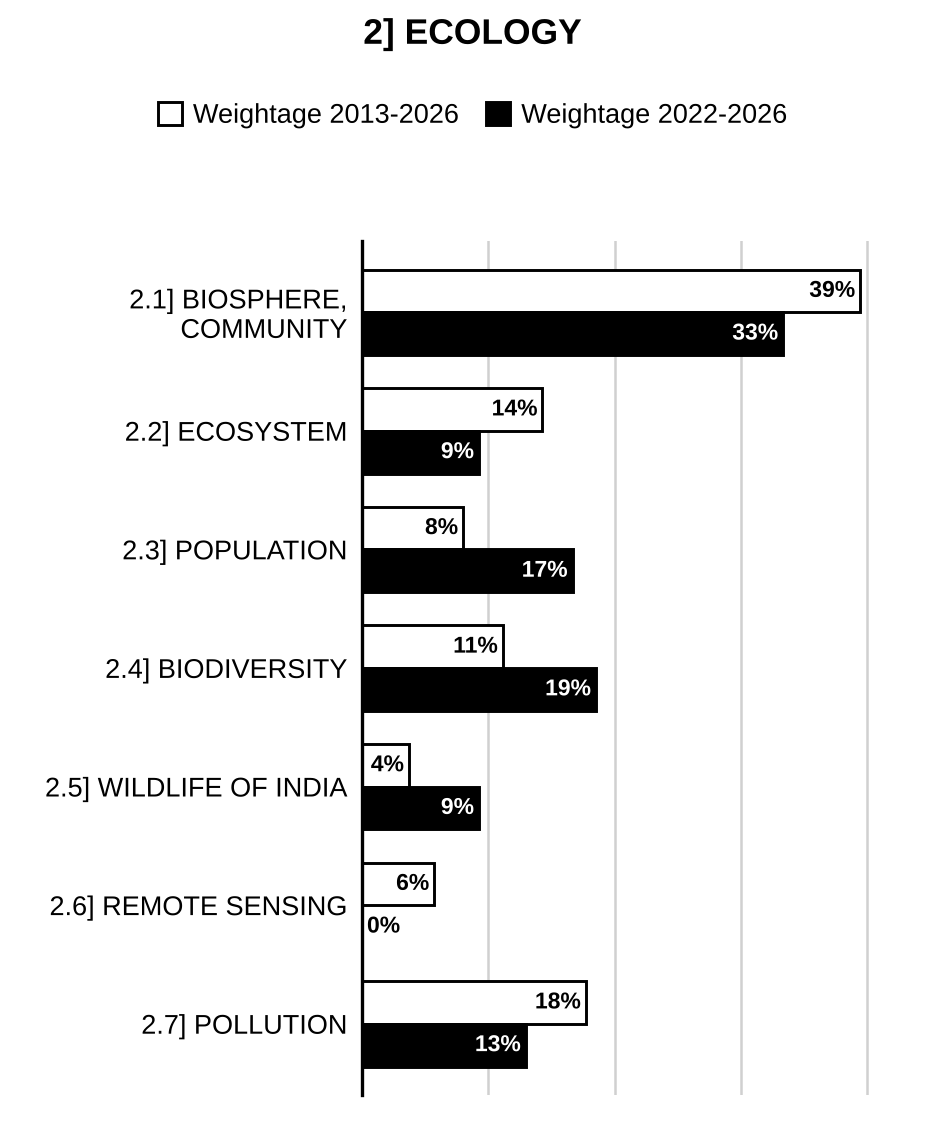
2.1] Biosphere and community ecology
32 questions
Green house effect. [2026/10m/150w/5a]
Biome. [2025/10m/150w/5e]
Give an illustrated account of carbon cycle with suitable diagram. [2025/15m/8b]
What is ecological succession? Explain the different types and theories of ecological succession. [2024/20m/6a]
Ecological niche. [2023/10m/150w/5a]
What are ecotones? Explain by giving examples. Also write a note on ‘edge effect’. [2022/10m/150w/5a]
Explain biological, non-biological and industrial fixation of nitrogen. [2022/15m/8b]
Ecological succession. [2021/10m/150w/5d]
Division of biosphere. [2020/10m/150w/5a]
Phosphorus biogeochemical cycle. [2020/10m/150w/5c]
Greenhouse effect and its impact on the atmosphere. [2019/10m/150w/5a]
Biome. [2019/10m/150w/5b]
What is Biogeochemical cycle? Discuss in detail the Nitrogen cycle. [2019/20m/6a]
What is community ecology? Explain different stratification in biotic community. Add a note on species abundance and species diversity. [2019/15m/7b]
What is ecological succession? Give an account of the causes, types and general process of ecological succession in nature. [2018/20m/6a]
What are Ecotones? Are wetlands ecotones? Justify. [2017/10m/150w/5b]
List different human-induced changes in the atmosphere. Describe greenhouse effect and its impact. [2016/10m/150w/5a]
Define ecological succession. Differentiate between primary and secondary succession. Explain various steps involved in the mechanism of ecological succession. [2016/20m/6a]
Enlist the various biomes of the biosphere and discuss the problems and adaptations of the animals of marine and desert biomes. [2016/20m/7a]
What are biogeochemical cycles? Discuss nitrogen cycle indicating the role of atmospheric N-fixation, the role of bacteria and the impact of human activity. [2015/20m/6c]
Distinguish between edge, border and ecotone. Why do edges and ecotones often support a greater diversity of species than the adjoining communities? [2014/10m/150w/5a]
Distinguish between a dominant and keystone species. Add a note on the crucial role played by the keystone species on the community structure and structure of a food web. [2014/20m/7a]
Describe the carbon cycle and discuss its peculiarities. How do human activities interfere with the carbon cycle? [2013/25m/6a]
State briefly what are biomes, ecotones and ecological succession. Give an account of the causes, trends and general process of ecological succession in nature. [2013/25m/7a]
With suitable examples and diagrams, explain the concept of ecological succession. [2012/12m/150w/5c]
Draw a flow diagram of nitrogen cycle, and give accounts of nitrogen fixation, nitrification and denitrification. [2011/15m/150w/5a]
Mention the various steps of sulphur biogeochemical cycle and draw a well labelled diagram. Discuss its significance. [2010/20m/200w/5a]
Describe ecological succession giving suitable examples. [2009/30m/6a]
What is ecological succession? Describe its process in a pod or lake. [2007/20m/200w/5a]
Define the terms Biome and Ecotone and describe major terrestrial biomes. [2006/60m/6]
Discuss Carbon Cycle. Add a note on the greenhouse effect. [2005/20m/200w/5a]
Green house gases and green house effect. [2004/20m/200w/5a]
2.2] Ecosystem
10 questions
Food Web. [2024/10m/150w/5a]
Define food chain. Describe different types of food chain with suitable examples. [2023/15m/6b]
Write a note on ecological pyramids with suitable examples. [2021/15m/6b]
Define ecosystem. Discuss the structure and functions of ecosystem. [2021/20m/8a]
Elaborate the term ‘Ecosystem’ and explain its structural components with examples. Comment on Trophic Dynamics concept. [2017/15m/7b]
Explain adaptations of animals inhabiting fast flowing waters. [2017/15m/8c]
Enlist the various biomes of the biosphere and discuss the problems and adaptations of the animals of marine and desert biomes. [2016/20m/7a]
Define ecosystem. Discuss the dynamics of the ecosystem and the factors influencing it. [2013/25m/6b]
Draw diagrams to differentiate between ecological pyramids based on predator-prey relationship and energy flow in an ecological niche. [2012/12m/150w/5a]
Discuss briefly the degradation of terrestrial ecosystem by human activities. [2011/30m/8a]
2.3] Population ecology
7 questions
Enumerate various population characteristics. Explain the following characteristics in detail: (i) Natality and mortality (ii) Population dispersion. [2026/20m/6a]
Define population. Explain the different characteristics of population. [2024/15m/8b]
Lotka-Volterra model. [2023/10m/150w/5e]
Population dynamics. [2018/10m/150w/5b]
What is meant by distribution? Explain patterns of distribution in natural populations. [2015/15m/6b]
“A population is a self-regulating system.” (Wynne Edwards.) Explain. [2011/30m/6a]
What is meant by the population? Describe various characteristics of a population. Discuss the phenomenon of stabilization of populations. [2004/60m/6]

Preparing for Prelims too?
Our UPSC Prelims Topic-wise PYQ eBook covers every Prelims question with detailed explanations, so you can see exactly where UPSC asks from.
View the BookDownload Free Sample2.4] Biodiversity and conservation
10 questions
Differentiate among alpha, beta and gamma diversity. Explain various factors which threaten the biodiversity. [2026/20m/7a]
Biodiversity hot spots. [2025/10m/150w/5a]
What is meant by biodiversity? Explain various means of in situ conservation of biodiversity. [2022/20m/7a]
Biodiversity hotspots. [2021/10m/150w/5e]
Endemism with reference to India. [2018/10m/150w/5c]
What is meant by Biodiversity? Explain Protected Area Networking w.r.t. their establishment, monitoring and management. [2017/15m/8b]
Define biodiversity hot-spot and mention the criteria of its selection. Write about biodiversity hot-spots of the Indian sub-region giving their salient features. [2015/20m/7c]
Distinguish between in situ and ex situ conservation of animals. Provide suitable examples. [2011/30m/6c]
Define sustainable development. Discuss the principles of sustainable development in the conservation of natural resources. [2010/20m/6a]
Discuss the strategies adopted for conservation of natural resources and biological diversity in India. [2005/60m/6]
2.5] Wildlife of India
4 questions
Red Data Book. [2024/10m/150w/5e]
What is Project Tiger? Discuss the various threats and conservation strategies to protect tigers in India. [2023/15m/7b]
What is meant by Biodiversity? Explain Protected Area Networking w.r.t. their establishment, monitoring and management. [2017/15m/8b]
Enlist five mammalian wildlife endangered species of India. Discuss the present scenario of conservation methods employed for Gir lion. [2010/30m/7b]
2.6] Remote sensing for sustainable development
5 questions
Describe the uses of remote sensing in sustainable development. [2020/15m/6b]
Define remote sensing. Explain how it can be used as an effective tool for sustainable development. [2016/15m/7b]
Define sustainable development. What are the merits of remote sensing in sustainable development? Give examples. [2014/20m/6a]
What are the merits of remote sensing in sustainable development? Give examples. [2012/12m/150w/5b]
Applying remote sensing in studying distribution of animals. [2009/20m/200w/7c]
2.7] Pollution and biodegradation
15 questions
Define air pollution. Explain the types, sources, consequences and control measures of air pollution. [2025/20m/6a]
Differentiate between primary and secondary pollutants. [2022/5m/6b(i)]
Explain primary and secondary treatment of waste water. [2022/10m/6b(ii)]
Give an account of causes, consequences and control of water pollution. Comment on “Ganga action plan”. [2019/20m/8a]
Ozone layer depletion. [2018/10m/150w/5a]
Give an account of sources, impacts and prevention of air pollution. Comment on Montreal and Kyoto protocol also. [2018/20m/7a]
Discuss Thermal Pollution and its preventive measures. [2017/10m/150w/5c]
Discuss environmental degradation with regards to inland water resources. Suggest measures to restore the water quality of our rivers, lakes and reservoirs. [2017/20m/8a]
What is ‘Ganga action plan’? Explain. [2015/10m/150w/5a]
Give an account of causes and consequences of pollution of aquatic resources and the problem of cultural eutrophication. Suggest measures for abatement of water degradation. [2015/15m/7b]
What is ozone layer? Describe the mechanism of degradation of ozone layer and its impact. [2014/15m/8b]
Give the mechanism of ozone degradation by chlorofluorocarbons. [2011/15m/150w/5b]
Environmental biodegradation. [2009/20m/200w/7b]
What is pollution? Describe water pollution, its sources and prevention. [2007/60m/6]
The ozone layer and its impact. [2006/20m/200w/5a]

Strengthen your GS papers
Our UPSC Mains Topic-wise & Year-wise PYQ eBook (2013–2026) maps every GS question to the syllabus, so you know what UPSC asks and how often.
View the BookDownload Free Sample« Previous: Non-Chordata and Chordata | Next: Ethology »
Back to: Zoology Optional PYQs – Topic-wise | Also see: Zoology Optional year-wise question papers
Last updated: 31 October 2026