
Here are all 90 Biochemistry questions asked in UPSC Zoology Optional Paper II from 2004 to 2026, arranged under the 6 topics of the official syllabus. Within each topic the latest questions come first.
Each question ends with a code such as [2024/15m/3b] – the year, the marks, the word limit (where UPSC set one) and the question number in the paper.
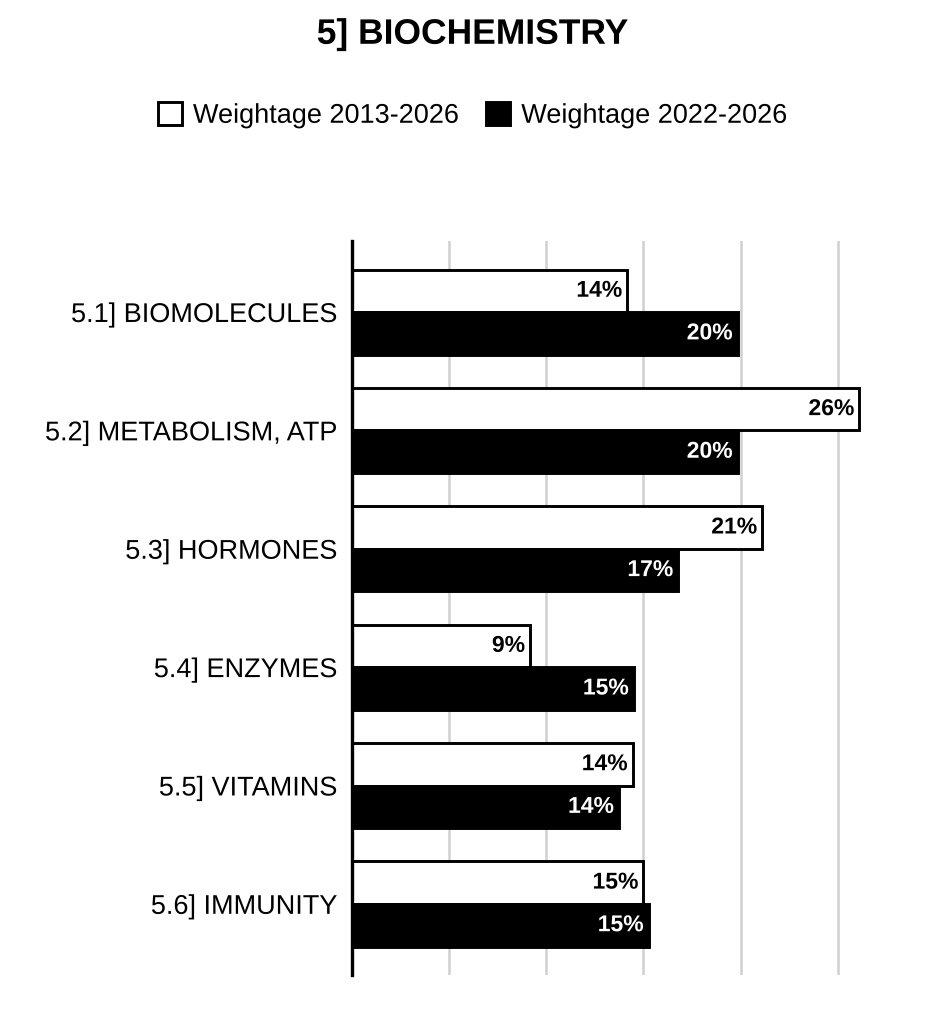
5.1] Biomolecules and bioenergetics
14 questions
Explain various levels of protein organization with suitable examples. [2026/20m/6a]
Structure of dipeptide unit of a protein. [2025/10m/150w/5d]
Draw structure of cholesterol and explain its role in health and diseases. [2025/15m/8b]
Classify carbohydrates by giving suitable examples. Also, mention characteristics of each category. [2023/20m/6a]
Fatty acids regulate the nature of lipids, justify. [2021/10m/150w/5a]
What is bioenergetics? Discuss the role of second law of thermodynamics in energy transduction. [2021/15m/6c]
Secondary structure of proteins. [2019/10m/5b]
Give the structural formula of an amino acid and show how a peptide bond formation occurs. Also explain how amino acids differ from each other. [2016/10m/5b]
Differentiate between saturated and unsaturated fatty acids and their functions. [2015/10m/5d]
Which eukaryotes do not contain repetitive DNA? Give a brief account of biological macromolecules found in all living organisms. [2013/15m/3c]
Interactions that stabilize the secondary and tertiary structure of proteins. [2010/15m/150w/5c]
Classify L-amino acids on their structural basis. What is the biochemical importance of sulphur containing amino acids? [2010/20m/6b]
Structure of fatty acids and lipids. [2009/20m/200w/8a]
Ketone bodies. [2006/20m/5a]
5.2] Metabolism and ATP
24 questions
Write down the reactions that produce NADH during Krebs cycle. [2025/10m/6a(i)]
Explain the role of proton gradient in oxidative ATP synthesis. [2025/10m/6a(ii)]
Discuss the role of oxidative phosphorylation in cellular and tissue metabolism. [2024/15m/8b]
Describe the balance sheet of ATP production in glycolysis. [2023/10m/150w/5b]
Draw the molecular structure of ATP synthase and diagrammatically explain the chemiosmotic concept of ATP synthesis. [2022/20m/6a]
Cyclic AMP is a second messenger, justify. Discuss the importance of cyclic AMP in intracellular signal transduction with suitable example. [2021/15m/6b]
Define oxidative phosphorylation. Describe the theories of mechanism of ATP synthesis. [2020/20m/6a]
“Glycolysis is considered as metabolic hub.” Justify. [2020/15m/7b]
Make a diagrammatic presentation of Krebs’ cycle. [2019/15m/7c]
Describe in detail about the respiratory chain or electron transport during oxidative phosphorylation in Mitochondria. [2018/20m/7a]
Give the structure of cyclic AMP and discuss its role as a second messenger by giving suitable examples. [2017/15m/7c]
Illustrate the organisation of electron transport particles on the inner mitochondrial membrane and explain their role in ATP synthesis. [2017/20m/8a]
Discuss that TCA cycle is the central pathway in the energy metabolism of a cell. [2016/20m/6b]
Describe with suitable diagrams the role of G-protein in the synthesis of C-AMP. Demonstrate how C-AMP activate protein kinase. [2015/10m/5a]
Illustrate and narrate structure of particles of mitochondria. How do they facilitate movement of protons across the mitochondrial membrane leading to ATP generation? [2014/10m/1b]
What is cyclic AMP? How is it derived? Mention the role of cyclic AMP in eukaryotic cells. [2013/10m/5b]
Discuss the role of various oxidoreductases in metabolism of glucose (aerobically/anaerobically) to differentially release ATP molecules. [2011/15m/1a]
Draw a labelled flow chart of β-oxidation of fats to display the types of enzymes that catalyze the formation of intermediates and step-wise release of ATP. [2011/20m/7a]
Cyclic-AMP as a second messenger. [2010/15m/150w/5a]
What are high energy compounds? Substantiate their role in biological systems. [2010/20m/6a]
Describe briefly Mitchell’s chemi-osmotic hypothesis for ATP synthesis. [2010/20m/7a]
Give an account of structure and role of cyclic AMP. [2009/30m/6a]
Explain the biochemical mechanism of conservation and release of energy in a cell. [2009/30m/6b]
Structure and function of cyclic AMP. [2007/20m/5a]
5.3] Hormones
19 questions
Biosynthesis of peptide hormones. [2026/10m/150w/5c]
Describe the role of pancreas in blood sugar regulation. [2026/15m/8b]
Classify hormones and write down the process of steroid hormone biosynthesis. [2024/15m/6b]
Explain the cellular mechanism of action of steroid hormones. [2022/15m/6c]
What are peptide hormones? With the help of schematic diagram, discuss the epinephrine cascade for the glucose release from hepatocytes. [2021/20m/6a]
Give a brief account of tropic hormones which affect the endocrine glands. [2019/20m/7a]
Describe the role of Calcitonin, Parathormone and Vitamin in calcium metabolism. [2018/20m/8a]
Explain in brief about the synthesis and functions of steroid and peptide hormones. [2016/15m/6a]
Define hormones. Distinguish between Steroid and Peptide hormones. Give the name of the hormones and its mechanism of action that uses and/or Calcitonin as second messenger. [2015/15m/6c]
Name the enzymes and hormones released by liver and pancreas. Discuss their functions in digestion of food and maintenance of blood glucose balance. [2014/10m/5b]
Describe the short-term and long-term effects of stress on human body. [2013/10m/5d]
Describe the mechanism of synthesis of protein and steroid hormones. How do they affect cellular activity? [2013/15m/6a]
Mention the hypothalamic-adenohypophysial secretions that stimulate, sustain and regulate adrenal cortex functions. Add a note on feedback systems. [2013/15m/7a]
Compare the action of steroidal and peptide hormones at organismal and cellular levels. [2012/20m/2c]
Mention the principal steps in the biosynthesis of insulin in β-cells of the islets of Langerhans. Add a note on the reasons for hypoglycemia and hyperglycemia, and their effects on body functions. [2011/20m/4a]
Compare the functions of prostaglandins and histamine. Give reasons for their being considered as hormones. [2011/20m/6c]
Give a schematic representation of thyroxin biosynthesis. [2010/20m/6c]
Biosynthesis of steroid hormones and their functions. [2009/20m/5a]
Mechanism of Hormone action. [2007/20m/5b]

Preparing for Prelims too?
Our UPSC Prelims Topic-wise PYQ eBook covers every Prelims question with detailed explanations, so you can see exactly where UPSC asks from.
View the BookDownload Free Sample5.4] Enzymes
8 questions
Activation energy based mechanism of enzyme action. [2025/10m/150w/5c]
Explain competitive and non-competitive enzyme inhibition. [2023/10m/150w/5e]
Explain enzymes, their characteristics as well as induced-fit model of mechanism of enzyme action. [2023/20m/8a]
Illustrate the following: (i) and base pairing as a part of DNA double strand (ii) Michaelis-Menten kinetic pattern of an enzymatic reaction. [2022/15m/6b]
Define and explain the ‘Michaelis-Menten equation’, and write its significance in enzyme kinetics. [2019/20m/6a]
What is an active site? How does enzyme catalysis take place in an active site? Explain with suitable examples. [2015/15m/7c]
Enzymes. [2005/20m/5b]
What is an enzyme? Give a detailed account of the structure and functions of enzymes. [2004/60m/6]
5.5] Vitamins and co-enzymes
11 questions
Define vitamins. How are vitamins different from co-enzymes in their structure and functions? [2026/15m/8c]
Why are vitamins also called coenzymes? Justify. [2024/15m/7b]
Explain the source(s) and functions of the following: (i) Vitamin (ii) Vitamin (iii) Vitamin [2023/15m/7b]
Define coenzyme. Explain the role of coenzymes in the regulation of metabolic reactions by giving suitable examples. [2021/10m/150w/5b]
What are vitamins? Describe the types and biological roles of fat-soluble vitamins. [2020/15m/8b]
What are ‘Co-enzymes’? Explain their importance in metabolism. [2017/10m/5a]
Explain the functions of coenzymes with suitable examples. [2016/15m/7a]
What are vitamins and co-enzymes? Describe fat soluble vitamins with examples. [2015/10m/5b]
What are vitamins? Name and give the functions of water soluble vitamins. Tabulate the diseases that occur in humans due to hypo and hypervitaminosis. [2014/10m/5e]
What is anti-vitamin? Classify and describe the function of vitamins in human nutrition. [2013/15m/8c]
Describe the structure & physiology of fat soluble vitamins. [2006/60m/6]
5.6] Immunoglobulins and immunity
14 questions
Describe the mechanism of generation, differentiation and activation of T-cells. [2026/15m/7b]
Discuss the mechanism of action of cytotoxic-T cell. [2025/15m/7b]
Functions of immunoglobulins. [2024/10m/150w/5a]
Define immunity. Explain cell-mediated immune response in vertebrates with suitable diagram. [2022/10m/150w/5a]
Describe the basic structure and functions of immunoglobulins. [2020/10m/5a]
Explain the structure and functions of IgG immunoglobulin. [2019/15m/6b]
Discuss antibodies as key players of humoural immunity. [2017/15m/7b]
Give the classification of immunoglobulins and state their functions. Draw a labelled diagram of IgM. [2016/15m/8b]
Differentiate between Innate and Adaptive immunity. Justify your answer with suitable examples. [2015/10m/5e]
What are immunoglobulins? Describe the structure of IgG and add a note on its diversity. [2014/20m/7b]
How does the structure of antibody give its specificity of functions? Add a note on the causes of allergic reaction. [2012/15m/1a]
Role of immunoglobulins in immunity. [2009/20m/200w/8c]
Discuss active and passive immunity. Mention autoimmune disorders. [2007/60m/6]
Give short descriptions of any three of the following: Immunoglobulins. [2004/20m/5a]

Strengthen your GS papers
Our UPSC Mains Topic-wise & Year-wise PYQ eBook (2013–2026) maps every GS question to the syllabus, so you know what UPSC asks and how often.
View the BookDownload Free Sample« Previous: Systematics | Next: Physiology (with Special Reference to Mammals) »
Back to: Zoology Optional PYQs – Topic-wise | Also see: Zoology Optional year-wise question papers
Last updated: 31 October 2026