
Sanskrit Literature Optional PYQs Topic-wise for UPSC Mains (2009–2026) are listed below unit by unit, in the order of the official syllabus – 967 questions in all. Click any unit to open all its previous year questions, arranged topic-wise with the latest first.
Want full papers instead? Open the Sanskrit Literature Optional year-wise question papers for Paper 1 and Paper 2, or the official syllabus.
Want the trends behind these questions? See the Sanskrit Literature Optional PYQ analysis: marks by unit, repeated questions and a paper-wise analysis for every year from 2020 to 2026.
Paper I
| Unit | Topic (click to open PYQs) | Sub-topics | Questions | Link |
|---|---|---|---|---|
| 1 | व्याकरणम् | 5 | 81 | Click here → |
| 2 | भाषा | 3 | 44 | Click here → |
| 3 | साहित्येतिहासः काव्यशास्त्रं साहित्यविधाश्च | 12 | 124 | Click here → |
| 4 | भारतीयसंस्कृतेः मूलतत्त्वानि | 6 | 80 | Click here → |
| 5 | भारतीयदर्शनस्य प्रवृत्तयः | 10 | 90 | Click here → |
| 6 | लघुनिबन्धः | – | 18 | Click here → |
| 7 | अपठितगद्यांशः | – | 48 | Click here → |
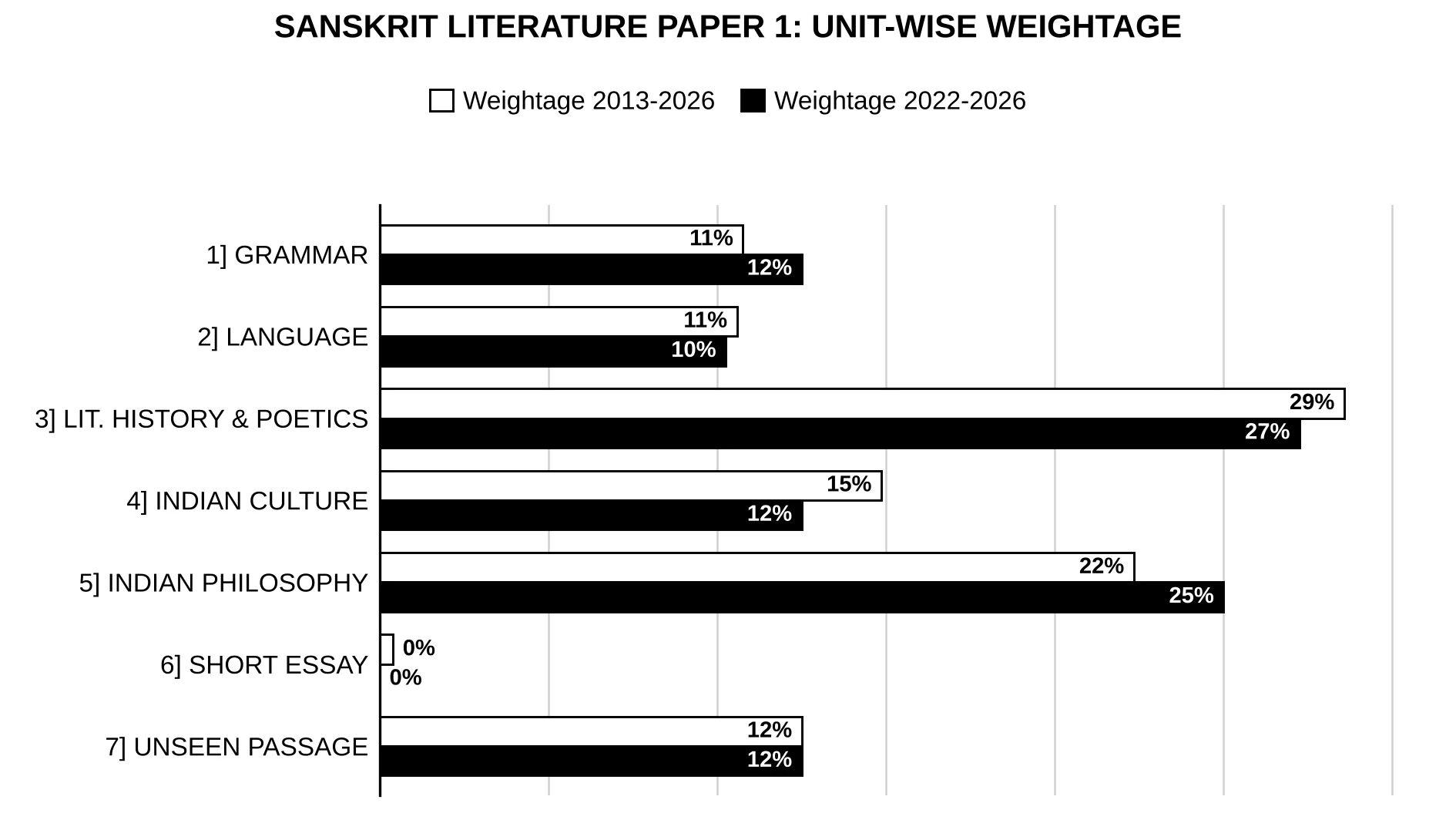
Trend: Over 2013–2026 the history of literature, poetics and literary forms (Unit 3) carries the largest share, about 29% of the marks, followed by Indian philosophy (22%), Indian culture (15%), the unseen passage (12.5%), grammar (11%) and language (11%); the separate short essay has almost disappeared since 2013 (0.4%). The shares in 2022–2026 are much the same, with philosophy rising to 25%. Within Unit 3, poetics (3.3) leads with about 28% of the unit, followed by drama (3.7), the Mahābhārata (3.5) and the Rāmāyaṇa (3.4), the last rising to 17% in 2022–2026. In grammar, kāraka (1.3) leads, while samāsa (1.4) has become the largest grammar topic in 2022–2026 (34%) and sandhi has fallen to 2%. Among the darśanas, the general survey (5.1), Vedānta (5.3) and Sāṃkhya (5.6) are the most asked; in culture, the technical sciences (4.6) and the arts (4.5) lead, and varṇāśrama (4.4) has risen to 30% of the unit in 2022–2026.

Preparing for Prelims too?
Our UPSC Prelims Topic-wise PYQ Book covers every Prelims question with detailed explanations, so you can see exactly where UPSC asks from. Now available as a hard copy and an eBook.
Buy Hard Copy on AmazonBuy eBook (PDF)Paper II
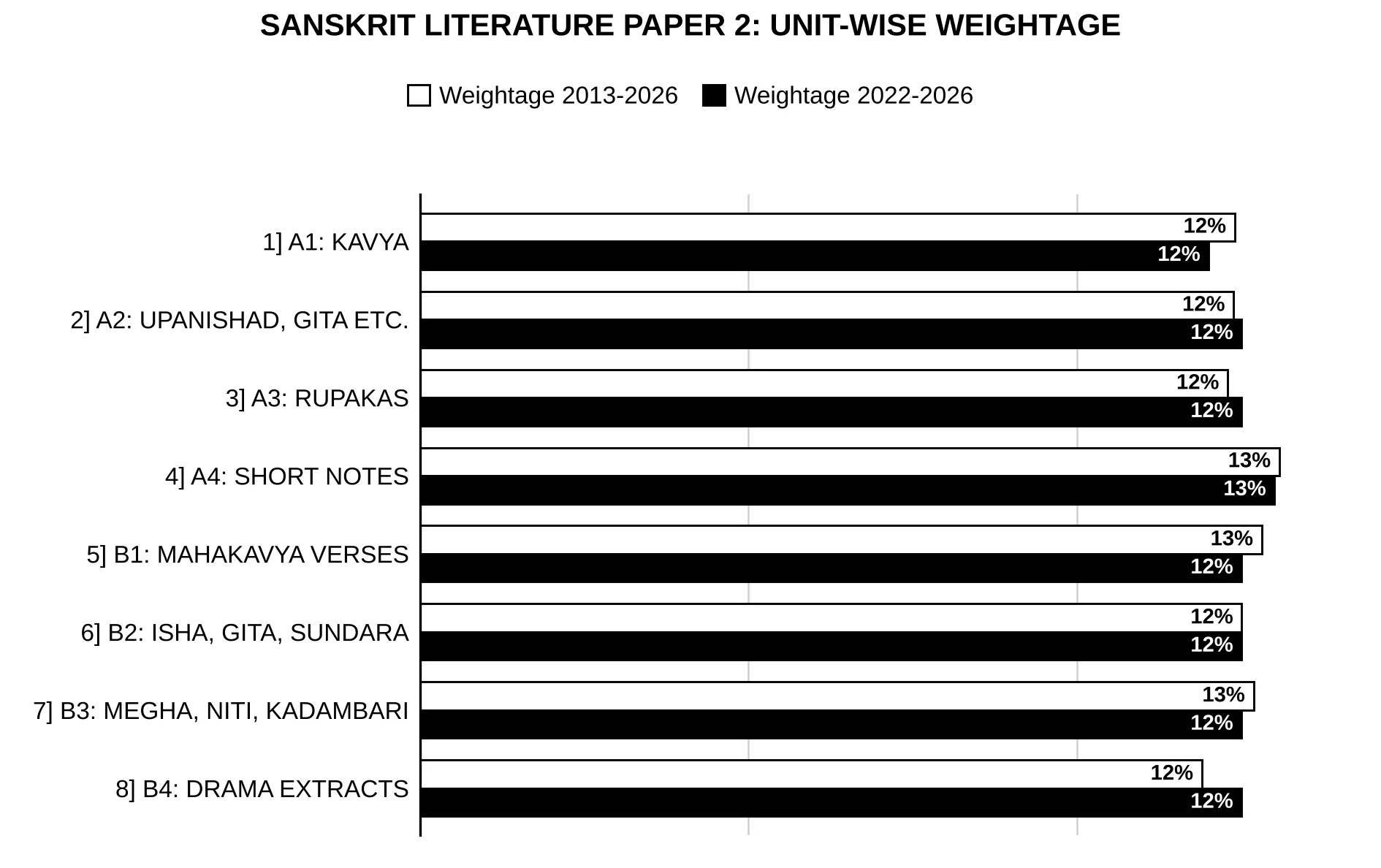
Trend: The eight groups carry almost equal marks by design, about 12–13% each, in both periods, and every prescribed text is asked almost every year. In Section A, the Gītā (2.2) and the Īśāvāsya (2.1) take two-thirds of group 2, with Kauṭilya’s Arthaśāstra rising to 27% in 2022–2026; Kādambarī (1.6), Naiṣadhīyacarita (1.5) and Daśakumāracarita (1.7) lead group 1; Abhijñānaśākuntala (3.2) and Uttararāmacarita (3.5) lead the dramas; and in group 4 the Meghadūta (4.1) leads over 2013–2026, while in 2022–2026 the Pañcatantra (4.3, 27%) comes first, ahead of the Meghadūta and the Gītagovinda (21% each). In Section B the passages are spread fairly evenly over the three texts of each group, with the Kirātārjunīya verses (5.3), the Śukanāsopadeśa (7.3) and the Uttararāmacarita extract (8.3) slightly ahead.
Frequently asked questions
How many Sanskrit Literature Optional PYQs are there?
There are 967 Sanskrit Literature Optional questions from 2009 to 2026, across Paper I and Paper II, arranged under 15 units of the official syllabus. A question that covers two topics is listed under both.
Which Sanskrit Literature Optional units are asked most often?
By number of questions – साहित्येतिहासः काव्यशास्त्रं साहित्यविधाश्च (Paper I, 124); भारतीयदर्शनस्य प्रवृत्तयः (Paper I, 90); खण्डः ख, वर्गः 1: महाकाव्यपद्यानि (Paper II, 85); व्याकरणम् (Paper I, 81). The weightage graphs on these pages compare the share of marks across periods.
What does a code like [2024/15m/3b] after a question mean?
It gives the year, the marks, the word limit (where UPSC set one) and the question number in the paper. So [2024/15m/3b] is Question 3(b) of the 2024 paper, worth 15 marks.
Where can I download the full Sanskrit Literature Optional question papers?
Every available paper is free as a PDF on our Sanskrit Literature Optional year-wise question papers page, for both Paper 1 and Paper 2.
How should we use these PYQs in our preparation?
Read the syllabus for a unit first, then go through its questions, starting with the most recent years. In Paper II, read each prescribed text in the original and note which passages and themes UPSC returns to. Practise writing answers within the word limit and time.
How this collection is organised
Units follow the official syllabus – Paper 1: 1 व्याकरणम्, 2 भाषा, 3 साहित्येतिहासः काव्यशास्त्रं साहित्यविधाश्च, 4 भारतीयसंस्कृतेः मूलतत्त्वानि, 5 भारतीयदर्शनस्य प्रवृत्तयः, 6 लघुनिबन्धः and 7 अपठितगद्यांशः (for example Paper 1 – 1.4 समासः); Paper 2: units 1–4 for Section A (general study of the prescribed works, groups 1–4) and units 5–8 for Section B (the portions prescribed for first-hand reading, groups 1–4), with each prescribed text as a topic of its own (for example Paper 2 – 3.2 कालिदासः, ‘अभिज्ञानशाकुन्तलम्’). Topic names are given in Sanskrit.
Every passage printed for explanation is placed under the prescribed text it is taken from: under its Section B topic when it lies in the portion prescribed for first-hand reading, and otherwise under the work’s Section A topic (for example a Nītiśataka verse from a later paddhati under Paper 2 – 4.2). The papers do not name the source; it has been identified editorially from the passage itself, and these attributions remain open to correction.
In Paper 1, questions on a particular poet’s work are placed under the genre it belongs to (for example ‘नैषधं विद्वदौषधम्’ under महाकाव्यम्, the Uttararāmacarita under रूपकम्), sayings about a poet as a whole (‘उपमा कालिदासस्य’, ‘बाणोच्छिष्टं जगत्सर्वम्’) under the history of classical Sanskrit literature, and questions on the doctrine of the Gītā under the general survey of Indian philosophy.
Some questions cover more than one topic. We’ve kept such questions in each topic of relevance (at most two). A grammar question made up of short items of different kinds is placed under the two grammar topics with the most items.
Graphs at the start of each paper show the weightage of every unit in that paper, and graphs for each unit show the weightage of its topics. Weightage is the share of marks asked from a unit or topic, compared for 2013–2026 (white bars) and the last five years, 2022–2026 (black bars). A question placed under two topics has its marks split equally between them.
Each of the topicwise question is suffixed by a question code like this [2024/10m/1a]. This code indicates a) year in which the question was asked, b) maximum marks the question carried and, c) the question number in actual paper, in given order.
Until 2012, each paper carried 300 marks (60 per question); since 2013 each paper carries 250 marks (50 per question). Where a question offered more parts than were to be answered (“any two” of three short notes, “any three” of four passages, a choice of essay topics), every part is included with its own marks.
All papers are transcribed from scans of the UPSC question papers. Every page was transcribed and then checked a second time by an independent reader against the scan. The wording, spelling and punctuation are as printed, including the papers’ own misprints. Many questions are printed in Sanskrit with an English version below; only the Sanskrit version is given here. All papers of all eighteen years were complete and legible.
Spotted an error? Use the “Report an Error” box at the end of any page – we review every report and update the page.

Strengthen your GS papers
Our UPSC Mains Topic-wise & Year-wise PYQ Book (2013–2026) maps every GS question to the syllabus, so you know what UPSC asks and how often. Now available as a hard copy and an eBook.
Buy Hard Copy on AmazonBuy eBook (PDF)Last updated: 2 November 2026