
Here are all 74 Work Psychology and Organisational Behaviour questions asked in UPSC Psychology Optional Paper II from 1995 to 2026, arranged under the 10 topics of the official syllabus. Within each topic the latest questions come first.
Each question ends with a code such as [2024/15m/3b] – the year, the marks, the word limit (where UPSC set one) and the question number in the paper.
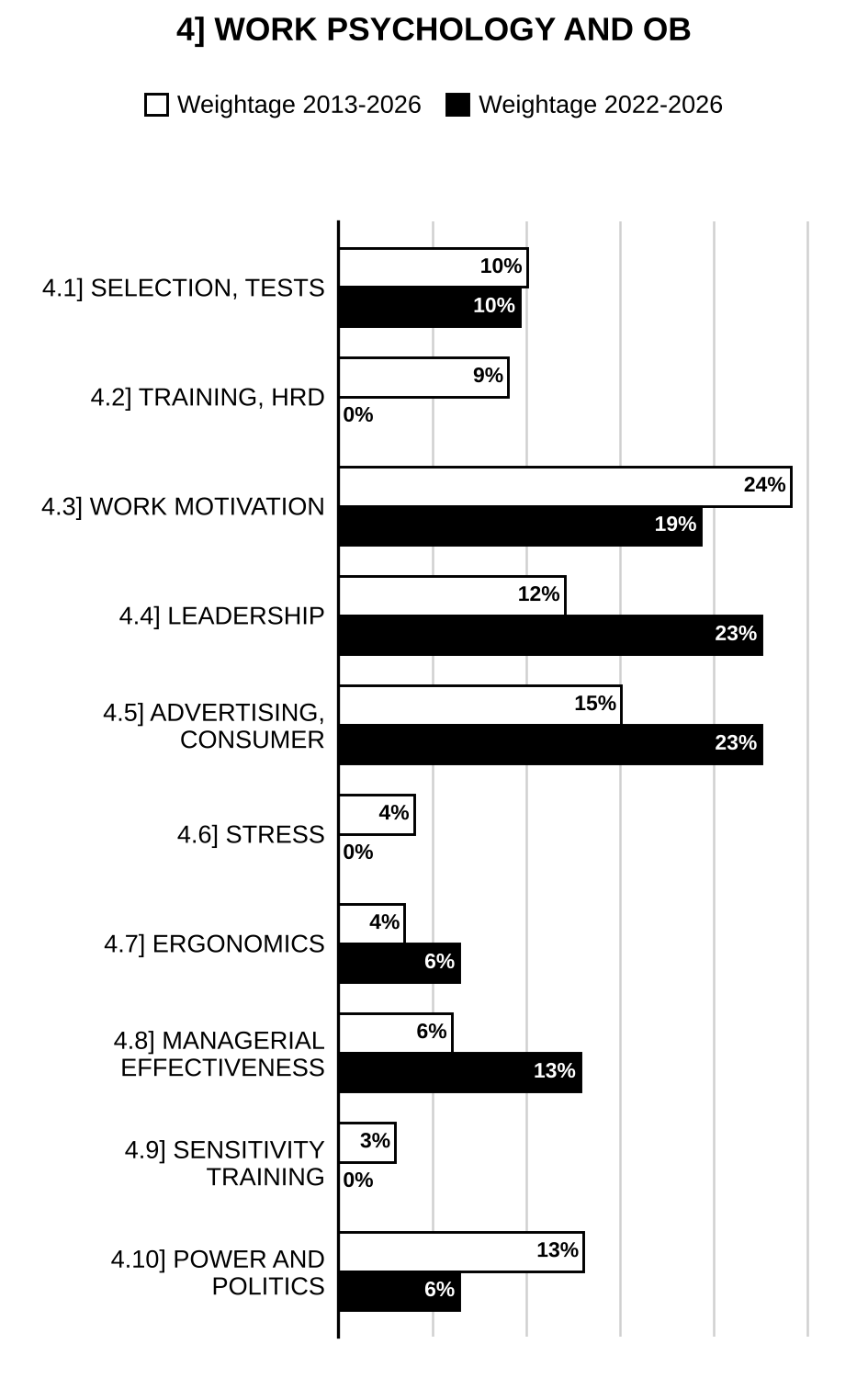
4.1] Personnel selection and training; use of psychological tests in the industry
8 questions
Why is selection considered to be a process of infusion of fresh blood in the organisation? Discuss the steps involved in employee selection. [2022/15m/3c]
“Psychological tests are important in personnel selection.” Give reason to it and describe which psychological tests are generally used. [2019/10m/150w/5a]
Critically evaluate the role of self-report personality inventories in personnel selection. [2017/10m/150w/1a]
Do you think that efficacy of personnel selection can be improved by using multiple methods? [2015/15m/3a]
What do you mean by personnel selection and training? Explain the uses and importance of psychological tests in the industry. [2006/60m/2]
Enumerate the importance of Personnel Selection and Training in Industries. Describe the more commonly used psychological tests in personnel selection and evaluation of training effects. [2002/20m/200w/1d]
Discuss the uses of psychological testing in selection. [1998/20m/200w/1c]
Is aptitude testing sufficient for determining the suitability of a person for a particular job? If not, mention the other tests that should be applied. [1997/20m/200w/1c]
4.2] Training and human resource development
6 questions
How can one differentiate between learning and training? Discuss any two executive training methods giving suitable examples. [2019/10m/150w/5b]
How is competency mapping made use of for human resource development in modern organizations? Illustrate. [2016/15m/3b]
To what extent would you agree that human resource development is more about inculcation of human values and less about development of competencies? [2015/10m/150w/5a]
Can leaders be trained? What will be the essential components of a leadership training programme for the civil servants? [2014/20m/4c]
Human Resource Development is a continuous process to develop human capabilities and potentialities to achieve personal and organizational goals. Give your comments. [2001/60m/3]
Show conceptual relationship between social change and organizational change. [2000/20m/200w/1c]
4.3] Theories of work motivation: Herzberg, Maslow, Adam Equity theory, Porter and Lawler, Vroom
17 questions
What are the components of Vroom’s theory of motivation? How can it be used to increase the performance of workers? [2024/15m/4a]
Explain Maslow’s need hierarchy theory. Critically evaluate the same. [2023/15m/3a]
Explain the factors affecting the work motivation within work organization in India. [2021/10m/150w/5a]
In case of highly skilled professionals does their motivation come from within or is it the result of situational factors? Explain this in the light of theories of motivation. [2020/15m/8a]
Critically examine Herzberg’s two-factor theory of motivation and point out that in what way Herzberg’s theory is different from Maslowian theory? [2019/20m/6c]
Explain Herzberg’s theory of work-motivation. Critically comment on its relevance in Indian context. [2018/20m/4c]
Distinguish between content and process theories of work motivation. Comment on the applicability of Maslow’s theory of work motivation in the Indian context. [2017/15m/2a]
Is Herzberg’s theory relevant for understanding work motivation in Indian organizations? Explain. [2016/10m/150w/1c]
Explain Vroom’s expectancy theory of work motivation and link this theory with variable-pay programs. [2012/20m/250w/4c]
Compare procedural and distributive justice, and present their effect on employees motivation. [2011/30m/3b]
Evaluate the applications of equity theory and Porter-Lawler’s theory in modern organizations. [2010/20m/200w/1c]
Evaluate the applications of any two theories of Work Motivation in modern organizations. State the importance of Participatory Management in Indian Industry. [2007/60m/4]
Discuss the managerial implications of motivation theories. State the specific programmes drawn from these theories giving examples of organizations in which they are applied. [2004/60m/2]
Discuss Maslow’s theory of need-hierarchy. Can Maslow’s theory be applied to industries? [2000/60m/3]
Discuss the techniques of motivating industrial employees with particular reference to Herzberg’s theory of work motivation. [1999/20m/200w/1c]
What do you understand by work motivation? Discuss the Maslow’s theory of need hierarchy. How can Maslow’s theory be applied in industrial situations? [1998/60m/3]
Is work culture an essential component of effective work motivation? Discuss its operation in public and private industrial set-up in India. [1996/20m/200w/1d]
4.4] Leadership and participatory management; transformational leadership
11 questions
Distinguish between Transactional and Transformational Leaders. Suggest how can they contribute towards creating an effective organizational environment. Give examples. [2026/20m/2c]
Can the applicability of concept of norm crystallization in an organization affect transformational leadership in that organization? [2025/15m/3b]
Critically evaluate whether the principles of participatory management are equally effective in bureaucratic organizations as in industrial organizations. [2016/15m/4a]
Can leaders be trained? What will be the essential components of a leadership training programme for the civil servants? [2014/20m/4c]
Comment on: Provide comparison between transformational and transactional leadership for their relevance to Indian organizations. [2011/20m/200w/5a]
Evaluate the applications of any two theories of Work Motivation in modern organizations. State the importance of Participatory Management in Indian Industry. [2007/60m/4]
Leaders in the organizational set up work with different kinds of strategies than leaders in other fields. Comment. [2003/20m/200w/1a]
There have been various leadership and management theories and styles. Which one of them do you consider to be the most suitable in the Indian condition? Give reasons. [2000/60m/2]
Discuss the relevance of traditional and modern participative management techniques in the Indian industry. [1999/60m/4]
Show your acquaintance with the components of leadership training. [1998/20m/200w/1b]
What are the components of leadership training? Discuss the limiting and facilitative factors in leadership training for a public sector industrial set-up in India. [1995/20m/200w/1b]
4.5] Advertising and marketing; consumer psychology
9 questions
Describe the applications of psychological principles in the field of marketing. Cite illustrations from Indian context. [2023/20m/4c]
How does advertising help people to buy intelligently and enable them to take a step in the direction of a higher standard of living? Critically examine. [2022/15m/8a]
What do you understand by psychology of advertising? How can consumer awareness be enhanced through advertising? [2021/20m/6c]
How can psychological theories be put to use to inoculate people against their impulsive buying behaviour? [2016/15m/7a]
Discuss the key determinants of consumer behaviour in India. How do cultural values influence it? [2013/15m/200w/3c]
What are the psychosocial components of advertising and marketing? Identify and discuss the relevant ethical considerations. [2012/30m/6a]
Write a short note on: Advertising and marketing. [2006/20m/200w/1d]
Discuss the psychological theories and contributions of psychology in effective advertising. [2000/60m/7]
Discuss the role of mass media with a special reference to television in spreading the idea of consumerism in India. [1996/20m/200w/5b]

Preparing for Prelims too?
Our UPSC Prelims Topic-wise PYQ eBook covers every Prelims question with detailed explanations, so you can see exactly where UPSC asks from.
View the BookDownload Free Sample4.6] Stress and its management
2 questions
What are the potential sources of stress for people working in research and development organisations? Discuss some of the individual and organizational approaches in these organizations to manage stress. [2020/20m/4c]
What is stress? Discuss certain methods of stress management. [1998/60m/7]
4.7] Ergonomics
2 questions
What is ergonomics? Explain the benefits of ergonomics in the work place with suitable examples. [2024/10m/150w/1c]
What is man-machine system? In this context, explain the applications of human engineering in designing the display systems of the aircrafts. [2017/15m/7b]
4.8] Managerial effectiveness
11 questions
What is the role of citizenship behaviour towards successful organizational environments? [2026/10m/150w/1b]
Managerial effectiveness is influenced by the reasoning and decision-making abilities of a manager. Critically evaluate with the help of researches. [2025/10m/150w/1d]
To what extent, do you think that the principles of management derived from the study of industrial organisations can be applied to improve the functioning of bureaucratic organisations in India? [2014/10m/150w/5b]
Differentiate between managerial effectiveness and efficiency, and discuss the factors influencing them. [2011/30m/4b]
What is organizational communication? What will be the form of organizational communication in the 21st century because of the advent of information technology? [2000/60m/8]
Comment on: Briefly discuss the major theoretical explanations for group formation in the organization set-up. [1999/20m/200w/1d]
Enumerate the methods for improving the effectiveness of upward communication in the organization. [1999/20m/200w/5c]
Discuss the types of group at work situations. How can group work be measured? [1998/60m/4]
What is organizational communication? Discuss the various factors of effective communication in industries. [1998/60m/6]
Is work culture an essential component of effective work motivation? Discuss its operation in public and private industrial set-up in India. [1996/20m/200w/1d]
Describe the various psycho-social factors which contribute to communication gap. Illustrate your answer from a public sector industrial organisation as well as a Govt. Department. How would you overcome communication gap? [1995/60m/8]
4.9] Sensitivity training
3 questions
Explain the nature of sensitivity training. Comment on its utility as an organizational development technique. [2018/15m/4a]
Explain the models of sensitivity training. Relate them to organizational development. [2012/20m/250w/4b]
What are the merits of ‘sensitivity training groups’ as a training programme in organizations? [2009/20m/2c]
4.10] Power and politics in organizations
5 questions
Explain how power and politics go hand-in-hand. [2022/10m/150w/1c]
How does power in organizations tend to concentrate in the hands of a few persons? Discuss the tactics used to gain power. [2021/15m/4a]
Discuss the factors that contribute to political behaviour in organizations. [2020/10m/150w/5d]
What is your understanding of organizational politics? Discuss how it impacts decision-making processes in bureaucratic organizations. [2013/15m/200w/2a]
What bases of power are used by successful leaders to exercise influence within organizations? Discuss. [2013/15m/200w/6c]

Strengthen your GS papers
Our UPSC Mains Topic-wise & Year-wise PYQ eBook (2013–2026) maps every GS question to the syllabus, so you know what UPSC asks and how often.
View the BookDownload Free Sample« Previous: Therapeutic Approaches | Next: Application of Psychology to Educational Field »
Back to: Psychology Optional PYQs – Topic-wise | Also see: Psychology Optional year-wise question papers
Last updated: 30 October 2026