
Here are all 69 Psychological Problem of Social Integration questions asked in UPSC Psychology Optional Paper II from 1995 to 2026, arranged under the 5 topics of the official syllabus. Within each topic the latest questions come first.
Each question ends with a code such as [2024/15m/3b] – the year, the marks, the word limit (where UPSC set one) and the question number in the paper.
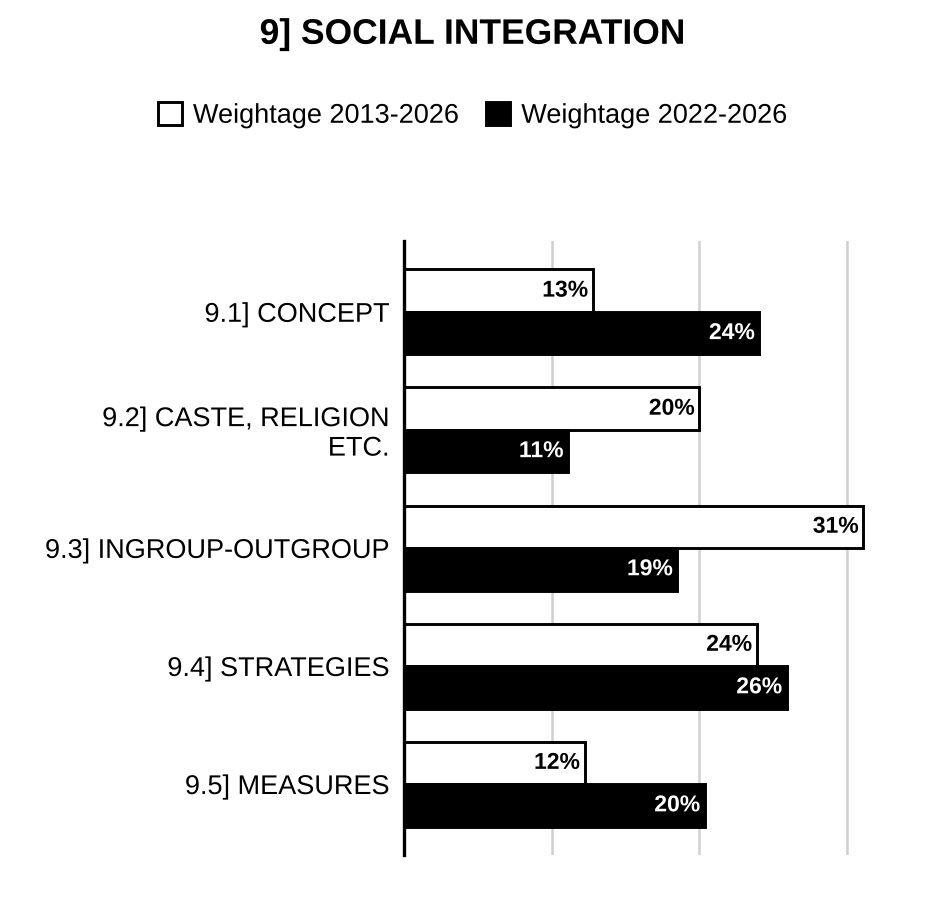
9.1] The concept of social integration
8 questions
Define social integration and discuss the major psychological barriers to achieving it in a multicultural society. [2026/15m/6b]
What is social integration? Explain the psychological measures that can be taken to achieve the goal of social integration. [2024/15m/7a]
Explain the concept of social integration citing suitable examples. [2022/10m/150w/5a]
What is meant by social integration? How can religious harmony be promoted to attain social integration in the present scenario in India? [2020/10m/150w/1a]
Critically describe the role of cultural assimilation in facilitating/hindering social integration in India. Illustrate with suitable example. [2018/20m/7c]
Describe the concept of social integration. What are the major problems of social integration? Explain in detail the measures to achieve social integration. [2005/60m/6]
Elucidate the concept of Social Integration. How would you use this concept in bringing about unity amongst people of different castes, religion, language and class in India? [2002/20m/200w/5a]
What are the various components of dynamic social integration? Describe the various psycho-social factors which hamper proper social integration in India. Suggest remedial measures. [1995/60m/7]
9.2] The problem of caste, class, religion and language conflicts and prejudice
9 questions
Suggest measures to overcome social conflicts and communal tensions using psychological principles. [2026/10m/150w/5a]
What are the psychological measures to be used for social integration of the communities divided by conflicts of religion? [2025/20m/6c]
Is prejudice inevitable? Discuss the techniques for reducing caste prejudice. [2021/20m/3c]
What are the forms of social conflicts? Explain the methods of resolution of social conflicts. [2021/15m/8a]
Discuss the relevance of frustration-aggression hypothesis in the context of caste prejudice in India. [2018/15m/6b]
What psychological factors will explain lack of social integration involving religious groups in India? Discuss. [2016/20m/4c]
Religious violence in India has shown only a marginal decline over the years. What social and psychological factors explain it the most? [2015/15m/7a]
Is religion in India at the root of social conflicts? Discuss and provide suitable ways to deal with such conflicts. [2013/15m/200w/8b]
Is it possible to achieve social integration with the help of psychological principles? How can a psychologist deal effectively with class and caste conflicts? [2003/60m/7]

Preparing for Prelims too?
Our UPSC Prelims Topic-wise PYQ eBook covers every Prelims question with detailed explanations, so you can see exactly where UPSC asks from.
View the BookDownload Free Sample9.3] Prejudice between the ingroup and outgroup; causal factors of conflicts and prejudices
20 questions
Interactions between members of diverse groups can affect the ratings of in-group and out-group members. Discuss with the help of researches. [2025/10m/150w/5c]
What is implicit prejudice? How does it differ from explicit prejudice? Explain with the help of examples. [2024/10m/150w/5c]
Explore causal factors of social conflicts and suggest methods of resolution. [2022/20m/7c]
How does categorization as in-group and out-group influence social relations? How can such influence of categorization be minimized? Discuss with examples. [2020/15m/3a]
Explain why group membership can have a powerful influence on social behaviours and decisions. [2019/15m/2a]
What is the difference between prejudice and discrimination? Discuss the newer forms of prejudice that we see today. [2019/15m/3a]
Discuss the relevance of frustration-aggression hypothesis in the context of caste prejudice in India. [2018/15m/6b]
What do you understand by intergroup attitudes? Why are such attitudes considered to be a social phenomenon? [2017/20m/6c]
Discuss the process of prejudice formation. State the psychological strategies that can be adopted for conflict resolution. [2016/20m/8c]
According to Social Identity Theory, social categorization and differentiation processes are implicated in intergroup conflict. Evaluate the theory against available research evidence. [2015/20m/4c]
Identify relevant indices for understanding the emergence of ingroup and outgroup processes. Discuss with the help of a suitable theoretical framework. [2013/20m/200w/3b]
Distinguish between prejudice and discrimination. Explain the variables moderating the manifestation of prejudice into overt behavior. [2012/20m/250w/7b]
Clarify the relationship between stereotypes and prejudices, and examine their impact on social integration. [2011/30m/6b]
‘Prejudice is a consequence of socialisation and learning.’ Discuss this statement and suggest measures to reduce prejudices in the Indian context. [2010/30m/8a]
What processes create out groups? To what extent can developing superordinate goals and norms promote inter-group cooperation and reduce conflicts between groups? [2009/60m/8]
Discuss the socio-cultural approaches for understanding the origins of ethnic prejudice and discrimination. [1999/20m/200w/5b]
What are the nature and manifestations of social prejudices? [1998/20m/200w/5c]
Discuss the different sources of development of prejudice in India. What steps do you suggest for minimizing the effects of prejudice? [1997/60m/6]
How can personality affect the formation of prejudices? [1996/20m/200w/1b]
What are the major components of prejudice? Discuss the factors which generate and strengthen prejudice with special reference to the Indian scene. [1996/60m/6]
9.4] Psychological strategies for handling the conflicts and prejudices
20 questions
Suggest measures to overcome social conflicts and communal tensions using psychological principles. [2026/10m/150w/5a]
Interactions between members of diverse groups can affect the ratings of in-group and out-group members. Discuss with the help of researches. [2025/10m/150w/5c]
Discuss the psychological strategies for handling the intergroup conflict. [2023/15m/6b]
Explore causal factors of social conflicts and suggest methods of resolution. [2022/20m/7c]
Is prejudice inevitable? Discuss the techniques for reducing caste prejudice. [2021/20m/3c]
What are the forms of social conflicts? Explain the methods of resolution of social conflicts. [2021/15m/8a]
How does categorization as in-group and out-group influence social relations? How can such influence of categorization be minimized? Discuss with examples. [2020/15m/3a]
In the light of research, discuss the ways in which social conflicts can be resolved. [2019/20m/3c]
Discuss how social integration can be promoted in India in the light of intergroup contact hypothesis and crossed categorization research. [2017/15m/7a]
Discuss the process of prejudice formation. State the psychological strategies that can be adopted for conflict resolution. [2016/20m/8c]
Explain how the creation of superordinate goals can help in resolving social conflicts. [2014/10m/150w/1d]
Justify with examples how the insights derived from studies on ‘intergroup contact hypothesis’ would be useful in promoting harmonious relations among different castes and in maintaining social order. [2012/12m/150w/5b]
What is ‘Intergroup-contact’ hypothesis? Discuss its implications and limitations in reducing prejudices. [2010/30m/6a]
‘Prejudice is a consequence of socialisation and learning.’ Discuss this statement and suggest measures to reduce prejudices in the Indian context. [2010/30m/8a]
What processes create out groups? To what extent can developing superordinate goals and norms promote inter-group cooperation and reduce conflicts between groups? [2009/60m/8]
Write a short note on: Psychological strategies for handling prejudice. [2007/20m/200w/5b]
Write a short note on: Psychological strategies in handling the conflicts and prejudices. [2005/20m/200w/5a]
Explain psychological strategies for handling conflicts and prejudices. Write about the measures to achieve integration. [2004/60m/7]
What is prejudice? Describe the methods for reducing prejudice and facilitating social integration. [2001/20m/200w/5b]
Discuss the different sources of development of prejudice in India. What steps do you suggest for minimizing the effects of prejudice? [1997/60m/6]
9.5] Measures to achieve social integration
12 questions
What are the psychological measures to be used for social integration of the communities divided by conflicts of religion? [2025/20m/6c]
What is social integration? Explain the psychological measures that can be taken to achieve the goal of social integration. [2024/15m/7a]
What are the measures to achieve social integration? [2023/10m/150w/5b]
What is meant by social integration? How can religious harmony be promoted to attain social integration in the present scenario in India? [2020/10m/150w/1a]
Discuss how social integration can be promoted in India in the light of intergroup contact hypothesis and crossed categorization research. [2017/15m/7a]
What psychological knowledge will you put to use for social inclusion of the stigmatized? [2014/15m/4b]
Describe the concept of social integration. What are the major problems of social integration? Explain in detail the measures to achieve social integration. [2005/60m/6]
Explain psychological strategies for handling conflicts and prejudices. Write about the measures to achieve integration. [2004/60m/7]
Is it possible to achieve social integration with the help of psychological principles? How can a psychologist deal effectively with class and caste conflicts? [2003/60m/7]
Elucidate the concept of Social Integration. How would you use this concept in bringing about unity amongst people of different castes, religion, language and class in India? [2002/20m/200w/5a]
What is prejudice? Describe the methods for reducing prejudice and facilitating social integration. [2001/20m/200w/5b]
What are the various components of dynamic social integration? Describe the various psycho-social factors which hamper proper social integration in India. Suggest remedial measures. [1995/60m/7]

Strengthen your GS papers
Our UPSC Mains Topic-wise & Year-wise PYQ eBook (2013–2026) maps every GS question to the syllabus, so you know what UPSC asks and how often.
View the BookDownload Free Sample« Previous: Application of Psychology to Disadvantaged Groups | Next: Application of Psychology in Information Technology and Mass Media »
Back to: Psychology Optional PYQs – Topic-wise | Also see: Psychology Optional year-wise question papers
Last updated: 30 October 2026