
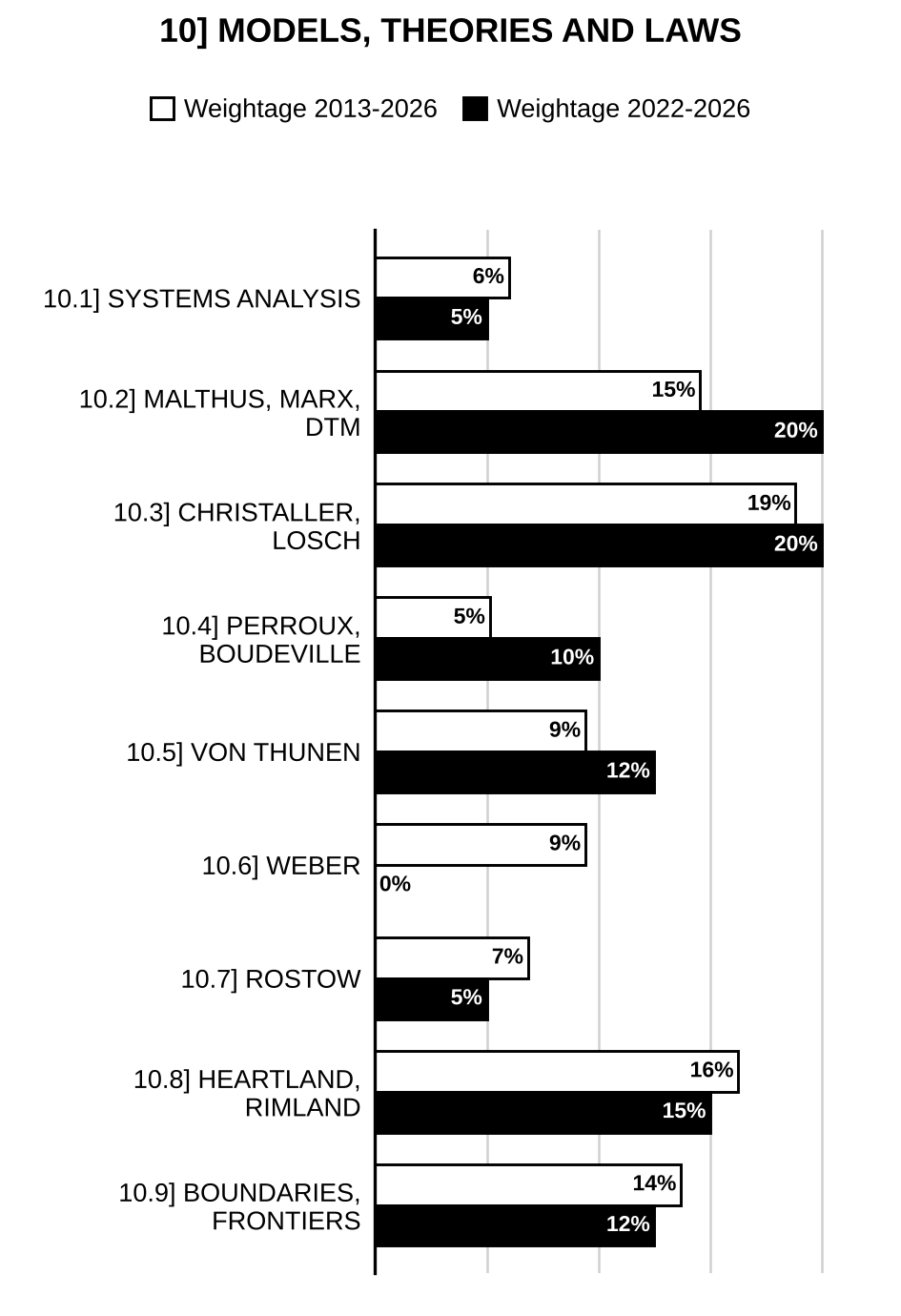
Here are all 62 Models, Theories and Laws in Human Geography questions asked in UPSC Geography Optional Paper I from 1995 to 2026, arranged under the 9 topics of the official syllabus. Within each topic the latest questions come first.
Each question ends with a code such as [2024/15m/3b] – the year, the marks, the word limit (where UPSC set one) and the question number in the paper.
10.1] System analysis in human geography
5 questions
Why is systems analysis important in urban planning and what are its limitations? [2025/10m/150w/5e]
Write an explanatory note on geographical systems. [2017/10m/150w/5c]
Giving suitable examples, describe the importance of system analysis in geographical studies. [2014/15m/7a]
Discuss System Approach and its applicability in Geography. [2011/30m/8a]
Discuss the concept and application of systems analysis in Human Geography. [2001/60m/8]
10.2] Malthusian, Marxian and demographic transition models
7 questions
Analyze the role of demographic transition theory in explaining variations in fertility and mortality rates globally. [2025/15m/8b]
Has Malthusian Theory been discredited in contemporary times? Justify your answer. [2023/10m/150w/5d]
“The stages of Demographic Transition are a reflection of uneven economic development across the globe.” Explain with suitable examples. [2023/15m/7c]
Compare and contrast the Malthusian and Neo-Malthusian perspectives in the context of population growth, resource use and environmental impact. [2020/20m/6a]
Provide an account of world population transition in the context of fertility decline and socio-economic development. [2020/15m/8b]
“Marx’s view on population is more humanistic.” Comment. [2015/10m/150w/5d]
Write a note on the parameters used to describe the demographic transitions in the developing countries like India. [2007/60m/8]
10.3] Central place theories of Christaller and Losch
10 questions
What is complementary region? With reference to hierarchy of settlements, describe the different types of complementary regions as proposed by Christaller. [2024/20m/8a]
Explain with suitable diagrams A. Losch’s model of the Theory of Location related to Central Places. Why has this been criticized? [2023/20m/7a]
Examine the relevance of Central Place Theory of Christaller in the present context. [2021/10m/150w/5e]
Discuss the applicability of Christaller’s Central Place Theory. [2017/20m/7a]
Give a critical account of Losch’s theory of central places. [2016/20m/8a]
What are the basic postulates in the Central Place Model of Christaller? [2013/20m/250w/6c]
Critically examine the salient features of Central Place Theory propounded by Christaller and Losch. [2011/30m/8b]
Give an account of the functional bases of central place hierarchy. [2007/60m/7]
Bring out the main points of difference between the central places theories of Christaller and Losch. [2002/60m/6]
Explain the basis and applicability of Christaller’s Central Place Theory. Bring out the recent modifications. [2000/60m/7]
10.4] Perroux and Boudeville
2 questions
Why has F. Perroux’s theory of growth pole as a model of regional growth been criticised? Explain with examples. [2025/20m/8a]
Write a note on “forward and backward linkages” in Perroux’s thesis of economic growth and regional development. [2018/10m/150w/5d]

Preparing for Prelims too?
Our UPSC Prelims Topic-wise PYQ eBook covers every Prelims question with detailed explanations, so you can see exactly where UPSC asks from.
View the BookDownload Free Sample10.5] Von Thunen’s model of agricultural location
7 questions
“Under what situations Von Thunen’s model of agricultural location is still rational.” Justify with examples. [2026/10m/150w/5e]
Explain the relevance and applicability of Von Thunen theory of Agriculture-location in today’s world. [2022/15m/8b]
Write a note on the relevance of von Thünen’s agricultural location theory in the present context. [2020/10m/150w/5e]
Discuss the relevance of Von Thunen’s model on agricultural location in the contemporary context. [2015/20m/7a]
Write a short note on: von Thunen’s concept of economic rent. [2010/12m/5e]
Describe the view of von Thunen on agricultural location. [2008/60m/8]
Write a short note on: Isolated states. [2002/20m/200w/5c]
10.6] Weber’s model of industrial location
9 questions
Present a critical account of Alfred Weber Theory of industrial location. [2021/15m/8c]
Distinguish between ‘isodapanes’ and ‘isotims’. Critically examine the least cost theory of industrial location given by Alfred Weber. [2019/20m/8a]
Discuss the degree of importance of transportation costs as a factor of industrial location with respect to “footloose industries”. [2018/10m/150w/5b]
Explain ‘Isodapane’. [2016/10m/150w/5b]
Write a short note on: Isodapane in the Theory of Industrial Location. [2011/12m/5c]
Write a short note on: Weight Triangle. [2009/20m/200w/5a]
Discuss Weber’s theory of industrial location, and assess its relevance in the present-day context. [2005/60m/7]
Write a short note on: Locational Triangle. [1998/20m/200w/2c]
Critically examine Alfred Weber’s Theory of the Location of Industries. [1997/60m/7]
10.7] Rostow’s model of stages of growth
4 questions
Explain the theoretical framework and stages of economic growth proposed by Rostow’s model. [2024/10m/150w/5e]
Outline briefly the “age of mass consumption” as described by Rostow in his ‘multi-stage theory of growth’. [2018/10m/150w/5e]
Explain the necessary conditions of takeoff and subsequent stages of development of a nation as propounded by Rostow. [2014/20m/6a]
Critically examine the stages of Economic Growth Model propounded by Rostow. Illustrate your answer with suitable examples. [2003/60m/8]
10.8] Heartland and Rimland theories
10 questions
Explain the Rimland Theory with reference to ongoing geopolitical scenario in the world. [2026/15m/8c]
Explain the Heartland theory with reference to contemporary geopolitical scenario of the world. [2024/15m/6c]
Discuss how and why Mackinder modified his concept of Pivot Area after the World Wars. [2020/20m/8a]
Examine the relevance of the ‘rimland theory’ in the contemporary world. [2019/15m/8c]
“The Heartland Theory is gaining importance once again.” Comment. [2017/20m/8a]
Write a short note on: Relevance of Heartland theory in Contemporary world. [2013/10m/150w/5e]
Examine the Heart-land theory, and assess its merits and demerits. [2005/60m/6]
To what extent are the heartland and rimland theories helpful in understanding the world political situation today? Express your opinion clearly. [2004/60m/6]
Write a short note on: Rimland Theory. [2002/20m/200w/5d]
Without the Mediterranean Europe could not be held, without the Middle East the Mediterranean could not be held. Discuss. [1996/60m/8]
10.9] Laws of international boundaries and frontiers
8 questions
“Boundaries and frontiers have different meanings in geographical literature.” Substantiate your answer in the present context. [2023/15m/8c]
Explain the geometrical boundaries with examples. [2022/10m/150w/5e]
Boundaries are important in geopolitics. Explain. What issues develop from the inclusionary and exclusionary aspects of borders? [2021/15m/7b]
In the modern world, most of the frontiers have been replaced by boundaries. Explain the reasons. [2020/15m/6c]
Discuss the genetic classification of boundaries suggested by Hartshorne. [2019/10m/150w/5e]
Define and differentiate between boundaries and frontiers. Describe the geometrical boundaries with suitable examples. [2016/15m/7c]
Distinguish between boundaries and frontiers. Identify different types of boundaries. [2011/30m/7a]
Describe the laws of international boundaries and frontier. [2008/60m/7]

Strengthen your GS papers
Our UPSC Mains Topic-wise & Year-wise PYQ eBook (2013–2026) maps every GS question to the syllabus, so you know what UPSC asks and how often.
View the BookDownload Free Sample« Previous: Regional Planning | Next: Physical Setting »
Back to: Geography Optional PYQs – Topic-wise | Also see: Geography Optional year-wise question papers
Last updated: 30 October 2026